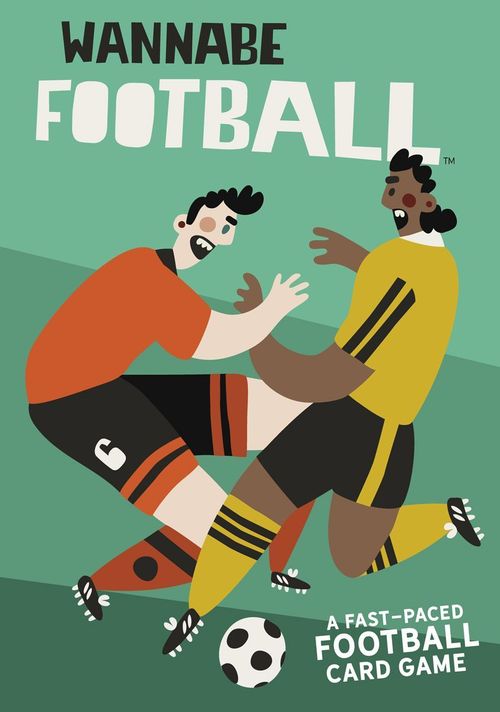
Wannabe Football
Wannabe Football Rulebook
Table of Contents
Table of Contents
The Cards
The game contains 41 Player Cards (green back) and 19 Multi Cards (red back), 4 Referee Cards and 2 Turn Maps.
Player Cards are used to pass the ball, dribble, tackle and shoot on the goal. Multi Cards are the game's "dice" and show what happens in the different situations. Each Multi Card can be used for a variety of situations. You only look at the part of the Multi Card corresponding to where you are in the game – for example, did you score a goal or did the referee whistle a foul?
Warming Up for the Match
Sort and shuffle the red and green decks and place them face down. Place the Referee Cards and Turn Maps to the side. Deal four Player Cards to each player.
Flip a coin to decide who starts. The player who starts draws an extra Player Card. (Players draw a new Player Card at the start of each turn.)
The player starting the game may play any Player Card except for a shot on goal.
Playing the Game
The pitch is divided into 6 zones.
To play a card, it must match the card that is already on the table. Cards are played on top of each other on the table, so you can only see the top card. The top card represents the pitch.
When playing a card, it must be turned towards you, i.e. upside down for your opponent. The tip of the arrow on the top card shows the current position of the ball. In order to play a card, the yellow dot on the card you want to play must be located at the current position of the ball. The players take turns playing a card. (Remember to draw a Player Card when it is your turn.)
The Star
A Player Card with a star allows you to play an extra card on your turn. When you play a star player, you must draw a Multi Card to see if you can continue. If there is a star on the Multi Card, you may play again. If the star is faded, play continues to the next player as normal.
The Whistle
A tackle must be spotted by your opponent! If your opponent does not see the whistle and react before starting his/her own turn, then the referee does not see anything and game continues.
If the whistle is spotted, your opponent draws a Multi Card and checks for a free kick.
Dead Ball
If there is a whistle or a yellow or red card on the Multi Card, then the referee has ruled a free kick and there is a dead ball situation.
A dead ball situation occurs if the referee whistles for a:
- Free kick
- Out of bounds
- Goal
- Corner kick
- Goal kick
- Offside
In a dead ball situation, players draw cards as needed to refill their hands to four cards. Remove the Player Cards that make up the pitch. The player whose turn it is draws an extra Player Card as usual at the start of a turn.
Free Kick
The player taking a free kick may play any card. However, the player may only play a shot on goal as the first card if the free kick is taken on the opponent's side of the pitch. If the free kick is from your own side of the pitch, you must play a different card before a shot on goal.
The free kick is taken from the side of the pitch where the yellow dot is located: Look at the Player Card that led to the free kick. It will be from your side of the pitch, or your opponent's side of the pitch.
Once the free kick is taken with the first card, play proceeds as usual.
(Diagram captions: "Free kick from your side of the pitch" and "Free kick from your opponent's side of the pitch".)
Shot on Goal
A Player Card with a ball on the pitch instead of the yellow dot is a shot on goal. You shoot from the location of the ball. When you play a shot on goal card, draw a Multi Card to see if you have scored a goal. If the Multi Card indicates a goal, keep the card and put it in a separate pile to keep track of your score.
The outcome of the Multi Card determines the result:
Goal
Dead ball situation. All players refill their hands up to four cards. Now it is your opponent's turn: He/she may not shoot directly on goal with the first card.
Corner Kick
Dead ball situation. All players refill their hands up to four cards. It's your turn again. Draw a card as at the start of your turn and play any card of your choice.
Off Target Shot
Dead ball situation. Goal kick: All players refill their hands up to four cards. Now it is your opponent's turn: He/she may not shoot directly on goal with the first card.
Off the Woodwork
No dead ball situation – the ball is still in play! It is your turn again: Draw a card as at the start of your turn and play any card of your choice.
Dribbling
A Player Card with a curled arrow and no other symbols represents dribbling. When you play a dribbling card, you draw a card from your opponent's hand and discard it. Your opponent now has one fewer card in his/her hand until the next dead ball.
At the next dead ball, all players can draw cards to refill their hand to four cards each.
Pass / You Cannot Play a Card
If you do not have a Player Card that matches the card on the table, you have to call pass and play continues to the next player.
Remember: You are not allowed to have more than four cards in your hand when your turn is over. If you have five cards, you must discard one card.
Double Pass
If you have to pass immediately after your opponent has passed, the ball goes out of bounds. Since you passed on your own ball in play, the ball goes to your opponent. Look at the arrow to determine where the ball went out of bounds (which half of the pitch). This will determine whether a shot on goal may be played as the next card (see "Free Kick").
Red Card
A red card must be placed in your hand and remains there until the game is over. The red card takes the place of one of the cards you are allowed to have in your hand.
(You may only have up to four cards in your hand at the end of your turn.)
Yellow Card
If the Multi Card shows a yellow card, exchange it for one of the cards in your hand. If you get two yellow cards, you must place a red card in your hand.
Offside
When checking for a star, you might get an offside card. The offside free kick is always taken from your own half of the pitch.
End of Game / Extra Time
When the last Player Card has been drawn, the game goes into extra time. The next double pass marks the end of the game. (At this point, both halves have been played.)
Penalty Kick
A foul committed in the box: Immediately take a penalty kick. Turn over a Multi Card to see if you scored a goal. Play then continues as normal.
Penalty Shootout
Players keep the Multi Cards for the goals they have already scored. Players then take turns drawing a Multi Card to see if they score.
National Sides
There are four national sides in the game. Once you have become familiar with the rules of the game, you and your opponent can choose to play with a national side in a two-player game:
- France: The first time you get a yellow or red card, it does not count. The referee ruling is cancelled and there is no free kick.
- Croatia: Every time you dribble into the box, you are automatically allowed to shoot on goal. You do not have to use a Player Card to shoot on goal, but can simply draw a Multi Card.
- Belgium: If you are allowed to continue play into the box with a star player, then you are automatically allowed to shoot on goal. You do not have to use a Player Card to shoot on goal, but can simply draw a Multi Card.
- England: Once during the game, you are allowed to exchange up to four cards in your hand for up to four new cards. You may only have up to four cards in your hand at the end of your turn.
Four Players
Two teams with two players per team. You sit on the same side of the table as your teammate. The direction of play is different than in a two-player game: Play does not continue around the table, but instead in a "figure 8", as shown on the Turn Map.
Take a Turn Map for your team and place it between you and your teammate.
Each player is dealt four cards. The player who starts draws a Player Card at the start of the turn. Let's say that it's your turn: When you play a star player, you may not attempt to continue as usual. Instead, your teammate must follow up by drawing a Multi Card and continuing play if possible. You play the continuation of your teammate's star player cards. This way, you can play a couple of cards without giving your opponents a turn. You are allowed to talk with your teammate during play, but you may not view each other's cards. But you are allowed to say: "I'm good on the left side!" Or: "Can you shoot?" When you're finished playing back and forth with your teammate (and perhaps shooting on goal), your turn is over. Keep in mind that all of this took place during your turn, even if your teammate also played a star player or shot on goal. Play continues to the next player according to the Turn Map.
You and your teammate must always take turns playing a card, including if the ball hits the woodwork and bounces back into play.
When you dribble, you may keep the card you steal and discard one of the other cards in your hand. This is different from a two-player game, where you don't get to keep the stolen card. You may choose which opponent you take a card from.
The ball goes out of bounds if two players in a row call pass. The game ends when the last Player Card has been drawn from the pile and pass has been called three times in a row.
One Round (Sequence of Play)
- Draw a Player Card.
- Play a Player Card, or call pass if you cannot play any of the cards in your hand. Draw a Multi Card in connection with a star player, if applicable, and play an extra card if you get a starred Multi Card.
- Discard one card if you have more than four cards.
- End of turn. (You can tell your opponent: "Your turn.")
On your opponent's turn:
- Draw a Multi Card when your opponent plays a card with a whistle.