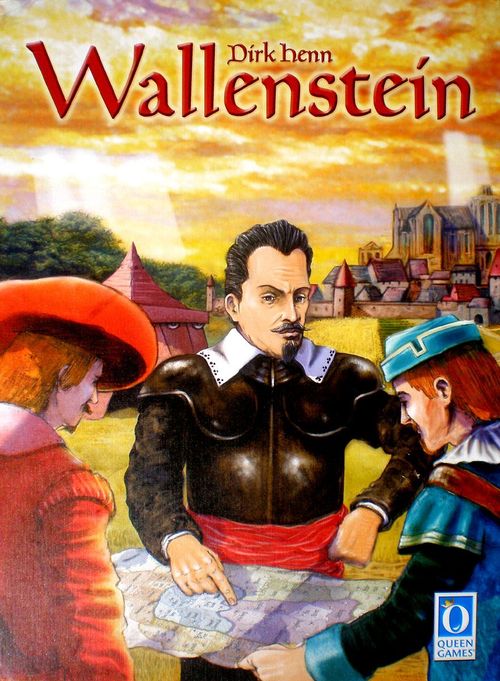
Wallenstein
Wallenstein Rulebook
Table of Contents
Table of Contents
Game components
- 1 game board – a map showing the 5 regions of Brandenburg, Sachsen, Österreich, Bayern, and Kurpfalz. Each region consists of 9 counties. Some counties are marked by a lighter border; these counties are not used when playing with 3 players.
- 45 county cards – there is one card for each county.
- 25 money cards – each player has their own set of 5 cards, showing their coat of arms. These cards have a value of 0 – 4 coins shown in their lower half, the upper halves are blank.
- 10 action cards – the players use these cards to determine the order in which the actions take place.
- 12 event cards – an event affecting a particular action is shown in the upper half, the lower half displays the players' loss of grain during the winter round.
- 5 player mats – double-sided mats, one for each player. The back (landscape) is used at the start of the game when assigning initial counties. Players use the front side throughout the game for planning their actions.
- 310 colored cubes – 62 each in 5 player colors. Each cube represents an army.
- 20 green cubes – these cubes represent the neutral peasants' armies.
- 15 coat of arms tokens - 3 each in 5 player colors. There is one of each of three different types for each player: victory points marker, grain marker, and military leader
- 5 bonus tiles – the owner of a bonus tile benefits from a special bonus.
- 80 building tiles – 28 palaces, 26 churches, and 26 trading posts. Players build these buildings in their counties, thus gaining victory points.
- 42 revolt markers – these are used to record the extent of peasant uprisings in a given county.
- 60 coins – 20 coins of 1 Thaler each, 20 coins of 2 Thalers each, 20 coins of 5 Thalers each.
- 1 dice tower made up of three parts – used for combat.
- 1 sorting tray – for building tiles, revolt markers, and coins.
- 1 linen bag
- 1 supplement – including a default initial line up, a game survey, and a detailed description of all event cards.
- These Rules
Before each game, assemble the 3 parts of the dice tower: funnel, cardboard tower and tray. Both tray and funnel of the dice tower are – other than shown in the rulebook illustration – made of clear plastic, so that all players will have a better view of combat results. For technical reasons, these parts are printed in black in the rulebook illustration.
Object of the game
During the times of the Thirty Years' War, each player tries to gain dominance as a military leader and to secure the best of everything for themselves.
In order to be successful, it is not just sufficient to control as many counties as possible, but a player's empire should be well developed by building palaces, churches and trading posts.
The players managing to build the most buildings of each type in each of all 5 regions will gain valuable bonus victory points.
Setup
Counties used in the game
If there are only 3 players, they do not need certain county cards. These cards are removed from the game; the corresponding counties on the map are marked by a light border.
These counties are off-limits during the game, i. e. no armies may enter there.
Please remove the following county cards in a 3-player-game: Bremen, Holstein, Lüttich, Burgund, Konstanz, Fm. Bayern, Steiermark, Tirol.
A player's initial components
Each player takes the player mat of their chosen color, their armies (62 cubes in that color), their military leader token, and their set of money cards (0 – 4). Give the following start capital to each player:
- 3 players …………………………… 18 Thalers,
- 4 players …………………………… 15 Thalers,
- 5 players …………………………… 12 Thalers.
Players keep their armies and coins always on open display. Put all components not used (when playing with less than 5 players) back into the box.
Assigning initial counties
Shuffle the county cards well and place the pile face down in easy reach. Reveal the two top cards.
Next to the picture of the military leader, the back of each player mat shows 9 numbered locations, embedded in a landscape. Depending on the number of players, each player places a number of armies as imprinted on 7 to 9 of these locations. The armies of each location are called a group.
Now these armies are deployed to the initial counties the following way: Starting with the oldest player, and continuing in clockwise direction, each player either takes one of the two revealed county cards or the top card from the pile. Then, the player selects any group of armies from their player mat and places it in that county on the game board.
Players keep the selected county cards on their hand. If one of the two face up cards is picked up, it is immediately replaced by a new card from the pile.
Players continue placing their armies in this manner until all players have placed all their army groups on the game board. The remaining armies are each player's personal supply.
Please note: If all players are inexperienced and doubtful which counties to select best, they may skip the step "Assigning initial counties" and use the default line up as shown in the supplement.
All remaining county cards (not owned by any player yet) are placed next to the game board in a face down pile. Players may conquer these counties during the course of the game.
After assigning initial counties is completed, all players flip their player mat to the front side, depicting the action boxes.
Please note: In case the two open cards at a player's disposal are still the same than during their previous turn, they may put both cards at the bottom of the pile and reveal the next two cards from the top of the pile.
Victory points and grain markers
All players place their victory points marker on space „0" of the victory points track and their grain marker at the lower end of the food track.
The dice tower
Place the green peasants' armies next to the game board as common supply.
Now the basic fill of the dice tower must be done. 7 army cubes of each player and 10 peasants' army cubes are filled in the tower through the funnel, casting them all at once.
Any cubes emerging in the tray are put back into the concerned player's personal supply respectively into the common peasants' armies supply.
Example: In a 3-player-game, 31 cubes are cast into the dice tower at the start of the game.
Coins
The coins are used when players pay for their various actions. All coins not given to the players at the start of the game are placed next to the game board as common supply.
Event cards
Shuffle all event cards well and place them as face down pile next to the game board.
Reveal the four topmost event cards and place them next to the event cards pile.
During each of the next 3 game rounds one of these events will affect all players.
In the 4th game round (winter) the remaining event card shows how much grain each player will lose this winter.
Put the action cards and bonus tiles on the table, ready to use.
Sequence of play
The game lasts for 2 years, consisting of 8 game rounds altogether. After 3 game rounds (spring, summer, and fall), there is an intermediate game round (winter) and scoring takes place. Then, another 4 game rounds are played.
Spring, summer, and fall
Each of these three game rounds consists of the following steps, performed in this order:
- Display action cards
- Display bonus tiles
- Plan individual actions and place a bid
- Determine event
- Fix player order
- Perform actions
Display action cards
Actions are the main options for the players to act. All 10 actions are depicted on the players' mats. Each player may perform each of these actions once per game round within their own area of control.
The order in which these actions will be performed is redetermined each round. Shuffle the 10 action cards face down and place the top 5 cards face up on their designated spaces 1 to 5 at the lower edge of the game board. The remaining 5 cards are placed face down on the spaces 6 to 10.
Please note: The displayed cards indicate the order in which these actions will be performed; action no. 1 is performed first, action no. 2 next etc. The first 5 actions are visible for all players, so everybody can secretly consider their plans how to allocate their actions to their counties. The 5 face down action cards will only be revealed one after the other during further progress of the round.
Display bonus tiles
Shuffle the bonus tiles well and place them face up in their designated boxes on the game board, one after the other. The players will acquire them by auction later on and the tiles have two functions. The position of the box of a certain bonus tile determines the player's position in player order and the bonus tile itself shows that player's benefit for this round:
+1 Thaler
The player receives 1 extra Thaler when performing the action „Collect taxes".
+1 Grain
The player receives 1 extra grain when performing the action „Collect grain".
6 Armies
The player is entitled to place 6 armies when performing the action „Deploy 5 armies".
+1 Army when attacking
As attacker, the player casts 1 extra army (from their personal supply) into the dice tower when performing their actions "Combat/Movement A and B".
+1 Army when defending
As defender, the player casts 1 extra army (from their personal supply) into the dice tower when an opponent performs their actions "Combat/Movement A and B".
Please note: If an action is affected by an event and a bonus tile, the event is applied first and only thereafter the effect of the bonus tile is used.
Example: Arne collects taxes in Burgund. Burgund pays 7 Thalers. The current event limits tax collection to a maximum of 5 Thalers. However, Arne owns the bonus tile "+1 Thaler" and thus gains 1 extra Thaler, his total being 6 Thalers.
Plan individual actions and place a bid
Secretly and simultaneously, the players scheme which of the 10 actions they want to perform in which of their own counties.
Each player selects that county from their own county cards in which they want to perform their planned action and places this card face down in the appropriate action box of their player mat. This process is repeated until all action boxes are covered.
If a player does not want to perform a certain action, they place one of their money cards in that action box. In this case, the coins have no meaning.
Please note: In the rare case that a player does not have sufficient cards to cover all their 10 action boxes, they simply do not cover any actions they do not want to perform. An uncovered action box is considered covered by a money card.
The following actions are at each player's disposal:
Build a palace
The player pays 3 Thalers into the common supply and places a palace in that county.
Build a church
The player pays 2 Thalers and places a church.
Build a trading post
The player pays 1 Thaler and places a trading post.
Any kind of building, no matter if palace, church, or trading post, may be built on a free building site only. There are 1 up to 3 building sites in each county. No kind of building may be built more than once in any county.
Example: A church is built in Bremen. Now only one building site is left over in Bremen. A palace or a trading post may still be built there.
Collect grain
The player gains as many grain units as shown on the selected county card. They advance their grain marker accordingly on the food track.
Collect taxes
Der Spieler erhält so viele Taler aus dem allgemeinen Vorrat, wie auf der Länderkarte angegeben.
The player gains as many Thalers from the common supply as shown on the selected county card. Collecting grain or taxes in a county may cause a revolt there. (See combat rules, page 11).
Each county card shows the amount of grain and taxes to be collected there.
If no revolt was invoked or if a revolt was successfully subdued, one revolt marker is placed in that county now.
Deploy 5 armies
The player pays 3 Thalers and puts 5 armies from their personal supply in the selected county.
Deploy 3 armies
The player pays 2 Thalers and puts 3 armies from their personal supply in the selected county.
Deploy 1 army/move
First, the player pays 1 Thaler and puts 1 army from their personal supply in the selected county. Then, they may move any number of armies from this county into any one adjacent county under their own control (no combat will take place).
General rules for army movement:
Any number of armies may move into an adjacent county, but 1 army at least must be left behind. The number of armies in a county is not limited.
Combat/Movement –A–
The player may move armies from the selected county into one adjacent county. If they do not control this county (meaning it is a neutral or an opponent's county), combat will follow (see combat rules on page 11). In this case also at least 1 army must be left behind in the county of origin.
Combat/Movement –B–
This is the same as explained under –A– above.
Each of the 10 action boxes of all players' mats should be covered now – if even possible. No box may contain more than 1 card.
Place a bid for player order
Additionally, all players must place a bid for player order including a bonus action. To comply with this, they place one of their unused money or county cards in the auction box of their player mat.
Example: Dirk wants to collect taxes this round. He controls Burgund, which allows him to collect a tax amount of 7 Thalers. He decides for this action and places his county card "Burgund" face down in his action box "collect taxes". This means, that he will not be able to perform any other action in Burgund this round, because now the card is placed on his mat already.
Determine event
Shuffle the face up event cards (2, 3, or 4, depending on which round this is) and draw one of them. Place this card face up in the event box of the game board. This card indicates the event of this game round. It will modify certain actions for all players during this round. Put any remaining event cards face up next to the game board.
Please read the detailed explanation of event cards in the supplement.
Fix player order
All players reveal their bid (the card in their auction box) and pay the amount shown on the card to the common supply; players who had bid a county card pay nothing.
In order of their bids, highest bidder going first, next highest bidder second etc., players now select their position of the player order by swapping their military leader token for the bonus tile of their choice (positions 1 to 5). Put any remaining bonus tiles (less than 5 players) aside for the remainder of this round.
Players who had bid a county card precede players who had bid a zero money card.
The last players to select their position are those who had bid no card at all (this is possible only if a player does not have sufficient county cards).
In case of a tie (players had either bid the same amount of money or a county card or no card at all) put the military leader tokens of the players concerned into the linen bag and draw one after the other; this is the order in which they select their position.
The position of a player's military leader on the game board determines their position in player order for this round. Any unclaimed positions (less than 5 players) are disregarded.
Hint: The advantage of bidding a county card is that the player does not pay any money, but still precedes players who had bid „0" money. The disadvantage is that now all players know that this round no action will be performed in that county.
Example: The player selecting the bonus tile of box 1 will be first player for this round.
Example in a 3-player-game: This round, the player order is Red – Blue – Black.
Perform actions
Now actions are performed in order of the action cards display at the bottom edge of the game board.
All players perform each action in player order, before they perform the next action.
If a player is able to perform the current action, they must do so. If a player cannot perform the action, or only part of it, they must skip this action for this round.
After all players have completed performing (or skipping) the current action, this action card is put aside and the next face down action card is revealed.
After all 10 actions have been completed, this game round ends. All players resume their military leader token and return their bonus tile.
Remove the event card of this elapsed round from the game.
Shuffle the action cards and start the next game round.
Please note: Players reveal their county card of the current action only when it is their turn to perform this action.
Players take all cards from their player mat back on their hand only after all 10 actions have been completed by all players. The only exception to this is when a player's county is conquered by another player; in this case, the losing player must hand the card out to the conqueror immediately.
Note: After fall, the military leaders remain on the game board until the end of winter, because this player order remains unchanged during winter.
If this elapsed round had been fall, the next round will be winter (see page 10).
Winter game round
In this game round, the players' counties must be supplied with grain or revolts may arise. In addition, a scoring will take place.
Supplying counties with grain
First, the grain supplies of all players suffer losses. The fourth, remaining event card indicates how many grain units have to be removed from each player's supply. The grain markers on the food track are moved back accordingly.
Now each player must prove that they own at least 1 grain unit for each of their own counties. If a player fails to meet this condition, one or more revolts will arise in their empire (see Combat rules page 11).
Example: This winter, all players will lose 3 grain units each.
Revolts
The number of revolting counties and their fierceness is found out by consulting the supply chart printed on the game board ((also, please see chart to the right).
In case of revolts, the player to the left of an affected player randomly draws that many face down county cards from that player's hand as indicated by the chart (number of revolting counties). Revolts will arise in these counties now (see Combat rules page 11).
If a player suffers from more than one revolt, they decide themselves about the order in which these revolts will take place.
If more players than one are affected by revolts, these are handled in player order of the former fall game round.
Do not forget: If more players than one are affected by revolts, these are handled in player order of the former fall game round.
Example: Dirk controls 9 counties, but owns 7 grain units only this winter. This means that 2 of his counties are not supplied (left column of the chart). Therefore, there will be a revolt in one of his counties (center column). His left neighbor randomly draws one of his cards. There is one revolt marker already in that county
The following revolt is a battle of Dirk's armies against that many peasants' armies as there are revolt markers in that county plus the additional number of armies as shown in the right column of the chart (in this case Dirk fights against 1 + 2 = 3 peasants' armies).
Scoring
Each player now gains victory points for their own counties and buildings, as well as for the majority of building types in the different regions:
- Each controlled county …………… 1 victory point (VP)
- Each building …………………………………… 1 VP
- The most palaces in a region* …………………… 3 VP's
- The most churches in a region* …………………… 2 VP's
- The most trading posts in a region* ……………… 1 VP
* In case of a tie all concerned players gain this amount of VP's minus 1 VP. The players' victory points markers are advanced on the victory points track immediately.
End of the year
After the first 4 game rounds have been played, players reveal 4 new event cards and move their grain markers on the food track back to space "0", also all revolt markers are removed from all counties.
Another 4 game rounds will be played (spring, summer, fall and winter) and the game ends after the second and last scoring in winter.
After 4 rounds: 4 new event cards, remove all revolt markers, reset all grain markers.
Combat rules
General dice tower rules
Each time a battle is fought players use the dice tower.
One of the players takes all engaged armies (cubes of attacker and defender) in their hand and casts them into the dice tower, along with all cubes currently lying in the tray. This way, caused by the devices inside the tower, some of these cubes are retained inside the tower. On the other hand, also some of the cubes that had been retained before will tumble into the tray. The final number and colors of cubes in the tray is completely at random.
Important: The tower may never be emptied (only after the game is over!). If accidentally some cubes tumble into the tray during the game, they simply remain there. They will be cast into the tower along with all other cubes from the tray when the next battle is fought.
When is battle taking place?
The following situations result in battle:
- Player versus player – a player moves their army or armies to another player's county (i. e. a county with another player's army or armies).
- Player vs. a neutral county – a player moves their army or armies to a county without any armies (a county without any armies belongs to nobody and therefore is considered neutral).
- Peasants vs. a player [revolt]. A revolt in a player's county may arise for two causes:
- Collecting grain/taxes – A player collects grain or taxes in a county where at least 1 revolt marker is already.
- Undersupply in winter – A player does not own sufficient grain for all their counties.
Please note: A player needs at least 2 armies in the county of origin if they want to attack another county: 1 army to move to the attacked county and 1 army to be left behind.
Armies participating in battle
Player vs. player or a neutral county
The attacker always fights with all their armies moved to the contested county.
Add to these all armies of the defender in that county.
Add 1 peasants' army instead in case of a neutral county.
Additionally, cast all army cubes currently lying in the tray into the tower when a battle is taking place.
Peasants vs. a player [revolt].
In this case, the player is the defender and they use all their armies positioned in the affected county.
The same number of peasants' armies is taken from the common supply as there were revolt markers in that county before the revolt broke out.
Note: Peasants' armies are never placed in a county! Even when the peasants win a battle, all their surplus armies are taken from the tray and put back to the common supply.
Revolts in winter
If a revolt arises in winter, add an additional number of peasants' armies to the tower as shown on the supply chart.
As usual, cast all army cubes from the tray into the tower as well.
Example: Dirk collects taxes in Lüneburg. There are 2 revolt markers so far, so combat is taking place. Dirk takes his 4 armies present in Lüneburg, 2 peasants' armies and all armies from the tray and casts them all into the tower. If he turns out to be the winner, he will keep this county, but another revolt marker is added to Lüneburg.
Example: Arne lacks 2 grain units in winter. His county Anhalt is drawn randomly and the peasants there revolt. A total of 3 peasants' armies are fighting (2 according to the supply chart plus 1 because of the existing revolt marker).
Note: If the defender has won but there are only peasants' armies in the tray this is considered a tie.
Combat result and its consequences
The combat result is derived from the number of both attacker's and defender's armies that had tumbled in the tray. The side with the larger number of armies is the winner of the conflict.
All armies in the tray of any factions not involved are not considered and remain in the tray.
Player vs. player or vs. a neutral county
If there is/are no revolt marker/s in the defending county, any peasants' armies in the tray are allied with the defender (these are the first losses to be removed, any remaining peasants' armies are put back to the common supply).
That side with fewer cubes in the tray has lost the battle. Its armies are removed from the tray and put back to that player's personal supply.
Though the other side is the winner, it loses the same number of armies as the loser; these armies are also removed from the tray and put back in that player's supply.
The winner's remaining armies from the tray are placed in the contested county. This player keeps respectively receives that county card.
In case of a tie, all armies of both contestants are removed from the tray and put back to their respective supplies. All buildings, armies and revolt markers are removed from that county and its card is added to the common supply.
Example: Blue moves 4 armies from Anhalt to Kursachsen, controlled by Yellow. Combat ensues, all attacking (4 x Blue) and defending (3 x Yellow) armies are cast into the tower (the tray is empty at this point). 3 blue armies, 1 yellow and 1 green (peasants') army emerge in the tray. There is no revolt in Kursachsen, thus the peasants join the defender. Still, Blue is the winner (3:2). The yellow, green and 2 blue armies are put back to their respective supplies, the remaining "victorious" army is placed in Kursachsen. Yellow gives the Kursachsen county card to Blue.
Please note: If a player takes control of another player's county, the former owner must hand over that county card immediately.
Peasants vs. a player [revolt].
If the peasants win or if there is a tie, all involved armies are put back from the tray to their respective supplies. Remove all buildings and revolt markers from that county and add that county card to the common supply.
If the player wins the conflict, they place their remaining armies from the tray back in that county.
End of the game and winner
The game ends after the second winter round has been completed. The player with the most victory points is the winner of the game, a tie is broken by the higher amount of Thalers.
© Copyright 2002, 2010 Queen Games, D-53842 Troisdorf, Germany
Expansion "Emperor's Court"
The basic rules remain unchanged – you will find any changes or amendments explained in these rules.
Germany at times of the Thirty Years' War: War spreads all over the country and leaves its marks everywhere. The military leaders are still fighting for territory control and glory, while peasant revolts and famines expand all over the country. However, the leaders do not fight for their interests on the battlefield only. Each leader has courtiers at the Emperor's Court under their influence. They try to flatter the Emperor and get hold of gifts and highly rated privileges for "their" leader.
But be careful: If you vie too much for the Emperor's favor you might easily loose control of your armies …
Game components
- 1 Emperor's Court – In the lower area, you see the entrance hall, where the courtiers ask for permission to enter the audience hall in the upper area. The audience hall offers additional space for 3 favor cards.
- 5 Extra player boards – adding 3 new options to the player mats of the basic game.
- 35 Wooden courtiers – 7 of each player color. Court officials are used at the Emperor's Court to obtain favor cards.
- 21 Favor cards – each card is a special favor, which its owner can use only once. The number near the bottom edge of each favor card is for identification and other game purposes only. See page 6 for a detailed explanation of all favor cards.
- 15 dice tower cards – serving to convert armies into courtiers.
- These rules
Set up
Use the same setup procedure as in the basic game.
Place the Emperor's Court next to the main game board.
Jeder Spieler erhält zusätzlich zum Material des Grundspiels:
- 1 Extra player board
- 7 courtiers in their player color, and
- 3 dice tower cards
The players place their extra player board next to their standard player board. Keep the courtiers and dice tower cards in easy reach of all players. When playing with less than 5 players put any courtiers and dice tower cards not needed back in the box.
When filling the dice tower initially the players take one courtier from their own supply for each of their own army pieces falling into the tray of the tower. They place these courtiers in the entrance hall of the Emperor's Court and return the army pieces to their own supply.
Shuffle the favor cards and place the deck face down next to the game board.
During initial filling of the dice tower 2 green peasant armies, 2 blue armies of Frank, 2 red armies of Dirk and 1 purple army of Anika tumble down into the tray. Both Frank and Dirk put 2 of their courtiers in the entrance hall of the Emperor's Court, Anika deploys one of her courtiers there. They retrieve their army pieces from the tray and put them back into their supply.
Sequence of play
The basic sequence of play is enhanced with 2 additional steps during spring, summer and fall rounds.
The intermediate round (winter) remains unchanged.
The two additional steps are:
- Display favor cards
- Perform actions at the Emperor's Court
The players augment the step „Plan Individual Actions and Bid for Turn Order" with planning their actions on their extra player board.
On the right, you see when these steps are taking place.
- Display Action Cards
- Display bonus tiles
- Display favor cards
- Plan individual actions and place a bid
- Determine Event
- Fix Turn Order
- Perform actions at the Emperor's Court
- Perform Actions
The additional steps in detail
Display favor cards
Draw the top three cards from the deck of favor cards and place them face up on the card spaces in the audience hall of the Emperor's Court.
The card with the highest number must be placed on the space showing four courtiers; the card with the next lower number must be placed on the space showing three courtiers and finally the card with the lowest number on the last free space.
The favor card # 10 is placed on the space with 4 courtiers, the # 8 card on the space with 3 courtiers and the #2 card on the remaining space with 2 courtiers.
Plan individual actions on player mats and extra player boards and place a bid
When planning their actions on their player mats, the players additionally plan their actions on their extra player boards secretly and simultaneously.
They must place 1 card on each space of their extra player board, if possible.
The 3 action boxes on the extra player boards allow the players to convert armies into courtiers and deploy them at the Emperor's Court. 1, 2 and/or 3 armies can be converted by each player.
Depending on which cards the players had placed on their extra player board they can perform different actions during the step „Perform actions at the Emperor's Court":
The 3 action boxes of the extra player boards: Convert 1 army, Convert 2 armies, Convert 3 armies.
One courtier is deployed for each converted army.
Important: Cards must be placed crosswise on the extra player boards ("tapped")!
County cards
If a player has placed a county card in one of the action boxes, they must immediately remove as many of their own armies from this county as demanded. They take the same number of their courtiers from their own supply and deploy them at the entrance hall of the Emperor's Court. They return the armies to their supply.
At least 1 army must remain in that county.
Barbara has played the county card „Vogtland" on her extra player board. Since she had put this card in the action box "Convert 3 armies" she removes 3 of her armies from Vogtland and instead deploys 3 of her courtiers at the entrance hall of the Emperor's Court. Only 1 of her armies remains in Vogtland.
Dice tower cards
If a player has placed a dice tower card* in one of the action boxes they must immediately remove (carefully!) as many of their own armies from the tray of the dice tower as needed. They place the same number of courtiers (from their own supply) and deploy them at the entrance hall of the Emperor's Court. They return the armies to their supply.
Auf dem Aktionsfeld „2 Armeen umwandeln" hat Barbara
Barbara had placed a dice tower card in her action box "Convert 2 armies". She removes 2 of her armies from the tray and instead places 2 of her courtiers in the entrance hall of the Emperor's Court.
*A dice tower card on a player mat (of the basic game) has the same effect as a money card – the player will not perform this action.
A dice tower card on the auction box is treated like a "0" money card.
Money cards
If a player does not want to convert armies into courtiers or cannot do so, they place a money card on that particular box of their extra player board. In this case, they do not perform any action. Ignore the Thalers on the money card.
If an action cannot be completed (for example there are not sufficient armies in the county/tray or the supply of courtiers is running short) this action is not performed.
Barbara had placed a money card in her third action box. She does not perform any action for this box.
Perform actions at the Emperor's Court
After having determined the new player order, players perform their actions at the Emperor's Court. These actions take place before the players perform any actions of the basic game.
Performing actions at the Emperor's Court consists of two steps:
1. Reveal cards and deploy courtiers
In player order and one after the other, the players reveal their cards on their extra player board and perform the appropriate actions, as explained above.
The start player begins by revealing their card in the "Convert 3 armies" box first and then performs this action. Next they repeat this procedure for their "Convert 2 armies" box and finally for their "Convert 1 arm" box. Only after they have finished all these actions, the next player takes their turn, etc.
After all players have finished their actions of the extra player board, this step is complete and the game proceeds with step 2:
2. Take advantage of the Court's favor
The player who deployed the most courtiers at the entrance hall may vie first for the Emperor's favor. The other players follow in descending order of the number of their courtiers. In case of a tie the basic player order prevails among the tied players.
The active player moves all their courtiers from the entrance hall to the audience hall. The player may now ask a favor of the Emperor. This means they may take one of the displayed favor cards but are not obliged to do so. If the player takes a card, they must put back into their supply as many of their courtiers as shown on the card's space. They must apply the card's favor immediately, if possible, and then remove the card from the game.
When all displayed favor cards have been taken, this step is complete.
After all players have performed their actions at the Emperor's Court any courtiers still remaining in the audience hall are moved back to the entrance hall. Any remaining favor cards are removed from the Emperor's Court and from the game.
The game now proceeds as usual.
Barbara has played one money card, one dice tower card and one county card on her extra player board. She may deploy a total of 5 courtiers at the entrance hall.
Because Barbara (yellow) has deployed the most courtiers, she starts and moves all of her courtiers from the entrance hall to the audience hall. She decides for the #8 card, taking it from the Emperor's Court. She must also remove three of her courtiers for it, then she follows the instructions of the card. Next is Dirk (red). He has the second most courtiers and moves them to the audience hall. He takes the #2 card, removes as many of his court figures as demanded and follows the instructions of the card.
Jens und Anika have the same number of courtiers in the entrance hall. However, Jens is higher up in player order as Anika, so it is his turn now to move his blue courtiers to the audience hall. Unfortunately, he cannot take the #10 card because the number of his courtiers is insufficient.
Also Anika cannot take this favor card, but she moves her courtiers to the audience hall nevertheless.
End of the game
The game end and victory conditions of the basic game remain unchanged.
© Copyright 2010 Queen Games, D-53842 Troisdorf, Germany
Game overview
Setup (details see rules book)
- 3-player game only: remove certain county cards
- Hand out game components; each player receives:
- Player mat, military leader token, and 62 armies
- Money: 3 players - 18 Thalers, 4 players - 12 Thalers, 5 players - 18 Thalers
- 1 set of money cards („0" to „4" Thalers) 3a. Select initial counties
- 3 players – deploy armies to 9 counties
- 4 players – deploy armies to 8 counties
- 5 players – deploy armies to 7 counties, or 3b. use default line up (see below)
- Fill dice tower: cast 7 armies of each player and 10 peasants' armies into the tower (put any cubes reemerging in the tray back to their respective supply)
- Draw 4 event cards
Sequence of Play - summary
1. Spring
- Display action cards
- Display bonus tiles
- Plan own actions and place a bid
- Determine event
- Fix player order
- Perform actions
2. Summer – same as spring
3. Fall – same as spring
4. Winter
- Loss of grain, possibly resulting in revolts
- Gain victory points
- Remove revolt markers
- Draw 4 new event cards
- Reset grain markers
5. End of the year and end of the game after second year.
Default line up of initial counties
We recommend this line up for beginners.
The following listings show the counties' names on the right and the number of armies to be deployed there on the left.
Give the corresponding county cards to each player.
Initial line up for 3 players
| Player A | # | Player B | # | Player C | # |
|---|---|---|---|---|---|
| Gft. Mark | 5 | Strassburg | 5 | Augsburg | 5 |
| Osnabrück | 4 | Mittelmark | 4 | Böhmen | 4 |
| Oberösterreich | 4 | Paderborn | 4 | Lüneburg | 4 |
| Passau | 3 | Bm. Konstanz | 3 | Salzburg | 3 |
| Erwbm. Trier | 3 | Breisgau | 3 | Würzburg | 3 |
| Erzbm. Köln | 2 | Burgund | 2 | Kärnten | 2 |
| Niederösterreich | 2 | Hessen-Kassel | 2 | Lausitz | 2 |
| Sächs. Lande | 2 | Neumark | 2 | Mecklenburg | 2 |
| Vogtland | 2 | Vorpommern | 2 | Schlesien | 2 |
For 4 players
| Player A | # | Player B | # | Player C | # | Player D | # |
|---|---|---|---|---|---|---|---|
| Lüneburg | 5 | Oberösterreich | 5 | Bm. Zweibrücken | 5 | Augsburg | 5 |
| Holstein | 4 | Grafschaft Mark | 4 | Böhmen | 4 | Oberpfalz | 4 |
| Württemberg | 4 | Schlesien | 4 | Hm. Paderborn | 4 | Osnabrück | 4 |
| Mecklenburg | 3 | Kärnten | 3 | Erzbm. Köln | 3 | Kursachsen | 3 |
| Wolfenbüttel | 3 | Tirol | 3 | Strassburg | 3 | Salzburg | 3 |
| Anhalt | 2 | Erzbm. Trier | 2 | Hessen-Darmstadt | 2 | Bremen | 2 |
| Baden | 2 | Lausitz | 2 | Lothringen | 2 | Fm. Bayern | 2 |
| Mittelmark | 2 | Niederösterreich | 2 | Passau | 2 | Vogtland | 2 |
For 5 players
| Player A | # | Player B | # | Player C | # | Player D | # | Player E | # |
|---|---|---|---|---|---|---|---|---|---|
| Gft. Mark | 5 | Augsburg | 5 | Altmark | 5 | Lothringen | 5 | Hm. Paderborn | 5 |
| Böhmen | 4 | Mecklenburg | 4 | Erzbm. Trier | 4 | Bm. Zweibrücken | 4 | Oberösterreich | 4 |
| Schlesien | 4 | Würzburg | 4 | Neumark | 4 | Kärnten | 4 | Osnabrück | 4 |
| Erzbm. Köln | 3 | Bremen | 3 | Bm. Lüttich | 3 | Baden | 3 | Salzburg | 3 |
| Lausitz | 3 | Hessen-Darmstadt | 3 | Kursachsen | 3 | Niederösterreich | 3 | Wolfenbüttel | 3 |
| Mähren | 2 | Holstein | 2 | Anhalt | 2 | Burgund | 2 | Hessen-Kassel | 2 |
| Vogtland | 2 | Regensburg | 2 | Mittelmark | 2 | Steiermark | 2 | Passau | 2 |
The event cards (basic game)
The event cards have two functions. The upper part shows the modification of a certain action for this game round.
The lower part shows the loss of grain during winter, applicable to all players.
As all four event cards are revealed at the beginning of the year, all players have the ability to adjust the planning of their actions accordingly. This means, they are not at the mercy of these events by hook or by crook.
Nevertheless, actions are not only affected by events but by bonus tiles as well.
Therefore, it is most important to deal with the modifications in correct order. Always, the event is applied first, followed by the effect of the bonus tile.
Example: The player receives 6 armies.
The event cards, with their action modification and their winter grain loss, are as follows:
- When building a trading post here, 1 revolt marker is removed from this county. Loss of grain in winter: 5 units
- When building a trading post here, 1 revolt marker is removed from this county. Loss of grain in winter: 7 units
- When a neutral county is attacked, 2 peasants' armies are cast into the tower. Loss of grain in winter: 3 units
- When a county containing a palace is attacked, 1 additional army from the defender's supply is cast into the tower. Loss of grain in winter: 2 units
- When a county containing a palace is attacked, 1 additional army from the defender's supply is cast into the tower. Loss of grain in winter: 6 units
- All counties containing a church are safe from attacks during this round. Loss of grain in winter: 3 units
- The maximum revenue of the action "Collect taxes" is 5 Thalers, even if the county grants more. Loss of grain in winter: 0 units
- The minimum revenue of the action "Collect taxes" is 6 Thalers, even if the county grants less. Loss of grain in winter: 2 units
- All counties containing a church are safe from attacks during this round. Loss of grain in winter: 4 units
- The minimum gain of the action "Collect grain" is 4 units, even if the county produces less. Loss of grain in winter: 3 units
- The maximum gain of the action "Collect grain" is 3 units, even if the county produces more. Loss of grain in winter: 4 units
- The actions „Deploy 5 resp. 3 armies" are reduced to „Deploy 3 resp. 2 armies". Loss of grain in winter: 1 unit
The favor cards (Expansion „Emperor's Court)
Generally, the effect of favor cards must be applied immediately. Cards # 4, 10, 11, and 18 are exceptions to this rule!
# 1: The player may remove this round's event card. The event will be ignored. However, the player is not obliged to remove the event card.
# 4: The player removes one revolt marker from any of their own counties. If they do not control any such county currently, they may keep this card and parry the next revolt marker in one of their counties. Discard the card after it has been used.
# 12: The player deploys 3 armies free of charge in one of their own counties or one neutral county. In the latter case, the player receives this county card w/o any battle.
# 2, 9, 16: The player receives as many Thalers as shown and adds them to their supply.
# 3, 8, 14: The player puts as many armies from their own supply as shown in the tray of the dice tower.
# 5, 15, 20: The player gains the as many units of grain as shown. They advance their grain marker accordingly on the food track.
# 6, 13, 19: The player gains the number of victory points shown. They advance their victory point marker accordingly on the victory point track.
Ziffern 7, 17, 21: The player constructs the building shown free of charge in one of their own counties. The general rules for buildings still apply.
Ziffern 10, 11, 18: During this round only, the player cannot be attacked with the action "Combat/Movement A/B" resp. "A" + "B". Remove the card from the game at the end of the round.
Expansion "Landsknechte"
This is another little expansion for the game „Wallenstein" which can be added to the basic game on its own or in combination with "Emperor's Court". The basic Wallenstein rules remain unchanged except for the following amendments.
Components
- 5 card sets, each comprising 4 different cards
- these rules
Preparing to play the game
Give one card set (4 cards) to each player. All players place these cards in front of themselves as a face up pile. The cards must be arranged in proper order (see illustration), the card with the empty banner on top.
Playing the game
Each time after fixing the player order, all players check if they control counties in at least 4 different regions.
A player meeting this condition slides the top card of their pile underneath their pile and is entitled to receive one of the benefits shown on the new top card. This is done in given player order.
If a player does not meet the required condition, they leave their pile as it is. The top card remains unchanged.
Note: Of course, in this case they do not receive any benefit!
After winter is over, all players rearrange their pile of cards like at the beginning of the game.
Please note - in combination with Emperor's Court: Prior to any Court actions!
Benefits:
- The number of Thalers as shown.
- Put this number of armies as shown into the tray.
- The number of grain units as shown.
- The number of victory points as shown.