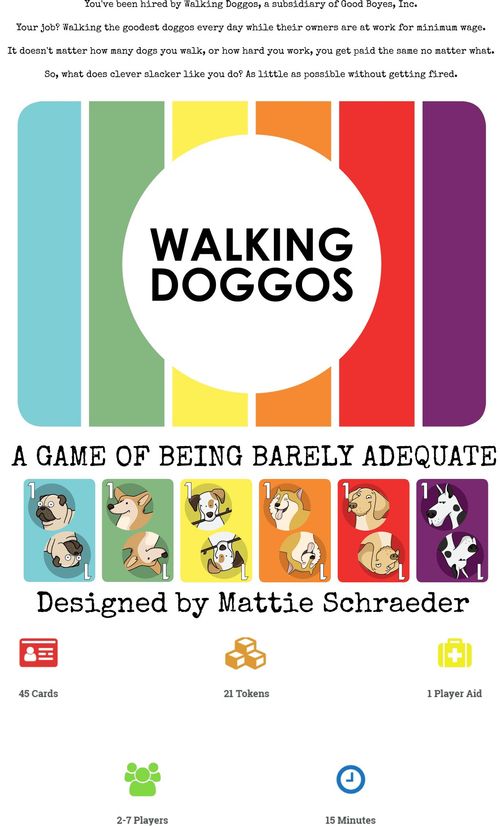
Separate the 5 pugs numbered 1-5 from the deck and put them by the cheat sheet face down.
Return the non-pug cards with a value greater than 1 more than the number of players to the box.
For 2 players, remove cards numbered 4-8, for 3 players remove cards numbered 5-8, etc.
Choose a dealer and shuffle all of the remaining non-pug cards.
Give each player 3 clue tokens.
Deal out 5 cards face down to each player.
Remaining cards are put in the center of the table and shuffled with the stack of 5 pug cards. This forms the dead hand.
Each player picks up their hand so that the cards are facing outwards, careful to make sure they don't see what is in their own hand.
Phase 1 - Clues
Starting with the first player and proceeding clockwise, players take turns giving another player who has at least one clue token one of three clues:
The breed of doggos
All cards of the same breed must be pointed out, and can only be used if there are at least two cards of the given breed.
The number of doggos
All cards of the same number must be pointed out, and can only be used if there are at least two cards of the given number.
The exact breed and number of a single card
A single card is pointed out and the player is informed of both the breed and number of that card.
Once a player has been given a clue, they may rearrange their hand in order to help them remember what they've been told, and then one of their clue tokens is returned to a pile in the center of the table. If all three clue tokens are returned, that player can no longer receive clues.
Players may be asked what they know about their hand, and must respond as truthfully as possible what clues they have been given.
They cannot be given a clue which matches a clue they were already given.
If they happen to remember wrong, a player may give them a corrected clue if so chosen, or even a clue that contradicts or confuses their beliefs of their cards, as long as the clue is truthfully given.
Phase 2 - Trading with the dead hand
Once all players have been given their 3 clues, players take turns optionally deciding whether to trade a card with the dead hand.
Starting with the first player and proceeding clockwise, each player either passes or shuffles one card into the dead hand and draws a new card to replace it.
The new card is kept face down until all players have either passed or traded with the dead hand, after which the card is added to the players' hands.
Phase 3 - Betting
Once all players have either traded with the dead hand or passed, players take turns betting how many packs they're going to walk.
Starting with the first player and proceeding clockwise, each player takes a number of tokens equal to the number of packs they think they will be able to walk.
Players cannot make a bet of 0.
Phase 4 - Building and Taking Walking Packs
Once all players have made their bets, players take turns playing cards into a pack.
Start with the first player and proceeding clockwise, a card is placed face up in the center of the table.
Players use the knowledge given to them by clues, as well as what cards are visible in other players' hands, to decide which card to play.
Whoever played the highest rank card takes all the face up cards and places them into a face down pile in front of them.
Each pack should be kept in a separate pile.
Breed supersedes number, and is based on breed size.
Great Danes > Labradors > Shiba Inus > Beagles > Corgis > Pugs
An 8 Great Dane is greater than a 7 Great Dane, which is greater than an 8 Labrador, which is greater than a 7 Labrador, and so forth.
The player who won the last pack then picks a card to play to start a new pack.
Phase 5 - Scoring
When all cards have been played, the scores are tallied.
If a player exceeds the number of packs that they bet, they get one point for each pack above their bet.
If a player exactly meets the number of packs that they bet, they get no points.
If a player does not meet their bet, they lose one point for each pack they failed to walk.
Players who have a negative score at the end of the game are fired.
The winner is the player with the least number of points that has not been fired.
In the case of a tie, players count the total numbers of the dogs they walked, and the player who walked the least number of dogs is the winner.
For a longer game
Play over multiple rounds, with each player dealing once.
Keep track of score between rounds.
Players with a negative score that would normally be fired, instead have a chance to bring their scores into the positives through future rounds.
In addition, keep track of the total number of dogs walked.
After each round has been played, if a player still has a negative score, they are fired.
The winner is the player with the least number of points that has not been fired.
In the case of a tie, the player who walked the least number of dogs is the winner.