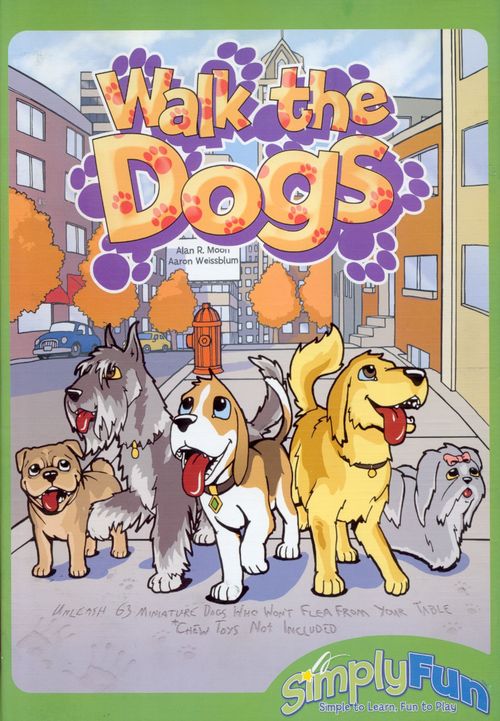
Walk the Dogs
Walk the Dogs Rulebook
Table of Contents
Table of Contents
Object of the Game
Be the first player to create a complete line of five of the same breed of dog or be the one with the most points at the end of the game.
What's in the Box
- 63 Dogs (7 breeds)
- 42 Dog Cards
- 5 Bone Cards
- 3 Leash Cards
- 3 Dog Catcher Cards
- 1 Score Sheet
- 1 Doggie Bag
Setup
- Grab the doggie bag and randomly pull out dogs, placing them in a single line on the table. All the dogs should be facing the same way—nose to tail. Continue until you've created a full line of all 63 dogs. Get creative with your dog line, letting them wind around the play area in any shape!
- Shuffle the deck of cards, and deal out two cards to each player. If players are dealt a bone card or a dog catcher card, then they should discard it and draw another card. Any discarded cards should then be placed back into the deck and reshuffled.
- Place the deck in the middle of the table, face down. Allow some space for a discard pile during play.
- The player whose first name begins closest to the letter "D" begins the game.
Four-player setup places Player 1 and Player 2 across from each other with the deck and discard pile between them, the line of dogs winding through the middle of the play area, and Player 3 and Player 4 completing the table.
How to Play
During the game, players collect dogs from the middle of the table for their own personal line by playing cards. Sometimes you can even take dogs from another player's line! If a player manages to get five dogs of the same breed in a single group, nose to tail, in their personal line, they win the game immediately! Otherwise, the game will end when the last dog is taken from the line in the middle of the table.
On Your Turn
Take the following actions on your turn:
-
Draw a Card: Take the top card from the draw deck, and add it to your hand. If the card is a special action card (bone or dog catcher), then show everyone at the table, perform the action on the card (see the Special Action Cards section) and then draw another card so that you once again have three cards. Then continue to step 2.
-
Play a Card: When a player plays a card, they take the number of dogs shown on the card from the line of dogs on the table. They then discard the played card to the discard pile on the table. There are four types of cards:
- Green Cards: Allow a player to take dogs from the front of the line. There are green cards that show one, two or three dogs. The player must always take the exact number of dogs shown on the card, unless the line is out of dogs and it is not possible to take more.
- Red Cards: Allow a player to take dogs from the back of the line. There are red cards that show one, two or three dogs. The player must always take the exact number of dogs shown on the card, unless the line is out of dogs and it is not possible to take more.
- Yellow Cards: Allow a player to take one dog from the front of the line and one dog from the back of the line. The player must always take the exact number of dogs shown on the card, unless the line is out of dogs and it is not possible to take more.
- Leash Cards: Allow a player to take one dog from the front or back of another player's line of dogs and add it to the front or back of their own line.
-
Build Your Own Line: When players take their first dog or dogs, they must start a line in front of themselves on the table. When they take dogs on future turns, they must add all the dogs to their own line as follows:
- When you take one dog, you may add it to the front or back of your line.
- When you take two dogs, you may add one dog to the front of your line and one to the back. Or you may add both dogs to the front of your line or both dogs to the back in any order.
- When you take three dogs, you may add the dogs to the front or back of your line or in any combination you wish.
-
Play Continues to the Next Player: After you complete your turn, the next player to the left starts their turn by following the same steps 1 through 4.
Special Action Cards
Bone Cards: If a bone card is drawn, the player who drew it immediately reveals it to all players. Play stops and everyone must check to see which player has the least dogs in their line. The player with the least dogs is given the bone card to keep in front of them. This card is worth three points at the end of the game. If more than one player is tied for the least amount of dogs, and if the player who drew the card is one of the tied players, they keep the bone card. Otherwise, the next tied player in clockwise order receives the card. The person who drew the bone card then draws another card and continues their turn as normal.
Example: Greg draws a bone card and shows it to all the players. Everyone checks to see how many dogs they have in their line. Greg has eight dogs, Kim has seven dogs, Alisha has 10 dogs and Jeff has seven dogs. Kim and Jeff are tied for the least amount of dogs but because Kim is sitting closer to Greg, going clockwise around the table, she gets the bone card and not Jeff.
Dog Catcher Cards: If a dog catcher card is drawn, the player who drew it immediately reveals it to all players. Every player in the game then loses their longest-exposed group of dogs (one or more dogs of the same breed) either on the front or back of their line. If a group of dogs on the front and back of the player's line is equal, they may choose which group to discard. All players' discarded dogs are now removed from the game and placed back into the doggie bag. The dog catcher card is then discarded, and the player who drew it draws another card and continues their turn as normal.
Example: Mary's line of dogs from front to back contains: schnauzer, schnauzer, pug, pug, poodle. She loses both of her schnauzers. If her line was pug, schnauzer, schnauzer, pug, pug, golden retriever, she could choose to lose either the pug at the front of her line or the golden retriever at the end of her line.
End of the Game
When a player gets a group of five matching dogs of the same breed in a row, they immediately win the game! Otherwise, the game ends when the last dog is taken from the line in the middle of the table. (A player may play a final card that would allow them to take more dogs than the number of dogs left on the table.)
In either case, gameplay stops and each player receives points for every dog in their line. Players score their dogs by multiplying the number of identical breeds in a row by itself, as follows:
- 1 point: One dog by itself, multiplied by one.
- 4 points: Two matching dogs in a row, multiplied by two.
- 9 points: Three matching dogs in a row, multiplied by three.
- 16 points: Four matching dogs in a row, multiplied by four.
- 3 points: Bone card.
After totaling all the points, the player with the most points wins the game. If there is a tie, then the tied player with the largest group of matching dogs wins the game.
Example: Molly is scoring her line of dogs from left to right. The pug is worth one point, the poodle is worth one point, the three schnauzers are worth nine points, the four beagles are worth 16 points and the final poodle is worth one point. Molly also has a bone, which gives her another three points, for a total of 31 points.
Try This
Simple Rules
For younger players, try playing the game without the leash, bone, and dog catcher cards. This will help simplify and introduce players to the basic gameplay of collecting dogs and arranging their lines.
Advanced Rules
Play with all the regular rules except, on your turn, you either draw a card or you play a card (not both)! You are allowed to only hold four cards maximum in your hand at any one time. When it's your turn, you need to decide whether to play a card or draw a card, adding to the tension and strategy of the game.
Life & Thinking Skills
Strategic Thinking—Players think about the dogs they need, what dogs other players are likely to take and what cards other players might play, and how to play their cards to maximize their chances to get five in a row.
Early Multiplication—Players score their dogs by multiplying the number of identical breeds in a row by itself (2x2, 3x3, 4x4, etc.).