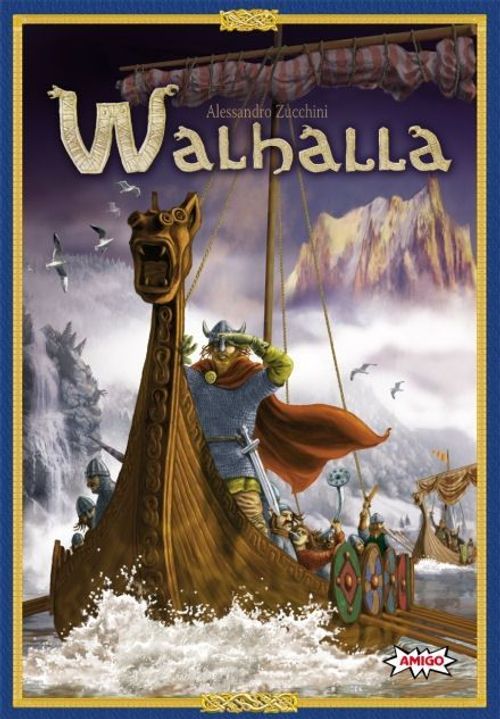
Walhalla
Walhalla Rulebook
Table of Contents
Table of Contents
Components
- 56 Vikings, in four colors
- 4 Score Markers, in four colors
- 18 Terrain Tiles
- 12 Dragons
- 32 Action Cards
- 6 Headlands
- 1 Game Board
Setup
Place the game board in the middle of the table. Shuffle the terrain tiles well and lay them face down along the coastal side of the board so that three peninsulas and four fjords are formed. Each peninsula consists of six terrain tiles. Once all the terrain tiles have been laid out, turn them face up. As a variant, a peninsula may consist of five to eight terrain tiles during setup.
Once the peninsulas have been built, attach the headlands to the ends of the peninsulas as follows: first, shuffle the headlands numbered 3–5 and place them face down, one at each end of a peninsula. Then shuffle the headlands numbered 6–8 and place them face down, one next to each headland numbered 3–5. Then turn all the headlands face up.
Example setup for three players: the board lays out the Supply Track and Asgard along one edge, and Walhalla and the Score Track along another. The Action Card draw pile and the Dragon pile sit beside the board. The terrain tiles form the terrain spaces of each peninsula (in the personal-supply area called Midgard), with the headlands at the ends of the peninsulas and the four fjords between them. Each player keeps a hand of cards.
Each player chooses a player color and takes 7 Vikings (with four players) or 9 Vikings (with three players) in their chosen color for their personal supply ("Midgard"). The remaining Vikings are placed in "Asgard" next to the game board. Vikings from Asgard can enter play as reinforcements after the end of a game round (a raid). If only three players take part in the game, the Vikings of the unused player color are removed from the game entirely.
Shuffle the action cards well and place them face down next to the board as the draw pile. Then each player is dealt one action card face down to their hand. Also shuffle the 12 Dragons well and place them face down next to the board as the Dragon pile (draw pile).
Now each player moves one Viking of their color from Asgard to Walhalla, and places their score marker (in their player color) on space 0 of the board's score track.
Game Play
A game consists of three game rounds in total — that is, three raids by the Vikings on the three peninsulas.
Determine a starting player, for example the player who most recently drank mead from a cow horn. Play then proceeds clockwise.
A turn is divided into three phases:
- Draw a Dragon / Board It
- Send the Dragon on a Conquest
- Disembark
1. Draw a Dragon / Board It
When it is a player's turn, they must draw a Dragon from the Dragon pile. Each Dragon has room for three Vikings. Two of the seats are color-neutral. The active player may fill these with one of their own Vikings each — for tactical reasons, they may also choose to leave one or both of these seats empty. One seat in the Dragon is marked with a player color. That seat may be filled with one Viking belonging to the player of that color. That player is asked, "Would you like to come along?" and must decide before the active player determines where the Dragon will land.
Special cases: it can happen that the colored seat shows the color of the active player. In this case, the active player may fill the Dragon with three of their own Vikings. It can also happen, in a three-player game, that the colored seat shows the player color that was removed from the game — in that case, that seat in the Dragon remains empty. If a player has no more Vikings in Midgard, they cannot place any Vikings in the Dragon. (They may, however, be able to sell action cards — see Action Cards.)
2. Send the Dragon on a Conquest
Next, the Dragon is sent on its conquest: the active player maneuvers the Dragon, in any orientation, parallel to the peninsulas, into any one of the four possible fjords, until it touches the coastal edge of the board or another Dragon. A Dragon may only sail into a fjord if it can land alongside at least one terrain space. (Headlands do not count as terrain spaces.)
3. Disembark
Once a Dragon has landed at a peninsula, the Vikings disembark. The Viking whose seat is closest to the board goes ashore first, then the one in the middle, and finally the one furthest from the board. Important: a Viking may only disembark onto a terrain space directly to the right or left of their seat in the Dragon. If two terrain spaces are adjacent to their seat, the player may choose which side their Viking disembarks on. A Viking may never disembark at a headland.
When a Viking disembarks, three different situations can occur:
- The Viking moves onto a free terrain space. In this case, the player places their Viking on the terrain space. If applicable, the action determined by the terrain space is carried out (see Terrain Spaces).
- The Viking moves onto a terrain space that is already occupied by a fellow player's Viking. In this case, the player whose Viking is disembarking attacks the other player's Viking. The two Vikings fight over the terrain space. The defending player must now decide whether their Viking loses or wins the fight:
- Lose the fight: If the player chooses to lose the fight, their Viking may honorably withdraw from the contested terrain space onto the board, into Walhalla. The attacking Viking remains standing on the terrain space and may carry out an action, if applicable.
- Win the fight: If the player chooses to win the fight, their Viking remains on the terrain space. Because the fight was won, the defending player must remove one of their Vikings from Walhalla and place it in Asgard. The attacking Viking, who lost the fight, may gloriously enter Walhalla. Important: if a player has no Viking left in Walhalla, they cannot defend a terrain space — that is, they cannot win a fight. (Exception: the Shield action card.)
- The Viking moves onto a terrain space that is already occupied by one of their own Vikings. A player may never attack their own Vikings. If they have a choice between attacking their own Viking or a fellow player's Viking, they must attack the other player's Viking. If the only options are attacking their own Viking or disembarking at a headland, their Viking returns from the Dragon to Midgard instead.
Example of a Turn
Sarah (Red) is taking her turn. She has drawn a Dragon and let two of her Vikings board it. The third seat in the Dragon is marked black — Thorsten (Black) has let one of his Vikings board there. Sarah then sent the Dragon on its conquest, and it has landed.
1a) Thorsten's Viking must disembark first. The terrain space to his right is already occupied by one of his own Vikings. So that Viking may not disembark there.
1b) The terrain space to the left of Thorsten's Viking is already occupied by a Viking belonging to Alexander (Yellow). The black Viking must now attack it. Alexander chooses to lose the fight. The yellow Viking therefore enters Walhalla, and the black Viking occupies the terrain space.
- Next, the Viking occupying the middle seat in the Dragon disembarks. Since neither terrain space adjacent to this seat is occupied, Sarah may choose which side her Viking disembarks on. She chooses the forest to the right of her Viking.
3a) Sarah's second Viking from the Dragon then disembarks. The shrine to its right is already occupied by one of her own Vikings, so the Viking may not disembark there.
3b) The village to the left of Sarah's Viking is free, so the Viking must disembark there.
Terrain Spaces
Each terrain tile is divided into two terrain spaces. There are four different types:
- Shrines: If a player's Viking occupies a shrine, that player immediately draws one action card from the draw pile to their hand.
- Forests: If a player's Viking occupies a forest, that player immediately receives the number of victory points shown on that terrain space. They move their score marker forward on the score track by the corresponding number of spaces.
- Villages: If a player's Viking occupies a village, nothing happens right away. At the end of a raid, that Viking earns a bonus (either +1 or +2) for the peninsula scoring (see End of a Raid).
- Wheat Fields: If a player's Viking occupies a wheat field, nothing happens right away. At the end of a raid, the player receives victory points for each occupied wheat field: after the first raid, a player receives one point for this; after the second, two points; and after the third, three victory points for each wheat field occupied by one of their Vikings (see End of a Raid).
Playing Action Cards
Players may play action cards during the "Disembark" phase or at the end of a raid. These affect the course of play or the intermediate and final scorings (see Action Cards). Played action cards are placed face up on a discard pile next to the board. If the draw pile for action cards runs out, the already-played action cards are shuffled and placed face down next to the board as the new draw pile.
End of a Raid
A raid ends when all twelve Dragons have been sent on their conquest, or when no player has any Vikings left in Midgard.
Players may now play any further action cards. Each player who wants to play one or more action cards places them face down in front of themselves. All played action cards are then revealed and resolved simultaneously (see Action Cards). Peninsula scoring takes place after each of the first two raids; final scoring takes place after the third and last raid.
Peninsula Scoring
For peninsula scoring, each player first adds up the number of their own Vikings on each peninsula, with each peninsula scored individually. To this, each player adds any bonus points earned from occupying villages, or from action cards played (see also Action Cards).
The player with the highest total on a peninsula receives 6, 7, or 8 victory points — the number of victory points is determined by that peninsula's two headlands. The player with the second-highest total on a peninsula receives 3, 4, or 5 victory points accordingly. In case of a tie for first place on a peninsula, the values of both headlands are added together and the victory points are split between the tied players, rounding up if necessary; in this case, there is no second place on that peninsula. In case of a tie for second place on a peninsula, the value for that place is split between the tied players, rounding up if necessary. For each occupied wheat field, the respective player receives victory points as described under Terrain Spaces.
Example of a Peninsula Scoring
-
The peninsula with headlands 5 and 7 is scored: Sarah (Red) has three Vikings on this peninsula. The red Viking occupying a village receives +1 as a bonus. Andreas (Blue) has two Vikings here. Alexander (Yellow) is represented on this peninsula by one Viking, which receives +1 as a bonus. Thorsten (Black) has one Viking on this peninsula. This produces the following result: 4 (Red) / 2 (Blue) / 2 (Yellow) / 1 (Black). Sarah, in first place on this peninsula, receives 7 victory points. Andreas and Alexander are tied for second place. The 5 victory points are therefore split and rounded up. Both Andreas and Alexander receive 3 victory points for this peninsula. Thorsten, in last place, receives no victory points.
-
The peninsula with headlands 3 and 8 is scored: Thorsten (Black) has three Vikings here, one of which receives +2 as a bonus. Andreas (Blue) has two Vikings on this peninsula, one of which receives +1 and the other +2 as a bonus. Alexander (Yellow) has two Vikings on this peninsula, and Sarah has none. This produces the following result: 5 (Black) / 5 (Blue) / 2 (Yellow). Thorsten and Andreas are tied for first place on this peninsula. The values of both headlands are therefore added together (3 + 8 = 11), and the sum is split and rounded up. Both Thorsten and Andreas receive 6 victory points. Alexander receives no victory points.
Preparing for the Next Raid
The board is now prepared for the next raid. Vikings occupying villages, forests, and shrines are removed from those terrain spaces and placed in Asgard. Vikings occupying wheat fields remain on those terrain spaces for the coming raid.
The Dragons are then collected, shuffled, and placed face down next to the board again as the Dragon pile. The starting player for the next raid is the player to the left of the starting player of the previous raid.
Resupply
Before a new raid can begin, Vikings must come to Midgard as reinforcements. To determine this, each player first counts the number of their Vikings in Walhalla. If applicable, points from the "Walhalla" action card are added to this count (see also Action Cards). According to the values shown on the supply track, players' Vikings move from Asgard to Midgard for the next raid, provided the players still have enough Vikings in Asgard. (First place with three players receives 10 Vikings, first place with four players receives 8 Vikings, and so on.) Important: if a player still has Vikings in Midgard left over from the previous raid, they may also use those for the next raid.
Example of Resupply with Four Players
Thorsten (Black) has three Vikings in Walhalla, Alexander (Yellow) and Sarah (Red) each have two, and Andreas (Blue) has none. Thorsten is therefore in first place, Sarah and Alexander are tied for second place, and Andreas is in third place. This produces the following resupply: Thorsten receives 8 Vikings as reinforcements from Asgard, Alexander and Sarah each receive 7, and Andreas receives 6.
Heroes' Departure from Walhalla
After Midgard has been refilled for the next raid, some heroes depart from Walhalla. From every player, as many Vikings are removed from Walhalla and placed in Asgard as the player(s) with the lowest number of Vikings in Walhalla have. If a player has no Vikings in Walhalla, none are removed from them either.
Example: at the end of a raid, Sarah has four Vikings in Walhalla, Alexander has three, and Thorsten and Andreas each have two. The lowest number of Vikings is held by Thorsten and Andreas, namely two. Two Vikings are now removed from Walhalla and placed in Asgard for every player. Afterward, for the next raid, Sarah still has two Vikings in Walhalla, Alexander has one, and Thorsten and Andreas have none.
Game End & Final Scoring
The game ends after the final scoring of the third raid. The player with the most victory points after the final scoring wins the game. Final scoring is carried out as follows:
- Peninsula scoring (as after the first two raids).
- Each player receives one victory point per occupied terrain space.
- Finally, the majority in Walhalla is scored: the player with the most Vikings in Walhalla receives six victory points, and the player with the second-most receives four victory points. In case of a tie for first place, both values are added together and the victory points are split between the tied players and rounded up; in this case, there is no second place. In case of a tie for second place, the value for that place is split between the tied players and rounded up.
Action Cards
Action cards played at the end of a raid or during resupply:
- Forest Bonus (4x): For each occupied forest, the player receives one additional victory point.
- Wheat Field Bonus (4x): For each occupied wheat field, the player receives one additional victory point.
- Shrine Bonus (4x): For each occupied shrine, the player receives one additional victory point.
- Village Bonus (4x): For each occupied village, the player receives one additional victory point.
- Peninsula Bonus (3x): If a player plays this card, it counts as two additional Vikings when determining the majority for the scoring of the relevant peninsula (6, 7, or 8 points).
- Walhalla (1x): If a player plays "Walhalla" during resupply, it counts as two additional Vikings when determining the majority in Walhalla. These additional Vikings do not count for the Heroes' Departure from Walhalla!
Action cards played during a raid:
- Hunt (4x): A player plays this at the start of occupying a forest and receives double the number of victory points shown on the forest (4 or 6 points instead of 2 or 3) for that forest.
- Attack (4x): A player plays this before attacking a fellow player's Viking. The defender no longer has a choice; the fight for the terrain space counts as lost for them, and their Viking honorably enters Walhalla.
- Shield (4x): A player plays this to fend off an attack from an opposing Viking. If a player uses the Shield to defend, no Viking is removed from Walhalla. This card may also be played even if the player has no Viking in Walhalla. Important: the Shield has no effect against the Attack action card!
Selling Action Cards: If a player wants to board a Viking onto a Dragon (their own or as a passenger) but has no Viking in Midgard, they may bring a Viking from Asgard to Midgard. To do so, they must discard one action card per Viking and move back one victory point on the score track.