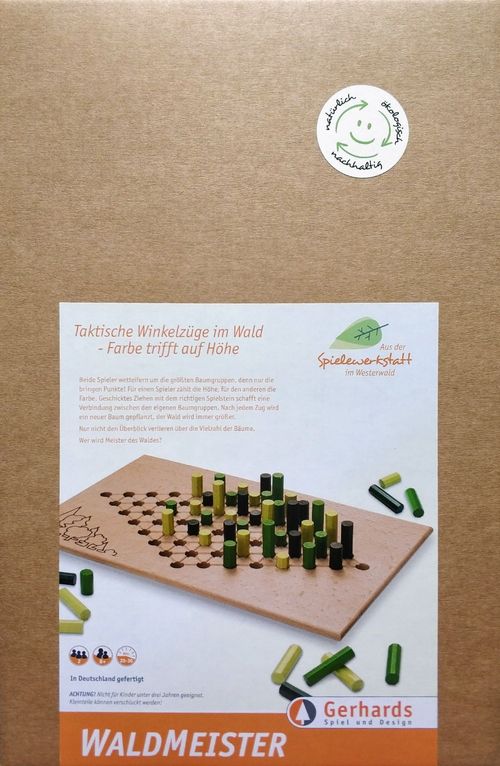
WaldMeister
WaldMeister Rulebook
Table of Contents
Table of Contents
Game Materials
- 32 x 20 cm gameboard made from solid beechwood
- 54 playing pieces: 6 pegs each in 3 colors and 3 heights
Set-Up of the Game
The playing pieces are pegs in 3 colors (yellow-green, leaf-green, dark green) and 3 heights (tall, medium, short) (see illus. 1).
Each player gets 3 pegs per color and per height, i.e., 27 pegs in total, and puts them openly in front of him. The empty gameboard is placed between the players.
Object of the Game
Both players try to use the pegs to form clusters as large as possible. For one player, it's the largest cluster in the same color (for each color) that counts; for the other player, it's the largest cluster of the same height (for all 3 heights). Before the game starts, players agree on who will focus on colors and who will go for heights.
For the scoring at the end of the game, all pegs are considered – also those placed by the other player.
This Is How the Game Is Played
The starting player can be determined in any way. He sticks one of his pegs into any hollow on the board. The other player relocates this peg on his first turn. To this end, he may move it in a straight line across any number of unoccupied hollows. After that, he sticks one of his own pegs into the hollow he took the peg from. Now the first player has his next turn.
From now on, each turn proceeds as follows:
The active player chooses any one peg on the gameboard, relocates it in compliance with the rules, and then sticks any one of his own pegs into the hollow he just took the peg from. After that, the other player executes his turn in the same manner (see illus. 2A and 2B).
When a player relocates a peg, he may not jump over any pegs on the board.
Illus. 2A: Player A collects pegs of the same height. He moves the short leaf-green peg to a cluster of fitting pegs and then brings a tall dark green peg into play.
Illus. 2B: Player B collects pegs of the same color. He moves a yellow-green peg to a cluster of pegs in the same color and then places a new yellow-green peg.
This way, each of the two players tries to group the pegs according to his own objective so that they get into a fixed position. Once a peg has been surrounded on all sides, it can no longer be moved in compliance with the rules, and is thus secure. Ideally, a player positions the pegs in such a way that the other player is no longer able to split the cluster later.
What Counts as a Cluster?
A cluster consists of any number of pegs of the same height or the same color that are either directly next to one another or are connected and not separated by an unoccupied hollow or a peg of a different color or height. A cluster can also be a row and extend right across the playing area, or surround other pegs.
Ending and Scoring the Game
The game ends when all pegs have been placed. At this point, the playing area is not completely full; 10 hollows remain empty.
Then one player counts the largest cluster in each color, and the other player counts the largest cluster of each height (1 point per peg). Since there are 3 colors and 3 different heights, each player has 3 largest clusters. Each player adds up his points. The player with the highest total score wins (see illus. 3A and 3B).
Illus. 3A, scoring example for heights: tall 4, medium 12, short 9 = 25.
Illus. 3B, scoring example for colors: yellow-green 7, leaf-green 8, dark green 6 = 21.
Tip
Since most players have more difficulty in forming clusters of the same height, they should always play 2 games and swap the objectives for the second one. The player who scores the most points overall in the two games is the winner.