Wadi: The Watchmen
Wadi: The Watchmen Rulebook
Table of Contents
Table of Contents
Components
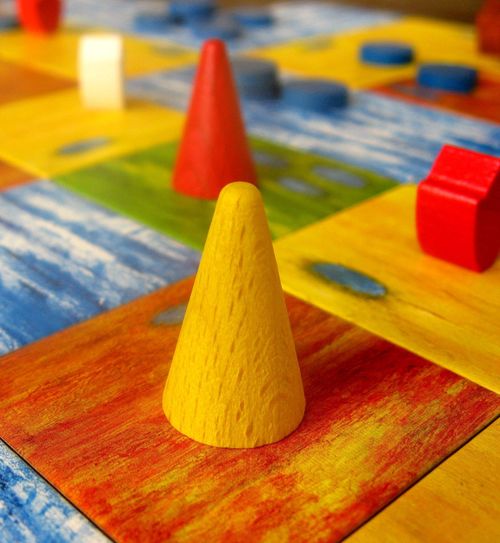
4 guards (one per colour).
Object of the Game
Each player has one guard. With the guard you can temporarily block strategically interesting areas and thus reserve them for yourself.
How to Play
The game is played by the rules of the base game Wadi. The following rules apply only in addition. All rules of the base game remain in force.
It is recommended, however, not to apply Building Rule B. This variant (without Building Rule B) is explained again at the end of these rules.
Restricted Area
On land tiles on which a guard stands, nothing may be changed. Nor may anything be changed on the land tiles directly adjacent to it, horizontally and vertically. These land tiles form the restricted area.
In detail: shadufs and water discs located in the restricted area remain standing or lying where they are. Furthermore, no other guards or shadufs may be placed into the restricted area. It is also not permitted to pump water out of the restricted area or into the restricted area. This also applies to the player whose guard controls the restricted area.
Wadi tiles (river tiles) do not belong to the restricted area and therefore cannot be influenced by a guard.
Restricted area: the restricted area of the red guard.
Restricted area: the guard has no influence on wadi tiles.
Pumping
A shaduf within a restricted area may pump, but only from and onto land tiles outside the restricted area.
Pumping: the yellow shaduf can pump a water disc onto one of the land tiles marked with a black tick. Pumping may not go onto the fields marked with a red cross.
Placement
At the end of the first round there is a one-time intermediate round, in which each player must place his guard. Play goes counterclockwise. First, the player who was last to take a turn places his guard. Then the penultimate player places his guard, and so on.
Guards may only be placed on empty land tiles. That is, on land tiles without a guard, shaduf or water disc.
A player may not place his guard into the zone of his own shadufs. These zones are bounded by wadi tiles (river tiles) and the edge of the board (see example).
Zones: except in zone 1 (dashed outline), red may place his guard in each of the other zones (namely zones 2 and 3 and the rest of the board).
After every player has placed his guard, the first round is over and the players begin the next round. From now on play continues clockwise.
Moving
In the second and all subsequent rounds, the player whose turn it is must, at the start of his turn, first move his guard. The guard may not remain on its current field.
The guard may only be moved onto an empty land tile (that is, one without a guard, shaduf or water disc). It may not be moved into the restricted area of another guard.
Unlike when placing a guard, a guard may now also be moved into a zone containing one or more of its own shadufs.
After the guard has been moved, the player carries out the rest of his turn (building a shaduf and/or pumping).
Moving: yellow moves its guard first. After that the rest of the turn is carried out. The guard may be moved onto one of the land tiles marked with a black tick. Alternatively, it is moved to another area of the board.
The guard may not be moved onto these land tiles, because shadufs already stand there.
The guard must be moved at the start of the turn and may not remain here.
The guard may not be moved onto a land tile within the outlined area. Because of the red guard, these fields are restricted area.
The guard may not be moved onto these land tiles, because water discs already lie there.
Removal
Instead of moving the guard, it may also be removed from the board. However, the guard may not be placed again later.
As soon as there are no more water discs on the wadi tiles (the round is still played to the end), the players may no longer remove their guards from the board. The guard must nevertheless continue to be moved at the start of a turn.
If there is no longer any possibility to move his guard, the player must remove his guard from the board, even if all wadi tiles are empty.
Scoring
The player who first removed his guard from the board receives 2 points. The second player receives 1 point. The remaining players receive no points.
If a player's own guard is still on the board at the end of the game, that player receives 4 minus points.
A player also receives 4 minus points if he had to remove his guard while no water discs lay on wadi tiles any more.
If a player receives minus points for his guard, he cannot receive plus points for it.
In addition, every player receives the points according to the scoring of the base game.
4 Players
If you play Wadi - The Watchmen with four players, it is best to use all land tiles to build the board. Too few land tiles can result in few or no action options for a player.
Variant Without Building Rule B
In this variant a shaduf may never be built directly horizontally or vertically next to another shaduf. This also applies when the player whose turn it is can no longer pump any water discs out of the wadi.
If you have downloaded the new rules of Wadi (available since October 2009), please play with the scatter rule (Streuungsregel).