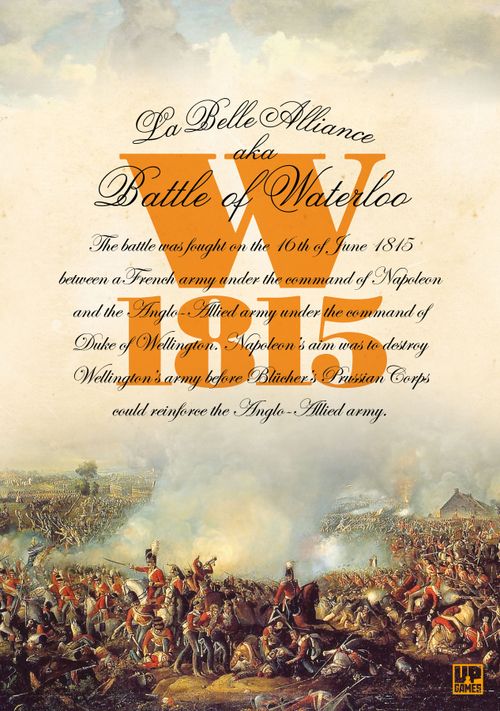
W1815
W1815 Rulebook
Table of Contents
Table of Contents
Feedback and Updates
We hope that our product will offer you a good gaming experience. If you have any questions about the game you are always welcome to contact us at www.upgames.fi. If, subsequently, the rules require updates, corrections or clarifications, these will be published on our website.
Game Components
The game contains the following components: 1 map, 1 rulebook, 8 French cards, 5 Anglo-Allied cards, 1 Prussian card, 18 French division markers, 14 Anglo-Allied division markers, 6 Prussian division markers, 12 cube markers (7 blue, 3 red, 1 black, 1 white) and 2 dice.
Overview of the Game View
The game contains a battlefield map which is used to record casualties and the current strength of the participating armies. The cards are setup around the battlefield map with each card representing a Corps. Players take it in turns to activate one Corps and carry out an action. The rules for each individual Corps action are described on the cards. The results of these actions are then recorded on the battlefield map. The game ends when either army routs.
Game Setup
The game is setup in following steps:
- Place the battlefield map in the middle of the table
- Setup cards. Lay out the French cards next to the map on French player's side and the Anglo-Allied and Blücher cards on the allied side of the map. The cards each contain background picture in their front side to indicate which side they should be setup. (The front side is set up face up.)
- Setup division markers. The blue division markers are placed in the French Corps boxes on the battlefield map while the red division markers are placed in the Anglo-Allied boxes. The black division markers are for Blücher's Prussians and are not placed on the battlefield map at this stage. Set them aside for now.
- Place three blue markers in the Grand Battery's boxes and one blue marker in the Plancenoit box to record French control.
- Place one red marker in the Hougoumont box and one red marker in the La Haye Sainte box to record Anglo-Allied control.
- Place a blue marker on the French morale track in the square with the number 10. Setup red marker to Anglo-Allied morale track to the square number 10.
- Place the white marker on the time track on the Midday box
Game Rules
The game is played in turns. Each turn contains a phase for each player and a time phase. The player whose phase it is, is called the phasing player, the opponent is called the non-phasing player. The game continues until either army routs.
Turn Order
- French player's phase
- Allied player's phase
- Time phase
Phase Sequences
The French and Allied player phases are divided into the following sequences which must be played in the given order.
- The player chooses to take an action with one of his/her Corps (actions are outlined on the designated Corps cards).
- After making this decision the player performs this action, usually rolls a die.
- Check the outcome of the action on the card and record the effects on the battlefield map
- Rout tests if required. If both players must make a rout test at the same time the non-phasing player tests first.
Actions
The phasing player chooses a Corps card and executes the action written on the card. The French player can either choose one of their six Corps cards or the card representing the Grand Battery. Once per game the French player may also use Napoleon to make an action more effective. The Anglo-Allied player can choose to make activate one of his four Corps or activate Blücher's Prussians. The latter simulates the arrival of the Prussian troops, which will cause problems for the French. Once per game the Anglo-Allied player may choose to use Wellington to give a general advance order, which is counted as an action.
The player can choose to make repeated actions with the same Corps even if that Corps was chosen in the previous turn. But a Corps cannot be activated if it has no division markers left. Nor can the Grand Battery be activated if it has no markers left.
Some Corps can make counter attacks (this ability is recorded on the Corps card). It is played as an action (instead of the normal action), but can only be chosen if the opponent's last action was undertaken by the target of the counter attack. Counter attacks must therefore be immediate.
Die Roll
Most of actions require a die roll (d6) to determine the outcome of the chosen action. The player who makes the action rolls one d6. In some cases modifiers are added to the die roll results. These are noted on the Corps cards.
Outcomes
The Corps cards show the outcomes of the possible actions. Usually actions cause casualties or morale losses for either or both armies.
- FC = French Casualty
- AC = Anglo-Allied Casualty
- FM = French morale loss
- AM = Anglo-Allied morale loss
If the army suffers a morale loss, expressed as a number, 1, 2, 3 etc., move the marker along the morale track an equal number of squares to this number. Similarly, for each casualty suffered, the army must remove one division marker from the battlefield map and place it on the casualty track. Fill the track from top to bottom. The division must be taken from the Corps which was targeted by the action. If the target Corps has no remaining division markers, the owning player can choose another Corps to take the casualty.
If the Corps (or Grand Battery) loses its last marker, then one extra morale loss is caused for the owning player.
Rout Tests
If the army suffers a casualty and the casualty track is filled to the extent that this casualty has to be placed in the box with letters "RT" then the army must make a rout test. If the outcome of an action was that casualties were caused to both armies pushing both armies into the RT zone at the same time, the non-phasing player must make the first test with the phasing player only testing if the non-phasing player passes their rout test.
To execute a rout test the player must roll a d6. If the result is higher than the current army morale level (see the army morale level tracker) then the army routs and the routing player loses the game which ends immediately. The player who failed the test loses the battle and their opponent is awarded a victory.
Rout Test Modifiers
Modifiers exist to the rout test die roll results. These modifiers are added to the raw score of the d6 die rolls. The die roll value can be adjusted above 6.
The French casualty track (only) also contains boxes marked 'RT+1' and 'RT+2'. If either or both of these boxes contain casualties the highest modifier is added to the rout test die roll. For example if the French side has a casualty in the RT+2 box on the casualty track, then two is added to the raw d6 score for the French rout test die roll.
If either army reach a box marked with "B" in the morale or casualty track, that army immediately routs without a rout test.
Time
The time marker is used to record the game time. Move the time marker one square forward in the following cases (only once per reason):
- When Prussians get their 5th division marker onto the battlefield
- When the French and Anglo-Allied armies together have 10 or more division markers on the casualty tracks
Plancenoit
Plancenoit initially contains a French marker, but if the Prussians capture it then replace the French marker with Prussian marker.
Hougoumont
At the beginning of the game Hougoumont has an Anglo-Allied marker, but the French 2nd Corps (Reille) can capture it in which case change the marker to a French one.
La Haye Sainte
At the beginning of the game La Haye Sainte has an Anglo-Allied marker, but the French 1st Corps (d'Erlon) can capture it in which case change the marker to a French one.
Card Errata
The following corrected card texts come from the official W1815_Cards_ERRATA.pdf published by U&P Games on upgames.fi. They replace the corresponding printed cards; the rest of the deck is unchanged.
Reille — II Corps
Hougoumont captured (the printed card wrongly read "La Haye Sainte captured")
ACTION — Target: II Corps (Hill)
Roll a die:
| Die | Result |
|---|---|
| 1 | 1 FC |
| 2 | 1 AC ... 1 FC |
| 3 | 1 AC ... 1 FC |
| 4 | 1 AC |
| 5 | 2 AC ... 1 FC |
| 6+ | 2 AC ... 1 AM |
+1 modifier for the die roll if II Corps (Hill) in squares.
Counter attacks: – . Enemy counter attacks: –
Kellerman — III Cavalry Corps
Infantry: - Cavalry: 5100 Artillery: 12
ACTION — Target: II Corps (Hill)
Roll a die:
| Die | Result |
|---|---|
| 1 | 1 FC |
| 2 | 1 AM ... 1 FC |
| 3 | 1 AM ... 1 FC |
| 4 | 1 AM |
| 5 | 1 AM ... 1 FC ... 1 AC |
| 6+ | Ney's cavalry charge (turn the card) |
At the end of the action II Corps must form squares (turn Hill's card). +1 FC for all results if II Corps (Hill) in squares before the action.
Counter attacks: Hill — Make the action against II Corps (Hill) with +1 modifier for the die roll. Enemy counter attacks: –
Milhaud — IV Cavalry Corps (front)
Infantry: - Cavalry: 5100 Artillery: 12
ACTION — Target: I Corps (Orange)
Roll a die:
| Die | Result |
|---|---|
| 1 | 1 FC |
| 2 | 1 AM ... 1 FC |
| 3 | 1 AM ... 1 FC |
| 4 | 1 AM |
| 5 | 1 AM ... 1 FC ... 1 AC |
| 6+ | Ney's cavalry charge (turn the card) |
At the end of the action I Corps must form squares (turn Orange's card). +1 FC for all results if I Corps (Orange) in squares before the action.
COUNTER ATTACKS: Uxbridge — Roll a die:
| Die | Result |
|---|---|
| 1 | 1 FC |
| 2 | 1 AM ... 1 FM |
| 3 | 1 AM |
| 4 | 1 AC ... 1 FM |
| 5 | 1 AC |
| 6 | 1 AC ... 1 AM |
Enemy counter attacks: –
Milhaud — IV Cavalry Corps (back)
Ney's cavalry charge — French player must choose to play this action until rallied (unless all Kellerman's and Milhaud's divisions are lost.)
ACTION — Target: II Corps (Orange)
Roll a die:
| Die | Result |
|---|---|
| 1 | 1 AM ... cavalry rallied (turn the card) |
| 2 | 1 AM ... cavalry rallied (turn the card) |
| 3 | 1 AM ... 1 FM |
| 4 | 1 AM |
| 5 | 1 AM ... 1 AC |
| 6 | 1 AM ... 1 AC |
-x modifier for the die roll. x = the number of the lost cavalry divisions (Kellerman + Milhaud).
+1 FC for all results if I Corps (Orange) in squares before the action.