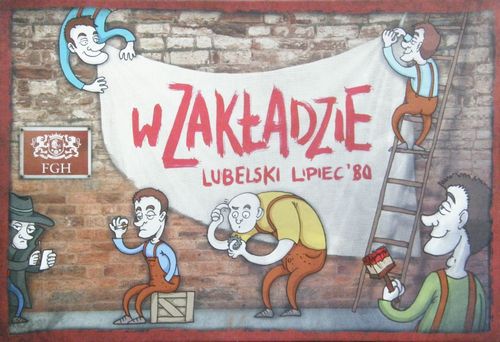
W Zakładzie: Lubelski Lipiec '80
W Zakładzie: Lubelski Lipiec '80 Rulebook
Table of Contents
Table of Contents
- Game Objectives
- Game Components
- Game Board
- Motive Cards Overview
- Motive Card - Director
- Secret Service Agent
- Action Cards
- Voice of FSC Cards
- Track Markers - Red Cubes
- Director Pawn
- Worker Tokens
- Player Aid Cards
- Point Tokens
- Game Preparation
- Playing the Game
- Standard Round
- Ending and Winning the Game
- Explanation of Some Places on the Board, Bonuses, Action Cards and Roles
- Historical Background
Game Objectives
In "In the Department. Lublin July '80" every player has a different victory objective, depending on the motive card chosen randomly at the beginning of the game. The game ends immediately when any one victory condition on the motive cards is met. Another possible victory route is to be in possession of the Director motive card when the plant productivity reaches 102%.
Game Components
- Game board
- Rulebook
- 7 motive cards
- 60 action cards
- 23 Voice of the FSC cards
- 18 worker tokens
- 100 point tokens
- 2 track markers
- Director's pawn
- 6 player aid cards
Game Board
There are nine areas on the board of "In the Department. Lublin July '80": Chief Director, Recreation garden, Smoking room, Director's office, Factory canteen, Production floor, The Voice of FSC office, Warehouse, Supplies department. Each room except the Recreation garden has a bonus space that can be placed on.
On the left side of the board there is a track that shows productivity, and on the right there is a track showing the level of worker discontent.
Board labels: Rooms; Bonus space for the room; Symbols describing the effect of each room; Productivity track; Discontent track.
Motive Cards Overview
Each player aims for a different objective, which is drawn at the beginning of the game. Three of the winning conditions require players to get 11 points of one type: Labor champion collects 11 diligence points, Slacker collects 11 comradeship points, and Careerist collects 11 bootlicking points. Two motive cards are manipulating the situation on the discontent track: the Journalist reducing discontent to level 0, while at the highest level, the Oppositionist can start a Strike. These cards are secret motives and the players should not disclose them until the end of the game.
Motive Card - Director
The Director card is not assigned to any player at the beginning of the game and it is the only motive card on display for the whole game. At the beginning of each round, the Director card is given to the player with the highest number of surveillance tokens. The Director card allows players to perform room inspections. A player can win the game if he is controlling the Director when the plant reaches 102% of productivity. This is another route to victory outside of the hidden motive cards drawn at the beginning of the game.
Secret Service Agent
(Only used for 5 or 6 players)
The goal of the Secret Service Agent is not to get a certain number of points of productivity or discontent. The player holding this card has a victory condition to correctly accuse another player as being the Oppositionist by filing a report. The Agent may file a report a maximum of three times during the game at the end of each round. At the beginning of the game the Secret Service Agent is hidden, but after the submission of the report, they continue to play openly. The exact rules for the submission of the report can be found later in this manual.
Action Cards
These are the cards that players can use in the game to help them win or make it difficult for other players to achieve their motive objectives. Action cards held by the players, as well as motive cards, are secret and should not be shown to other players until they are used.
Before the game begins, each player draws three action cards. At no time during the game can a player have more than five action cards in hand.
To play a card, the player must pay the card cost. The cost ranges from 0 to 2 points, and the type of points is determined by the colored boxes located on the top left corner of a card. Action cards are played just before or just after putting worker tokens on the game board (with the exception of response cards). Played cards are placed face up next to the board in a discard pile. When the last card of the deck is drawn, you shuffle the action discard pile, making a new action draw deck.
Voice of FSC Cards
The Voice of FSC cards are divided into three decks, each assigned to a specific stage of the game (respectively, Stage I, Stage II and Stage III). In each round the player controlling the Director draws one Voice of FSC card from the deck and places it next to the board face up. The FSC event is described and is active for the current round of play (except for "Strike at WSK Świdnik" which remains in the game and "Agreement at WSK Świdnik"). At the end of the round the active FSC card is removed from the game.
Track Markers - Red Cubes
2 wooden cubes are provided for displaying the current performance level on the productivity track and the discontent track. At the beginning of the game set the initial position of the markers to 50% for productivity, and to 6 on the discontent track.
Director Pawn
Used by the current Director. During the Inspection phase, the player places the pawn on a chosen space on the board. Detailed rules for the Inspection are described later in the rule book.
Worker Tokens
Each player in the game controls three worker tokens in one color: two worker tokens show an "X" representing Slacking, and one with a "Tick" representing Work.
Player Aid Cards
There are six cards in the colors matching the colors of the player worker tokens. At the beginning of the game, players put their aid card in front of them to avoid any confusion regarding their color. The player aid cards list the victory conditions for different objectives and the round order.
Point Tokens
They are used to determine points scored by the players: Surveillance, Comradeship, Diligence and Bootlicking.
Tokens with the number 5 correspond to the five regular tokens of the same kind. Players at any time may replace 5 ordinary tokens with a 5-value token, and vice versa.
NOTE! Points are open knowledge and should be visible to other players.
Game Preparation
Before the start of the game:
- Place the board on the table and set the track marker on the starting values. Productivity track to 50% and Discontent track to 6.
- Divide the Voice of FSC cards into three separate decks (Stage I, Stage II and Stage III). Then shuffle each of the resulting decks. For Stages I and II, the "Strike at the WSK Świdnik" and "Wave of strikes" should be placed in the lower half of the corresponding decks. The resulting three deck piles should be placed next to the board.
Citizen Comrade! To prepare the Voice of FSC Phase I remove from the deck "Strike at WSK Świdnik" and lay it next to the board. Draw 3 Voice of FSC cards, and then add them to the "Strike at WSK Świdnik" card and shuffle. Add the other shuffled cards on top of the stack in order to ensure "Strike at WSK Świdnik" is in the lower part. Repeat for Stage II using the card "Wave of strikes."
- Shuffle the deck of action cards and then deal each player three cards.
- Take the top three cards from the action cards deck and place them face up next to the game board below the Warehouse. The action deck should be placed next to the board.
- Give each player four point tokens, one of each type: Comradeship (Green), Diligence (Blue), Bootlicking (Yellow) and Surveillance (Red).
- Place the Director motive card with the pawn next to the game board.
- Shuffle the motive cards (except Director) and randomly assign each player to one of them. Keep motives secret.
In a 6 player game, all motives are in play. With 5, randomly remove a motive. If you are playing with 3 or 4, return the Secret Service Agent motive back into the box.
NOTE! We recommend doing the same when playing your first game with the 5 players – a game with the Secret Service Agent requires some experience, so it is better to be acquainted with the rules before adding the role.
- Give each player three Worker tokens and a player aid of the selected color.
- Determine the starting player. We propose that this is the player whose birthday is on 11th July or as close to that date as possible, but you may also choose randomly.
After doing all the above, you can now start the game.
Playing the Game
The game is divided into three stages corresponding to specific dates of July 1980. The stages are divided into rounds, each of which consists of six phases:
- Director Selection
- The Voice of FSC
- Worker Shifts
- Inspection
- Settling Accounts
- End of the Round
Stage I
The first days of July, the beginning of the strike in Lublin. This stage lasts until the end of the round in which the Voice of FSC card "Strike at WSK Świdnik" appears. After the last phase of this round proceed to Stage II.
Stage II
Culmination of strikes in Lublin and the surrounding area. This stage continues until the end of the round in which the Voice of FSC card "Wave of strikes" is drawn. After the last phase of the round the final stage begins.
Stage III
The end of strikes and a slow return to work by plant workers. This stage lasts until all the Voice of FSC cards are used. After drawing the last Voice of FSC card, complete the current round followed by the end of the game.
Citizen Comrade! In each stage of "In the Department. Lublin July '80," Voice of FSC cards affect game play and tracks on the board. Remember this when developing your strategy. In Stage I, it is easier to increase capacity at the plant. Stage II promotes opposition, which can lead to a strike. In Stage III, it is easier to lower discontent.
First Round of the Game
In the first round, the players omit the following phases: Director selection, Voice of FSC and Inspection. In the first round of play, no player has control over the Director. All the following rounds of the game have all six phases.
Standard Round
1. Director Selection
At the beginning of each round (except the first) the player with the highest number of surveillance points will control the Director. If there is no one person with the highest number of surveillance points, the players have to bid. Auction starts with the player who placed tokens first in the previous round (during Worker Shifts).
During the auction, you bid points (any kind), declaring how many of them you are willing to discard in exchange for receiving the Director position. Players can at any time pass and withdraw from the auction without losing any points. However, they cannot return to the auction in the current round. Bidding continues until all players have passed except one. The winner of the auction receives the Director motive card and pawn and loses the declared number of points.
If no player wants to take part in the auction, the person who was the Director in the previous round remains in the position, even if he/she has a smaller number of surveillance points than the other players.
Citizen Comrade! Being the Director has many advantages. It allows you to control and slow down other players during the Inspection phase, as well as to gain an advantage over them with the safe use of their Slacking worker chips. Taking it all the time, when the capacity of the plant is at a high enough level, can help achieve victory, regardless of your secret motive. You can also win by being the Director in the last round of Stage III.
2. Voice of FSC
The player controlling the Director draws 1 Voice of FSC card from the appropriate deck, reads it aloud and places it next to the board. The card effect is valid for the entire round.
3. Worker Shifts
a) Placing tokens
This is the most important phase of the round. Players, in turn order, place their worker tokens in selected rooms or bonus areas. The player to the left of the person controlling the Director places one of their tokens, either Work or Slacking, face down. Then, clockwise, other players do the same until all worker tokens are on the board. Players can place worker tokens in a room in which there are other tokens, but not where there is already one of their own tokens.
NOTE! Bonus spaces are also parts of the rooms. This means that the player who put a token on a bonus space also gets the points from this room and cannot put another token there. When you put a token on a bonus space, place it on the room's nut.
Citizen Comrade! Placement of workers is a key part of the game. Placing Work and Slacking worker tokens to mislead the player controlling the Director is very important and allows you to gain an advantage over your opponents.
b) Playing action cards
When it is a player's turn to place a worker token, they can also play one of their action cards. To play an action card, the player places it next to the board and reads aloud its effect. They then have to pay the cost of playing the card by paying the number and type of points required as stated on the card (except the cards that have no cost, but they can be used only by the player who controls the Director). During the round, each player can play only 1 of these cards. To ensure this, used action cards should be kept in front of players until the end of the current round. A player may play a card when placing any Worker token (immediately before or after you place your token on the board).
NOTE! In the game there are six cards with the key word "response." These cards can be played out of turn, in the moment determined by their text, and do NOT count against the one-card limit per round.
Citizen Comrade! Using action cards can significantly bring you closer to victory or hinder other players. Try to use them wisely. Cards that will prevent others from victory should be used as soon as possible. While those that bring your victory are better saved for the right moment, that will prevent opponents from noticing their defeat.
4. Inspection
The player controlling the Director card for the round puts the pawn on a chosen factory room to start the Inspection. All worker tokens in the inspected room (including the one in the bonus space) are flipped face up. Revealed Work tokens remain in the game. If worker tokens show the Slacking symbol, then these tokens are removed from the room and all worker tokens of the same color (belonging to the same player) are also revealed in other rooms on the board. Only Work tokens of these players now remain on the game board. After the room inspection phase the pawn is returned to the Director card.
NOTE! The Inspection also affects the worker tokens of the player controlling the Director.
If this was the last round of a given stage, the player controlling the Secret Service Agent motive has the opportunity to file a report in an attempt to achieve victory. Then a new round begins.
Filing a report: To file a report, the player controlling the Secret Service Agent must reveal their motive card and discards one of their worker tokens (Slacking) from the game. Then they point to one player who is suspected of being an Oppositionist or states that no one controls the Oppositionist (this may occur if the player count is 5). The Agent can only choose from the players who have a lower number of total points than they have. The Agent checks the selected motive card without revealing it to the other players. If correct, they show the card to the other players and win the game. Otherwise, the card returns to that player and the game continues with the player controlling the Secret Service Agent motive card known to all players. This player has one worker token fewer as a penalty for a wrong accusation.
Citizen Comrade! Wrong submission of the report may significantly hinder the game. Therefore, if you control the Secret Service Agent, be sure to carefully observe the actions of other players. Report Oppositionists only when you are almost sure the player has that motive.
5. Settling Accounts
In this phase, the players in turn bring into force the effects of each of the nine spaces on the board (including additional rooms that can come from Voice of FSC cards), left to right, from the top floor to the bottom floor. The first room resolved is the Chief Director room, the last room is the Supplies department.
Resolving single rooms:
a) The effect of the bonus spaces
The player who has a token in a bonus space of a room can take advantage of its properties. Take your token off the board and use the room effect & additional bonus.
b) Room effects
Starting with the player who sits closest to the Director (clockwise rotation), the tokens are removed from the currently resolved room and the related effects are applied. Check the corresponding symbols (their meaning is described below). The effects of the rooms are mandatory – players have to use them if possible.
Citizen Comrade! Although in this phase players have a limited impact on the game, it is usually during this phase that victory is achieved. That is why it is very important to monitor the number of points held by the other players, as well as both tracks. You should also be aware of the Director. Removing tiles from players at the right time can prevent them from winning.
Symbols on the board:
- Surveillance
- Bootlicking
- Comradeship
- Diligence
- Productivity
- Discontent
- Action card
The symbols (Surveillance, Bootlicking, Comradeship, Diligence) show one of the four symbols next to it and provide points to the players. This means that a player removing his worker marker from the room receives one point of a particular type.
- Up arrow indicates that a player removing his worker token from a room moves the correct track marker (productivity or discontent – depending on the symbol) one space up on the board track.
- Down arrow indicates that a player removing his worker token from a room moves the correct track marker (productivity or discontent – depending on the symbol) one space down.
- The Action card symbol is for the Warehouse. A player removing their Worker token from the room must discard an action card from their hand, then select 1 point of any kind (except Surveillance).
- The Action card symbol is for the Supplies department. A player removing their Worker token from the room draws two action cards (still may not exceed five cards in hand).
6. Ending the Round
In this phase the player who controlled the Director discards one of their Surveillance points to the bank. All action cards played by the players are put to the discard pile. Place used Voice of FSC cards on a separate discard pile. After that is done, a new round begins.
End of stage: If one of the Voice of FSC cards drawn was a stage ending card ("Strike at WSK Świdnik" or "Wave of strikes" for Stage I or Stage II, respectively), after playing all phases of the current round, the next stage should begin. All Voice of FSC cards from the completed stage should be removed from the game (except the "Strike at WSK Świdnik" card, which is a room). The next stage Voice of FSC card will be drawn in the next round.
Ending and Winning the Game
The game ends when a player reaches the goal described on their motive card. This can happen at different moments in the game – in the Worker Shift or the end of a round, or if a player with the Secret Service Agent motive makes a report and identifies the Oppositionist. That player reaches victory and the game ends immediately, the end of the current round does not occur.
NOTE! When Phase III is completed – the Voice of FSC cards run out – and if none of the players have achieved victory, the player controlling the Secret Service Agent has the opportunity to make a final report and a chance to win the game. Only when this fails, the final round comes to an end, and the winner is the player currently controlling the Director card.
Citizen Comrade! Playing the Secret Service Agent requires more secrecy in the pursuit of objectives. Remember that the player controlling the Secret Service Agent achieves victory by reporting the Oppositionist and should hinder them in their task. If you are too openly trying to achieve your goal, predicting the Oppositionist will be very simple – in this way the Secret Service Agent will almost certainly win at the end of the current stage of the game.
Explanation of Some Places on the Board, Bonuses, Action Cards and Roles
Places on the Board and Bonuses
Chief Director - bonus space
The player who has a worker token on the bonus space may remove another player's worker token from the board. You cannot remove a token from the Chief Director's room. It does not matter if the token was revealed in the Inspection phase (it may be a Slacking or Work token).
Smoking room - bonus space
The player on the bonus space may force the player with the most Bootlicking points to discard a card. In the case when several people are tied (including ties of 0), the player may choose. The number of Bootlicking points the active player has is irrelevant, as they cannot choose themselves.
Factory canteen, Production floor - room
The effects of these spaces must be played in the order they appear on the board. A player removing their chip first selects a point of the type shown, then makes changes to the specified track.
The Voice of FSC office - bonus space
The player can see the top two cards of the current stage Voice of FSC deck. If the current stage only has one card remaining, the player cannot choose this deck (besides, it means that the last card is the "Strike at WSK Świdnik" or "Wave of strikes" for Stage I or Stage II, respectively).
The Voice of FSC office - room
The effect of the room must be played in the order printed on the board. A player removing the token first moves the discontent track down and then moves the productivity track up.
Warehouse - bonus space
The player takes a card from their hand and exchanges it with one already in the Warehouse. This means that the card set aside will be available for the next person that places a worker token on the Warehouse bonus space.
Warehouse - room
The player must discard an action card of their choice and choose a point of their choice (except Surveillance). The player will not be able to activate this room if they do not have any action cards in hand.
Supplies department - bonus space, room
The player draws two action cards into hand if they have a token on the Supplies department, or three if the worker token is on the bonus space. Note, however, that at no time can a player have more than five action cards. Using the Supplies department, the player takes cards up to their hand limit.
Voice of FSC Cards
Incentive bonus, Saturday after work (Stage I); Waves of strikes (Stage II); Propaganda (Stage III)
The above cards bring additional effects during the "settling accounts" phase to rooms which they relate. This additional effect is always played last, as if it were a symbol printed on the board, to the right of those already there.
Machine maintenance (Stage I)
Productivity should be raised at the time this card is discarded, which is at the end of the round.
Strike at WSK Świdnik (Stage I)
This card is treated as an extra room, the affect is to increase discontent. During the "settling accounts" phase it is considered the last room (after the Supplies department). All cards affecting the rooms can also affect this room (e.g. "Cleaning lady"). Also, the player controlling the Director can perform an inspection on this room as well.
Price increase (Stage I)
The effect of this card should happen immediately prior to settlement of the Factory canteen. Discontent should be increased by one level only when the condition on the card is met.
New football pitch (Stage I)
This card replaces the Recreational garden for the round. Players should ignore the symbols on the board and follow the symbols on the card. Additionally, before the room is resolved, if there are at least two worker markers placed on it then decrease Discontent one level.
Agreement at WSK Świdnik (Stage II)
Remove the "Strike at WSK Świdnik" card from the game and decrease Discontent one level. If the Discontent track is at "1," the marker does not move down, but the "Strike at WSK Świdnik" card should still be removed.
Appeal to the workers (Stage II)
At the beginning of the "settling accounts" phase, the player controlling the Director may spend Diligence points to reduce Discontent by one level for each token spent. The Director may only reduce points equal to the number of worker tokens on the Recreational garden. This is done before the players begin to resolve the rooms.
11th July (Stage II)
Players must discard an action card in order to place on the Recreational garden or the Voice of FSC room. In addition, whenever a player's worker token is removed in the "settling accounts" phase from the Smoking room or Factory canteen – beyond the usual effects of these rooms – they get one additional Comradeship point and Discontent increases one point. This means a player on the bonus area of the Factory canteen may get up to three Comradeship points!
Strike at MPK (Stage II)
During this round, players play only two worker tokens. Each player will choose one to be unused. Frequently, people keep one Work and one Slacking token. In order to not forget the effect of this card, after drawing it, the players can place their unused token on it.
Pay raises (Stage III)
The effect of this card comes into effect immediately. Discontent decreases one level. If the result would be Discontent at 0, the track does not move. Regardless, the player controlling the Director loses one Surveillance point.
Commotion among the management (Stage III)
This card allows players to remove another player's worker token from the bonus space and replace it with their own. The opponent's token is still in the room, but is no longer in the bonus space.
End of strikes (Stage III)
All players must place a worker token in the Production floor room (Slacking or Work). In the "settling accounts" phase Productivity may increase by a maximum of three points, even if the room has more than three worker tokens. Anyone who has a token in the room gains a Diligence point.
Action Cards
150% norm
In this round, the Slacking worker tokens are treated as Work tokens and the Work tokens are treated as Slacking tokens. Thus, in the Inspection phase, the discovery of a Slacking token has no effect. If the Director finds a Work token, it should be removed from the board.
Anecdote
Play this card on another player. That player will discard one worker token of their choice. They do not need to disclose what type of marker was discarded.
Denouncing letter
If the player has a token in the Chief Director room, they may discard another player's worker token from any room. You cannot remove a token from the Chief Director room. The player whose token was discarded will not be able to use it this round. However, if the chosen player has more than one token in the room, they may select the token to remove.
Surveillance
The player who played the card can look at any worker token on the board, not showing it to other players.
Drunk tank
Play this card on another player. That player must discard an action card or point for each worker token on the board. If they choose not to pay, or cannot pay, they must discard all tokens not paid for.
To the toilet for a second...
This is a response card, which allows the player to ignore the effects of the inspection for the round. The player's Slacking worker token should be treated as a Work token. This has no effect on other worker tokens or tokens controlled by other players.
Price increases
This is a response card, which makes it difficult for another player to play an action card. When a player attempts to play an action card, they must pay double the cost. If they cannot, the card is not used and returned to their hand.
Work overtime
Player places this card in a room and treats it as a Work worker token. Player may place in a room where they already have worker tokens. As with other action cards, it can be played immediately before or immediately after placing a worker token on the board.
Transfer
The player playing this card may move any worker token, without checking if it is Work or Slacking. Player can place the token in any room, even if the opposing player already has a worker token in the room.
I'm late
This is a response card. The player on which it is played on (including yourself) places their worker tokens last (immediately after the Director).
This way, sir
This is a response card which allows the player to change the place of inspection in the round. Play after the inspection room is selected. The player that controls the Director is then forced to move the pawn to another room in the same row. This card does not work on the "Strike at WSK Świdnik" because it is not in a row with other rooms.
Union of Metalworkers
The player playing this card receives two total points of Comradeship, Diligence or Bootlicking. You cannot take two points of the same type.
Tips on How to Play Each Motive
Slacker, Hero of Labor
The goal is to get 11 points of a particular type, Diligence or Comradeship. Certain rooms on the board may allow the player to obtain up to three points in one turn. The Factory canteen / Production floor can significantly accelerate the accumulation of points. However, each of these rooms increase the level of one of the tracks on the board, which may help another player reach their goal. Therefore, you should very carefully monitor both tracks – sometimes it is better to sacrifice a round and obstruct other players, than to collect the points you need to win.
Careerist
The goal of the Careerist is to accumulate 11 Bootlicking points. However, the board has no room allowing you to get two Bootlicking points using one worker token. This means the Careerist scores points slower than other players. With the bonus of the Director's office, you can easily block other players by reducing their points. In addition, by virtue of collecting Bootlicking points, the Careerist has the ability to take advantage of the bonus area of the Chief Director room. This is an additional way to thwart the other players.
Journalist
The goal of the Journalist is to reduce the Discontent track to zero. Use two rooms on the board: The Voice of FSC office and Recreational garden. In addition, a lot of Voice of FSC cards – mainly those in Stage I – result in a reduction of Discontent. The player, through skillful use of the bonus area of The Voice of FSC office, may delay the start of Stage II where more cards will increase the level of Discontent. Also, because the Journalist's goal does not require points, they can use action cards more often than other players.
Oppositionist
The goal of the Oppositionist is to call a strike in the department. To do so, they must constantly raise discontent. They can do this by placing worker tokens in the Smoking room and/or Factory canteen. In addition, many of the Voice of FSC cards will help. Calling a strike is easiest after the start of Phase II – historically associated with the biggest wave of strikes in the Lublin region. The Oppositionist must be very careful in their actions. Besides the usual opponents, a Secret Service Agent is lurking. At the end of each stage they can file a report on a player, who is suspected of being an Oppositionist and thus achieving victory. Being too overt with your actions will make it easier for the Secret Service Agent. If you do not manage to finish the game before the stage is finished, it is easier for them to win. It is a good idea to wait for more overt action until the end of Phase I. During the game the Oppositionist can focus on blocking other players from gaining points or protecting themselves from the Secret Service Agent by denying the agent points so they cannot file a report. The bonus area of The Voice of FSC office can be used to manipulate cards and end the stage at the most beneficial time. With the Stage II Voice of FSC cards, victory will be easier.
Secret Service Agent
Life is not easy for the Secret Service Agent and mostly consists of observation and hindering the game for other players. The agent must wait for the right time to achieve victory. It is important to be properly prepared. First, they must carefully observe the actions of the players to correctly predict which one is the Oppositionist, or if they are out of the game (this can happen in a 5 player game). Second, they must ensure they have enough points to allow the filing of a report on the selected player. This requires deliberate use of action cards and not sacrificing too many points in actions for the Director. You may know the player controlling the Oppositionist without having the points to file a report. A great way to gain points is to use the bonus area in the Factory canteen and Production floor, effectively slowing the Slacker and Hero of Labor from achieving their goals. The agent should also benefit from the bonus field of The Voice of FSC office to manipulate cards and ending the stage at the most beneficial time.
Historical Background
Lublin July 1980
The idea of First Secretary of the Polish United Workers' Party Edward Gierek was simple. With money borrowed from the West, Poland could build and modernize industrial plants, their ability to give loans to businesses and enrich the country. The project, however, proved to be only partially successful. The first stage was to give loans and was successful. The second, modernization, was much worse and increased debts catastrophically.
Hopes for the better life Gierek envisioned, collided with the reality of socialist economics: shortages in stores, hours spent in lines, widespread waste and mediocrity. On the other hand, the media's propaganda of success evoked increasing frustration. Poland's economic situation continued to worsen and the so-called "monetary overhand" grew at an enormous pace. 1 July 1980 brought price increases, mainly on meat and sausages. Very quickly, workers in Polish factories responded, including in the Lublin region. The protests in Lublin were distinguished from others by their scale and the number of strikers gathered in the same area.
Some say it all started with steak, which increased in price at WSK Świdnik, which caused an uproar with local workers. On July 8 began "Lublin July." Very quickly strikes took over workplaces, including the truck factory in Lublin, train station, Lublin Betting Auto Repair, "Polmozbyt" Lublin, MPK Lublin, Pulawy Nitrogen Plant, Tannery, etc. In all, 91 plants from the Lublin region, along with several neighboring provinces, totaled 150 plants striking. The protests were attended by tens of thousands of people.
The workers were peaceful. No one went out into the street to burn the local communist party offices, as in the past. They occupied the factories and workers simply stopped working. They went to their homes after their shifts, returned to work the next day and continued the strike. This continued, as the authority did not meet the demands of the strikers. Existing political opposition, including the Defence Committee, called for solidarity between plants, but it was still too early. This lasted for the entire month of July.
Worker's demands were mainly economic: the withdrawal of price increases, raising wages, improving supplies and working conditions. However, in the socialist world, nothing is apolitical. There were questions: why are wages for the police and army higher than other professional groups? Why must party members have so many advantages? Why do the trade unions not represent workers? Where did all the meat go? They were convinced the Polish meat supply was being sent to Moscow. The joke that stores ran out because all the pigs signed up for the Communist Party, was funny, but did not solve the problem.
When strikes broke out, they were euphemistically proclaimed by the communist propaganda as "unjustified breaks," and suddenly products were scarce in the stores. The more the streets were blocked and transportation was unavailable only increased the internal shortages and made it difficult to get to work. In spite of this the strikes lasted, as did the need to understand the opposition and disagreement with the status quo.
The government did not know how to deal with this surprising situation. They started with the easiest method and tried to conceal it. Both the central and local media were silent, as if nothing happened. Information had to be provided by Radio Free Europe or second hand. Such an attitude merely confirmed that this could only be addressed under the pressure of strikes. They had two options, either pacify the protests, as they did many times, or print money and bring it in a suitcase to the strikers. The only rational solution, change the economic system, was not an option. Meeting the demands of strikers in one plant caused similar demands in others and would create a domino effect. The communists, however, were no longer able to create any rational plan out of the situation. In discussing the causes of the crisis, the party got lost in the meandering double-speak used for years. Even when they correctly understood the circumstances, they were unable to go beyond their doctrine and the resulting mind set. Fortunately, they did not pursue a violent solution.
One of the first results of the protests was the acknowledgement of the festivities on 22 July. For the first time since 1944, Lublin formally and uproariously celebrated the most important holiday of the communist regime, which was historically associated with the city. It was a symbolic victory – no longer afraid of the people and their power.
One may wonder that without Lublin July, would August 1980 be possible, and would history have been the same? The historians disagree. It certainly proved that groups of determined people can force government concessions. Lublin July was a prelude to the events on the coast, which resulted in solidarity and later organized the struggle against the system. Fighting is not just about price increases and better working conditions, but also about human dignity and freedom.