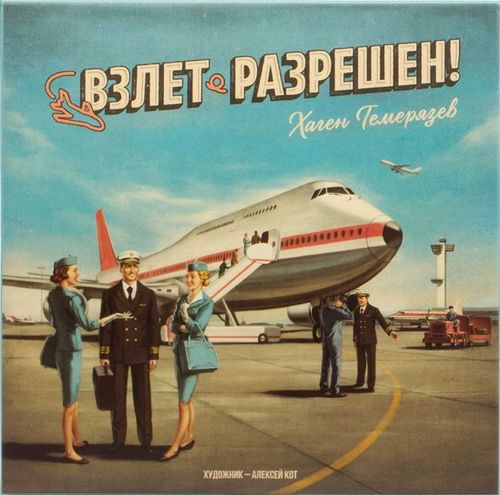
Взлет разрешен!
Взлет разрешен! Rulebook
Table of Contents
Table of Contents
Welcome on board!
Clear for Takeoff is the most realistic civil aviation board game in the world. During the game you will take control of a single airline. Your primary goal is to ensure that all of your aircrafts depart from the airfield. Each airline varies from one another by having an exclusive fleet of aircrafts.
The player who makes all of their aircrafts take off from the airfield first is declared the winner. But, the game doesn't stop there! Play continues until there is just one airline remaining on the airfield.
Setting up the game
To begin, you must prepare the airfield:
- Place the board in the center of the table.
- Shuffle the card deck and deal a starting hand of nine cards to each player.
- Place the remaining deck of cards on the board.
- Let each player choose an airline and place all of the corresponding aircrafts next to him/her. Players may choose their airline either randomly or at will.
You are now ready to begin!
Board areas: Hangar, Place for Weather Cards, Place for the Deck, Place for Discard Pile, Takeoff position.
The game turn
The last player to have visited an airfield begins the game. Play proceeds clockwise around the table. During your turn, you must perform (only) one of the following two actions:
- Exchange cards from your hand with cards from the deck, face-up.
- Play cards from your hand and draw cards from the deck, face-down.
Exchanging cards from your hand with cards from the deck
You may discard from one to four cards, face-up, from your hand at the start of each your turn. Draw the same number of cards face-up, one by one, from the deck. Other players must be able to see them.
- When drawing new cards from the deck you may not take Weather, Failure or Delay cards to your hand.
- If you draw a Weather card its effect resolves immediately. If you draw several Weather cards, the effects of the latter are applied and the previous cards go to the discard pile.
- If you draw a Failure or Delay card your most prepared aircraft is either damaged or delayed. If you have several aircrafts at the same preparation step, the largest aircraft is damaged or delayed. If all of your aircrafts are the same size and preparation step, the player to your left may choose which one is affected. If you do not have any aircrafts that can be damaged or delayed, discard the card and continue.
- All cards are placed into the discard pile after their effects have been resolved.
Note: it is important to keep track of the sequence in which these cards appear.
Example. Suppose that you have discarded three cards and draw, face-up, the following cards:
- 1st card: SN-SNOW - change the weather by replacing the current Weather card with the SNOW card. You still have to draw three more cards.
- 1st card: A (Movement Card) - take the card to your hand. You have to draw two more cards.
- 2nd card: DLY-DELAY - delay your most prepared aircraft on A, B, C, VIP1 or VIP2 position and discard the card. If you do not have any aircrafts that can be delayed, discard the card. You still have to draw two more cards.
- 2nd card: AI-ANTI-ICE - take the card to your hand. You have to draw one more card.
- 3d card: ICE - change the weather to ICE by replacing the current SNOW card with the ICE card. You still have to draw one more card.
- 3d card: VIP - take the card to your hand. Finish the card collection.
Note: you must draw the same number of cards that you have discarded. Weather, Failure and Damage cards are not included; therefore, you must resolve their effects immediately and continue drawing new cards in their place.
Playing cards
You may perform only one of the following actions per turn:
Change the weather. To change the weather you must play a Weather card from your hand. The Weather card is placed front-side up on the game board (on the place for Weather Card). The actions on the Weather card resolve immediately. The previous Weather card is discarded.
Damage or delay an opponent's aircraft. To damage or delay an opponent's aircraft, you must play a Failure or Delay card from your hand and point out which aircraft is damaged or delayed. The affected aircraft goes back to the Hangar.
Anti-ice an aircraft (applicable only on takeoff position). In 'Ice' weather conditions, aircrafts must be appropriately prepared in order to take off. To anti-ice an aircraft you must play an Anti-Ice card. Each aircraft size requires a different number of these cards. Play one Anti-Ice card for small aircrafts, two Anti-Ice cards for medium aircrafts and three Anti-Ice cards for wide-body aircrafts.
Move an aircraft. Each airline has aircrafts of different sizes, and each aircraft requires a different number of cards to progress it from the Hangar to the runway. Play one Movement card for small aircraft, two Movement cards for medium aircraft and three Movement cards for wide-body aircraft.
Note: you may only place or advance one aircraft per turn.
Note: when an aircraft is moved from its Hangar it can only be placed on A, AC, VIP1 position if it's free.
Note: forgetfulness is dangerous in aviation! Remember to make sure that you have nine cards in your hand at the end of your turn. If you forget you will have to wait until the end of your next turn.
Position A
To place an aircraft on position A, play from one to three A cards (depending on the size of the aircraft).
Position B
To advance the aircraft from position A to position B, play from one to three B cards.
Position D (from B)
To advance an aircraft from position B to position D, play from one to three D cards and choose which runway the aircraft will use (31L or 31R). When the aircraft advances to position D, it is placed behind any other aircrafts. When the sequence moves, so does your aircraft, even if it's not your turn. If there is not a sequence, the airplane goes to the closest takeoff position at point D (31L or 31R). If every part of position D is occupied, you may not play a D card.
Position A on a stand A-C
To place an aircraft on position A, play from one to three A cards (depending on the size of the aircraft).
Position C
To advance an aircraft from position A to position C, play from one to three C cards.
Position D (from C)
To advance an aircraft from position C to position D, play from one to three D cards (depending on the size of the aircraft) and choose which runway the aircraft uses (31L or 31R). When the aircraft advances to position D, it is placed behind any other aircrafts. When the sequence moves, so does your aircraft, even if it's not your turn. If there is not a sequence, the airplane goes to the position D, closest to the takeoff position. If every part of position D is occupied, you may not play a D card.
Note: you are not allowed to advance an aircraft from stand A-C to position B, and from stand A to position C. There is the following logic in aircraft advance: A-B-D or A-C-D, or VIP1-VIP2-D. However you can place an aircraft to VIP1 from any A, B, C position (see VIP card below).
Note: when position C on a stand A-C is occupied it is not possible to place another aircraft on corresponding position A.
VIP positions
For every type of aircraft, you must play (only) one VIP card from your hand in order to place it on the VIP1 position. From your next turn the aircraft will move independently towards the takeoff position.
Note: if the VIP2 position is occupied, you may not place your aircraft on VIP1 position.
When advancing an aircraft to position D it must be placed at the end of the sequence. When the sequence moves, so does your aircraft, even if it's not your turn. If there is not a sequence, the aircraft moves to position D, closest to the takeoff position (31L or 31R). If all positions at point D are occupied, your aircraft can not leave VIP2.
Independent aircraft movement
Independent aircraft movement occurs at the end of your turn after you have: exchanged face-up cards, played cards from your hand, drawn face-down replacement cards from the deck.
- If your aircraft is on VIP1 at the start of your turn, when your turn ends the aircraft will automatically advance to VIP2.
- If your aircraft is on VIP2 at the start of your turn, when your turn ends you may choose which runway the aircraft will use (31L or 31R) and advance the aircraft to position D.
- If your aircraft is placed on position D at the closest point to the takeoff position (there is no sequence in front of it) at the start of your turn, when your turn ends the aircraft will automatically advance to the takeoff position on the corresponding runway.
- If your aircraft is on the takeoff position at the start of your turn, when your turn ends the aircraft will automatically take off (weather permitting).
- If the aircraft is clear to take off, but the player forgot to take off his/her aircraft, it must be placed at the end of the sequence on position D near the corresponding runway. You can't linger or bustle about in aviation - it's very dangerous!
Cards description
Movement cards
A - Boarding - to place an aircraft on position A, you must play one A card for small aircrafts, two A cards for medium aircrafts and three A cards for wide-body aircrafts.
B - Push and Start - to advance an aircraft on position B, you must play one B card for small aircrafts, two B cards for medium aircrafts and three B cards for wide-body aircrafts.
C - Start Up - if you have placed an aircraft on stand A-C using A cards to advance the aircraft to position C you must play one C card for small aircrafts, two C cards for medium aircrafts and three C cards for wide-body aircrafts.
Note: when position C on the A-C stand is occupied, it is not possible to place another aircraft on stand A-C.
D - Taxi - to advance an aircraft on position D, you must play one D card for small aircraft, two D cards for medium aircrafts and three D cards for wide-body aircrafts, and then choose which runway the aircraft will advance towards (31L or 31R). When the aircraft advances to position D, it is placed behind any other aircrafts. When the sequence moves, so does your aircraft, even if it's not your turn. If there is not a sequence, the airplane goes to the position D closest to the takeoff position (31L or 31R). If every part of position D is occupied, you may not play a D card.
V.I.P. - when you play a VIP card, you may place any aircraft on the VIP1 position, regardless of its size. On your next turn it will start moving towards the takeoff position independently. You may apply this card to an aircraft in Hangar and an aircraft on positions A, B or C. In addition, if the VIP2 position is occupied, you may not place your aircraft on VIP1.
Note: the V.I.P. aircraft can be affected by Failure and Delay cards.
LC - Lucky Captain - the LC card allows you to replace any Movement card (A, B, C or D). For example, if you want to advance a wide-body aircraft from position A to position B, you must play three B cards; however, if you only have two B cards in your hand and one LC card, you may play B+B+LC. You may play as many LC cards as you have in your hand, such as B+LC+LC or even LC+LC+LC.
Failure and Delay cards
FLR - Failure - when you play this card, you must choose any other player's aircraft from anywhere on the airfield. This aircraft goes back to the airline's Hangar immediately.
Note: if you draw this card face-up during the card exchange its effects will be applied to your most prepared aircraft.
DLY - Delay - when you play this card, you have to choose any aircraft on position A, B, C, VIP1 or VIP2. This aircraft goes back to the airline's hangar immediately.
Note: if you draw this card face-up during the card exchange its effects will be applied to your most prepared aircraft on position A, B, C, VIP1 or VIP2.
Anti-Ice card
AI - Anti-Ice - this card is required to take off in 'Ice' weather conditions. Play one Anti-Ice card for small aircrafts, two Anti-Ice cards for medium aircrafts and three Anti-Ice cards for wide-body aircrafts to take off from the takeoff position. If you don't anti-ice your aircraft, it is not allowed to take off and moves to the end of the sequence. Its place is immediately occupied by the next aircraft. If that aircraft is also yours, it doesn't take off that turn. If there is not a sequence after the aircraft, it stays in the takeoff position, but doesn't take off.
Note: you may anti-ice only one aircraft per turn.
Weather cards
- At the beginning of the game the weather is clear and aircrafts may take off without any restrictions.
- The weather is applied to the aircraft which is ready to take off at the end of each turn. However, the SNOW card has an additional effect (see below).
- If the weather doesn't permit a takeoff, you may play a Weather card to change the weather and take off at the end of your turn.
- If you have two aircrafts on both takeoff positions - one on 31L and another on 31R - they will take off simultaneously at the end of your turn (weather permitting).
- When played, Weather cards are placed face-up at the top of the game board.
- The actions on the Weather card resolve immediately.
- When the weather is changed, the previous Weather card is discarded.
SC - SKY CLEAR - the weather is clear and aircrafts take off without any restrictions.
FG - FOG - aircrafts are not allowed to take off. When FOG is in play the sequence on D does not move and all aircrafts hold their positions.
31L - 31L CLOSED - aircrafts are not allowed to take off from runway 31L. When this card is in play, the sequence on the corresponding D position does not move and all aircrafts hold their positions until the Weather card is changed. Runway 31R is in use without restrictions.
31R - 31R CLOSED - aircrafts are not allowed to take off from runway 31R. When this card is in play, the sequence on the corresponding D position does not move and all aircrafts hold their positions until the Weather card is changed. Runway 31L is in use without restrictions.
SN - SNOW - wide-body aircrafts are not allowed to take off. When a wide-body aircraft is ready for takeoff and the weather is set to SNOW, it is not allowed to take off and moves to the end of the sequence. Its place is immediately occupied by the next aircraft. If that aircraft is also yours, it doesn't take off that turn. If there is not a sequence after the wide-body aircraft, it stays in the takeoff position, but doesn't take off.
Additional effect: in snowy weather you must play one additional Movement card (A, B, C or D) to place or advance an aircraft.
XW - CROSSWIND - medium aircrafts are not allowed to take off. When a medium aircraft is ready for takeoff and the weather is set to CROSSWIND, it is not allowed to take off and goes to the end of the sequence. Its place is immediately occupied by the next aircraft. If that aircraft is also yours, it doesn't take off that turn. If there is not a sequence after the medium aircraft, it stays in the takeoff position, but doesn't take off.
ICE - ICE - in order to take off when the weather is set to ICE, you must use one Anti-Ice card for small aircrafts, two Anti-Ice cards for medium aircrafts and three Anti-Ice cards for wide-body aircrafts. If you don't anti-ice your aircraft, it is not allowed to take off and moves to the end of the sequence. Its place is immediately occupied by the next aircraft. If that aircraft is also yours, it doesn't take off that turn. If there is not a sequence after the aircraft, it stays in the takeoff position, but doesn't take off.
Deck notes
- If the card deck runs out of cards, reshuffle the discard pile to create a new card deck.
- Cards drawn from the deck during the card exchange are drawn face-up.
- Cards drawn from the deck at the end of your turn are drawn face-down.
- Players who forget to move their aircraft or draw cards from the deck must wait until the end of their next turn. For example, if the weather was clear, but the player forgot to take off his/her aircraft, it must be placed at the end of the sequence on position D near the corresponding runway.
Helpful tips
Use these helpful tips to ensure you don't miss anything!
- At the end of your turn you must have nine cards in your hand.
- Play cards from your hand, or exchange cards from your hand with cards from the deck.
- 2.1. If you decide to play cards from your hand:
- 2.1.1. You may place a new aircraft on position A or VIP1, if free.
- 2.1.2. You may advance previously placed aircrafts to position B, C or D.
- 2.1.3. You may play Failure or Delay cards.
- 2.1.4. You may play a Weather card (new weather conditions start immediately).
- 2.1.5. You may play an Anti-Ice card (aircrafts can't take off without an Anti-Ice card during icy weather conditions).
- 2.2. If you decide to exchange cards from your hand with cards from the deck:
-
2.2.1. Discard from one to four cards, face-up, from your hand. Other players must be able to see them.
-
2.2.2. Draw the same number of cards, you exchange, face-up, to your hand. Other players must be able to see them.
Note: when exchanging cards face-up, you may not take Weather, Failure or Delay cards to your hand.
- 2.2.2.1. If you draw a Weather card, its effects resolve immediately and current weather conditions are replaced. It is possible for the weather to change several times during a single turn.
- 2.2.2.2. If you draw a Failure or Delay card its effects are applied to your most prepared aircraft. If you have several aircrafts at the same preparation step, the largest aircraft is damaged or delayed. If all of your aircrafts are the same, the player to your left may choose which one is affected. If you do not have any aircrafts that can be damaged or delayed, discard the card and continue.
-
- 2.1. If you decide to play cards from your hand: