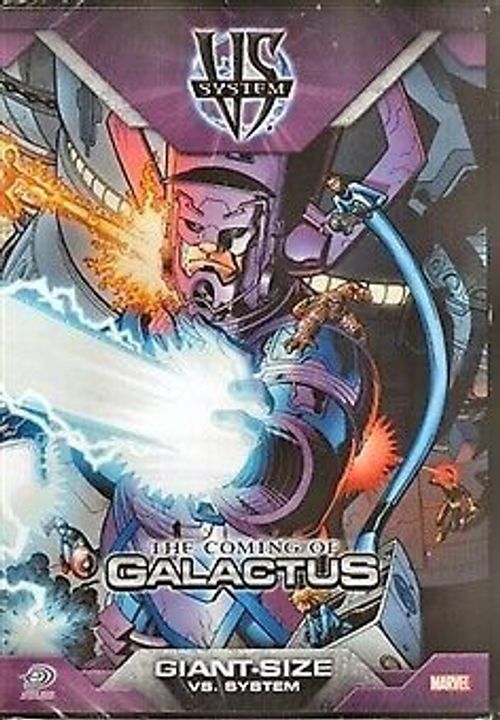
VS. System: The Coming of Galactus Giant-Size Deck
VS. System: The Coming of Galactus Giant-Size Deck Rulebook
Table of Contents
Table of Contents
Preview: Epic Plot Twist
(Heading supplied by the transcriber; the article has no heading for this section.)
This plot twist KO's all cards with the same name and version as the target no matter who controls them, so Alliance players should consider carefully before running multiple copies of the same character or location in different decks. (And consider extra carefully before running Army characters or non-unique locations!)
Even with all the above careful consideration, Galactus can simply trash the largest character he's facing before it gets a chance to swing this turn. At the risk of stating the obvious, this can have a huge impact on how a turn plays out and is very capable of "stealing a planet" from an Alliance initiative.
Don't be fooled by that cost of 8. Galactus starts out with an extra resource for each opponent he's battling, so this plot twist will come online on turn 5 in a typical three-opponent game.
Like all the other cards in the Galactus deck, this plot twist can be played in normal Vs. System decks. Note the cunning wording that allows you to exhaust any card named Galactus you control, whether it be a Giant-Size avatar, or a giant-sized 16 / 16 or 25 / 25!
And to answer that rules question from above, an Epic plot twist can't be negated. (But making its target illegal in response will still effectively do the same thing.)
Giant-Size Rules
John and Hump have already clued you in on many of the Giant-Size rules. Here's a summary of the major differences between this new format and normal Vs. System. In general, if something's not mentioned, it works the same as normal.
Winning
The game is won by reducing your opponent to 0 endurance or less while keeping your endurance higher, and this is checked at the normal point during the wrap-up each turn.
Unlike a normal game, each side has 100 endurance. Galactus has that much all to himself because he's, ya know, real big. The Alliance players, on the other hand, don't have individual endurance totals, but instead share a combined total of 100.
What's a combined total? It means that any time an Alliance player loses or pays endurance, that amount is deducted from the combined total (and, similarly, any endurance gains are added).
One other total that Alliance players should keep their eyes on is the number of planets Galactus has won. Once that total hits three, Galactus may consume all three during the build phase to knock one player out of the game completely, regardless of where the endurance totals stand.
Starting
As the game starts, each member of the Alliance chooses one team, and all chosen teams are crossed over for all Alliance players for the duration of the game.
Each player (including Galactus) draws an opening hand of four cards and can mulligan as normal. Galactus then draws an additional card for each Alliance player, and then chooses that many cards from his hand to put face-down into his resource row.
Turn Sequence
Galactus draws three cards at the start of each turn. Alliance players each draw two as normal.
Regardless of initiative, Galactus always performs his resource, recruit, and formation steps before the Alliance. Then, the Alliance players share:
- A single resource step, during which they may each place a resource
- A single recruit step, at the start of which they each get an individual amount of resource points equal to the number of cards in their individual resource rows
- A single formation step, during which they can rearrange their own characters within their own visible and hidden areas as normal
During the combat phase, the Alliance players share a single attack step, during which they can team attack with other Alliance players in any mutually agreeable order.
Starting with the third turn, each turn opens with a new planet phase, at the start of which the top card of the planet deck is flipped and becomes the contested planet for the turn. Then, there's a priority window for effects before the draw phase. The contested planet specifies the initiative for the turn; the Alliance has the initiative for the first two turns. The contested planet's objective is checked as the very first part of the wrap-up each turn, after all players have passed the recovery phase. Galactus wins the planet unless the Alliance has completed its objective.
Planets
A planet's powers are active only while it's being contested. Planets can be won (and then later consumed) by Galactus, or saved by the Alliance. Consuming a planet removes it from the game. Players can't interact with planets in any other way. In particular, planet effects can't be negated.
Home Stretch
A few more rules for that player at the kitchen table who everybody turns to for help:
- Each Alliance player can target any Alliance-controlled character as if he or she controlled it.
- Galactus can't directly attack an Alliance player unless no Alliance player controls a non-stunned, visible character.
- The uniqueness rule applies on a player-by-player basis, so two different Alliance players can play the same unique card.
- "Opposing" means controlled by an opponent. "Friendly" means controlled by any player who isn't an opponent (including yourself). The Alliance players are friendly to each other and opposing to Galactus.
- At the start of each game, the Alliance elects (or rolls dice to choose) a decision maker. Any time the Alliance can't agree on a mutual decision, that player makes the choice.
And that's really all there is to it!