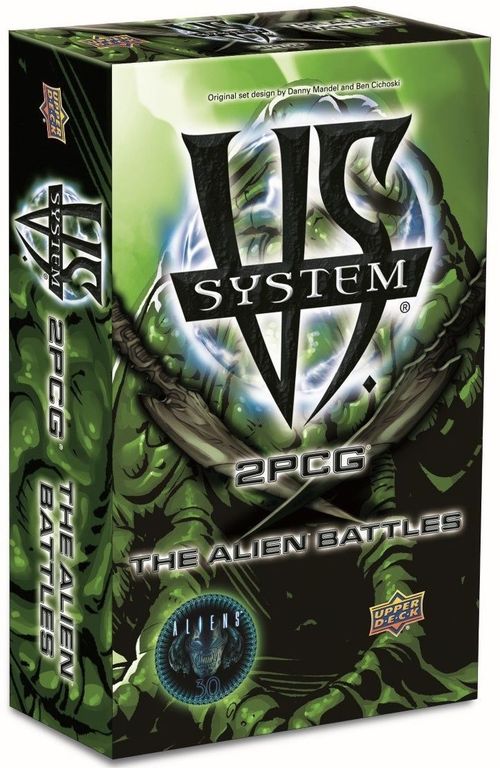
Vs System 2PCG: The Alien Battles
Vs System 2PCG: The Alien Battles Rulebook
Table of Contents
Table of Contents
- What is the Vs System?
- Gameplay Overview
- The Card Types
- Basic Game Concepts
- Setting Up the Game
- Turn Sequence
- Ending the Game
- Additional Rules
- Character Powers
- Main Characters vs Supporting Characters
- Uniqueness
- Power-Ups
- Resources and Locations
- Running Out Of Cards
- Searching and Shuffling
- Token Characters
- Timing
- Base ATK and DEF
- The Golden Rules
- What's New With Aliens
- Free for All - 3 or 4 players
- 2 vs 2
- 2-Headed Teammates
- Building Your First Decks
- Deck Building Rules
- Game Terms
- Select Keyword Powers
What is the Vs System?
The Vs. System is a card game where 2-4 players each build a deck of Characters, Plot Twists, Locations, and Equipment to try to defeat their opponents. Each Vs. System product comes with a full playset of cards so you'll have everything you need to play the full game right out of each box.
Game Contents
- 200 Cards
- Assorted Counters
- This Rulebook
If you're familiar with the Vs. System 2PCG...
If you've already played the Vs. System 2PCG most of these rules will be familiar to you. We suggest you check out the following sections to see what's new:
- Equipment (pages 4 & 16)
- New Location Symbols (page 5)
- What's New With Alien (page 25)
Gameplay Overview
Each player starts with a Main Character, such as Warrant Officer Ripley or The Perfect Organism. During the game, you'll play resources and recruit Supporting Characters, like Hicks, Hudson and Lambert. You'll organize your formation between your Front and Back Rows, and you'll make solo and team attacks against your enemies in order to stun and KO them. You'll play Plot Twists to enhance your team or hurt your opponent's. You'll outfit your squad with powerful Equipment. You'll use your Locations to activate your team's Super Powers. Your Main character will earn Experience Points and Level Up to dominate the battlefield. Finally, you'll KO your opponent's Main Character (or they'll KO yours).
The Card Types
Main Characters
A Main Character card shows: its Name, Team Affiliation, Type (Main Character), Powers, Level (L1 or L2), ATK/DEF, Health, and the Ranged symbol (if any). Example: Lt. Ripley (Level 2) has the power Gear Up (Build: Reveal the top five cards of your deck. Put an equipment from among them into your hand and the rest on the bottom in any order.) and the power I Can Handle Myself (Main: Search your deck, hand and KO pile for an equipment and equip it to a character on your side. This power can be used only once this game.).
You start the game with a Level 1 Main Character. When it levels up during the game, you'll switch it with its Level 2 Version.
Supporting Characters
During your turn you can recruit Supporting Characters into your Front or Back Row. A Supporting Character card shows its Name, Team Affiliation, Type, Cost, Powers, ATK/DEF, Health and Ranged symbol (if any). Example: Xenomorph Ambusher (Xenomorphs, Cost 2, Creature, Swarm, Camouflage: This character can't be attacked while it's in your back row; 2/3 ATK/DEF).
Main Characters and Supporting Characters work the same way. They can attack, defend, get stunned, and take wounds. The only exception is some cards specifically refer to Main Characters or Supporting Characters.
Note: The color of a character's Health symbol has no effect on game play.
Plot Twists
During your turn, you can play Plot Twists from your hand. Plot Twists always say when during the turn you can play them. You can only play a Plot Twist if you have a face-up character with the matching Team Affiliation.
A Plot Twist card shows its Name, Team Affiliation, the Any Turn symbol (on some), and Game Text. Example: Build the Hive (Xenomorphs): "Combat: If this is a melee attack, put two -1/-1 counters on a character in the combat." Example: Chestburst (Xenomorphs; Any Turn symbol): "Main: Turn an enemy location face down."
Equipment
During your turn, you can put Equipment cards onto your characters. Equipment cards have a cost just like characters. You can only play an Equipment if you have a face-up character with the matching Team Affiliation.
An Equipment card shows its Name, Cost, Team Affiliation and Game Text. Example: M41A Pulse Rifle (The Company, Cost 1): "Light Armor-Piercing Rounds: Equipped character has the Ranged symbol and has +3/+0 while making a ranged attack. M-40 Grenades: Main: Put three -1/-1 counters on an enemy back row character."
Locations
Each turn you can play a card face-down as a resource. But if it's a Location, you can play it face-up instead. Each location has a power symbol. During the game, you can turn a Location face-down in order to activate a Super Power that requires that symbol. (You may also discard a location from hand to generate that symbol.)
A Location card shows its Name and Power Symbol. Examples: The Sulaco, Earth (Basic Locations).
There are six Power Symbols: Might, Intellect, Skill, Energy, Humanity, and Alien.
Each team also has a Special Location which grants any Power Symbol that team uses. A Special Location shows its Name, Power Symbol (any), Game Text and Team Affiliation. Example: LV-426 (Xenomorphs).
Basic Game Concepts
- Deck: Your deck must include exactly 60 cards, not including your Main Character.
- Hand: You start the game with seven cards and draw two cards each turn. There is no limit to the number of cards you can have in your hand at one time. If an effect tells you to discard a card, that means from your hand.
- KO Pile: When a card gets KO'd or discarded, it goes into your KO pile, which is next to your deck. The KO Pile is face-up, and any player can look through it at any time.
- Three Rows: Each player has three rows: Front, Back, and Resource.
- When you recruit a character, it can go into your Front or Back row. Characters in front are your main line of attack. They also protect characters in your Back Row. Characters in your Back Row are safer, but they can only attack if they have the Ranged symbol.
- Each turn you'll place a Location or a face-down card from your hand into your resource row. Your resources give you recruit points each turn which you'll use to play your Supporting Characters and Equipment.
- Ready/Exhausted: A card in play is either ready (upright) or exhausted (turned on its side). Only ready characters can attack. Cards enter play ready.
- Stun: When a character is defeated in combat, it becomes stunned. Turn it face-down, exhaust it, remove all +1/+1 and -1/-1 counters from it, KO any equipment on it, and put a Wound counter on it. Stunned characters can't be attacked and they lose their powers until they recover. Some effects can cause a character to become directly stunned (without it being in combat).
- KO: When a character has at least as many Wounds as its Health, it's KO'd. (Put it into the KO Pile.)
(The original includes a layout diagram showing the Front Row, Back Row, Resource Row, Deck and KO Pile, with ready, exhausted, and stunned characters and Wound counters.)
Setting Up the Game
- Each player needs a deck that has one Main Character and exactly 60 game cards. (See pages 29-30 for which cards to include in your first deck.)
- Put the Wound, XP, +1/+1, and -1/-1 counters nearby. Note: The color of the Wound counters has no effect on gameplay, but we recommend using the red ones for humans, white ones for synthetics, and green ones for xenomorphs.
- Randomly determine who gets to choose which player goes first.
- Starting with the first player, each player puts their Level 1 Main Character into either their Front or Back Row. Then they put the Level 2 version off to the side where all players can see it.
- Each player should set their deck down next to where their Back Row will be.
- Each player shuffles their deck and draws seven cards.
- Starting with the first player, each player may mulligan one time if they don't like their hand. Shuffle your hand into your deck and draw seven new cards. (It's usually a good idea to mulligan if you don't have any Locations or any supporting characters that you can play in the first few turns.)
Turn Sequence
Each turn, you'll go through the following four phases in order. Then the next player takes a turn. (In a 3 or 4 player game, the next player is the player to your left.)
- Draw Phase
- Recovery Phase
- Build Phase
- Main Phase
1. Draw Phase
During this phase, first any "At the start of your turn" effects happen. Then you draw two cards. (If you're the first player and this is the first turn of the game, you don't draw any cards on your first turn.)
2. Recovery Phase
During this phase, if you have any stunned characters, they all recover. Then ready all of your characters.
3. Build Phase
During this phase, perform the following three steps in order:
Resource Step
You may choose any one card in your hand and place it face-down into your resource row. (It is now a "resource".) If you play a Location as a resource, you may place it face-up. (It's still a resource.) Locations are not unique; you can have more than one with the same name. (Playing a resource is optional.)
Recruit Step
You now gain 1 Recruit Point for each resource you have. (It doesn't matter if the resource is face-up or face down.) You can spend any or all of your Recruit Points to play Supporting Characters and Equipment from your hand. When you play a character, put it into your Front or Back row. When you play an Equipment, put it onto one of your face-up characters. (We suggest you place the Equipment card partially beneath the character card.)
Example: During Ellen's Resource Step, she plays the Nostromo Location face-up as a resource. She now has four resources, so during her Recruit Step she gains 4 Recruit Points. She spends them to play Newt (who costs 1) into her Front Row and Kane (who costs 2) into her Back Row. She then decides to play the M41A Pulse Rifle (which costs 1). She can put it on any of her characters and decides to put it on her Main Character.
If you have any Recruit Points leftover, they go away after this step.
Formation Step
You can now rearrange any or all of your characters between your Front and Back Rows. Any character (including your Main Character) can go into either row. It doesn't matter if a character is to the left or right of another character. All that matters is who's in the Front and who's in the Back.
4. Main Phase
This is the longest phase of the turn. During this phase, you can make any number of attacks, one at a time, until you choose to stop attacking or all of your characters are exhausted.
Your Front Row characters can make Melee attacks. Your Back Row characters that have the Ranged symbol can make Ranged attacks. (Note: You can put a Ranged character in your Front Row to have it make a Melee attack if you want.)
Making a Melee Attack
Starting a Combat
- Exhaust one of your ready Front Row characters to become the attacker and choose a face-up Front Row enemy to be the defender. If an opponent has no face-up Front Row characters, you can attack his Back Row characters.
- If your character has the Flight symbol it may fly over your opponent's Front Row to attack a Back Row character unless your opponent has their own Flight-symbol character in their Front Row. (Note: In this set, no characters can fly, but a few can Leap over your opponent's Front Row when they attack.)
During Combat
- Once combat has begun, you can play one Combat Plot Twist or use one Combat Super Power or you can pass. Then your opponent can do the same. Then you go again, and so on, until both of you pass in a row. (If a player passes but then other player plays something, the other player can still play something.) Then resolve the combat.
- When a player plays a Plot Twist or uses a Super Power, it resolves immediately before the next player has a chance to play their own Plot Twist or Super Power.
Resolving Combat
- To resolve the combat, the Attacker now "strikes" the Defender, and the Defender simultaneously "strikes back" against the Attacker.
- Compare the Attacker's ATK to the Defender's DEF. If the ATK is greater than or equal to the DEF, the defender will be stunned. Also compare the Defender's ATK to the Attacker's DEF. If the ATK is greater than or equal to the DEF, the attacker will be stunned.
- So there are four possible results to a combat: No one gets stunned, the Attacker gets stunned, the Defender gets stunned, or both characters get stunned.
- When a character becomes stunned, turn it face-down, exhaust it, remove all +1/+1 and -1/-1 counters from it and put a wound counter on it. You also KO any Equipment on it.
Making a Ranged Attack
Ranged attacks work the same way as Melee attacks with the following exceptions:
- You choose one of your Back Row characters with the Ranged symbol to be the attacker.
- The defender only gets to strike back if it also has the Ranged symbol.
Note: If your character attacks from the Front Row, it is always a Melee attack whether or not your character has the Ranged symbol.
Flight and Ranged
- If your character has the Flight symbol and the Ranged symbol, it can attack from your Back Row AND fly over your opponent's Front Row (if your opponent has no Flight-symbol characters in their Front Row) to attack a Back Row character. The defender will still only strike back if it has the Ranged symbol.
Team Attacks
Two or more characters that have the same Team Affiliation and are in the same row can make a Team Attack against a single defender. Team Attacks work just like solo attacks with the following exceptions:
- You choose two or more Front Row characters to make a Melee Team Attack.
- You choose two or more Back Row characters that have the Ranged symbol to make a Ranged Team Attack. (Just like in a regular Ranged Attack, the defender only gets to strike back if it has the Ranged symbol.)
- In both cases, if all of your attackers have the Flight symbol, they can fly over your opponent's Front Row to attack their Back Row (unless your opponent has a Front Row Flight-symbol character).
Resolving a Team Attack works like this:
- Add up the ATK of all your Attackers and compare them to the Defender's DEF to see if the Defender will get stunned.
- The Defender then chooses exactly one Attacker to strike back against. It compares the Defender's ATK to that character's DEF to see if it will get stunned.
For example, let's say three different 2/2 Xenomorphs attack a 6/6 Defender. When the combat resolves, the total ATK of the Attackers is 6, which is enough to stun the Defender. The Defender picks one of the 2/2s to strike back at, compares its 6 ATK to the Attacker's 2 DEF and stuns it. The other two 2/2s survive.
After each Combat resolves, you can make another attack. Once you're done attacking (either by choice, or because you have no ready characters left, or because all enemy characters are stunned) and you're ready to be done with your Main Phase, your turn ends. Resolve any "at the end of your turn" effects, and then the player to your left gets to take a turn.
Ending the Game
The game ends when you KO your opponent's Main Character or they KO yours. If you're playing 3 or 4 players, then it ends when only one Main Character is left. If the final two Main Characters would get KO'd at the same time (either because they're in combat with each other or through some card effect), the player whose turn it is wins the game.
Additional Rules
+1/+1 and -1/-1 counters
Many effects put +1/+1 or -1/-1 counters on characters. These numbers alter a character's ATK and DEF until something removes the counters.
If a character ever has +1/+1 and -1/-1 counters at the same time, they cancel out. Remove one of each until the character only has one type.
When a character gets stunned, remove all +1/+1 and -1/-1 counters from it.
If a character's DEF is ever reduced to 0 (whether from -1/-1 counters or some other effect), it's immediately stunned.
Stunned Characters
When a character becomes stunned, remove all +1/+1 and -1/-1 counters from it, KO any Equipment on it, turn it face-down exhausted, and put a wound counter on it. If it now has wounds greater than or equal to its Health, it's KO'd. Put it into its owner's KO pile. (Note: If a character only has 1 Health, don't bother putting the wound counter on it. Once it gets stunned, it's immediately KO'd and you can put it directly into your KO pile.)
If a character gets stunned by an effect in the middle of a combat, it is removed from Combat.
Stunned characters can't be attacked or gain +1/+1 or -1/-1 counters, and they temporarily lose their powers (until they recover). Stunned characters can't ready.
Any player can look at any stunned character at any time.
Some effects say to "Daze" a character. This stuns the character except it doesn't gain a wound. (It works like the character getting stunned in all ways except for no wound.)
Some effects say to "Wound" a character. This puts a wound on the character but does not stun it. (If the character has wounds greater than or equal to its Health, it is KO'd.)
Recovering Characters
Your stunned characters automatically recover during your Recovery Phase. (You can't choose to leave them stunned.)
Some card effects can also recover a character. When a character recovers, turn it face-up but leave it exhausted. (Note: Recovering a character does NOT heal any wounds from it.)
Playing Equipment
You can play Equipment cards during your Recruit Step. Pay Recruit Points equal to the Equipment's cost and put it onto a face-up character on your side. (It doesn't matter if the character is Main or Supporting, ready or exhausted.) The Equipment gives the character access to new powers.
The Equipment will stay with that character until the character becomes stunned or otherwise leaves play. At that point, the Equipment gets KO'd.
A character can have only one Equipment at a time. If you play a new Equipment on a character that already has one, the older Equipment gets KO'd.
If an Equipment has a Team Symbol, you may only play it if you have a face-up character with that Team Symbol on your side (including your Main Character). However, you can play it on any character on your side. For example, if a character with The Company symbol is on your side, you can play a Power Loader on any character on your side even if they don't have the symbol.
Equipment is not unique unless it says otherwise.
Playing Plot Twists
Each Plot Twist will say when you're allowed to play it. If it says "Build" then you can only play it during your Build Phase. If it says "Main", then you can only play it during your Main Phase while there isn't a combat going on.
If it says "Combat", then you can only play it during a combat on your turn. And if the word "Combat" has the Any Turn symbol next to it, then you can play it during a Combat on any player's turn. (Most "Combat" Plot Twists can be used on any player's turn.)
Unless it says otherwise, you can only use a "Combat" plot twist to affect a character in the combat.
When you play a Plot Twist, follow its instructions, then put it into your KO pile.
Some Plot Twists have a Team Symbol on the top right of the card. That means you may only play it if you have a face-up character with that Team Symbol on your side (including your Main Character). However, you can use it to affect any character regardless of Team Symbol.
Character Powers
There are three types of character powers: Keywords, Super Powers, and Level Up Powers.
Keywords
Keywords are powers that often show up on more than one character. When a character has a keyword power, just follow the instructions in its text. (Some common or older keywords might not have their text displayed. In that case, you can look up their definition in this Rulebook.)
Flight and Ranged are the two most common keyword powers. They are represented by icons (the Flight symbol and the Ranged symbol) instead of the actual words.
(Example card: Vriess, The Company, Cost 1, 2/1, Health 2 — Immobile: Vriess can't move during your Formation Step. I'll Put Holes In You!: When Vriess gets stunned on an enemy player's turn, put a -1/-1 counter on an enemy character.)
Super Powers
All Main characters and some Supporting characters have Super Powers. Each Super Power has a name, a cost (the power symbol), a timing word (when you can use the Power), and an effect. For example, on Warrant Officer Ripley: "Hide in the Shadows" is the Name; "Main" is when you can use the Power; the Humanity symbol is the cost to use the Power; "Daze a character on your side but it keeps its equipment" is the effect. On The Perfect Organism: "Its Structural Perfection" is the Name; "Combat" (with the Any Turn symbol) is when you can use the Power; the Alien symbol is the cost; "If the Perfect Organism is melee attacking, the defender can't strike back this combat" is the effect.
The words "Build" or "Main" or "Combat" tell you when you can use the Super Power (just like how Plot Twists work). For example, Warrant Officer Ripley's power can only be used during your Main phase while there isn't a combat going on. The Perfect Organism's power can only be used while it's in combat on your turn. If it had the Any Turn symbol next to "Combat", you could use it on your turn or another player's.
You can only use a character's "Combat" Super Power if that character is in the combat. But if the power says "Any Combat", then you can use it during a combat even if that character isn't part of it.
Each Super Power has at least one power symbol. To activate a Super Power, you must pay for it by turning one of your Locations with that symbol face-down OR by discarding a Location with that symbol from your hand.
Example: It's your Main Phase. You decide to use Warrant Officer Ripley's "Hide in the Shadows" power, so you turn your Earth location face-down to pay the Humanity cost. Then you get the power's effect. You could also have discarded an Earth card from your hand to pay the Humanity cost.
You can use any number of different Super Powers each turn, as long as you can pay for them. However, you can't use the same Super Power more than once each turn.
Some Super Powers have more than one power symbol. You have to pay for all of them by turning matching Locations face-down or discarding them from hand, or a combination of both.
Level Up Powers
Every Level 1 Main Character has a Level Up Power. On Warrant Officer Ripley: "Level up (7) - At the start of your Build Phase, Warrant Officer Ripley gains an XP for each wound she has." The number (7) is how much XP Ripley needs to Level Up; "At the start of your Build Phase, ..." is the XP Condition.
When you meet the XP (experience) condition, put an XP counter on the Level 2 version of your main character. Once you have XP equal to the number next to "Level Up", remove the XP counters from the Level 2 version of your main character and replace the Level 1 version of your character with its Level 2 version.
The Level 2 version should retain the same orientation as the Level 1 version (ready/exhausted and face-up/stunned). Put each wound, +1/+1 or -1/-1 counter, and Equipment that was on the Level 1 version onto the Level 2 version.
Level 2 characters work just like Level 1 characters except they're more powerful and they have an additional Super Power.
Note: While your Level 1 character is stunned, its Level Up Power is turned off.
Main Characters vs Supporting Characters
Main Characters work like Supporting Characters with the following exceptions:
- Main Characters start in play and don't have a cost.
- Main Characters can level up.
- If your Main Character gets KO'd, you're out of the game.
- Some effects say they only work on Main Characters or on Supporting Characters.
Other than that, treat Main Characters exactly the same as Supporting Characters. They attack, defend, team attack, get +1/+1 or -1/-1 counters, have equipment, get stunned, use powers, etc.
Uniqueness
You can only have one character with a specific name on your side at one time. If you already have a character on your side and you play another one with that name, you must KO the first one. If they both enter play simultaneously, then you must pick one to KO. If the second one ends up on your side through some special effect (e.g. Mind Controlling an enemy character), you still must KO the first character.
The only exception to all of this is your Main Character. You may never control a character with the same name as your Main Character. If an effect would cause that, ignore that effect. You can't play a Supporting Character with the same name as your Main Character.
Note: You are allowed to have more than one character with a specific name if it has the Swarm keyword.
Power-Ups
If you have a card in hand with the same name as a face-up Main or Supporting Character on your side, you may discard it to Power Up that character. Put a +1/+1 counter on the Powered-Up character. You can Power Up a character either as a Main action or as an Any Turn Combat action.
Example: You attack with your Main Character, The Perfect Organism. During combat you decide to Power Up The Perfect Organism, so you discard a The Perfect Organism Supporting Character from your hand and put a +1/+1 counter on your Main Character.
Resources and Locations
Cards in your Resource Row count as Resources whether they're face-up or face-down. Once a Location turns face-down, it will stay face-down unless an effect turns it face-up. You can look at your own face-down resources at any time. You can't look at enemy face-down resources.
You can rearrange your Resource Row if you like as long as your opponent can see how many you have and which Locations you have. Resources don't exhaust.
There are six basic locations, one for each of the six power symbols. Also, each team has one special location that has a Team Symbol on the top right of the card. These locations can produce any of the power symbols, but only for a member of that team on your side or in your hand. (That matters when you're building your own decks and mixing teams together. See page 31 for more info.)
You can use a Location (by turning it face-down or discarding it) to pay for a Super Power. But you can't use the same Location card to pay for multiple Super Powers. Each Super Power must be paid for separately.
Basic Locations with Different Names
In different universes (like comic or space adventure), basic Locations may have different names. However, they still count as being the same basic Location. Your deck can include up to four copies of a specific basic Location (for example one that makes Might), and all copies of it must have the same name.
Running Out Of Cards
If a player needs to draw a card but his deck his empty, he skips those draws. Play continues as normal. But if all players are out of cards and no one is willing or able to attack to put wounds onto Main Characters, the player with the fewest wounds on his Main Character wins the game. If two or more players are tied for the fewest wounds, the game ends in a tie between those players.
Searching and Shuffling
Whenever you need to search through your deck, shuffle it once you're finished.
Token Characters
Token characters are set aside at the start of the game as opposed to in your deck. But some effects can put them directly into play. A token character works just like a regular character except that if it ever gets put into a KO pile or otherwise leaves play, remove it from the game again.
Timing
When you play a Plot Twist or use a Super Power, it resolves before anyone can play another Plot Twist or use another Super Power. When an effect triggers, it resolves before anyone can play a Plot Twist or use a Super Power. If multiple triggers happen at the same time, the player whose turn it is decides the order.
Base ATK and DEF
Some effects refer to a character's Base ATK and DEF. This means a character's stats before any effects or counters modify them. A character's Base ATK and DEF is usually the same as their printed ATK and DEF. The only difference is that some effects might temporarily change a character's Base stats.
The Golden Rules
Whenever a card contradicts a rule in this rulebook, the card is correct. And if one effect says you can do something and another says you can't do something, can't beats can.
What's New With Aliens
The following are new rules and concepts introduced with this expansion.
Two New Teams
This set includes The Company and the Xenomorphs.
Good and Evil
Some effects in previous Vs. System sets refer to Good and Evil characters. The Company counts as a Good team and the Xenomorphs count as Evil. (Some may disagree with that assessment, but our superiors at The Company assure us that it's correct.)
Two New Power Symbols
This set adds the new Humanity and Alien symbols to Locations and Super Powers.
Equipment
Equipment is a new card type that attaches to characters. (For details on how equipment works see pages 4 & 16.)
Creature
This is a new keyword that means "This character can't have equipment. This power can't be lost or turned off (even while the character is stunned)."
Swarm
This is an old keyword, but it's very prevalent on the Xenomorph team. It means "You can have any number of this character on your side. This power can't be lost or turned off (even while the character is stunned)."
Amplify
Amplify is a new ability found on some Super Powers. If you discard a Location (instead of turning it face-down in your resource row) to use a Super Power, you get its Amplify text.
Facehuggers and Capturing Characters
If you have Ovomorphs in your deck (the eggs that make Facehuggers), you'll use the Facehugger Pile.
- The Facehugger Pile includes three Facehugger token characters and one Extended Incubation card. These cards start the game out of play. (If more than one player is using Ovomorphs, they will each use their own Facehugger Pile.)
- When an Ovomorph is ready to Hatch, reveal a random card from your Facehugger Pile.
- If you reveal the Extended Incubation card, the Ovomorph doesn't open yet. Shuffle the Extended Incubation card back into your Facehugger Pile.
- If you reveal a Facehugger token character, KO its Ovomorph, put the Facehugger into your Back Row, and it captures an enemy supporting character. (It can capture a face-up or stunned supporting character.)
- "Capture" is a new game action that means:
- Remove the Captive card from the game, but keep any wound counters on it.
- Put the Captive card next to (or underneath) its Captor to make it clear who its Captor is.
- When the Captor leaves play, put its Captive back into play stunned in its owner's back row.
- You may pay a Humanity symbol at the start of your Build Phase. If you do, KO the Facehugger and put its captive into its owner's KO pile. Then you may put a Xenomorphs-symbol character from your hand into your back row. (This represents the new Xenomorph bursting out of the captive's chest.)
- Note: Put the KO'd Facehugger token back into your Facehugger Pile.
Free for All - 3 or 4 players
When you play with three or four players, all of the usual rules apply with a few exceptions:
- You win when all other Main characters are KO'd.
- The player who goes first draws no cards on their first turn. The player who goes second only draws one card on their first turn.
- During your Main Phase, you can have your characters attack any other player's characters using the normal combat rules. You can make all of your attacks against one player, or spread them out against multiple if you want.
- During combat, each player (including players who don't have an attacker or defender) can play Plot Twists to influence the combat.
- When a Main character is KO'd, all of that player's cards are immediately removed from the game. (This doesn't count as those cards getting KO'd.)
2 vs 2
You can also play 2 vs 2. In this case, you win when both enemy Main Characters are KO'd.
- Teammates should sit so the turn order goes Team A, Team B, Team A, Team B.
- The player who goes first draws no cards on their first turn. The player who goes second only draws one card on their first turn.
- You can't attack your teammate's characters.
- When a Main character is KO'd, all of that player's cards are removed from the game.
Optional Rule: When you recruit a character, you may put it into your teammate's Front or Back Row (they control it now).
2-Headed Teammates
This is a variation of 2 vs 2.
- Teammates sit next to each other, and they share one giant Front Row and one giant Back Row.
- They don't share a Resource Row.
- Each team takes one shared turn. Both players Recruit separately during their Recruit Step. (You can't share Recruit Points.)
- Then they arrange their single Formation Together.
- Then they do their Attacks together.
- They both count as controlling all characters on their side.
- Each player on the team that takes the first turn does not draw cards on that turn.
- The game ends when both Main Characters on a team are KO'd. When your Main Character is KO'd, you continue to play on.
Building Your First Decks
For your first few games we recommend building the following decks.
The Company
Supporting Characters: 2 Newt; 3 Vriess; 4 Call; 2 Captain Dallas; 2 Kane; 2 CMO Clemens; 3 Engineer Parker; 2 Bishop; 3 Christie; 2 Brother Dillon; 2 Private Hudson; 2 Ash; 2 Johner; 2 Corporal Hicks
Equipment: 3 M41A Pulse Rifle; 3 MU/TH/ER 6000; 3 Power Loader
Plot Twists: 2 Let's Rock
Locations: 4 Weyland-Yutani Complex; 3 The Nostromo; 3 The Sulaco; 3 The Auriga; 3 Earth
Xenomorphs
Supporting Characters: 5 Adolescent Xenomorph; 3 Ovomorph; 3 Leaping Xenomorph; 2 Xenomorph Ambusher; 2 Xenomorph Lance-Tail; 2 Acid Blood Xenomorph; 3 Salivating Xenomorph; 2 Screeching Xenomorph; 3 Xenomorph Spitter; 2 The Dragon; 2 The Perfect Organism; 2 The Newborn; 2 The Queen
Plot Twists: 3 Build the Hive; 3 Chestburst; 3 Spook; 2 Let's Rock
Locations: 4 LV-426; 3 The Nostromo; 3 Fury 161; 3 The Auriga; 3 Space
You can use any of a team's Main Characters with those decks, but some Main Characters will be much more powerful once you build a new deck for them.
Deck Building Rules
Once you've played a few games you might want to build your own deck. Here are the rules:
- You must have a Main Character and a deck of exactly 60 cards.
- You can only have up to four copies of any one card in your deck.
- Exception: You can't include cards that are the same basic Location but have different names.
- You can put any Supporting Characters, Plot Twists, Equipment, and Locations in your deck. Just remember the following:
- Characters can only Team Attack if they share a Team Affiliation (on the top right of the card).
- If a Location has a Team Affiliation, it can only be used for a Super Power for a member of that team.
- If an Equipment or Plot Twist has a Team Affiliation, it can only be played if you have a face-up member of that team.
Game Terms
Any Turn Symbol: If a Plot Twist or Super Power has this symbol, you can use it on another player's turn.
Appears: When a card enters play it "appears." (Whether you played it from hand or some effect, put it into play. If a card changes sides, that does not count as "appearing.")
ATK/DEF: The numbers on characters above the ATK and DEF symbols. During combat, you compare your character's ATK to its enemy's DEF to see if you stun it.
Cancel (the combat): If an effect cancels the current combat, the combat ends but no characters get stunned. Leave all the Attackers and Defenders in their current orientation (ready/exhausted and face-up/stunned).
Daze: An effect that stuns a character. However, the character won't gain a wound.
Enemy: This applies to anything opposing you. An enemy player is your opponent. An enemy character is one an opponent controls.
Health: How many wounds it takes to KO a character.
Keyword Power: A power on a character in bold text. Just follow the instructions on the card. Flight and Range count as Keyword powers even though they're represented by icons.
KO: To put a character from play into its owner's KO pile. When a character has wounds equal to or greater than its health, it gets KO'd.
Melee Combat: A combat that involves Front Row attackers.
On Your Side: The cards you have in play are "on your side."
Owner: During the game you "own" your Main Character and all of the cards that started in your deck. (This only matters if a card references "owner.")
Power Up: You can Power Up a character you control by discarding a card with the same name as that character. Then you put a +1/+1 counter on that character. You can Power Up as a Main action, or you can Power Up as an Any Turn Combat action while that character is in combat during your turn or another player's.
Ranged Combat: A combat that involves Back Row attackers that have the Ranged symbol. In a Ranged attack, the defender can't strike back unless it has the Ranged symbol.
Ready/Exhausted: A character is either Ready (upright) or Exhausted (on its side). Only ready characters can attack. If an effect "readies" a character that is already ready or exhausts a character that is already exhausted, just ignore that part of that effect (but do the rest of it).
Stunned: When a character is defeated in combat, it gets stunned. Turn it face-down, remove any +1/+1 or -1/-1 counters, exhaust it, put a wound on it and KO any equipment it has. A stunned character can't attack or defend, doesn't protect anyone behind it, and loses its powers. It still keeps its other information like Name and Team Affiliation.
Super Power: A power on a character that you activate by turning a Location face-down or discarding a Location.
Wounds: When a character becomes stunned, it gains a Wound. If it has as many wounds as its Health, it gets KO'd. (Some card effects says to "wound a character." In this case, put a wound counter on it, but it doesn't get stunned.)
Select Keyword Powers
Most keyword powers in this set have their game text explained on the cards. But the following are older keywords or are used so commonly that they are not always defined on the cards.
Creature: This character can't have equipment. This power can't be lost or turned off (even while the character is stunned).
Ferocious: While in melee combat, this character strikes before characters without Ferocious.
Lethal: When this character stuns a defending supporting character, KO the supporting character.
Monstrous: While this character is defending against a melee team attack, it strikes back against each attacker.
Passive: This character can't attack and doesn't strike back.
Swarm: You can have more than one character with this name on your side at the same time. This power can't be lost or turned off (even while the character is stunned).