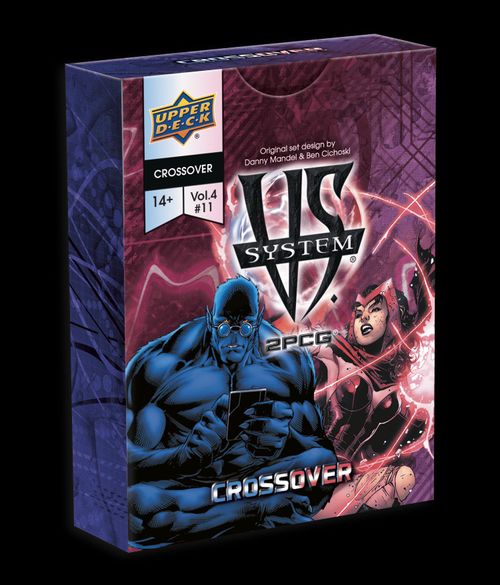
Vs. System 2PCG: Marvel Crossover Vol. 4, Issue 11
Vs. System 2PCG: Marvel Crossover Vol. 4, Issue 11 Rulebook
Table of Contents
Table of Contents
The Beyonder
The Beyonder requires two different out-of-game piles.
The first, his Creator pile, from his Creator of Battleworld power, will contain 5 Battleworld Domains. This pile is Variable (you choose the Domains) and Private (only you can look at it during the game). If the game is already in a Battleworld Domain when he uses this power, that one goes to its discard pile.
The second pile, his Power pile, from his Omnipotent power, will contain any 5 different Supporting Characters. These characters can be any Vs. System 2PCG cards: Photographic/Illustrated and any Property. This pile is Variable (you choose the characters) and Private (only you can look at it during the game). You will need to reveal the character you choose when you use it.
Spells and Spellcasters
Spells are Plot Twists introduced in the recent Mystic Arts Issue. They require a specific type of Spellcaster character on your side to pay a specific power symbol.
For example, Forget is an [yellow light-bulb icon] Spell. To play it, a Spellcaster on your side such as Baron Mordo must pay an [yellow light-bulb icon] power symbol. Other than the above requirement, Spells work just like any other Plot Twists.
Note: If a Spell is playable in combat, the Spellcaster who casts it does not have to be in combat.
Game Modes
This Issue contains more cards for the new game modes introduced in Crossover Volume 3. See that Issue and others for other cards for these additional ways to play! All players must agree to play with these modes before the game starts.
Egghead
An Evil card is any card with an Evil team affiliation. A list of Good and Evil teams can be found in the Complied Rulebook on upperdeck.com/op.
Scarlet Witch
Her Chaos pile contains 10 Terrain cards. This pile is Variable (you choose the Terrains - and you can choose cards from multiple Terrain sets) and Private (only you can look at it during the game). Place the Terrain just as if you were doing so at the start of the game. There is no limit to the amount of Terrain that can be in play.
Limbo (Battleworld Domain)
This Domain creates character tokens. A token character works just like a regular character except that if it ever gets put into a KO pile or otherwise leaves play, remove it from the game. We suggest you use face-down cards you aren't using.
Battleworld
Number of players: 2
Battleworld is a patchwork planet created by various cosmic entities over the years. There are always various lands, or Domains, on the planet. And there are five Battleworld Domain cards in this Issue.
Setup: Shuffle 12 random Battleworld Domains (or 5 if you only have the ones in this Issue) and place them face down in a pile between the players.
Rules: When a defending Main Character is wounded in combat, reveal the top Battleworld Domain. The game enters this Domain, meaning its effects are now applicable. The game will stay in that Domain until the next time a defending Main Character is wounded in combat, then the game will leave the current Battleworld Domain and enter the next one. (Put the older Domain into a discard pile next to the pile and reveal the top card of the pile to be the new Domain.)
The game can only be in one Domain at a time. If the Domain pile ever runs out, shuffle the discard pile, and make a new pile. Domains aren't "in play" and can't be affected by cards or effects.
Additional game modes that can be used with Battleworld: Story Mode, Terrain
Kingpin (Boss Battle)
Note that when he uses his Take Over the World power, it will trigger his Boss Battle effects for each Location that appears.
Angry Beasts (Terrain)
Besides being angry, the wolves are very smart, and good listeners. If there is a tie for the lowest DEF in his row, the player who placed the wolves chooses who to put the -1/-1 counters on.
Concealed Cave (Terrain)
This Terrain lets you hide characters. To do so, turn them face down, but ready. During their next Recovery Phase, turn them face up when you recover your stunned characters.
Inventions
If you have any characters that can create an Invention (inventors) in your deck, like Beast or Tony Stark in this Issue, you get a single Invention pile (even if you have multiple different inventors in your deck). This pile is Variable (it depends on which Inventions your inventors give you access to, and which of those Inventions you choose to include), and Private (only you can look at it during the game).
- The Invention pile gives you access to each Invention card without a team affiliation and each Invention card that shares a team affiliation with an inventor in your deck.
- You may include any number (including none) of each of these Inventions, up to their Invention number (the number in parentheses after Invention).
- Note that the Invention number is also the maximum number of Invention cards with that name that can be in a single Invention pile, even if you have more than one different Inventor who can create that particular Invention.
- When a character on your side creates an Invention, secretly choose an Invention card from your Invention pile that either has no team affiliation or that shares a team affiliation with the inventor and put it into your hand.
Boss Battle
Number of players: 3
This Issue contains three new Bosses to use in 2 vs. 1 games: Kingpin, Loki, and Magneto.
Setup: One player will play as the Boss. They choose one of the three Bosses in this Issue (or one of the six in previous Issues) as their Main Character. (They can play any Main Character with that name, from either the Photographic or Illustrated Universe.) They take the associated Boss Battle card as a reference and build their deck as normal. The other two players choose any Main Characters as normal (except they can't choose the Boss player's Main Character) and build their decks as normal.
Rules: Boss Battles use the normal game rules with the following changes:
- Playing as the Boss
- The Boss goes first. No players skip drawing cards during their first Draw Phase.
- When a Location appears on the Boss player's side, they get the related effect from its power symbol, as instructed on their Boss Battle card.
- The Boss player's characters can spread out their attacks against multiple enemy sides if they want.
- The Boss player only wins by KO'ing the other two players' Main Characters.
- When the last Main Character on a side is KO'd, all cards on that player's side (including their deck and discard pile) are immediately removed from the game. (This doesn't count as those cards getting KO'd.)
- Playing as the other two players
- These two players play as a team.
- During combat, each player (including players who don't have an attacker or defender in the combat) can play Plot Twists to influence the combat.
- They only win by KOing the Boss.
Additional game mode that can be used with a Boss Battle: Terrain
Option: For a truly gargantuan fight, two players can each choose a Boss and throw down in a Boss vs. Boss Battle!
All other rules from Boss Battle remain the same, except you will need to randomize the first player, who will skip drawing cards during their first Draw Phase.
Additional game modes that can be used with Boss vs. Boss: Battleworld, Story Mode, Terrain
Terrain
Number of players: 2-4
After including a City Terrain set in Crossover Volume 3, we added a second Terrain set in this Issue: the Forest.
Setup: Shuffle a set of 10 Terrain and place them face down in a pile. After players determine who goes first, but before they put their main characters into play, each player draws a Terrain card and looks at it. Then the first player places their Terrain, with the rest of the players following in turn order. (Each Terrain will tell you where it can placed, either in one of your rows or an enemy row. We suggest you turn it sideways in its row.) Then each player draws their hand and mulligans as normal.
Rules: Terrain either affects each character in a row or one or two characters in a row.
- If a Terrain affects an entire row, there is nothing else to do. Its modifiers apply to each character in that row this game.
- If a Terrain affects one or two characters, during each player's Formation Steps they can move the proper number of characters into or out of that Terrain. While a character is in a Terrain of this type, its modifiers apply to those characters.
- You can leave this type of Terrain empty: you aren't required to put characters in it.
- A character can't be in more than one Terrain of this type. (But it could be affected by a Terrain that affects an entire row and in one that affects only one character.)
New rules for the Forest Terrain:
- Some Forest Terrain are Secret. This means they get placed face down instead of face up. When you want to put characters in a Secret Terrain during your Formation Step, turn it face up and use it as normal.
- Forest Terrain are destructible (they have a number, marked with the red drop icon). A character can attack a destructible Terrain if it would normally be able to attack into that row. For example, it can attack an enemy player's back row Terrain if there are no characters in that player's front row. A character can also attack a destructible Terrain that is in its own row.
- When a character attacks a destructible Terrain, exhaust the attacker. Then immediately put a wound on the Terrain. That action is now concluded (players can't play Plot Twists, and the attacker doesn't "strike" the Terrain, etc.). If the destructible Terrain now has wounds equal to its number (red drop icon), put it in its pile's discard pile. If a Terrain pile ever runs out, shuffle the discard pile, and make a new pile.
Additional game modes that can be used with Terrain: Battleworld, Story Mode, Boss Battle, Boss vs. Boss
Option: For more strategic gameplay, players can draw two Terrain cards (or a larger number the players agree upon) during setup and choose the one they prefer.
Story Mode
Number of players: 2
In Story Mode, players will play through a series of three games (called Parts) with the same decks, gaining an advantage for each game they win. But Part 3 is winner-take-all! This Issue contains one new Story Mode: Altered Reality.
Setup: Choose a Story Mode card, either randomly or by consulting the "Story Complexity" list below.
Story Complexity (from least to most complex): Death of a Loved One, A Symbiote Story, Epic Quest, Altered Reality, Time Traveler, Galactic Game, Assassination Plot
We suggest you first try Story Mode with decks you have already built, but you might want to build decks especially for the Mode or for particular Stories after you've tried them a few times.
Rules: Player A always goes first in Part 1, then the winner of each Part goes first in the next Part. After each Part is over, simply follow the directions on the Story Mode card for whichever player wins.
Additional game modes that can be used with Story Mode: Battleworld, Terrain, Boss vs. Boss
Select Keywords
Some keywords aren't explained on their cards. Here are those keywords' definitions:
- Combat Master: While this character is in combat, enemy players can't play plot twists.
- Genius: At the start of your turn, draw a card.
- Hunter: This character has +3/+0 while attacking.
- Invade: While this character is attacking a back row character, that character can't strike this character.
- Swarm: You can have any number of this characters on your side. This power can't be turned off.