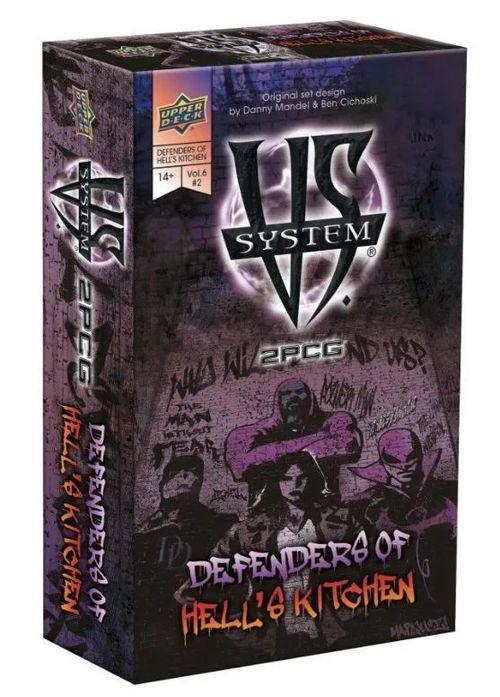
Vs. System 2PCG: Defenders of Hell's Kitchen
Vs. System 2PCG: Defenders of Hell's Kitchen Rulebook
Table of Contents
Table of Contents
- Game Contents
- Issues and Giant-Sized Issues
- Gameplay Overview
- The Card Types
- Basic Game Concepts
- Setting Up the Game
- Turn Sequence
- Combat
- Playing and Using Cards
- Ending the Game
- Building Your First Decks
- Seriously, You Can Stop Reading and Play!
- What's Next?
- Rules Reference
- Alternative Game Modes
- Turn Sequence (Quick Reference)
Game Contents
- 200 Cards
- Assorted Counters
- This Rulebook
Issues and Giant-Sized Issues
The Vs. System® 2PCG® releases with frequent expansions in the form of 55 card Issues, and Giant-Sized Issues which include 200 cards. Giant-Sized Issues serve as the perfect place to start with enough cards for new players to make multiple decks and an assortment of basic Locations.
Gameplay Overview
Each player starts with a Main Character, such as Luke Cage or Taskmaster. During the game, you'll play resources and recruit Supporting Characters like She Hulk or Bullseye. You'll organize your characters into a formation with your front row characters protecting back row characters. You'll make solo and team attacks against your enemies in order to stun and KO them. You'll play Plot Twists to enhance your team or hurt your opponent's. You'll play Locations your characters can use for their Super Powers. Your Main Character will earn Experience Points and Level Up to dominate the battlefield. Finally, you'll KO your opponent's Main Character (or they'll KO yours).
Don't worry, we'll walk you through all of this. First let's go over the different card types in Vs. System® 2PCG®.
The Card Types
Here is a brief introduction to the different types of cards. Don't stress the details, we'll get into those later. For now, just try to be able to recognize the different types of cards.
Main Characters
You start the game with a Level 1 Main Character. When it Levels Up during the game, you'll switch it with its Level 2 Version.
Supporting Characters
During your turn, you can recruit Supporting Characters into your front or back row.
Main Characters and Supporting Characters work the same way. They can attack, defend, get stunned, and take wounds. The only exception is some cards specifically refer to Main Characters or Supporting Characters.
Plot Twists
During your turn you can play Plot Twists from your hand that stir things up on the battlefield. Plot Twists always say when during the turn you can play them. You can only play a Plot Twist if you have a face-up character with the matching team affiliation.
Equipment
During your turn, you can put Equipment cards onto your characters to give them a little more kick. Equipment cards have a cost just like characters. You can only play an Equipment card if you have a face-up character with the matching team affiliation.
Locations
During your turn, you can play one Location to your resource row. Most Locations have a power symbol. During the game, you can turn a Location with a power symbol face down to pay for a Super Power that requires that symbol. You may also discard a Location from your hand to generate that power symbol.
There are two types of Locations: Basic Locations and Special Locations. Here are a couple of Basic Locations, which provide a single power symbol when used.
There are six power symbols: Energy, Intellect, Might, Skill, Alien, and Humanity. Alien and Humanity don't appear in this Issue.
Each team also has a Special Location which grants different power symbols that team uses. A Special Location's "Wild" power symbol can be used to produce your choice of several different power symbols, but only for a member of that team (see Locations in the Rules Reference). Some Special Locations show multiple power symbols on the card.
If an effect refers to a specific power symbol location this includes any basic or special location that can produce that power symbol. For example, "a Might location" would include any basic location or special location that can produce a Might symbol. Some Special Locations do other things as well. Check out previous Issues for some examples!
Now let's introduce some game concepts that will be discussed in more depth later.
Basic Game Concepts
- Deck: Your deck must include exactly 60 cards, not including your Main Character or any cards that start outside the game.
- Hand: You start the game with seven cards and draw two cards each turn. There is no limit to the number of cards you can have in your hand at one time. If an effect tells you to discard a card, that means from your hand.
- Level Up Zone: This is where players put the higher level versions of their starting Main Characters that they will level up into with enough experience (XP).
- KO Pile: When a card gets KO'd or discarded, it goes into your KO pile next to your deck. The KO pile is face up, and any player can look through it at any time. The order of your KO pile does not matter.
- Three Rows: Each player has three rows: front row, back row, and resource row.
- Each turn you may place a Location face up or another card from your hand face down into your resource row. Resources give you recruit points each turn which you'll use to play your Supporting Characters and Equipment.
- When you recruit a character, it can go into your front row or back row. Characters in your front row are your melee fighters. They also protect characters in your back row. Characters in your back row are safer, but they can only attack if they have the Ranged [crosshair icon].
- Cards in any of your three rows are considered "on your side".
- Ready/Exhausted: A card in play is either ready (upright) or exhausted (turned sideways). Only ready characters can attack. Cards appear on your side ready.
- Stun: When a character is defeated in combat, or if its DEF is ever reduced to 0, it becomes stunned. Turn it face down, exhaust it, remove all +1/+1 and -1/-1 counters from it, KO any Equipment on it, and put a wound counter on it. Stunned characters can't be attacked, and they lose their powers until they recover. Some effects can cause a character to become directly stunned (without it being in combat).
- KO: When a character has at least as many wounds as its health, it's KO'd. (Put it into the KO pile.)
- Recover: When a character recovers from being stunned, turn it face up but leave it exhausted. It keeps its wounds.
Setting Up the Game
Next up, how to set up and start a game of Vs. System® 2PCG®:
1: Decks and Counters
- Each player will have a deck that has one Main Character and exactly 60 game cards.
- See pages 22-23 for which cards to include in your first deck.
- Put the wound, XP, +1/+1, and -1/-1 counters nearby.
2: Reveal Starting Main Characters
- Players reveal their Main Character simultaneously.
3: Determine Who Goes First
- Randomly choose a player. That player then chooses who will be the first player this game.
- Turns will proceed clockwise from the first player.
4: Put Main Characters into Play
- Starting with the first player, then continuing clockwise, each player puts their Level 1 Main Character into either their front or back row. Then they place all the Level 2 and higher (if used) versions in their Level Up Zone where all players can see them.
- A player's Level Up Zone should be on the table directly above their deck, next to where their front row will be.
5: Draw Opening Hand and Optional Mulligan
- Each player shuffles their deck and draws seven cards.
- Starting with the first player, then continuing clockwise, each player may mulligan one time if they don't like their hand.
- To mulligan, shuffle your hand into your deck, then draw seven new cards. You must keep this second hand.
- It's usually a good idea to mulligan if you don't have any Locations or any Supporting Characters that you can play in the first few turns.
- Each player places their deck on the table next to where their back row will be.
After step 5, the game starts. The first player takes the first turn of the game.
Turn Sequence
Each turn has four phases played in order. Some phases or parts of phases are "automatic", meaning they just happen whether you want them to or not. Others are "optional", meaning you choose if you want to do anything in them.
1. Draw Phase (Automatic)
During this phase, any "At the start of your turn" effects take place. Then you draw two cards. (If you're the first player and this is the first turn of the game, you don't draw any cards.)
2. Recovery Phase (Automatic)
During this phase, if you have any stunned characters, they all recover. Then you turn each hidden character (see page 32 for more information) on your side face up. Then you ready all your characters.
3. Build Phase
During this phase, perform the following three steps in order. Anytime during these steps, even before any of them, or after all of them, you can play Build Plot Twists, and characters on your side can use their Build Super Powers.
Resource Step (Optional)
You may choose any one card in your hand and place it face down into your resource row. (It is now a resource.) If you play a Location as a resource, you may place it face up. (It's still a resource.) Locations are not unique; you can have more than one with the same name. (See Uniqueness on page 36.)
Recruit Step
You now gain 1 recruit point for each resource you have, regardless if the resource is face up or face down. (Automatic)
You can spend any or all of your recruit points to play Supporting Characters and Equipment from your hand. (Optional)
When you play a character, put it into your front row or back row. When you play an Equipment, put it onto one of your face-up characters. We suggest you place the Equipment card partially beneath the character card you're equipping it to.
Note: You lose any leftover recruit points after this step.
Example: During Angela's Resource Step, she plays a Training Ground Location face up as a resource. She now has four resources, so during her Recruit Step she gains 4 recruit points. She spends them to play Iron Fist (who costs 1) into her back row and Hellcat (who costs 2) into her front row. She has 1 recruit point remaining but nothing to spend it on, so it goes away.
Formation Step (Optional)
You can now rearrange any or all of your characters between your front and back rows. Any character (including your Main Character) can go into either row.
In most cases it doesn't matter if a character is to the left or right of another character. However, it matters a lot who's in the front and who's in the back.
4. Main Phase (Optional)
This is the longest phase of the turn. During this phase, you can make any number of attacks, one at a time, until you choose to stop attacking or all your characters are exhausted.
Your front row characters can make melee attacks.
Your back row characters that have the Ranged [crosshair icon] can make ranged attacks.
Note: You can put a Ranged [crosshair icon] character in your front row but it can only make melee attacks from there.
Anytime you're not attacking in this phase, even before you make any attacks, you can play Main Plot Twists and characters on your side can use their Main Super Powers.
Combat
Making a Melee Attack
Starting a Combat
- Exhaust one of your face-up and ready front row characters to become the attacker and choose a face-up front row enemy character to become the defender.
- If an opponent has no face-up front row characters, your character can attack one of their face-up back row characters.
During Combat
- Once combat has begun you, as the attacking player, can do one of the following:
- Play a "Combat" Plot Twist (see page 20)
- Have a character use a "Combat" Super Power (see page 18)
- Power Up a character (see page 19)
- Pass
- Then your opponent can do the same. Then you go again, then they go, until both of you pass in a row. (If one player passes but the other player takes an action, that first player can then take an action.) When a player takes an action, it resolves immediately before the next player has a chance to take their own action.
- Finally, resolve the combat.
Resolving Combat
- To resolve the combat, the attacker now "strikes" the defender, and the defender simultaneously "strikes" the attacker.
- Compare the attacker's ATK to the defender's DEF. If the ATK is greater than or equal to the DEF, the defender will be stunned. At the same time, compare the defender's ATK to the attacker's DEF. If the ATK is greater than or equal to the DEF, the attacker will be stunned.
- So, there are four possible results to a combat: No one gets stunned, the attacker gets stunned, the defender gets stunned, or both characters get stunned.
- When a character becomes stunned, turn it face down, exhaust it, remove all +1/+1 and -1/-1 counters from it and put a wound counter on it. You also KO any Equipment on it.
Making a Ranged Attack
Ranged attacks work the same way as melee attacks with the following exceptions:
- You choose one of your back row characters with Ranged [crosshair icon] to be the attacker.
- The defender only gets to strike if it also has Ranged [crosshair icon].
Note: If your character attacks from the front row, it is always a melee attack whether or not your character has Ranged [crosshair icon].
Flight
Flight [wing icon] allows a character to ignore face-up front row characters that don't have Flight [wing icon].
- Characters that have Flight [wing icon] may fly over an enemy front row to melee attack enemy back row characters unless there is a character with Flight [wing icon] in that enemy front row.
Ranged and Flight
- If your character has Ranged [crosshair icon] and Flight [wing icon], it can attack from your back row and fly over an enemy front row (if there are no characters with Flight [wing icon] in that enemy front row) to attack enemy back row characters. This counts as a ranged attack so the defender will still only strike if it has Ranged [crosshair icon].
Team Attacks
When one character attacks, it is a solo attack. Two or more characters that have the same team affiliation, are in the same row, and can both attack from that row can make a team attack against a single defender. Team attacks work just like solo attacks with the following exceptions:
- Choose two or more front row characters to make a melee team attack.
- Choose two or more back row characters that have Ranged [crosshair icon] to make a ranged team attack. (Just like in a regular ranged attack, the defender gets to strike only if it has Ranged [crosshair icon].)
- In both cases, if all of your attackers have Flight [wing icon], they can fly over an enemy front row to attack enemy back row characters (unless the enemy front row has a Flight [wing icon] character).
Resolving a team attack works like this:
- Add up the ATK of all your attackers and compare the total to the defender's DEF to see if the defender will get stunned.
- The defender (if it can strike) then chooses an attacker to strike and compares the defender's ATK to that character's DEF to see if it will get stunned.
Example: Let's say three different 2/2 (2 ATK/2 DEF) characters melee team attack a 6/6 (6 ATK/6 DEF) defender. When the combat resolves, the attacker's total ATK is 6 which is enough to stun the defender (who has a DEF of 6). The defender picks one of the 2/2s to strike, compares its 6 ATK to the attacker's 2 DEF and stuns it. The other two 2/2 attackers survive the combat.
After Each Combat
After each combat resolves, you can make another attack, play a Main Plot Twist, or have a character use a Main Super Power. Otherwise, end your turn.
Ending the Turn
Once you're done attacking, playing Plot Twists, and using Super Powers, and you're ready to be done with your Main Phase, your turn ends. Resolve any "At the end of your turn" effects, and then the next player gets to take a turn.
Playing and Using Cards
Playing cards and using them are what Vs. System® 2PCG® is all about. Here are some more details about how and when to play and use different card types.
Locations
During the Resource Step of your Build Phase, you may play a Location from your hand to your resource row. Locations are mostly used by characters to pay for Super Powers. If a Location has a team affiliation, it can only be used by a character with that team affiliation.
Some Special Locations have special effects. Just follow the instructions on them to use them.
Characters
There are two types of characters in the game: Main Characters and Supporting Characters. You will start the game with a Main Character. If your Main Character is KO'd, you lose the game.
You can play Supporting Character cards during your Recruit Step by spending recruit points equal to the character's cost. When you play one, put it into your front row or back row.
Characters are Unique unless they have Swarm. (See Uniqueness on page 36.)
Character Powers
Characters on your side will make attacks and use their powers. Most characters have one or more "powers". There are three types of powers characters can have: Keyword Powers, Super Powers, and Level Up Powers.
Note: While a character is stunned, all their powers are turned off until they recover.
Keyword Powers
Keywords are powers with a name in bold, that often show up on more than one character. When a character has a Keyword Power, just follow the instructions in its text.
Flight and Ranged are the two most common Keyword Powers. They aren't represented by text though. They're represented by the Flight [wing icon] and Ranged [crosshair icon] instead.
Super Powers
Most Main Characters and some Supporting Characters have Super Powers. They look like this: a name, then the cost to use the Power (shown as power symbols), then the effect. The words "Main", "Combat", "Draw", "Recovery", and "Build" tell you when the Power can be used.
Each Super Power has a different name and a different effect. Unless otherwise noted, characters on your side can only use their Super Powers on your turn. The words "Draw", "Recovery", "Build", "Main", and "Combat" tell you when they can be used.
"Draw", "Recovery" and "Build" Super Powers can be used any time in those phases.
Characters can only use their "Main" Super Powers during your Main Phase while there is no combat going on.
Characters can only use their "Combat" Super Powers while they are in combat.
A few characters have "Any Combat" Super Powers, which they can use during any combat, even if they're not in it.
Characters on your side can normally only use their Super Powers during your turn. However, if the Super Power has the Any Turn symbol, they can use that power during any player's turn (including yours).
Note: The Any Turn symbol will only be found on Combat and Any Combat Super Powers.
Each Super Power has a cost of at least one power symbol. To use a Super Power, the character must pay for it by turning one of your Locations with that symbol face down OR by discarding a Location with that symbol from your hand. Some Super Powers require more than one power symbol. Characters must pay for all of them by turning matching Locations face down or discarding them from your hand, or a combination of both.
Example: You want Kingpin to use his Criminal Mastermind Super Power, so you turn an Academy in your resource row face down to pay the Intellect cost. You could have also discarded an Academy (or a Fisk Tower Special Location) from your hand to generate the Intellect.
Characters on your side can use any number of different Super Powers each turn, if they can pay for them. However, a character can't use the same Super Power more than once each turn. (If multiple characters have the same power, they can each use it once in the same turn.)
Check for Reaction Powers
Some Super Powers are "Reactions" which trigger when a certain condition is met. When that happens, the character can pay the listed cost, and if they do, the effect occurs.
A Reaction Super Power can trigger on any player's turn, and some can even interrupt an effect in order to cancel or change what it does.
Level Up Powers
Most Main Characters have a Level Up Power. These powers represent the character gaining experience (XP), and allow them to become more powerful.
Example card shown in the rulebook: Daredevil, Level 1 Main Character, has the Level Up power "I Get to Save the World – Level Up (4) - When Daredevil makes a melee attack, he gains 1 XP."
Other Level Up examples shown in the rulebook: Jessica Jones, Level 1 Main Character, has "Taking Out My Anger – Level Up (10) - When Jessica strikes or gets struck, she gains 1 XP." Kingpin has "Chairman of the Board – Level Up (2) - At the end of your turn, if you have exactly two face-up supporting characters on your side, Kingpin gains 1 XP."
Gaining XP and Leveling Up
When you meet the XP condition, put an XP counter on the next Level of your Main Character in your Level Up Zone. Once you have XP equal to the number next to "Level Up", remove the XP counters from the next Level of your Main Character and replace the current version of your character with its next Level version.
The new version of the Main Character is the same character, just more powerful. As such, it will retain the same orientation as the previous version (ready/exhausted and face-up/face-down). Put each wound, +1/+1 or -1/-1 counter, and Equipment that was on the previous version onto the new version.
Powering Up
Supporting Characters can be used another way while in your hand: to Power Up a character on your side.
If you have a card in your hand with the same name as a Main or Supporting Character on your side, you may discard it to Power Up that character: put a +1/+1 counter on the Powered-Up character. You can Power Up a character either as a Main action or as a Combat action.
Example: You attack with your Main Character, Daredevil. During combat, you decide to Power Up Daredevil, so you discard a Daredevil Supporting Character from your hand and put a +1/+1 counter on your Daredevil Main Character.
Equipment
You can play Equipment cards during your Recruit Step by spending recruit points equal to the Equipment's cost. Equip the Equipment onto any face-up character on your side. The character now has access to the Equipment's powers.
The Equipment will stay equipped to that character until the character turns face down (either by being stunned or hidden) or leaves play. At that point, the Equipment gets KO'd.
A character can only have one Equipment at a time. If you play a new Equipment on a character that already has one, the older Equipment gets KO'd.
If an Equipment has a team affiliation symbol, you may only play it if you have a face-up character with that team affiliation symbol on your side (including your Main Character). However, you can equip it to any character on your side.
Equipment is not Unique unless it says otherwise. (See Uniqueness on page 36.)
Plot Twists
When you play a Plot Twist, follow its instructions, and then put it into your KO pile.
Each Plot Twist will say when you're allowed to play it. If it says "Draw", "Recovery" or "Build", then you can only play it during that Phase. (You can play it before or after any part of those phases.) If it says "Main", then you can only play it during your Main Phase while there isn't a combat going on. If it says "Combat", then you can only play it during a combat on your turn. But if the word "Combat" has the Any Turn symbol next to it, then you can play it during a combat on any player's turn.
Unless it says otherwise, you can only use a "Combat" Plot Twist to affect a character in the combat.
If a Plot Twist has two different times you can play it, you can play it at either of those times.
If a Plot Twist has a team affiliation symbol, you may only play it if you have a face-up character with that team affiliation symbol on your side (including your Main Character). However, you can use it to affect any character regardless of team affiliation symbol.
If a Plot Twist has two team symbols separated by a slash, you may play it if you have a face-up character with EITHER of those teams on your side.
Ending the Game
The game ends when you KO your opponent's Main Character or they KO yours. If the final two Main Characters are KO'd at the same time (either because they're in combat with each other or through some card effect), the player whose turn it is wins the game.
In a 3 or 4 player game, the game ends when only one Main Character is left. When a Main Character gets KO'd, remove all cards that player owns from the game.
Building Your First Decks
For your first few games, we recommend building the following decks:
Daredevil (Main Character)
Supporting Characters (34)
- 3 Colleen Wing
- 3 Iron Fist
- 2 Hellcat
- 3 Nighthawk
- 3 White Tiger
- 2 Echo
- 2 Jessica Jones
- 2 Luke Cage
- 1 Black Cat
- 1 Jake Lockley
- 1 Moon Knight
- 1 Mr. Knight
- 1 Steven Grant
- 1 Taskmaster
- 2 Doctor Strange
- 2 Elektra
- 2 Hulk
- 2 She-Hulk
Equipment (1)
- 1 Evidence
Plot Twists (8)
- 3 Defender
- 2 Make a Plan
- 3 Street Smart
Locations (17)
- 4 School for Gifted Youngsters
- 3 Academy
- 3 Fortress
- 3 Laboratory
- 3 Training Ground
- 1 Richmond Riding Academy
Kingpin (Main Character)
Supporting Characters (34)
- 3 Diamond Back
- 3 Hammerhead
- 3 Crossbones
- 2 Shocker
- 3 Nuke
- 2 Echo
- 1 Black Cat
- 2 Fixer
- 4 Mary Walker
- 3 Tombstone
- 1 Taskmaster
- 2 Bullseye
- 1 Elektra
- 1 The Hood
- 3 Purple Man
Equipment (1)
- 1 Contract
Plot Twists (8)
- 3 Street Fight
- 2 Disrupt the Plan
- 3 Underworld
Locations (17)
- 3 Academy
- 4 Asteroid M
- 3 Fortress
- 3 Laboratory
- 3 Training Ground
- 1 The Streets
Seriously, You Can Stop Reading and Play!
You don't need to read the rest of this rulebook right now. Just keep in mind the Golden Rules:
- Whenever a card contradicts a rule in this Rulebook, the card is correct.
- If one effect says you can do something and another says you can't do something, "can't" beats "can".
In case you can't help yourself, here's what follows:
- What's Next? Check out this section after a few games with the decks we've listed. It will tell you how best to switch up Main Characters, the deck building rules (including the two "Universes" in the game), and even tips for building your own deck.
- Specific Card Clarifications We want to make sure you know how to play these cards correctly. But there isn't always room for every detail on the cards themselves. Here's where you'll find more details about these cards and keyword powers that aren't explained on cards.
- Rules Reference An alphabetical reference for when you need to know more or refresh your memory about parts of the game.
- Alternative Game Modes Simple rules for how to play with 3 or 4 players.
Check these sections out as needed. But for now, have fun with your first decks!
What's Next?
Switching Main Characters
You can use any Main Characters with the suggested decks, but some are easier to use than others when you're learning the game. After your first few games with the above decks, next try using a different Main Character from the same team. We recommend experimenting with the Easy Main Characters, then the Medium Main Characters, then the Hard Main Characters.
- Easy: Elektra, Jessica Jones
- Medium: Bullseye, Iron Fist
- Hard: Moon Knight, Taskmaster
Note: When you switch Main Characters, you may also want to swap any Supporting Characters with the same names. For example, if you switch your Main Character from Daredevil to Iron Fist, you may want to remove the Iron Fist Supporting Characters from your deck and replace them with Daredevil Supporting Characters.
Specific Card Clarifications
Black Cat
Not Your Lucky Day works like this. When an enemy player would draw any number of cards (including their usual two during their Draw Phase), you may first pay an Intellect power symbol. If you do, they reveal the cards that they draw and then you can choose to have them shuffle them back into their deck. If you do, they then draw the same number of cards minus 1.
Diamondback
Throwing Knives causes Diamondback to strike each front row enemy character separately using her full ATK against each one.
Elektra
Twin Sais causes Elektra to instantly strike the defender twice at the same time in the middle of combat. To do this, double Elektra's ATK and if it's greater than or equal to the defender's DEF the defender gets stunned. If Twin Sais doesn't stun the defender, Elektra will still also strike normally when the combat resolves. This strike is treated separately from the Twin Sais strikes, so it will be compared on its own to the defender's DEF as normal.
Evidence
Since Evidence appears exhausted, you must wait a turn (and have it still be in play) for it to ready.
If you move an enemy supporting character to your side and hide it, it will remain there "imprisoned" for the rest of the game unless an effect causes it to leave play.
The "imprisoned" supporting character CAN get stunned. In this case wound it and exhaust it (like any other stunned character). However, during your Recovery Phase it will remain stunned since it's not allowed to turn face up.
Iron Fist
For Chi counters, you can use anything (we suggest using extra XP counters). Note: Iron Fist's power says that these Chi counters won't get removed when he gets stunned or hides.
Make a Plan
This Plot Twist avoids enemy effects that say your character can't strike AND effects on an enemy character that say it can't be struck. For example, Hammerhead's Head First says he can't be struck while melee attacking. But if Make a Plan were played on the defender, it would be able to strike him.
Note: Make a Plan does not allow a character without Ranged [crosshair icon] to strike against a ranged attacker.
Moon Knight (Main Character)
When you make a Moon Knight deck you also must bring a Personality out-of-game pile. This pile is Public (any player can look at it) and Fixed (it always includes the three main characters with Alternate Personality: Jake Lockley, Mr. Knight, and Steven Grant).
When one of these main characters uses his super power, he transforms into one of his other personalities: Randomly select one of the three characters in your Personality pile and switch it with the character that is currently in play. The new card goes into the same place as the old card was (same row, next to the same other characters) and with the same orientation (ready/exhausted; face up/face down). Note: This does NOT count as the new card "appearing."
Put any counters or equipment that were on the old card onto the new card. If any modifiers (such as Freeze) were affecting the old card, they are now affecting the new card.
Put the old card into your Personality pile. It can now be randomly selected when the new card needs to transform.
Note: The new card CAN use its super power the same turn it was transformed into. This will cause it to transform again. However, if for example Steven randomly transforms into Jake, and then Jake randomly transforms back into Steven, Steven won't be able to use his own super power a second time on the same turn.
Pact With Khonshu takes effect at the start of the game and will last the whole game, even if Moon Knight loses his powers or is not currently in play. It will cause Jake, Steven, or Mr. Knight to transform into Moon Knight one last time. From that point on, Moon Knight can't transform any more so if he uses The Fist of Khonshu ignore the transform part.
Moon Knight (Supporting Character)
Moon Knight, Jake Lockley, Steven Grant, and Mr. Knight all have Integrated Personalities. While one of them is in combat, any time you could take an action (such as playing a Plot Twist, using a super power, or powering up a character), you can transform him into a different card with Integrated Personalities in your hand. This follows the same transform rules explained above.
Note: Integrated Personalities says it can't be used more than once each combat. In other words, you can't switch (for example) Moon Knight with Jake Lockley and then switch Jake with someone else all in the same combat. (You can use Integrated Personalities again in a later combat though.)
Nuke
Adrenaline Pills will not ready Nuke if he gets stunned during the combat.
One of a Kind
If a card has One of a Kind, you can only put one copy of that card in your deck.
Starting Main Character Required
Some cards have Starting Main Character Required for a specific team. This means you can only include the card in your deck if a Main Character you start the game with has the listed team.
Super Strength
Several characters have the new keyword power Super Strength. While in melee combat, if an effect would put any number of +1/+1 counters on the character, put twice that many on them instead. And if an effect would increase their ATK and/or DEF double that increase as well. For example, if a Plot Twist would give a normal character +3/+0 it would give them +6/+0 instead.
Note: If a character with Super Strength has -1/-1 counters and you need to add +1/+1 counters to them, add the (doubled) counters first, then remove one of each type until only one type remains.
If a character somehow gets multiple instances of Super Strength, the counters and ATK/DEF increases it gets will be doubled and then doubled again and so on. So if it somehow has three instances of Super Strength and then an effect puts a +1/+1 counter on it, it would end up with eight +1/+1 counters (1x2x2x2).
White Tiger
Amulets of Power prevents White Tiger from gaining -1/-1 counters or having her +1/+1 counters removed. However, once she gets turned face down her +1/+1 counters will be removed normally.
Building Your Own Decks
After you've played several games with these deck lists, you're ready to step into a larger world: building your own deck! You can build your own deck from this Issue, or you can get some other Issues to add in!
Deck Building Rules
- Your deck must include a Main Character and exactly 60 cards. Your Main Character doesn't count toward your mandatory 60 cards, and you can't put additional main characters into your 60 card deck.
- You can only have up to four copies of any one card in your deck.
- Exception: Some Basic Locations have the same type (the same power symbol) but different names. You can't include Basic Locations of the same type but different names in the same deck. So if you want any Laboratories in your deck, you can't include other Basic Locations of the same type.
- You can build either an Illustrated deck or a Photographic deck, but you can't mix cards between them. (See "Two Universes" in the next section.)
- Cards in this Issue are considered to be in the Illustrated Universe.
- You can put any Supporting Characters, Plot Twists, Equipment, and Locations in your deck. Just remember the following:
- Characters can only team attack if they share a team affiliation (on the top right of the card).
- If a Location has a team affiliation, it can only be used for a Super Power for a member of that team.
- If an Equipment or Plot Twist has a team affiliation, it can only be played if you have a face-up member of that team.
Two Universes
The Vs. System® 2PCG® is split into two Universes based on the style of card art:
The Illustrated Universe includes cards with drawn or painted artwork. (Most cards, including the cards in this Issue, belong to this Universe.)
The Photographic Universe includes cards with images from movies or TV shows. (This Universe boasts several different licensed properties from popular movies and TV shows thus far.)
When you build a deck, you can't mix together cards (including your Main Character) from the Illustrated Universe with cards from the Photographic Universe. However, you can play decks from one Universe against the other.
The two Universes only affect deck building. Once the game starts, it doesn't affect anything. For example, if you have an Illustrated deck, it's perfectly fine to play an effect that moves an opponent's Photographic character to your side.
Deck Building Tips
Getting Started
Building a deck can be intimidating. There are so many cards! Where do you start?
Well, in Vs. System® 2PCG® it all starts with your Main Character. It can be your favorite character, or a card with powers that look fun to you.
Now we just need 60 cards!
How Many of Each Card Do I Include?
Each deck and player is different. Some decks and players want a lot of Plot Twists. Some want to make sure they always have a Location to drop in their resource row each turn. Rest assured, you will change whatever ratios you first choose as you learn about your deck. There are a lot of other factors that might affect these numbers: your Main Character's Level Up power, the number of Super Powers you want to use, etc. Suffice it to say that these ranges are very general.
Supporting Characters (24-32)
First, you'll need to determine the teams you want to use. Team attacking can be particularly important in Vs. System® 2PCG®, so first consider which Supporting Characters from your Main Character's team you want to include. You can stick to just one team in your deck (this is called a "Loyalty" deck). These decks have access to some immensely powerful effects from other Issues but have a small card pool to choose from.
But if you want to branch out to other teams, determine if you want to include another team in a big way (they will all be able to team attack with each other as well) or just go with the "good characters at each cost" plan. Or something in between.
The most important thing for the most important card type in your deck is to get what we call their "curve" correct. Line up the Supporting Characters you want to use by cost, starting with 1. You want to make sure you have at least several cards at each cost. And you want enough cheap Supporting Characters that you get off to a good start, but not so many that you'll draw them later in the game when you don't want them. For expensive Supporting Characters, you don't need as many because by the time you get to 6 and 7 resources, you'll have drawn a bunch of cards, but you still need enough to make sure you can play big characters near the end of the game. For the mid-cost Supporting Characters, you'll want to find a happy medium.
Locations (12-20)
You usually want 4 of your Main Character's team's Special Location and 4 each of the Basic Locations your Main Character can use. After that, check your Supporting Characters' Super Powers and go from there.
Plot Twists (8-16)
This depends on your play style, but also on how you plan on winning, because Plot Twists can do a lot of different things. The most basic are Combat Plot Twists that will help you win fights. Maybe you need to make sure your Main Character gets some stuns while they're attacking. Or maybe you need your Main Character to survive so you can get to later turns. Most players like to have a few Combat tricks up their sleeves. But if neither thing is that important to your deck's strategy, you might want more Main Plot Twists, which have a lot more variety: drawing cards, placing -1/-1 or +1/+1 counters, etc.
Equipment (0-8)
There isn't any Equipment in this Issue, but the upcoming X-Force Issue will have Equipment. Equipment is the card type with the least total amount of cards, but some of these cards can have the greatest impact on the game. Remember though, that Equipment gets KO'd when its bearer gets stunned, so have a plan for that: Ranged [crosshair icon] characters, who can be protected in your back row and still attack, characters with high DEF, or characters who are hard to strike in other ways are more likely to survive and keep your equipment around for longer.
Rules Reference
+1/+1 and -1/-1 (Counters): Many effects put +1/+1 or -1/-1 counters on characters. These numbers alter a character's ATK and DEF until something removes the counters.
If a character ever has +1/+1 and -1/-1 counters at the same time, they cancel out. Remove one of each until the character only has one type.
If an effect gives a character "+1/+1" or "-1/-1" but it doesn't say "counter" then that effect is temporary: you don't add counters to the character.
AKA: Some characters have AKA and another name in their text box. This means that they count as having both names. This counts for uniqueness and Powering Up characters.
AKA is not a power and so it can't be copied or turned off by things that affect powers.
Any Turn Symbol: If a Plot Twist or Super Power has this symbol, you can play it, or a character can use it on another player's turn (as well as your turn).
Appears: When a card enters play it "appears" whether you recruited it from your hand, or another effect put it into play. If a card changes sides or turns face up, that does not count as "appearing."
ATK/DEF: The ATK and DEF numbers printed on a character. During combat you compare your character's ATK to its enemy's DEF to see if you stun it.
Base ATK and DEF: Some effects refer to a character's Base ATK and DEF. This means a character's stats before any effects or counters modify them. A character's Base ATK and DEF are usually the same as their printed ATK and DEF. The only difference is that some effects might temporarily change a character's Base stats.
Cancel: If an effect cancels the current combat, the combat ends but no characters get stunned. Leave all the attackers and defenders as is. They don't ready. If an effect cancels a Plot Twist, discard the Plot Twist without resolving its effects. If an effect cancels a Super Power, don't resolve its effects. Locations turned face down or discarded to pay for the Super Power are not turned face up or returned to hand.
Daze: An effect that stuns a character without the character gaining a wound. It works like the character getting stunned in all ways except for adding a wound counter.
Discard: Taking a card from your hand and putting it into your KO pile.
Enemy: This applies to anything opposing you. An enemy player is your opponent. An enemy character is one on your opponent's side.
Enters combat: A character enters combat when they become an attacker or a defender.
Golden Rules: Whenever a card contradicts a rule in this Rulebook, the card is correct. And if one effect says you can do something and another says you can't do something, "can't" beats "can".
Good and Evil: Some effects refer to Good and Evil characters. A Good character is anyone on a Good team, and an Evil character is anyone on an Evil team. The Defenders team is a Good team and the Underworld team is an Evil team. If a character is on a Good team and an Evil team, it is both Good and Evil.
Note: the PDF's text layer drops the team names where the team icons sit in this sentence. They are supplied here from the set's own introduction ("the Good Defenders" and "the Evil Underworld") and the Team Affiliation icons on the cards.
Health (Maximum and Remaining): A character's maximum health is its printed health and any modifiers that increase or decrease it, like vitality counters. A character's remaining health is its maximum health minus any wounds on it.
Hidden/Hide: When a character hides, turn it face down but ready. Remove any +1/+1 or -1/-1 counters and Equipment from it. A hidden character can't attack or defend, doesn't protect anyone behind it, and loses its powers. It keeps its other information like name and team affiliation. Hidden characters do not satisfy team affiliation requirements for Plot Twists or Equipment while face-down.
Keyword Power: A power on a character in bold text. Just follow the instructions on the card. Flight and Range count as Keyword Powers even though they're represented by icons (Flight [wing icon] and Ranged [crosshair icon]).
KO: To put a card from play into its owner's KO pile. When a character has wounds equal to or greater than its health, it gets KO'd.
Locations: You may use a Location (by turning it face down in your resource row or discarding it from your hand) to pay for a Super Power. But you may not use the same Location card to pay for multiple Super Powers. Each Super Power must be paid for separately.
Once a Location turns face down, it will stay face down unless an effect turns it face up.
There are two types of Locations: Basic Locations and Special Locations. There are six Basic Location types, one for each of the six power symbols. Also, most teams have a Special Location that has a team affiliation symbol on the top right of the card. These Locations can produce your choice of several different power symbols, but only for a member of that team. There are also other Special Locations with other effects beside producing power symbols for Super Powers.
Note: Only four of the six Basic Location types are in this Giant-Sized Issue.
In different Issues (like comic or space adventure), Basic Locations may have different names. However, they still count as being the same Basic Location type (for example, two Basic Locations that each produce the same single power symbol). Your deck can include up to four copies of each of these Basic Location types, and all copies of it must have the same name.
Melee Combat: A combat that involves front row attackers.
On Your Side: The cards you have in play are "on your side." You control these cards. If a card gets moved to your side, you now control that card.
Owner: During the game you "own" your Main Character and all the cards that started in your deck. (This only matters if a card references "owner.")
Power Up: If you have a card in your hand with the same name as a Main or Supporting Character on your side, you may discard it to Power Up that character. Put a +1/+1 counter on the Powered-Up character. You can Power Up a character either as a Main action or as a Combat action.
Protect: A face-up character in a player's front row "protects" face-up characters behind it.
A face-up character in a player's back row is "protected" if there is at least one face-up character in that player's front row.
A protected character can't normally be attacked.
Ranged Combat: A combat that involves back row attackers that have Ranged [crosshair icon]. In a ranged attack, the defender can't strike back unless it has Ranged [crosshair icon].
Ready/Exhausted: A face-up character is either Ready (upright) or Exhausted (sideways). Only ready characters can attack. If an effect readies a character that is already ready, or exhausts a character that is already exhausted, just ignore that part of that effect (but do the rest of it).
Reaction: A type of Super Power that triggers when a certain condition is met. This could happen on any player's turn.
Recover: Your stunned characters automatically recover during your Recovery Phase. Some card effects can also recover a character. When a character recovers, turn it face up, but leave it exhausted.
Note: Recovering a character does not heal any wounds from it.
Remove from the Game: Some effects say to remove a card from the game. When this happens, set it aside out of play (not in a KO pile). Usually, a card that's been removed from the game is permanently gone, but some effects could allow the card to come back.
Resource Row: Your resource row will consist of face-down cards and Locations. Cards in your resource row count as resources whether they're face up or face down.
You can rearrange your resource row at any time, as long as your opponent can see how many you have and which Locations you have. You can look at your own face down resources at any time. You can't look at enemy face down resources.
Reveal: When a card tells you to reveal cards from your deck or hand, you must show them to each other player.
Running Out of Cards: If you need to draw a card, but your deck is empty, you just skip those draws and play continues as normal. But if all players are out of cards and no one is willing or able to attack to put wounds onto Main Characters, the player with the fewest wounds on his Main Character wins the game. If two or more players are tied for the fewest wounds, the game ends in a tie between those players.
Searching and Shuffling: Whenever you search your deck, shuffle it after you've finished.
Strike: Characters strike when a combat is resolved. Compare the striking character's total ATK to the enemy character's DEF. If the ATK is greater than or equal to the DEF, stun the enemy character.
Characters can sometimes strike at other times than when resolving combat. In this case, the character being struck does not get to strike the striking character.
Stun/Stunned: When a character is defeated in combat, or if a character's DEF is ever reduced to 0 (whether from -1/-1 counters or some other effect), it gets stunned. Remove all +1/+1 or -1/-1 counters from it, KO any Equipment on it, turn it face down exhausted, and place a wound counter on it. If it now has wounds greater than or equal to its health, it's KO'd and put into its owner's KO pile.
A stunned character can't attack or defend, doesn't protect anyone in a row behind it, and loses its powers (until it recovers). It keeps its other information like name and team affiliation. (Its team affiliation doesn't satisfy requirements for Plot Twists while it is face down.)
If a character gets stunned by an effect during combat but before the combat resolves, it is removed from the combat.
Any player can look at any stunned character at any time.
Super Power: A power on a character that they use by turning a Location face down or discarding a Location from your hand.
Team Affiliation: Some cards have a team affiliation(s) in the upper right corner. Characters with the same team affiliation can team attack while in the same row, and you need a face-up character of a matching team affiliation to play Plot Twists and Equipment with that affiliation.
Timing: When you play a Plot Twist, use a Super Power, or Power Up a character, it resolves its effect before anyone can take an action. If a power "triggers" in the middle of another action, resolve that action first then resolve the power that triggered. If multiple powers trigger at the same time, the player whose turn it is decides the order to resolve them.
Uniqueness: You can only have one character with a specific name on your side at one time. If you play a character with the same name as one that's already on your side, then you must KO the first one. If they both enter play simultaneously, then you must pick one to KO. If the second one ends up on your side through some special effect (e.g., Mind Controlling an enemy character), then you still must KO the first character.
The only exception to all of this is your Main Character. You may never control a character with the same name as your Main Character. If an effect would cause that, ignore that part of the effect. You can't play a Supporting Character with the same name as your Main Character. Discarding a Supporting Character from your hand to Power Up (see page 19) a character on your side is not considered "playing" that character.
Note: You can have more than one character with a specific name if it has the Swarm keyword.
Wound(s): When a character becomes stunned, it gains a wound. If it has as many wounds as its health, it gets KO'd.
Some card effects say to "wound a character." In this case put a wound counter on it, but it doesn't get stunned.
Alternative Game Modes
Free for All – 3 or 4 Players
When you play with three or four players, all of the usual rules apply with a few exceptions:
- You win when all other Main Characters are KO'd.
- The player who goes first draws no cards on their first turn. The player who goes second only draws one card on their first turn.
- During your Main Phase you can have your characters attack any other player's characters using the normal Combat rules. You can make all your attacks against one player or spread them out against multiple if you want.
- During combat, each player (including players who don't have an attacker or defender) can play Plot Twists to influence the Combat.
- When a Main Character is KO'd, all the cards that player owns are immediately removed from the game. (This doesn't count as those cards getting KO'd.)
2 vs. 2
You can also play 2 vs. 2. In this case, you win when both enemy Main Characters are KO'd.
- Teammates should sit across from each other, so the turn order alternates between players from each team.
- The player who goes first draws no cards on their first turn. The player who goes second only draws one card on their first turn.
- You can't attack your teammate's characters.
- When a Main Character is KO'd, all the cards that player owns are immediately removed from the game.
Turn Sequence (Quick Reference)
Draw Phase
- Any "At the start of your turn" effects trigger.
- Draw two cards.
Recovery Phase
- Recover each stunned character on your side.
- Turn each hidden character on your side face up.
- Ready each character on your side.
Build Phase
- Resource Step
- Choose a card in your hand and place it in your resource row.
- Recruit Step
- Gain 1 recruit point for each resource in your resource row.
- Spend recruit points on Supporting Characters and Equipment.
- Lose any leftover recruit points.
- Formation Step
- Rearrange each character on your side into either your front row or your back row.
Main Phase
- Make attacks with characters on your side.
- Characters in your front row can make melee attacks.
- Characters in your back row with Ranged [crosshair icon] can make ranged attacks.
- While you're not attacking, you may use Main Super Powers and play Main Plot Twists.