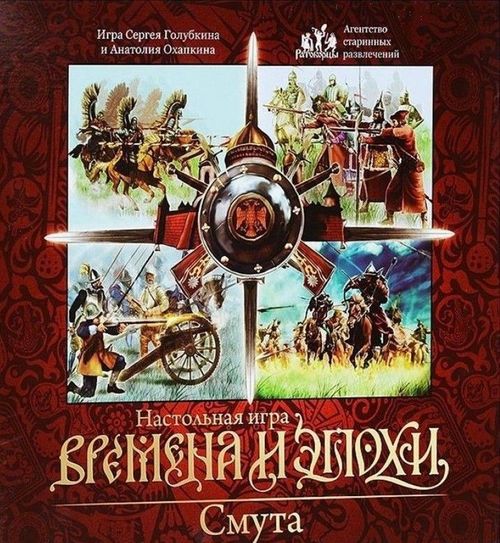
Времена и эпохи: Смута
Времена и эпохи: Смута Rulebook
Table of Contents
Table of Contents
Components
88 troop tokens:
- 60 base troops:
- 16 base infantry tokens;
- 16 base cavalry tokens;
- 16 base shooter tokens;
- 12 artillery tokens.
- 16 unique troops:
- 2 boyar cavalry tokens (Russian Tsardom);
- 2 militia tokens (Russian Tsardom);
- 2 winged hussar tokens (Polish-Lithuanian Commonwealth);
- 2 hajduk tokens (Polish-Lithuanian Commonwealth);
- 2 mounted arquebusier tokens (Sweden);
- 2 light artillery tokens (Sweden);
- 2 janissary tokens (Crimean Khanate);
- 2 sipahi tokens (Crimean Khanate).
- 12 neutral troops:
- 3 Cossack tokens (Zaporozhian Sich);
- 3 landsknecht tokens (Duchy of Prussia);
- 3 engs tokens (Denmark) (the unit's name is transliterated from the Russian "энги");
- 3 Nogai tokens (Great Nogai Horde).
24 event cards.
24 commander figures on stands.
24 commander cards.
Game board.
48 state coats of arms (12 for each state).
120 resources:
- 40 food tokens;
- 40 gold tokens;
- 40 politics tokens.
10 raid tokens.
2 markers:
- turn marker;
- phase marker.
4 mission cards (one for each state).
40 building tokens:
- 8 "Sown field / Ploughland" tokens;
- 8 "Outpost / Fortress" tokens;
- 8 "Town hall / Senate" tokens;
- 8 "Market / Bank" tokens;
- 8 "Training camp / Military academy" tokens.
Chapter 1. Game Setup
- Place the components as shown in the illustration:
- Place the figures of the neutral commanders on the neutral territories:
- For 4 players: on all territories.
- For 2 or 3 players: on the territories corresponding to the chosen states:
- Russian Tsardom: Great Nogai Horde;
- Polish-Lithuanian Commonwealth: Duchy of Prussia;
- Sweden: Denmark;
- Crimean Khanate: Zaporozhian Sich.
- Place the turn marker on the top position of the turn track (the year 1907). Source note: the printed text says 1907, but the turn track itself is labelled 1607 in its first cell (and 1612 in its last). This is transcribed as printed, not corrected; the track's own labels are the 1607 to 1612 years.
- Place the phase marker on the middle space of the winter track (the construction phase).
- Place one coat of arms of each chosen state on the political influence (PO) track, as shown in the illustration.
- Form a general supply of troops, sorted by type.
- Form a general supply of state coats of arms (of all participating states), food tokens, gold tokens, politics tokens, and raid tokens.
Placement of state coats of arms on the political influence tracks (the table in the source):
| Neutral state | War | Neutrality | Alliance |
|---|---|---|---|
| Great Nogai Horde | green emblem | yellow emblem, red emblem, blue emblem | — |
| Zaporozhian Sich | yellow emblem | green emblem, blue emblem, red emblem | — |
| Duchy of Prussia | red emblem | green emblem, blue emblem, yellow emblem | — |
| Denmark | blue emblem | yellow emblem, green emblem, red emblem | — |
The emblems are identified by colour as in the source. The colour of each state's emblem is the one shown in its own "War" cell; the same emblems are then placed in the "Neutrality" cells of the other rows.
For 4 players, all tracks of the neutral states take part in the game. For 2 or 3 players, only the tracks of the states chosen for the game take part, paired as follows:
- Russian Tsardom: Great Nogai Horde;
- Polish-Lithuanian Commonwealth: Duchy of Prussia;
- Sweden: Denmark;
- Crimean Khanate: Zaporozhian Sich.
-
Determine the first player at random. The players then take turns in clockwise order.
-
Each player chooses one of the available states (Russian Tsardom, Polish-Lithuanian Commonwealth, Sweden or Crimean Khanate). The player then chooses three commanders of his own state (not showing them to the other players) and places their figures on any of his own territories. Commanders are placed one at a time in turn, starting with the first player. The player places the commander cards in front of himself. Each player receives the mission card of his state and places it in front of himself.
-
Each player takes the following troops from the general supply:
- 2 base infantry tokens;
- 2 base cavalry tokens;
- 2 base shooter tokens;
- 1 artillery token.
Each player then distributes the troops he took among his commanders, forming a troop stack on each commander's card (a pile of troop tokens in any order). Each commander must receive at least 2 troops. Troops may be distributed in any combination. The distribution starts with the first player. The top troop of each commander's stack is visible to all players.
-
Choose one event card of each of the 6 types for each player (for 2 players, 12 cards; for 3 players, 18 cards; for 4 players, 24 cards). Shuffle the chosen event cards into one deck.
-
In the first turn, every neutral commander receives one corresponding unique troop:
- Johann Sigismund of Brandenburg receives landsknechts;
- Christian IV receives engs;
- Ishteryak-bey receives Nogais;
- Pyotr Sagaidachny receives Cossacks.
All cards of the neutral commanders, with the troops lying on them, are placed next to the game board.
Chapter 2. Course of the Game
The game lasts 6 turns. Each turn corresponds to a historical year and consists of 4 seasons; each season consists of 3 phases, which always follow in the same order. The phases are shown on the "Seasons of the Year" track.
The goal of the game is to score more victory points (VP, ПО) by the end of the 6th turn than the other players. VP are awarded for completed missions.
"Seasons of the Year" track:
- Start cell: the turn marker is placed here at the start of the game.
- Start cell: the phase marker is placed here at the start of the game.
- Winter season:
- 12. Territory capture phase;
-
- Construction phase;
-
- Military maneuvers.
- Spring season:
- 3. Politics acquisition phase;
-
- Political influence phase;
-
- Military maneuvers.
- Summer season:
- 6. Gold acquisition phase;
-
- Troop purchase phase;
-
- Military maneuvers.
- Autumn season:
- 9. Food acquisition phase;
The game begins with the construction phase.
All actions specified in a phase are begun by the first player; the players then perform these actions clockwise. After all players have acted in the given phase, the next phase begins. During a turn, move the phase marker clockwise along the "Seasons of the Year" track.
Winter Season
During this season, territories are captured, buildings are constructed, and commanders are moved.
12) Territory capture phase.
All enemy territories on which your commanders are located, and on which there are no unbesieged outposts or fortresses, are considered captured and pass under your control: place your state's coat of arms on them.
- You may capture only territories that border your territory, and also those territories that lie across the sea from yours.
- Sea territories may not be captured; they do not belong to any state.
Return all raid tokens to the general supply from territories, capitals and buildings (except outposts and fortresses).
If a territory has an outpost or a fortress, you besiege it: place one raid token on that outpost or fortress. An outpost is considered besieged if it has 1 raid token on it; a fortress is considered besieged if it has 2 raid tokens on it.
This phase is the last phase of the current turn: move the turn marker to the next year's division. The first player becomes the player to the left of the current first player.
1) Construction phase (the first turn begins from this phase).
Choose a building and place it on your territory, or turn an already present building token over to its other side, which upgrades it. Each territory may hold only one building. (On territories where there is already an outpost from the start of the game, a building cannot be constructed.) In addition, for 5 gold you may buy one more building or upgrade an existing building. A player may have a maximum of 2 buildings of one type.
2) Military maneuvers.
Spring Season
During this season, politics tokens are received, agreements with the neutral states are made, and commanders are moved.
3) Politics acquisition phase.
Count the amount of politics on your unblocked territories and on your building tokens, and take that many politics tokens from the general supply.
The capital yields one resource of your choice. After you have received one resource from the capital, place a raid token on the capital.
Turn over the top cards of the event deck; the number of cards revealed must equal the number of players.
4) Political influence phase.
For the right to control the neutral states (Great Nogai Horde, Zaporozhian Sich, Denmark and Duchy of Prussia), the right to choose an event card first, and the right to receive 1 VP, the players bid in turn order on the "Political Influence" tracks.
Diagram labels on the "Political Influence" tracks: War; Neutrality; Alliance; tracks of the neutral states; cells for placing the politics tokens of each state; VP track; event card track.
- Choose the track you need and place any number of politics tokens on the cell corresponding to your state. If politics tokens of another state are already on this track, the number of your tokens must exceed the number of that state's tokens. Then pass the turn to the next player.
- Repeat this procedure for as long as you have politics tokens. If you do not wish to bid, or cannot bid, say "Pass".
After all players have said "Pass", the change of the players' influence over the neutral states begins. Starting with the top neutral state, determine the player who made the largest bid on that state. This player may move the emblem of any player one position to the right or to the left on the neutral state's track. At the same time, only one state's emblem may lie on the War and Alliance cells. Then proceed to the next neutral state. If no one made a bid on a neutral state's track, nothing changes on that track.
The player who made the largest bid on the event card track chooses an event card first. Then the card is chosen by the player with the second-largest bid. The last to choose are the players who made no bids, in turn order.
The player who made the largest bid on the VP track receives 1 VP. If no player made a bid on the VP track, no one receives 1 VP.
Place all politics tokens from the "Political Influence" tracks into the general supply.
Example of the political influence phase: player 1 (playing the Russian Tsardom) places 1 politics token on the Great Nogai Horde; player 2 (playing Sweden) places 1 politics token on Denmark; player 3 (playing the Crimean Khanate) places 2 politics tokens on the Great Nogai Horde; player 4 (playing the Polish-Lithuanian Commonwealth) says "Pass"; player 1 says "Pass"; player 2 places 1 politics token on 1 VP; player 3 places 1 politics token on the event cards; player 4 says "Pass"; player 1 places 2 politics tokens on the event cards; player 2 says "Pass"; player 3 says "Pass"; player 4 says "Pass"; player 1 says "Pass"; no more bids may be made.
Continuation of the example: now the political influence changes.
1) Player 3 made the largest bid on the Great Nogai Horde track; he chooses to move his emblem to the "peace" cell (the source's word; this is the Neutrality cell of that track). 2) On the Zaporozhian Sich track there were no bids, so everything remains unchanged. 3) Player 2 made the largest bid on the Denmark track; he chooses to move his emblem from the War cell to the Neutrality cell. 4) Player 2 made the largest bid on the VP track and receives 1 VP. 5) Player 1 made the largest bid on the event card track and chooses an event card first; player 3 chooses the next card, as he made the second-largest bid; the remaining card goes to player 4.
5) Military maneuvers.
Summer Season
During this season, gold tokens are received, troops are bought, and commanders are moved.
6) Income phase (gold acquisition).
Count the amount of gold on your unblocked territories and on your building tokens, and take that many gold tokens from the general supply.
7) Troop purchase phase.
Buy the necessary base troops. If you have a Training camp or Military academy building, you may buy the unique troops of your state (maximum 2 of each type). If you are in an alliance with any neutral state, you may buy that state's unique troops (maximum 2 of each type).
If you have troops or commanders in your personal reserve, you may bring them into the game:
- place a commander's figure on any of your territories; the commander must have at least one troop;
- add troops to any commander located on your territory.
8) Military maneuvers.
Autumn Season
During this season, food tokens are received, commanders are moved, and neutral commanders are moved.
9) Harvest phase.
Count the amount of food on your unblocked territories and on your building tokens, and take that many food tokens from the general supply.
10) Military maneuvers.
11) Neutral states phase.
If you are in an alliance with any neutral state, carry out a military maneuver with that state's neutral commander (your territories are not blocked by the neutral commander). A neutral commander may attack the commanders of a state with which the neutral state is at war, and may also attack their outposts or fortresses. A neutral commander may block territories without outposts and fortresses belonging to states that keep neutrality with that neutral state.
If you are at war with any neutral state while other players are in neutrality with that state, the neutral commander of that state carries out a military maneuver against your territory (the first player chooses the territory).
Chapter 3. Counting Victory Points
Mark all victory points (VP, ПО) you earn during the game on the victory point scale by moving your coat of arms the corresponding number of spaces.
The game ends after the 6th turn. After this, count the victory points using the mission card.
Diagram labels on the mission card: base missions (for completing these missions, players always receive VP, regardless of the number of players); VP for completing this mission are awarded only if the game has 3 or 4 players; VP for completing these missions are awarded only if the state participates in the game.
Mission card: Russian Tsardom (the card as printed; the VP values are shown after each mission):
- Base missions (VP are always awarded):
- Alliance with the Great Nogai Horde: 3 VP;
- Fortress in Kazan: 2 VP;
- Military Academy in Kursk: 2 VP;
- Control of Moscow: 2 VP;
- Moscow is not blockaded: 2 VP;
- Control of 11+ territories: 1 VP;
- Control of 13+ territories: 1 VP.
- 3-4 players (VP are awarded only if the game has 3 or 4 players):
- Control of 2 territories that belonged at the start of the game to different states of other players: 2 VP.
- Sweden (VP are awarded only if Sweden takes part in the game):
- Annex Revel: 3 VP;
- Annex Vyborg: 2 VP.
- Polish-Lithuanian Commonwealth (VP are awarded only if the Commonwealth takes part in the game):
- Annex Riga: 3 VP;
- Annex Kiev: 2 VP.
- Crimean Khanate (VP are awarded only if the Khanate takes part in the game):
- Annex Perekop: 3 VP;
- Annex Azov: 2 VP.
The winner of the game is the player who has scored the most VP.
Two-player variant: players may choose only states that border each other. Sweden and the Crimean Khanate may not be chosen at the same time.
Three-player variant: the Russian Tsardom and the Polish-Lithuanian Commonwealth must take part in the game.
Chapter 4. Military Maneuvers
The military maneuvers phases of each season are phases 2, 5, 8 and 10. They are carried out under the rules of this chapter.
Starting with the first player, all players act with their commanders in turn order. Choose one of your commanders and perform one of the available actions with it (after this, the commander counts as having acted), then pass the turn to the next player. Repeat this procedure until you have no commanders that have not yet acted. If you cannot or do not want to perform actions with your commanders, say "Pass". When all players have said "Pass", the military maneuvers of this phase end.
- Military maneuvers cannot be performed on the territories of states that do not take part in the game.
- Military maneuvers cannot be performed on the territories of neutral states.
All available actions cost 1 food (place 1 food token into the general supply).
1) Movement.
A commander may move to 1 territory that borders the territory it is on; such a territory is adjacent. If this territory belongs to another state, it is considered blocked and yields no resources in the resource collection phases. If another commander is on this territory, a battle begins with that commander.
A commander may also move to sea territories (the Baltic Sea, the Black Sea). If another player's commander is there, a battle takes place only if one of the players wishes it; the player who moved into the sea territory decides first.
If you move your commander onto a territory that belongs to you and has a besieged outpost or fortress (raid tokens lie on them), the outpost or fortress is considered freed, and the raid tokens are removed from it.
2) Attack on another commander.
A commander may attack enemy commanders located on an adjacent territory. Move a figure of your commander onto that territory to start a battle: your commander counts as attacking, and the other player's commander counts as defending. The player whose commander won the battle leaves his commander on that territory.
The player whose commander lost the battle moves his commander to a neighbouring territory that belongs to him, if troops remain on that commander's card. If all neighbouring territories belong to other players, all troops, the figure and the commander card are placed in the player's personal reserve. If no troops remain on the commander's card, its figure and card are placed in the player's personal reserve.
If several commanders of another player are on the chosen territory, the attacking player chooses which commander he fights. After that battle, the defending player decides what happens to the remaining commanders on this territory: they either join the battle as attackers (they are considered attacking), or retreat to a neighbouring territory that belongs to them (no food is paid for this).
If your commander is at sea, it may attack an enemy commander located in the same sea for 1 food.
3) Attack on an outpost or fortress.
A commander may attack an enemy outpost or fortress located on the same territory, or on an adjacent territory. To do so, move your commander's figure there and start a battle with the chosen outpost or fortress. The player who owns the outpost or fortress chooses several base troops as its garrison (2 for an outpost, 3 for a fortress) and conducts the battle with these troops.
If the commander won the battle, the outpost or fortress is considered besieged.
To make an outpost or fortress besieged, it is not necessary to attack it: it may be besieged over one turn (or over two turns for a fortress), and then the territory, together with the outpost or fortress, passes under your control at the end of that period (after 2 turns for a fortress).
4) Raid.
A commander may carry out a raid on an adjacent enemy territory and thereby deprive it of its resources. The selected enemy territory must not have a raid token, an outpost, a fortress or an enemy commander on it. If you carried out a raid on an enemy territory, place a raid token on it, covering the resource icon (this territory is considered plundered and does not yield resources in the resource collection phase), then take 1 gold from the general supply for yourself.
5) Redeployment.
Redistribute any two troops among your commanders who are located on territories under your control.
All actions are performed either on the territory where the chosen commander is located, or on the territories adjacent to it.
Each commander acts only once per military maneuvers phase. To mark this, place its figure on the board after it has acted.
Battle
-
Prepare the troops of your commander: form a stack from its troops in any order, without showing them to the other players.
-
Simultaneously lay the troop stacks out against each other.
-
Combat: compare the strength of the troops lying on top of the stacks, taking into account the troop type and its special features. The troop with the greater strength wins and is set aside. The troop with the lesser strength is destroyed and returned to the general supply. If the strengths are equal, both troops survive and are set aside. Repeat this step until one of the troop stacks runs out. Troops that did not take part in the battle are considered survivors and are set aside.
-
Count the strength of all surviving troops (all troops set aside). The player whose troops have the greater total strength is the winner. When counting, take into account the special features of the troops and of the outposts or fortresses. If the total strengths are equal, the commander located in defence wins.
Order of using troop special features:
-
The attacking player decides first whether he will use any special feature of a troop, a commander or a building.
-
The players then use one of their special features each, in turn.
-
If a player does not use a special feature when it is his turn, he may not use it later in the current combat between the two top troops.
Example of battle: player 1 attacks Evert Gorn of player 2 with D.M. Pozharsky. Player 1's commander has 4 troops: militia, base artillery, base infantry and base cavalry. Player 2's commander has 3 troops: mounted arquebusiers, base shooters and base cavalry. The players, without showing each other their troops, form the order of their stacks, lay the stacks out simultaneously, and then compare the strength of the troops in the combats.
- Combat 1: base cavalry against mounted arquebusiers. Mounted arquebusiers have the shooter type, so the strength of the base cavalry is 3. Both troops have strength 3, and player 2 decides to use the special feature of his commander, a maneuver. He moves the mounted arquebusiers under the bottom of his troop stack. Now the base cavalry and the base infantry take part in the combat. The cavalry has strength 2, and the infantry has strength 3 (as it fights against cavalry). The infantry wins and is set aside; the cavalry returns to the general supply.
- Combat 2: artillery against shooters. Player 1 decides to use the special feature of the artillery: he pays 1 gold, and the artillery produces a volley of strength 2. The base shooters have strength 2, so they are destroyed (and they do no damage to the artillery) and are placed in the general supply. The artillery wins and is set aside.
- Combat 3: militia against mounted arquebusiers. The militia has strength 1 and defence 2; the mounted arquebusiers have strength 3. The sum of the militia's strength and defence is 3; the arquebusiers' strength is not enough to win, so the militia survives and is set aside. The mounted arquebusiers also survive and are set aside.
Player 1 still has a troop left: the base infantry. It has no opposing troop, so it survives and is set aside.
Survivors of player 1 (troops set aside): the strengths are added, 1 + 1 + 2 = 4, and the victory value of the militia, +2, is added. Total strength of the troops: 6.
Survivors of player 2 (troops set aside): 2 + 3 = 5. Total strength of the troops: 5.
Player 1 wins the battle. He also uses the commander's special feature, tactics, and places the destroyed base cavalry in his personal reserve.
Note on the example: as printed, the troop lists in this example do not fully match the sequence of combats (for instance, the troops shown as surviving for player 2 are not all named in its troop list). It is transcribed as printed.
Chapter 5. Appendices: Description of Troops
Diagram labels on a troop token: State; Cost; Type; Strength (the value of strength equals the number of swords); Special feature.
Troop types:
- Infantry;
- Cavalry;
- Shooters;
- Special.
Defence (shield icon): if the strength of the opposing troop does not exceed the sum of the strength and defence of this troop, the troop survives.
Victory (red icon): when determining the results of a battle, add the victory value to the sum of the strength of all surviving troops.
Base troops:
- Base infantry: in a battle against cavalry, the strength of infantry equals 3.
- Base cavalry: in a battle against shooters, the strength of cavalry equals 3.
- Base shooters: in a battle against infantry, the strength of shooters equals 3.
- Base artillery: you may pay one gold into the general supply, after which deal 2 damage to the opposing troop. If the strength of the opposing troop is less than or equal to 2, it is destroyed and returned to the general supply, and the artillery wins. If the strength of the opposing troop is greater than 2, the artillery is destroyed and returned to the general supply. Artillery has the special troop type.
Unique troops.
Unique troops may be bought only of the type that corresponds to your state. Purchasing them requires a "Training camp" and/or "Military academy" building on any territory of your state.
Russian Tsardom:
- Boyar cavalry: in a battle against cavalry or infantry, the strength of boyar cavalry equals 3.
- Militia: defence 2; victory 2. The militia has the special troop type.
Polish-Lithuanian Commonwealth:
- Hajduks: defence 1.
- Winged hussars: if your commander is attacking, you may pay one gold into the general supply, and the strength of the winged hussars becomes equal to 4 (attack only).
Sweden:
- Mounted arquebusiers: (the card has no special-feature text printed.)
- Light artillery: return the light artillery to the general supply (the commander's tactics special feature may not be applied to it), and deal 4 damage to the opposing troop. If the strength of the opposing troop is less than or equal to 4, it is destroyed and returned to the general supply. The light artillery has the special troop type.
Crimean Khanate:
- Sipahi: defence 1.
- Janissaries: in a battle against infantry or shooters, the strength of the janissaries equals 3.
Mercenary troops.
These troops may be acquired by a player who has an alliance with the corresponding neutral state (the right-hand position on the politics track).
- Zaporozhian Sich: Cossacks. In a battle against cavalry or infantry, the strength of the Cossacks equals 3.
- Great Nogai Horde: Nogais. (The card has no special-feature text printed.)
- Denmark: Engs. Defence 1.
- Duchy of Prussia: Landsknechts. (The card has no special-feature text printed.)
Description of Commanders
Diagram labels on a commander card: Command; State; Description.
Command: the indicator of the maximum number of troops that may be under the personal control of this commander.
Special features of commanders:
- Tactics: once per battle, the commander may return a destroyed troop under its control to the personal reserve, instead of placing it in the general supply.
- Logistics: when moving, the commander may pass through two land territories with one action, if at least one of these territories belongs to the commander's state. The cost of movement remains 1 food.
- Seamanship: when moving, the commander may pass through two territories with one action, if at least one of these territories is a sea territory. The cost of movement remains 1 food.
- Siege: outposts and fortresses under the control of an opponent receive 1 garrison fewer at the moment of choosing the garrison troops, and minus 1 victory when determining the winner of a battle.
- Defence: once per battle, the commander may give one troop under its control +1 strength. This feature may be used only when this commander is defending.
- Maneuver: once per battle, the commander may move the top troop under its control to the bottom of the troop stack.
- Reconnaissance: once per battle, the commander may cancel a special feature of a troop under the control of an opponent.
- Leadership: when determining the results of a battle, add 1 to the sum of the strength of all surviving troops.
- Raid: when the commander carries out a raid on a territory under the control of an opponent, it receives additional gold (2 gold in total).
Neutral commanders have the same special features, and in addition:
- After a neutral commander is defeated in battle, it returns to its neutral state (it is placed on its territory in the territory capture phase, with one of its unique troops).
- A neutral commander begins the game with its unique troop (engs, landsknechts, Nogais or Cossacks, respectively).
- In the territory capture phase, a commander receives one base troop (infantry, cavalry or shooters) at random. The number of troops cannot be higher than the command of the commander.
All neutral commanders perform military maneuvers in the neutral states action phase.
Description of Buildings
All buildings may be built only on territories of your own state. Each territory may hold only one building. On territories with a printed outpost, buildings may not be built (such an outpost cannot be upgraded).
Each building has two sides: one side is an ordinary building, and the other side is an upgraded building (marked by a red arrow in the bottom-left corner). It is forbidden to build an upgraded building immediately. First an ordinary building must be built; then, in the construction phase or with an event card, the building is upgraded.
A player may have a maximum of 2 buildings of one type.
- Town hall (Ратуша): during the politics acquisition phase, gives 1 additional politics.
- Senate: during the politics acquisition phase, gives 2 additional politics.
- Market (Рынок): during the gold acquisition phase, gives 1 additional gold.
- Bank (Банк): during the gold acquisition phase, gives 2 additional gold.
- Sown field (Посевное поле): during the food acquisition phase, gives 1 additional food.
- Ploughland (Пашня): during the food acquisition phase, gives 2 additional food.
- Training camp (Тренировочный лагерь): allows the purchase of unique troops.
- Military academy (Военная академия): allows the purchase of unique troops. In addition, once per year you may use its special feature. The special feature is to give any one of your troops +1 strength during a battle, or +1 damage for artillery (including the Swedish light artillery). After using the special feature, place a raid token on the military academy. While a raid token lies on the military academy, its special feature cannot be used. The raid token is removed in the territory capture phase.
- Outpost (Застава): a defensive building that makes the capture of your territories difficult (garrison 2, victory 4).
- When an enemy commander attacks an outpost, select from the general supply 2 base troops with a total cost of 4 gold (you may take 2 base troops costing 2 gold each, or 1 base artillery costing 3 gold, in which case its damage is dealt free). Then conduct the battle with the attacking commander using the selected troops. When determining the winner of the battle, add 4 to your total strength of surviving troops. After the battle, return the troops to the general supply. If you won the battle, the enemy commander remains on the territory with the outpost. If you lost the battle, the outpost is considered besieged and a raid token is placed on it.
Description of Event Cards
After the event cards are received in the political influence phase, all players perform the corresponding actions in turn order:
- New commander (Новый военачальник): choose a new commander of your state and one base troop for it. Then place the new commander's figure on any territory belonging to your state, and place the commander card with the chosen troop in front of you. A player may control at most 5 commanders.
- Pact of peace (Пакт о мире): until the territory capture phase of the next turn, your commanders, outposts or fortresses on territories under your control may not be attacked, and troops may not be moved.
- Diplomatic victory (Дипломатическая победа): choose any neutral state taking part in the game and move the coat of arms of any player on its political influence track one position to the right or to the left. (Only one state's coat of arms may lie on the "war" and "alliance" cells.)
- Reinforcement (Подкрепление): choose 2 base troops and add them to any of your commanders located on your territory. If you cannot add them to your commanders, place them in your personal reserve.
- Reconstruction (Реконструкция): build a new building on your territory for free, or upgrade an existing building for free (turn the building token over to its other side).
- Mention in the chronicle (Упоминание в летописи): receive 3 VP.