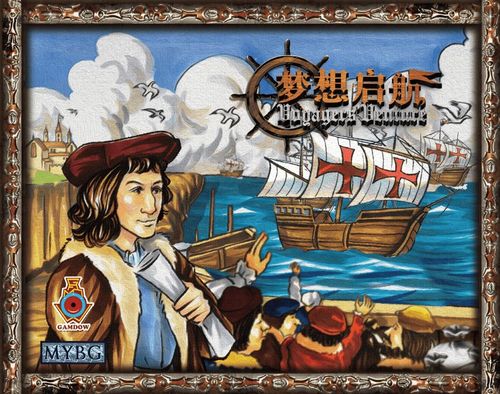
Voyagers' Venture
Voyagers' Venture Rulebook
Table of Contents
Table of Contents
Game Components
- Game Board – 1
- Common Cards – 97
- Fleet Cards – 18
- High Risk Cards – 18
- Fleet Reward Card – 1
- Game Scoring Cards – 5
- Game Tip Cards – 5
- Queen Marker – 1
- Gold Doubloon – 6
- Turn Marker – 5 (one color per player)
Set-Up
- Place the game board flat on the table.
- The player who has most recently ridden a boat is the starting player (or roll a die), each player chooses 1 color. From the starting player, and proceeding clockwise, each player places their color marker on the turn tracker in the corresponding position. Return any extra turn markers to the box.
- Place the High Risk Cards at the according position on the board. (The setup example below is for a 4 players game.)
- From the Common Card deck, find 2 copies each of the 1 sailor, 1 foodstuff and 1 weapon cards and shuffle those cards together. Each player will draw one of these at random as a starting resource card. Return the extra cards to the box. While playing the game, you may keep your resource cards hidden from the other players.
- Shuffle the remaining 97 Common Cards and place the deck face down on the game board. Shuffle the 18 Fleet Cards and place the deck face down on the game board.
- The Active Turn Track or Future Turn Track.
- Each player receives 1 gold doubloon, return the rest to the box.
- Place the queen marker on the round track at the first round.
- Place the Fleet Bonus card, the Fleet Reward Card, and the Game Tip Cards card near the board.
Card Decks
- Common Cards includes:
- (13x) sailor x1, foodstuff x1, weapon x1
- (12x) sailor x2, foodstuff x2, weapon x2
- (9x) Small Ship
- (3x) Medium Ship, Large Ship
- (7x) Noble Patron
- Total: 97
- Fleet Cards includes:
- (3x) Small Ship
- (9x) Medium Ship
- (6x) Large Ship
- Total: 18
- High Risk Cards includes:
- (2x) sailor x3
- (2x) foodstuffs x3 (printed as "oodstuffs")
- (2x) weapon x3
- (6x) Large Ship
- (6x) Smuggled Goods
- Total: 18
Card Notes
- Resources: Type includes sailors, foodstuff, and weapons. Amount can be 1, 2 or 3 of the same type.
- Ships: There are 3 kinds of ship: small, medium, and large. After the player pays the cost on the cards that have ship's pictures, player can place this card in front of him or her, facing up, and gain the marked reputations.
- Noble Patron: The top half of the sentences displays the resource symbols that required to help the noble patron. After paying the resources, the player displays the noble family card in front of him or her, and gains its ability listed on the card until the end of the game.
Game Flow
The game has 6 rounds. Each round plays out as below:
- Sponsor from Royal Family
- Dividing Sponsor
- Assembling Fleets
- End of the turn
1. Sponsor from Royal Family
A. Draw certain amount of cards from Common Card deck, Fleet Card deck and High Risk Card deck, according to the amount of players in the game. These cards presents the sponsor from Royal Family that approved by Queen Isabella.
The amount of cards drawn depends on the number of players:
- 3 players: 6 face up Common Cards, 2 face up Fleet Cards, 1 face down Common Card, 1 face down High Risk Card
- 4 players: 9 face up Common Cards, 2 face up Fleet Cards, 1 face down Common Card, 1 face down High Risk Card
- 5 players: 11 face up Common Cards, 3 face up Fleet Cards, 1 face down Common Card, 1 face down High Risk Card
B. (Diagram: the Common, Fleet and High Risk cards drawn are gathered into the Sponsor Card deck for the current round.)
2. Dividing Sponsor
From the starting player and moving along the turn order track, the active player will declare what he or she want from the face up and face down cards on offer this round.
Starting clockwise from the choosing player, each player decides if they agree or not to give the active player what they chose.
C. (Diagram: the active Voyager makes a bid. If Voyager B disagrees, Voyager B cuts and makes a new bid (Reducing). If Voyager C disagrees, Voyager C cuts and makes a new bid (Reducing). When all Voyagers agree, proceed to the dividing.)
All the players agree
- If all the players agree, the active player immediately receive all the cards he or she chose and takes those cards into his or her hand.
- Note: If a player receive a high risk card in their bargain, that player may choose to discard the high risk card without looking at it first. If they have looked at it, he or she must keep it.
- Move the active player's turn marker from the active Turn Track to the lowest empty position of the Future Turn Track.
- (Diagram note: Once the active player pass, his or her Turn Marker should be moved to the lowest empty position of the Future Turn Track's.)
One player disagrees
- The agreeing phase stops when a player disagrees and the disagreeing player immediately makes a bid on the cards, which is smaller than the bid of the previous player. There are 3 ways to cut a bid:
- Remove 1 or more cards from this bid. Example: Jerry disagrees with Tom's bid. He removes a 1 weapon card from Tom's bid, now he is only asking for a 1 sailor card and 1 medium ship as his bid.
- Remove 2 or more cards from the bid, then add 1 card on display to the bid. Example: Jerry disagrees with Tom's bid. He removes the 1 sailor and 1 weapon cards from the bid and adds the face down common card to this bid. Jerry is now bidding for 1 face down common card and 1 medium ship.
- Place one of your gold doubloons on one card that the previous player did not choose. If you do this, you may keep the bid the same size and move straight to the agree/disagree phase (2). The gold doubloon is attached to the card it is placed on until a player takes that card, and that player also takes your doubloon. (PS: Since the player adds a doubloon in the bid, it's considered as a way of reducing the active player's performance price artio of income.) Example: Jerry disagrees with Tom's bid. So he places 1 gold coin on a different card (1 foodstuff). Jerry's bid is now the same as Tom's bid was.
Notes
- Example: Player Tom is the 2nd player this round, but the 1st player to have all the other players agree on his bid. After taking his cards, he moves his turn marker to the 4th player spot in the next round, he will make his bid last next round.
- If the player has drawn a smuggled goods card, he or she must display this card in front of him or her to track for the end of game penalty. Then he or she draws the top common card.
- Note: You cannot discard or hide a smuggling goods card in your hand.
- Once a player gain sponsor, he or she won't participant the following bids in the same round.
3. Assembling Fleets
This player may use resources acquired so far to immediately pay for ships or nobles in his or her hand. The player discards the appropriate number of resources on the cards, and puts the ship or noble patron card in front of him or her and resolves its effects.
Example: Tom reveals a 1 sailor resource card and a small ship that requires 1 sailor to buy. He places the ship in front of him and discards the 1 sailor card. The small ship will give him one reputation at the end of the game.
- The first player to get 3 ships in front of him or her (paid for) takes the fleet reward card. (Diagram: three ships are exchanged for the Fleet Reward card.)
- You may combine purchases as long as you do it all at once.
Example: Tom reveals a 'sailor x2 card' and a 'weapon x2' card as well as 2 medium ships which both require 1 sailor and 1 weapon to buy. He has the resources needed on the cards he shows, so he discards those resource cards and puts the 2 ships in front of him, gaining 4 reputation (2 each) at the end of the game.
- Note: No resources will spill over if not handled simutaneously.
4. End of the Turn
After the last player receive his or her bid, this round is over. Check that each player has 8 or less cards in hand. If they have more, they must discard. Move the queen marker to the next position of the round track. Start the next round.
Card Overview
The printed card overview lists these cards. Card costs are shown as icons on the cards; where the printed examples and the card icons differ, the card icons are what is listed here.
Resource cards
- Gain 1 foodstuff, gain 2 foodstuff, gain 3 foodstuff
- Gain 1 weapon, gain 2 weapon, gain 3 weapon
- Gain 1 sailor, gain 2 sailor, gain 3 sailor
Noble patrons
- Chancellor of Coin: When you buy this card, take 1 doubloon from the box.
- Navy Commander: Once per round, you may pay 1 less sailor to buyships (at least 1).
- Intelligence Chief: Once per Game, you may examine 1 face down card. (at least 1)
- Secretary of Agriculture: Once per round, you may pay 1 less foodstuff to buyships (at least 1).
- Army Commander: Once per Round, you may pay 1 less weapon to buy ships.
- Cardinal: Once per Round, instead of the 3 ways to cut a bid, you may remove a 2-resource card from the bid, then add a 1-resource card.
- The Duke: Your hand limit is 9.
Ships
- Small ship (×3): costs 1 sailor, 1 weapon, or 1 foodstuff (one each); worth 1 reputation.
- Medium ship (×3): costs 2 weapons (×2) or 2 foodstuff (×1); worth 2 reputation.
- Large ship (×4): costs 3 weapons, 1 weapon + 1 foodstuff + 1 sailor, 3 foodstuff, or 3 sailors; worth 4 reputation.
Fleet Reward
- Fleet Reward: The first player to get 3 ships in front of him or her takes the Fleet Reward Card.
Game Scoring card
- Owner of Fleet Reward Card: +2
- Remaining in your hand:
- the most sailor: 1st +4, 2nd +2, 3rd +1
- the most weapon: 1st +4, 2nd +2, 3rd +1
- the most foodstuff: 1st +4, 2nd +2, 3rd +1
Game Tip card
- There are 3 ways to cut a bid: remove 1 or more cards from this bid; remove 2 or more cards from the bid, then add 1 card on display to the bid; place one of your gold doubloons on one card that the previous player did not choose.
- When you receive the card, you can donate the noble, buy the ship and intermix.
- Hand Card limit is 8.
Smuggled Goods card
- When you acquire a smuggled goods card, you must display it in front of you immediately and draw a Common Card. Once acquired cannot be given up. (The card face shows a −1.)
End of the Game & Scoring
The game finishes at the end of round 6. At this time, each player still has one last chance to use the resources they have in hand to buy ships and nobles. Then discard all remaining ship and noble cards in hands.
Scoring
- Follow the game tip card to determine end of game bonus reputation:
- Add up the total number of resources remaining in your hand. Example: The player with the most sailors (not resource cards, but total number of sailors ON resource cards) earns 4 reputation. 2nd place earns 2, and 3rd earns 1 (Only 4 or more players have a 3rd place). Repeat this process for most foodstuffs and most weapons.
- Display your ships in front of you. The player with the most ships gets 4 bonus reputation. 2nd place gets 2, 3rd place gets 1. (Only 4 or more players have a 3rd place).
- Note: If there is a draw both players get the lower place reward. For example, Tom and Jerry draw for 1st in number of weapons. Both players receive 2 points for 2nd place, and then check for third if there are 4 or more players. If in this example 2 players tie for third, they both receive no prize.
- Display all ships and noble reputation in front of you, calculate the total and add it to your reputation.
- If a player has the Fleet Reward Card, add the bonus (2) to his or her reputation.
- If a player has gold coins, each 2 is worth 1 reputation.
- Subtract 1 reputation for each smuggled goods that player has.
The player with the highest reputation wins the game, and the royal edict of Queen Isabella to strike out for new trade routes. If there is a draw, the player with the most ships is the winner, if there still is a draw, the player with the most total resources is the winner, if it is still a tie then the players win together.
Transcription notes: The rulebook is a scanned, image-only PDF (6 pages, "En Rulebook of Voyagers' Venture 1.1", uploaded to BoardGameGeek). Text was read from page images and transcribed by hand. Printed typos were kept as printed and marked where needed ("oodstuffs", "buyships", "simutaneously", "participant"). The printed example in Assembling Fleets describes medium ships costing 1 sailor and 1 weapon, while the medium ship cards show 2 weapons or 2 foodstuffs; both are recorded above.