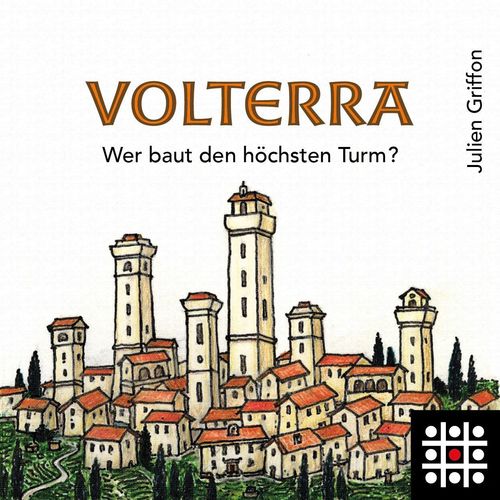
Volterra
Volterra Rulebook
Table of Contents
Table of Contents
Game Material
- 10 light tower pieces, 10 dark tower pieces
- 1 light pawn, 1 dark pawn
Preparation
Lay out a small "chess board" (4 x 5) with the 20 pieces. Place the pawns on the two central squares, each on its colour. The players pick a colour and designate the first player on turn.
Definitions
In the following rules, tower denotes both single pieces as well as several pieces stacked on top of each other. The colour of a tower's top piece shows who the tower belongs to. The eight towers surrounding the tower with the pawn on it are called neighbouring towers.
Play
The player on turn completes two actions that can be in any order:
- Move your pawn onto a neighbouring tower of your personal colour.
- Choose a tower of your own colour, which is next to your pawn and has at least one free side, and move its top or top-two pieces onto a different neighbouring tower. The covered tower can be one of your own or your opponent's towers.
Note: You can also first move a tower, and afterwards move your pawn. The pawn is allowed to move onto the tower that you just moved.
(Illustrated examples: Dark's first turn; Light's first turn.)
Moves not allowed
- Pawns are not allowed to move onto towers of the opponent's colour.
- Pawns are only allowed to move onto neighbouring towers.
- Towers can only be moved onto the pawn's neighbouring towers.
- Towers cannot be moved onto free spaces.
- Towers cannot be moved onto a square with a pawn.
- Only tower pieces with at least one free side are allowed to be moved.
- It is never allowed to move at once more than two tower pieces that are stacked on top of one another.
Separating the play field
It is allowed to separate the play field by removing a tower. (As long as two towers still touch at the corners, they are defined as connected.)
- After separating the play field, if both pawns stand on the same separated part of the field, the other part is forfeited.
- If a pawn stands on each of the separated partial-fields, each player continues to play on his/her own part of the play field.
Game End
The match is over as soon as one of the players can no longer carry out both actions in a single turn. At this point, the winner is the player with the highest tower.
If the match is drawn, the second highest towers are compared, and so on.
Variant
The 5 x 4 play field can be laid out in a free pattern. Starting with the first player, both players first alternate putting down their own tower pieces and then place their pawns on any tower of their personal colour.
A Practical Tip
Unused, newly painted game pieces have a slippery surface – not exactly ideal for a stacking game. We recommend you to wipe the upper- and undersides of the pieces a few times with a damp cloth, then dry with a towel. This improves the grip.