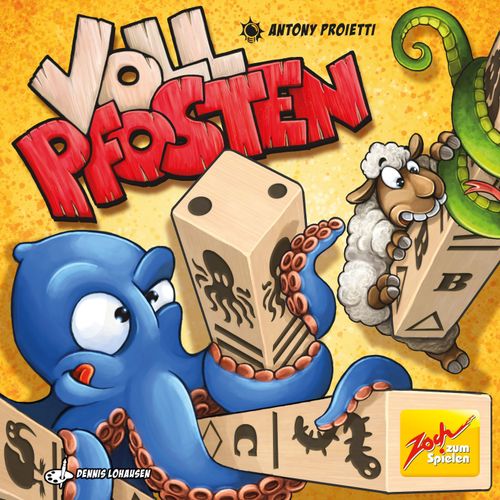
Vollpfosten
Vollpfosten Rulebook
Table of Contents
Table of Contents
Components
- 6 blocks with symbols (letters A–F, each showing a set of symbols)
- 1 white die with symbols
- 2 orange dice: a light orange die and a dark orange die (grab dice)
- 1 dark blue die (action dice)
- 1 light blue die (speech dice)
- 1 green die (interaction dice)
- 30 sticks of different lengths: 10 brown, 10 grey and 10 white
Note on the component list: the rulebook's component illustration says the white sticks are not used with three players. The rule text itself says the short sticks are not used with three players. The transcription follows the rule text as printed; the white-stick note is the illustration's caption.
Setup
- Place the 6 blocks in the middle of the table so that all players can easily reach them.
- Sort the 30 sticks by length and place them near the players.
Which Dice to Play With?
The white die is always used in the game. For your first game, take only this die.
The white die shows which block must be grabbed.
In later games, once you are familiar with the game, also use the orange dice: at first play with the light orange die, and then also use the dark orange die.
The orange dice show how the block must be grabbed.
The blue dice make the game harder. To start, choose one of the two blue dice.
The blue dice show what must be done before grabbing a block.
Once you are playing with three dice — white, one orange and one blue — you can add the green die.
The green die can replace one of the blue dice or be added to the other dice in the game.
The green die shows how you must interact with the other players.
How the Game Gradually Becomes Harder
When you are already playing "Закрутень" well, you can use both orange dice or both blue dice, even together with the green die, or remove any one of them from the game.
When you become a true expert at "Закрутень", you may choose which dice, besides the white one, you want to play with.
Turn Sequence
- First, roll the dice: one player rolls all the dice selected for the game.
- Then grab! All players, including the player who rolled the dice, quickly grab one of the blocks.
- When grabbing a block, observe the following rules:
- Grab the block with only one hand! Grab the block with your active hand (unless an orange die requires using the inactive hand).
- You may not grab a second block!
- You may not put back a block that you have grabbed.
- Do not change your grip or your hand once you have grabbed a block! Hold the block as you grabbed it.
- Do not snatch blocks out of your opponents' hands!
- Play fairly and be considerate towards the other players. Do not use physical force, so as not to harm yourself or other players!
The Dice Symbols
White Die: Which Block to Grab
Grab the block...
| If the die shows | Grab the block... |
|---|---|
| Six pips | ...with the largest number of dots. → A block with 6 dots is better than one with 5, 5 is better than 4, 4 is better than 3, and so on. |
| Stick (long shape) | ...of the greatest length. |
| Letter A | ...with the letter that is closest to the start of the English alphabet. → The letter "A" is better than "B", "B" is better than "C", "C" is better than "D", and so on. |
| Animal (centipede) | ...with the animal that has as many legs as possible. |
| Horizontal lines | ...with the largest number of lines. |
| Octagon | ...with the geometric figure that has as many corners as possible. |
Orange Dice: How to Grab the Block
Orange dice show how the block must be grabbed.
Grab the block...
| If the die shows | Grab the block... |
|---|---|
| Curved arrow over a hand (inactive hand) | ...with your inactive hand. |
| Curved arrow over a square (opposite condition) | ...with the condition opposite to the one shown on the white die. For example: if the white die shows the letter "A", grab the block with the letter that is as far as possible from the start of the alphabet. In this case the block with the letter "F" is better than "E", "E" is better than "D", and so on. |
| Curved arrow over a square and a hand (opposite value, inactive hand) | ...with the value opposite to the one shown on the white die, with your inactive hand. |
| Two flat hands (back of both hands) | ...with the backs of both hands. Clamp the block between the backs of your hands. |
| Two fingers (ring finger and little finger) | ...with the ring finger and little finger. Clamp the block between the ring finger and little finger of one hand. |
| Two flat hands with a square (opposite value, back of both hands) | ...with the value opposite to the one shown on the white die, with the backs of both hands. |
If you are playing with two orange dice, the following additional rules apply:
-
If both dice show the same inactive-hand symbol (curved arrow over a hand), these symbols cancel each other out. The same happens if both dice show the opposite-condition symbol (curved arrow over a square).
Example: If both orange dice tell you to grab the block with your inactive hand, you instead grab the block with your active hand.
-
The back-of-both-hands symbol (two flat hands) cancels the effect of the inactive-hand symbol (curved arrow over a hand). So if one of the orange dice tells you to grab the block "with the backs of both hands", always grab the block with the backs of your hands.
Illustration in the rulebook: the back-of-both-hands symbol combined with the inactive-hand symbol crossed out.
-
Any other combination of symbols on the dice is valid.
Examples:
- Grab the block with the ring finger and little finger of your inactive hand.
- Grab the block with the value shown on the white die, with the backs of both hands. The symbols for "opposite condition" (curved arrow over a square) cancel each other out.
Blue and Green Dice: What to Do Before Grabbing
The blue and green dice show what you must do before grabbing a block.
Dark Blue Die: ACT!
The dark blue die shows a movement that must be performed.
Before grabbing a block...
| If the die shows | Before grabbing the block... |
|---|---|
| Clap | ...clap your hands. |
| Figure standing | ...stand up and grab the block standing. |
| Figure turning | ...stand up, make a full turn around your own axis, and sit down again. |
| Figure running | ...stand up, run around your chair, and sit down again. |
| Figure touching the floor | ...touch the floor with both palms. |
| Figure jumping | ...jump up from the chair and sit down again. |
Light Blue Die: SPEAK!
The light blue die shows what you must say.
Before grabbing a block...
| If the die shows | Before grabbing the block... |
|---|---|
| Rooster | ...crow like a rooster. |
| Dog | ...bark like a dog. |
| Hand over mouth | ...cover your mouth with one hand and shout "Закрутень!" (the game's Russian name, here used as the shout). |
| Two figures | ...say the names of the players sitting to your right and left. |
| Countdown | ...count from 6 down to 1. |
| Tongue out | ...stick out your tongue. Harder variant: stick out your tongue and say your name. |
Green Die: TOUCH!
The green die shows how the players must interact with each other.
Before grabbing a block...
| If the die shows | Before grabbing the block... |
|---|---|
| High five | ...give a "high five" to the players sitting to your right and left. |
| Fist bump | ...bump fists with the players sitting to your right and left. |
| Pat on the back | ...pat the backs of the players sitting to your right and left. |
| Hands on heads | ...put your hands on the heads of the players sitting to your right and left. |
| Finger to chin | ...touch the chins of the players sitting to your right and left with a finger. |
| Little finger to little finger | ...touch little fingers with the players sitting to your right and left. |
Comparing Blocks and Taking Sticks
Now it is time to take sticks!
Compare the block you have grabbed with the blocks grabbed by the other players. The comparison works as follows:
If a player did not carry out the instructions shown on the orange, blue or green dice correctly, he returns the block he grabbed to the middle of the table and does not receive any sticks.
The other players then check which of the blocks grabbed in this round best matches the condition shown on the white die:
- The player with the best block takes a long stick.
- The player with the second-best block takes a medium stick.
- The player with the third-best block takes a short stick.
All other players do not receive any sticks.
When playing with three players, the short sticks are not used.
Lay out all the sticks you have received during the game in front of you in one continuous line.
Example (see the illustration on the following page of the rulebook):
Illustration caption (translated): On the white die a centipede came up, but because of the value shown on the orange die, the player must grab the block showing an animal with fewer legs. The best option is the snake. The player must grab the block with the inactive hand (as the orange die also requires), but first must run around their chair (blue die).
- Vanya grabbed the block that best matches the dice: the snake. However, before grabbing he did not run around his chair as the blue die required. Therefore Vanya does not receive any sticks.
- Zhenya grabbed the block showing a bird, but she did not carry out the orange die's condition and grabbed the block with her active hand. She also does not receive any sticks.
- Sonya, Roma, Tanya and Sasha were the only players who carried out all the required actions before grabbing. Among these players: Sonya grabbed the best remaining block, the one showing a sheep, and receives the longest stick. Roma grabbed the second-best remaining block, showing a beetle, and receives a medium stick. Tanya grabbed the third-best remaining block, showing an octopus, and receives a short stick. Sasha grabbed the block with the centipede and therefore receives nothing.
Only for Experienced Players: Hands Off!
Life is a game: there are always players of "Закрутень" who cannot be beaten! So that they do not become too full of themselves and do not lose their friends, these rules were invented especially for them:
The player who received the longest stick in the previous game of "Закрутень" becomes the Закрутень (the rulebook's name for this role) and:
- hides his hands under himself while the dice are rolled;
- may take his hands out to grab a block only after all the dice have shown their values.
End of Round: Everything Back in Place!
At the end of each round:
- all players sit down in their places;
- all blocks are placed in the middle of the table so that all players can easily reach them;
- the player who rolled the dice in this round passes them to the player on his left. If the Закрутень sits to the left of the player, the dice are passed to the player after him;
- the Закрутень again hides his hands palms-up under himself.
End of Game and Determining the Winner
When all the long sticks have run out, the game ends. The players compare the lengths of the lines of sticks they have made. The player with the longest line wins.