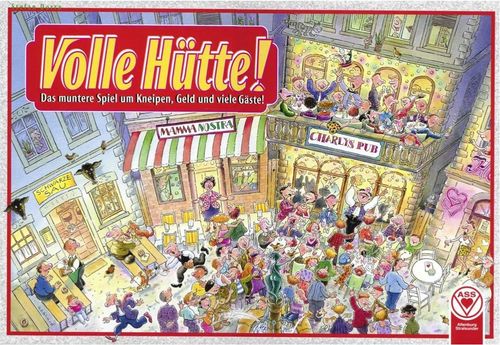
Volle Hütte
Volle Hütte Rulebook
Table of Contents
Table of Contents
Materials
The game contains the following components:
- 1 board
- 5 pub-boards (basic pubs with no installations)
- 63 customer figures (21 yellow, 21 red and 21 blue)
- 21 customer-cards
- 36 action-cards
- 6 "Kassieren bitte" (collect payment) cards
- 38 Installation cards:
- 9 terrace tables
- 9 (indoor) tables
- 4 dance floors
- 8 counters (bars)
- 4 table football machines
- 4 billiard tables
- 150 bank notes: 50 of 10 marks, 50 of 50 marks, 50 of 100 marks
- 1 copy of these rules (i.e. the German original)
Preparation
The board is placed in the middle and serves as a base for the various cards. The square installation cards (Einrichtungskaertchen) are shuffled and placed face down in a pile on the corresponding field of the board. The top two of these cards are then displayed, face-up, in front of the pile. Before the first game, these cards must be carefully removed from their cardboard base.
The (rectangular) cards are sorted into customer-cards (yellow), action-cards (red) and "Kassieren bitte!" cards (blue). Each of these groups is shuffled separately. The customer- and action-cards are placed in (face-down) piles on the corresponding fields of the board, and the top three cards from each pile are turned face up onto the relevant positions on the board. The 6 "Kassieren bitte!" cards are placed face-up in a pile on their field of the board.
Each of the 3 to 5 players now chooses a pub and takes 3 installation-cards and action-cards from the face-down piles. The section "Equipping pubs" describes how you may place these installation-cards in your pub. The action-cards, you place, for the time being, face down, before you.
The 63 customer-figures are placed ready by the board. The color of the figures stands for their value at "Kassieren" (collection of payment): Yellow: 10 marks, red: 20 marks, blue: 30 marks.
One player holds all the bank notes and so administers the bank. This player then has the first move. Play then proceeds to the player on the left.
1st move
Beginning with the bank administrator, each player in turn makes one of the following moves:
a) Equip a pub b) Receive customers c) Collect payment
2nd move
As soon as 10 or more customer-figures are in play, each player must then follow the first move with a second move: move customers.
Equip Pub ("Kneipe einrichten")
Someone who chooses the "equip pub" option takes one of the two face-up installation-cards from the board and places it in their pub. The empty place on the board is then replenished from the face-down pile (of installation cards). Where and how many installation cards are placed is decided by each player for themselves.
Terrace tables may, of course, only be placed on terraces; all other installations go indoors.
A counter (bar) may only be built up from a wall (not in the middle of the room) and consists of a maximum of three counter-cards (Thekenkaertchen) lying next to each other. There are no other limits to number and positioning; any free field in your pub may be covered. Thus, for example, it would even be possible for all four billiard tables to be placed in a single pub.
Receive New Customers
The player selects one of the three face-up customer-cards and places it, face-up on the discard-pile. They then take the customer figures indicated by the card (e.g. 2 red figures) and put them in the indicated place (e.g. at a counter (bar)) in their pub. If they have several counter-cards in their pub, they may distribute the figures on these as they wish. Finally, the customer-cards place is replenished from the face-down pile.
Is there enough room for all the customers?
If a player possesses no free billiard tables, they can, of course, not receive any customers who want to play billiards. If a player has only two free places on their terrace, then they may not choose a customer card which shows three or four figures with the type "Terrace".
Generally, they may only choose a customer-card if they can accommodate all the indicated figures in their pub. The places are marked by round chairs in the corresponding fields. Each chair is a free place. In the course of the game, further customers may be accommodated here. The table-football machines and billiard tables are an exception. Each of these may accommodate up to 4 customers. But, these installations are counted as full as soon as they hold one or more figures. For this reason, no place markings appear here.
Collect Payment (Abkassieren)
Someone who wishes to collect payment takes the topmost "Kassieren bitte" card and lays it face-up on the discard pile (Ablagestapel). In doing so, they create a windfall for all players, or at least, those who have customers in their pubs. The basic precondition for this move is that the player, as well as at least one other player, have at least one customer each in their pubs.
All players collect payment from the bank corresponding to the number and value of their customers. Yellow pays 10 marks, red pays 20 marks and blue pays 30 marks. The customer figures remain in place. The player who initiated the action also receives the "Trinkgeld" (gratuities - between 30 and 70 marks) indicated on the card. This can be well worthwhile!
After one of these basic moves, in the early rounds, play passes to the next player in turn, clockwise around the table. However, as soon as a total of at least 10 customer-figures are in play, each player also has the following 2nd move that moves the customers around the board and some landlords to despair. Only after this 2nd move is it then the next player's turn.
Customer Movement (Playing Action-Cards)
Each player has always two action-cards placed before them. Preferably face-down so that the others can't see what inspiring possibilities one has.
The player whose turn it is must play one of their two action-cards, placing it face-up on the discard-pile. The player then takes one of the face-up action cards from the board and replenishes it from the face-down pile.
The aim in playing the action-card is to transfer customers from a selected pub (preferably that belonging to the current leader) to another pub (preferably one's own). There are two types of card which offer different possibilities.
The Type A action-card: All customers (1, 2, 3 or 4) from one specified installation-card move to another, freely chosen installation which must be announced beforehand. The new installation must be of a different type to that which the customers are leaving; they may not go, for example, from a billiard table to another billiard table.
The Type B action-card: All customers (1, 2, 3 or 4) from one freely chosen installation-card switch to an installation-card of type specified on the action card. The customers may not move to an installation of the same type. The transferred customers must remain together as a group. At the same time, they must take places at the new installation as announced by the player.
Let us assume, for a moment, that 3 billiard players should move to a counter (bar). First, they look for a place at the counter in the same pub. If they don't find room, they wander clockwise until they find a pub in which there is room for all 3 at the counter. If the customers can't find room at a counter in any pub, they go home, i.e. they are taken out of the game.
When customers leave a pub, payment is collected - or perhaps not! Usually, the landlord receives the value of the customers immediately from the bank. If, however, the action-card shows a crossed-out banknote, the departing customers are bill-dodgers and the landlord doesn't get any money - hard luck!
Example of action-cards of type A: Anita plays the type A action-card (shown on the left) against Matthias. She indicates her 3 billiard players (2 red, 1 blue) and announces that these should move to the counter (bar). After all, who wants to play billiards for ever? As Matthias has no free places at the counter, the customers leave the pub and pay 70 marks. Next door, at Rita's, there is only one free place at the counter but Andreas, the next in order, has 3 counter-cards (Thekenkarten). One is free and each of the other two have one place occupied - it can therefore accommodate the three new customers. The customers now take places at Andreas'.
Example for action-card of type B: Andreas plays the type B action-card (shown above) against Rita whose customers on the dance floor (2 blue, closely embraced) now want to play billiards. Andreas, in the next clockwise position, has indeed a billiard table - this is, however, already occupied by a customer. The two blue customers therefore go on to Anita who has a free billiard table. If there had been no completely free billiard table in any of the pubs, the two would have gone home (back in the box). Rita, sadly, does not get the 60 marks as this is a case of bill-dodging.
Unplayable action-cards - only possible with type A - may simply be discarded. For example, if there are no billiard players in any pub. The action lapses and the player next moves normally. However, every action that may be completed, must be completed, even if it is directed against customers in one's own pub.
End of Game
The game ends immediately after the last "Kassieren bitte" card has been uncovered and each landlord has been able to collect payment six times.
Or: if the last "customer-movement" action card has been taken from the board. In this case, each landlord may collect payment from their customers once more. Now all landlords and landladies count their money and toast the player with the highest day's takings as "Kneipenkoenig".