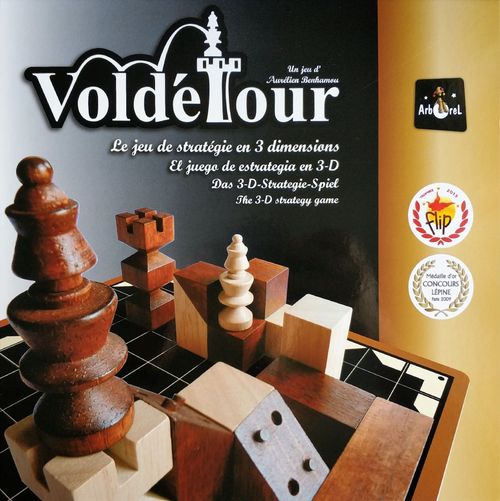
Voldétour
Voldétour Rulebook
Table of Contents
Table of Contents
Elements and setting up (fig. 1)
- A game board of 100 squares (2 black, 4 red - for the extension - and 94 white)
- 12 black pieces, 12 white pieces. Each color set includes 1 Lord (fig. 1a), 1 Tower (fig. 1b) and 10 construction pieces (Blocks, fig. 1c and Stairs, fig. 1d).
Each player chooses a colour and places his Tower on a black square (it will stay in this place during the whole game) with on its top his Lord. The other construction pieces are kept in reserve nearby the game board.
Objective of the game
Be the first player to put his Lord on the adversary Tower.
Principle of the game
Using Blocks and Stairs, each player builds 3-D roads (length, width, height) on which he moves his Lord. The squares of the board serve as reference to position the construction pieces and for the Lord's displacement (fig. 2).
Attack strategy is to create a road, with the possibility to build on the opponent's pieces, and/or move forward his Lord, including on the adversary's pieces.
Defence strategy is to block the opponent's pieces and/or stop the displacement of his Lord.
Game procedure
The players take turns. Black pieces start the game. There are 3 possible actions:
- place 1 Block of his color
- place 1 Stair of his color
- move his Lord 1, 2 or 3 squares.
During his turn, a player can decide to do the 3 actions, or only 1 (minimum required) or 2 of his choice (when it's done, he informs the adversary who then takes his turn). The Block and the Stair can be played in any order, one after the other, but no piece can be played after moving the Lord.
End of the game
The first player who places his Lord on the opponent Tower is the winner.
Position of the construction pieces
One piece is placed either directly on the game board, in contact or not with other pieces, or on other pieces, including those of the opponent. It can be placed in any direction in 3-D. Only the slope of a Stair has to face the sky or has to fit into another Stair (fig. 3).
To place a piece, a player can either take one of his unused piece from his reserve, or move one of his pieces already played. A piece cannot go back to reserve.
A construction piece is blocked (fig. 4) and then cannot be moved if:
- it is under another construction piece or under a Lord.
- it is surrounded by 4 construction pieces and if its vertical faces are entirely covered.
The height of the construction cannot exceed the height of the Tower.
No empty space under a construction is allowed (fig. 5).
Movement of the lord
The Lord can be displaced and stay on his own construction pieces, but also on the adversary pieces or directly on the game board. He has to leave his Tower at the latest during the 3rd turn, otherwise the player loses the game. Then, during a displacement, he is allowed to pass by it but not to stop on it.
The Lord moves forward, backward, left or right but not diagonally.
In case of a displacement of 2 or 3 squares, he can change direction at each movement from one square to another.
Except if Stairs are assembled, one slope is used as junction between 2 squares of different heights and allows the Lord to change levels. Slopes are not counted when the Lord moves. The Lord has to face a slope before using it (fig. 6). He is allowed to take several slopes if they are placed end to end as a continuous line in order to join 2 squares (fig. 7).
Lords cannot stand together on the same square and cannot jump over each other.