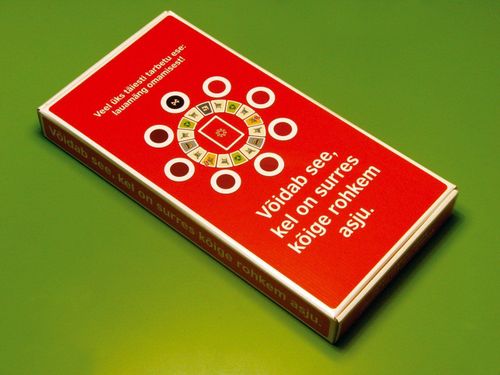
Võidab see, kel on surres kõige rohkem asju
Võidab see, kel on surres kõige rohkem asju Rulebook
Table of Contents
Table of Contents
1. Mängu eesmärk (Object of the Game)
Every game's aim, besides enjoying the beauty of the game, is of course victory! And if in Estonian society the one who dies with the most stuff wins, in the board game everything is quite Buddhistically the opposite: the game is won by the player who has the fewest things at the end of the game and the fewest points from them!
Players drift around the outer ring of the board and collect treasure, which despite their keen resistance tends to pile up ever faster. On the inner ring of the board, however, Death moves from mound to mound on its inevitable course.
Players may hurry through their everyday rat race as fast as they can, because the game ends when Death has gone around its ring and taken the final step. Only then are the things counted and the winner determined.
2. Mängu komplekt (Components)
- Game board (Mänguplats)
- 60 item cards (asjakaarti)
- 6 differently coloured pawns (erivärvilist nuppu)
- Classic die (Klassikaline täring)
- Rulebook (Juhend)
- Grim Reaper figure (Vikatimees), representing Death (Surm)
3. Mängu ettevalmistus (Setup)
Each player chooses a pawn of their liking. Players can take part in the game in numbers from 2 to 6, but the tighter and more exciting scramble happens when there are at least three players!
Death is placed on the black mound marked with bones on the outer ring of the board.
Each player chooses a starting square on the inner ring of the board and places their pawn on it. The starting square may be any light-coloured shopping-cart square (there are 8 of them on the board). Each player must choose a different starting square; two or more pawns may not start from the same square.
Translator's note: the printed rulebook places the starting squares on the inner ring, while the movement rules say pawns move around the outer ring. The text is transcribed as printed and this inconsistency is left as published.
The cards are shuffled thoroughly and placed face down in the middle of the board. Each player takes five cards from the top of the deck and places them face up on the table in front of themselves, so that all the other players can see them. These cards form the inheritance that each player receives as a burden at the start of their own path through life.
4. Kaartide tähendus (Meaning of the Cards)
Each card depicts one unnecessary thing that accumulates around the player over the course of their life and is hard to get rid of. The top edge of each card has a row of points showing the item's price. The more expensive and pointless the item, the more points it gives and the more reason there is to get rid of it during the game. Points on the cards range from one to five.
Cards come in six suits
- Blue AUTO cards: everything beautiful and ultra-necessary with which to tune your four-wheeled friend into a sexy one. Because even a car can, with good will, eventually be chiselled into a large status off-roader.
- Pink BLING-BLING cards: everything fluffy, luxurious, furry or pearly, which can be pulled onto your back, legs, fingers and hands, and hung around your neck and ears.
- Yellow HOBBY cards: everything desirable with which to fill your scant free time, without sparing yourself or your loved ones.
- Brown LEMMIK cards ("favourites"): everything that is the product of human genius, which helps make our pets' already stressful lives even more exciting, while also emphasising our own status and creativity.
- Green HOUSE cards (MAJA): everything baroque and rampant, with which your dwelling can be furnished almost into an impassable jungle, and against which to stub your toes, head or knees.
- Grey TECHNOLOGY cards (TEHNIKA): everything friendly, buzzing and blinking, which makes every technocrat's heart pound anxiously, and whose assembly, disassembly and activation takes an ever larger part of each of our days.
Translator's note: the suit names are given as printed on the cards, with English glosses added.
5. Mängu algus (Start of the Game)
First, players arrange their cards. Cards of different suits are placed side by side in a row in front of each player. Cards of the same suit are stacked on top of one another, with the cards of higher points placed beneath the cards of lower points.
The player whose five starting cards add up to the most points starts the game. Play continues with the player seated clockwise from them, and so on.
When the cards in the middle of the board run out, the junk lying on the rubbish heap goes back into use: the pile of discarded cards is shuffled and placed in the middle of the board. Recycle rules!
6. Mängu käik (Playing the Game)
First: moving
Roll the die and move your pawn clockwise around the outer ring of the board by the number rolled. A roll of six does not earn a new throw.
If you roll a one, you must first move the Death pawn one mound forward on the inner ring. Only after that do you move your own pawn.
When Death reaches a new bone-marked mound, the game ends at that moment and the points are counted.
If your pawn lands on a square where another player's pawn already stands, you may give that player one of your top items. This gift does not have to match suit or points, so give whatever you like! The more expensive the gift, the prouder you will be.
Second: the square you landed on
Act according to the square on which your pawn stopped.
- Shopping cart (Ostukäru): "Shopping!" Take one card from the middle of the board and place it in front of you. At this point it is fitting for everyone to cry out together to express their joy: "ŠOPING!"
- Shopping cart with the sign "1=2" or "–50%": this is already serious shopping, or "super shopping". Take TWO cards from the middle of the board. You may exclaim, for example: "SUPERŠOPING!"
- Rubbish bin (Prügikast): get rid of all of your visible (top) one-point cards. Throw them onto the rubbish heap beside the board.
- Robber (Röövel): get rid of all of your visible (top) two-point and three-point cards. Throw them onto the rubbish heap beside the board.
- Stock crash (Börsikrah): affects ALL players! When one player's pawn lands on this square, all players get rid of all of their visible (top) four-point and five-point cards. These are thrown onto the rubbish heap beside the board.
Third: gifting
You may give your items to other players! A card you give must always be of the same suit as, and exactly one point more expensive than, some visible (top) card of the recipient. A one-point card may be given onto a five-point card.
During your turn you may gift to your fellow players as many items as you manage to, even all of them! Items cannot be given to players who have no cards or who have no card of a suitable suit. Pure shamanism!
7. Mängu lõpp (End of the Game)
The end of the game is, as is well known, harsh, fair and terrible. When Death takes the final step on its ring and reaches the bone-marked mound again, the game ends at that same moment. The round is not completed, because nobody escapes life.
Each player adds up the points on their cards. The player with the fewest points is declared the winner.
The winner is congratulated and praised effusively. The player who has scraped together the most junk, however, sinks through the floor from shame at the same time, straight into the hot whirlpool of the shopping-hell auction.