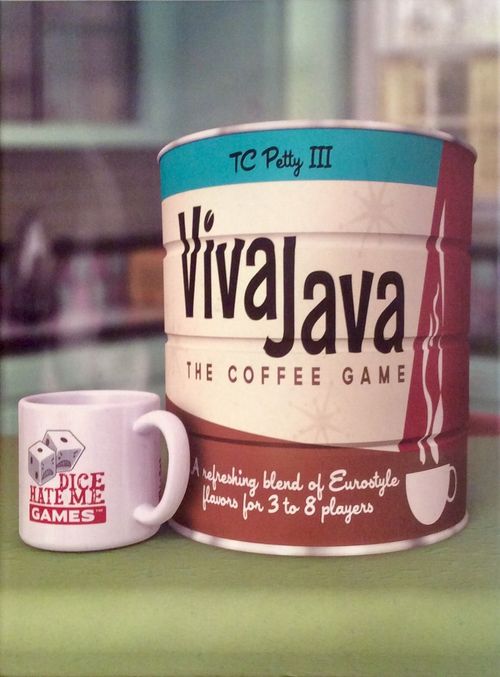
VivaJava: The Coffee Game
VivaJava: The Coffee Game Rulebook
Table of Contents
Table of Contents
- Field Components
- Game Set-up
- Additions for Games with 3-6 Players
- Additions for Games with 3-5 Players
- Sequence of Play
- Game End and Scoring
- Decaffeinated VivaJava
- The Intern Inspansion (VivaJava for 3-4 players)
- Variants
- Strategy & Game Notes
- Appendix A: Country/Intern Tokens
- Appendix B: Flavor Card Notes
- Appendix C: Research Tracks
- Research Track Abilities and Flavor Card Actions Timeline
- Game Reference
Field Components
- World Map — split into three regions (Americas, Africa, and Asia), each with three coffee-rich countries to explore.
- Performance Track/Best-Seller List
- 15 Blend Slates
- 2 Starter Slates
- 2 Variant Slates (see Variants, pg. 14)
- 1 Stale Marker (used in games with 3-5 players)
- 8 double-sided Research Labs
- 16 Flavor Cards
- 24 Intern Cards (see Intern Inspansion, pg. 12)
- 8 Player Reference Cards
- 8 Featured Blend Cards (see Variants, pg. 14)
- 8 Blend/Research Coins
- 9 Country Tokens
- 8 Roaster Purge Coins (see Variants, pg. 14)
- 15 Investment Tokens
Game Set-up
Unfold the World Map and Performance Track and place them on the table as shown below. Separate the 90 coffee beans by color and place them in piles as noted on the bottom of the World Map, arranged by Color Rank. These beans represent The Fields. Shuffle the Blend Slates and place them near the Western side of the World Map.
THE BREWMASTER
Players should designate one player as the "Brewmaster," who will control the assignment of Turn Order Tokens and control movement of the Scoring Tokens on the Performance Track. Typically, this should be either the owner of the game, the person who has played the most, or the most trustworthy gamer - if there is one.
Put Score Tokens in a Roaster. Pull them out one at a time and place on the Performance Track according to number of players.
Each Starter Slate has a column of 5 beans of specific colors. Take beans of the appropriate color from The Fields and add them to the Slates.
Place Starter Slates on the Best-Seller List. Average Joe should be in the Top Cup! position.
Shuffle Blend Slates, draw 3 and fill the spaces above the World Map.
Place Beans from The Fields onto the Country Crop spaces connected to the Countries below them, based on the color represented in the circles on the Blend Slates.
Shuffle the 9 Country Tokens with special actions and randomly place them on the World Map in the round Country spaces.
Give each player a set of pieces in the player's color, a Roaster bag, and a Research Lab. Research Markers should be placed at the start of each Research Track. Players take 2 white beans and 1 yellow bean from The Fields and place them into their Roasters.
Additions for Games with 3-6 Players
VivaJava scales easily for 3 to 6 players with only a few modifications to set-up and game play. In set-up and during the game when Blend Slates are placed above the regions on the World Map, a special symbol on each Blend Slate indicates an action that must be performed for a specific Country in that region.
This symbol shows that the players should not place a bean in the Country Crop space, and the Country Token in that location should be flipped to the ⊘ side.
Bean is not placed and Country Token is turned over. (applies to each Country marked with the ⊘ symbol on the newly revealed Blend Slate)
Additions for Games with 3-5 Players
When fewer Field Researchers scour The Fields for valuable beans, the VivaJava CoffeeCo. will often release a generic Blend into the market to maintain a healthy - if not terribly flavorful - bottom line. In games with 3 to 5 players, the Stale portion of the Best-Seller List is dominated by the Coffee* Blend. This Blend is immune to degrading and remains in the Stale position for the entire game.
During set-up in a game with 3 to 5 players, place the Coffee* Slate in the Stale position on the Best-Seller List.
This Blend Slate cannot be moved nor removed by any means during the game.
Sequence of Play
VivaJava: The Coffee Game is played over several rounds (typically 7), with each round broken down into three distinct phases:
1. IN THE FIELD — Players take turns placing their Field Researcher pawns on the World Map and collecting beans.
2. BLEND/RESEARCH — Players break into teams and either Blend (combining beans to score) or Research (gaining abilities).
3. POPULAR OPINION — Players add new Blends to the Best-Seller List and calculate scores. Blends then "degrade" and weaken.
The following details how to play VivaJava with 5-8 players. For additions to game play for 3-4 players, please see page 12.
1. In The Field
The first decision that the novice coffee aficionado will encounter is where in the world to travel in order to find that perfect bean. Players should note that the World Map is split into three regions (Americas, Africa, and Asia) and each region contains three possible coffee-rich countries to explore, each with its own Country Crop space and action.
Determine Turn Order
Turn Order for each round is determined by the position of Scoring Tokens on the Performance Track, so the player with the lowest score on the top of the stack is first in turn order. The Brewmaster gathers all players' Turn Order Tokens and places them on the Turn Order Track in proper order.
Place Field Researchers
Players, in turn order, place their Field Researchers onto Countries on the World Map. When players choose a Country, they must immediately resolve the action represented on the Country Token and then take the bean from the corresponding Country Crop space (if available) and place it into their Roaster. Each symbol listed on the Tokens represents a positive action (marked in dark brown) or a negative action (marked in red). Positive actions are optional, whereas negative actions must be performed.
Players continue placing Field Researchers in turn order until all players have chosen. A country cannot be chosen twice, so table-talk and scheming is encouraged. In games of 3 to 6 players, countries that are flipped to the ⊘ side cannot be chosen, unless a special action would allow it. For more information about specific Country Token abilities and effects, see Appendix A on page 16.
SPECIAL NOTE: On the first turn of the game, players ignore penalties if they place their Field Researcher on a country that contains a red negative action. In all subsequent turns, red negative actions must be taken.
2. Blend/Research
The World Map is split into three regions. During Phase 2, players split into three teams based on which of the three regions they have chosen (Americas, Africa, or Asia region).
Teams must now choose whether they will Blend or Research. With much loud debating, false promises, and negotiation, all players must decide which face of their Blend/Research Tokens to reveal. When everyone is ready, players reveal their Tokens simultaneously; a team's action is determined by majority vote. Any Token that is revealed with Blend face-up is a vote for the team to Blend, and any Token with Research is a vote for the team to Research.
Count the votes on each team, and determine which action each team has collectively chosen through majority vote. All ties result in a Research action.
PERCOLATE FREELY
The world of Big Coffee is constantly on the move, so players are encouraged to take simultaneous actions. Blending teams should not sit and wait for Researching teams to finish or vice versa.
a. Blend
It's time for the team to work together to create a Blend to top the Best-Seller List. The benefit in Blending is that most Blends remain on the Best-Seller List until a better Blend replaces it (or until Popular Opinion has waned).
Using Beans and Bags
Each team takes the Blend Slate above their region on the World Map. There are five spaces for beans on each Blend Slate and these will be filled by randomly pulling beans from each player's Roaster. NOTE: Players on a team must be able to contribute a total of five beans collectively, including using any Abilities, to create a Blend. Players must truthfully declare the number of beans (but not type) in their Roasters to ensure a Blend is possible. If not possible, the team must Research.
The team decides in which order players will pull beans from Roasters. If there is no unanimous decision, players pull in turn order.
One player starts by randomly pulling a bean from his Roaster and placing it on the Blend Slate in one of the five bean spaces; if he continues, he may repeat that action until he chooses to stop or is forced to stop to allow other players a chance to contribute at least one bean. Once a player stops pulling beans he may not add more beans to the Blend Slate later in the round. All players must contribute at least one bean, but are not required to contribute more. A player cannot stop pulling beans if this will cause the Blend to be incomplete.
COFFEE PROTOCOL
A player cannot show what's in a Roaster unless a card, action or rule requires it. Talk about it, lie about it, be detailed in your descriptions, but do not show what's in it.
Free Bean Space
Some Blend Slates have one bean space filled in with a specific color. When the other 4 bean spaces on the Blend are filled by a team (and all players have contributed at least one bean to the Blend), a bean of the specified color may be added to the Blend Slate from the Fields. If there are no beans of that type in the Fields, players cannot use this ability.
a. Blend (continued)
Placing on the Best-Seller List
Once the Blend Slate is filled, each player places a Blend Marker of his color onto the Slate. The Blend is then placed on the Best-Seller List according to the Roast Ranking that is shown on the board. If the Blend is exactly the same as a Blend already on the List, the old Blend is considered inferior and moved down the List. If two or more exact Blends are created simultaneously, the Blend with the team member who has the highest turn order is placed higher on the List, and so on.
All inferior Blends are moved down on the List. If this pushes a Blend off the List, this Slate is removed from play. All beans on the Slate are returned to The Fields, and all markers are returned to players. Investment Tokens on the Slate are returned to the general supply (see page 18).
Blending also gives players practical experience. After Blending, each player receives 1 RP to distribute on the Research Lab Ability Tracks!
BLENDING SOLO
It is possible for a player to be alone on a team. However, they may choose to Blend only if they are able to fill all Bean Spaces on the Blend Slate.
The Roast Ranking
The Roast Rank scale on the game board lists the possible ranking of a five-bean Blend. Blends are ranked and placed onto the Best-Seller List based first on the ranking of the combination, then on the color of the blend. For example, a Bold Blend of black beans would be ranked higher than a Bold Blend of white beans. Also, a Bold Blend of white beans would be higher-ranked than a Regular Blend of black beans.
Example of Blending
Chris, Cherilyn and T.C. are all in the same region and have decided to Blend. Chris says he has the best chance to give the team three-of-a-kind in yellow beans. Trusting him, Cherilyn and T.C. let Chris Blend first.
Chris reaches into his Roaster and pulls out a yellow bean, placing it onto the Blend Slate. So far, so good.
Chris pulls again - another yellow bean!
Chris decides to pull a third time - it's a white bean. Drat!
Since every team member must contribute at least one bean, Chris can no longer Blend. Cherilyn goes next and pulls a white bean - things are suddenly looking better!
Cherilyn has more white beans, but T.C. must contribute. He closes his eyes, reaches into his Roaster... and pulls out a white bean! The team now has an Americano Blend. Not bad.
BLEND MARKERS
Each player has only 3 Blend Markers. If a player should need to place a fourth Blend Marker, that player either removes a Blend Marker from another blend or doesn't add a Blend Marker to a Blend created this round.
The Best-Seller List
Cherilyn, Chris and T.C. now have a new Blend and are ready to place it on the market. The current Top Cup! Blend is a red/yellow Half-Caf Blend and the Swell Blend is a black/white Decaf Blend. As the team's new Americano Blend is stronger, the Half-Caf and Decaf Blends are moved down on the Best-Seller List and the Americano Blend takes the Top Cup! spot, which will net the team 3 Performance Points during Popular Opinion.
b. Research
Sometimes a little training is required in order for Field Researchers to stay at the top of their game. During the Research Phase, a team will split up and return to their own respective Research Labs to brew up some special abilities so they can create even more robust blends.
Spending Research Points
Each player on a team that chooses Research receives 3 Research Points (RPs) to distribute amongst his Ability Tracks. Players make this choice alone and can distribute them in any way they choose by moving their Research Markers from left to right and covering up a new spot on the track. Each spot represents 1 point used and the columns represent when a player has reached a new Research level.
The first spot in a column is marked ✷ to indicate that a player has reached a new level. When players have used enough Research Points to move a marker to this position, they have "leveled up" that ability and can take advantage of the special action indicated for that part of the track in the next round of play (with the exception of Flavor Cards, see page 17). Also, at Game End, players will receive Performance Points (PP) for each level they have achieved on each Research Track. Scoring is cumulative; for example, achieving the second level of Grow would net a player a total of 2 PP at Game End.
Once an Ability Track has been completed, a player may now use an End-track Ability. Specific abilities for each track are detailed on each Research Lab, and enhance a player's ability to acquire Performance Points. Research attributes are explained in detail on page 18.
Research Lab
Research Markers are moved from left to right on the Ability Tracks. In the example below, Shawn has used his 3 RPs to move up 2 spots in GROW, and 1 spot in SELECT. He will now be able to use the GROW special ability during the next round, and will receive 1 PP at Game End.
Shawn gained the GROW Ability through the allocation of his initial 3 RPs. However, he now has his sights set on gaining SELECT. He indicates that he would like to trade 2PP for 2 RP. His Score Token is moved accordingly, and he adjusts his Research Marker on the Track, reaching the first level of SELECT.
The Research Lab's five Ability Tracks are GROW, SELECT, INVEST, BREW, and FLAVOR.
Using Performance Points for Research Points
One of the most important benefits of Researching is that players may also trade Performance Points for Research Points.
After all teams have finished Researching and Blending, any players who Researched (not players who Blended) during the Round choose, in turn order, how many Performance Points they would like to trade for Research Points. The player's Scoring Token is then moved backwards on the Performance Track to indicate this. For each one PP spent, the player receives one (1) RP to use immediately to move his Research Markers along the Ability Tracks, or to use for certain End-track Abilities (such as for the Flavor Track - see Appendix C on page 18 for more details).
It is very advantageous to use this extra capital as early investments in abilities can make a large difference in the quality of a player's Blends on the Best-Seller List. Note that players may not move their Scoring Token below the -3 Performance Points mark on the Performance Track at any time.
3. Popular Opinion
Field Researchers must be given credit for their work. The final phase of each round of play is entirely based around dishing out Performance Points and preparing for the next round of play - or the end of the game!
Scoring
After all players have finished Blending and Researching (including trading in Performance Points for Research Points), Performance Points are awarded to players (in turn order) for their Blends on the Best-Seller List. There are five possible positions on the List, but only three possible payout amounts as denoted above each position.
For each Blend Marker a player has on a Blend, that player receives Performance Points equal to the number above the Blend Slate.
Blend Markers are not removed after scoring and remain until the Blend is knocked off the List.
In the example at left, T.C. (playing yellow) has a Blend Marker on the two best blends on the List. T.C. receives 3 points for the Top Cup! Blend and 2 points for the Swell Blend and his Scoring Token is moved up on the Performance Track. The Brewmaster removes T.C.'s Field Researcher pawn from the World Map and returns it to T.C.
Degrading Blends
Once all players have been awarded points, the Bestselling Blends become less desirable in the public's eye and degrade. Remove one bean from each Blend and return each bean to The Fields. The bean removed must be the least important part of the Blend.
For example, if a blend is five beans forming a Bold Blend with one extra bean, then it is a Bold Blend with one extra bean. The extra bean would be removed, because removing any other bean would degrade the blend to a Regular Blend - a weaker Blend than the Bold Blend. Once a bean has been removed from all Blends, the Blends are re-ordered on the List as needed, according to Blend and Bean Rank. If a Blend is ranked lower than Decaf, it is removed from the List.
Rainbow Blends
These very special Blends do not Degrade. Because of their complex flavor, they will stay on the Best-Seller List for a longer time.
There can be only one Rainbow on the Best-Seller List at a time. When a Rainbow is created, it replaces any Rainbow Blend already on the Best-Seller List. The current Rainbow Blend is removed from the game and the new Rainbow Blend is added to the Best-Seller List. If more than one Rainbow is created simultaneously, the Blend from the team with the member who holds highest turn order is placed on the Best-Seller List.
Example of Degrading
In the example below, the black/white Decaf Blend loses a white bean, the red/yellow Half-Caf loses one yellow bean (becoming a Decaf), and the Americano loses a yellow bean (becoming a Regular Blend).
The Degrading has changed the Roast Rank of the Blends, so they are reordered. There are two Decafs on the List now, but because black beans are Ranked higher than red, the black Decaf moves up. In the case of the red Decaf, the extra yellow bean would only be used to resolve ties.
Setting Up for Next Round
Finally, the Brewmaster shifts any remaining Blend Slates above the World map from West to East, filling in any gaps, then draws new Blend Slates as needed from the deck to fill in gaps. Return any beans on Country Crop spaces to The Fields, then restock countries from West to East with a bean as indicated on the Blend Slates. If not enough beans are left then leave those remaining Country Crop spaces empty.
TOO MUCH RESEARCH
If all teams choose Research in a round, remove the Blend Slate above Asia from the game, then continue setting up as described above.
Game End and Scoring
VivaJava: The Coffee Game can end in three ways:
NOT ENOUGH BLEND SLATES — If there are not enough Blend Slates to fill all three spaces above the World Map at the end of Popular Opinion, the game ends immediately.
4 END-TRACK ABILITIES — If at any time during a round a player has reached the end of 4 Ability Tracks, the game ends at the end of the round.
21 PERFORMANCE POINTS — If a player reaches 21 Performance Points on the Performance Track after all players have scored during Popular Opinion, the game ends at the end of the round.
When one of the three win conditions is met, players (in turn order) add up all PPs gained from Researching Levels and any bonuses from End-Track Abilities. The Brewmaster then moves the player's Token forward that many spaces on the Performance Track.
The player whose Scoring Token is farthest along the Performance Track is the winner and receives a wonderful promotion, complete with excellent investment options and a large pension. In the case of a tie, the Scoring Token that is lower in the stack is victorious.
SCORE REMINDER
Don't forget - all players receive Performance Points at the end of the game for achieving levels on the Ability Tracks in their Research Labs!
Decaffeinated VivaJava
Although most players who play VivaJava for the first time feel comfortable with game play within a couple of rounds, there's a lot to absorb. Don't be intimidated - once you pull your first beans and create your first killer Blend, you'll feel like a Brewmaster.
However, some players may prefer to play VivaJava with this learning variant that streamlines the Research Lab with more standardized End-Track scoring to allow players to focus on Blending and the ebb and flow of Degrading. This is a useful variant in introducing the game to inexperienced players. To play, flip the Research Labs to the Decaffeinated side and put the Flavor Cards in the box, as they will not be used. Note that there are no End-Track abilities, and many Game End scores are increased. Happy Blending!
The Intern Inspansion (VivaJava for 3-4 players)
The Intern Inspansion allows VivaJava to be played with 3 & 4 players. Interns are viable teammates that can be mentored by players to aid them in Blending or Researching. However, because Interns are often young and sometimes inept, mentoring an Intern incurs negative consequences, both immediate and long-term. When chosen, Interns are used for one turn only and then are placed face-down in a pile near the player's Research Lab.
SET-UP
Before set-up, 3 Blend Slates are randomly removed from the game. The game is then set up as per instructions for 6 or fewer players (as detailed on page 5), with some additions:
-
Reserve one extra unused Roaster; this will be the Intern Bean Reserve. From The Fields, remove 3 Black, 4 Green, 5 Red, 6 Brown, 7 Yellow, and 8 White beans and place them in this Roaster.
-
Shuffle the Intern Deck and place 3 cards, face up, near the World Map.
-
Each Intern Card shows beans that Interns will have in their Roasters. These beans are placed onto the Intern Card when drawn. Bean spaces on an Intern Card that include a bean of a solid color are filled with beans from The Fields before assigning beans to Countries. If there is a (?) symbol, the beans are drawn at random from the Intern Bean Reserve. Beans from The Fields are always used on Intern Cards before filling Countries if there is a shortage.
Each Intern Card shows a Portrait, Intern Roaster Beans, a Starter Bean (see Variants, page 14), an Ineptitude value, and an Intern Token.
1. In The Field
In turn order, players choose one of two options:
1) Place a Field Researcher onto a Country as normal.
2) Take an available, face-up Intern Card.
If a player takes an Intern Card, the red negative action listed on the card must be performed immediately. The player then moves the Intern and all beans on the Intern Card nearby to his Research Lab. By taking an Intern Card, a player has chosen to mentor this Intern and utilizes them as a special teammate this round. Once a player has chosen one of these two actions, the next player in turn order takes one of the two actions and so on.
When all players have chosen an action, the starting player may take another action. If the player has not chosen a Country, he must do so now. But, if the player has already chosen a Country, he may pass and choose not to mentor an Intern this round. Once all players have chosen an action or passed, play proceeds to Phase 2.
2. Blend/Research
Interns are easily moldable to a player's will, but are also inexperienced, self-limiting, and sub-par teammates. When choosing Blend or Research, Interns act as an extra vote for the player mentoring that Intern this turn; Interns always vote what their mentor votes. If two players on the same team control an Intern, any ties result in Research.
a. Blend (Interns can follow orders - sometimes)
When Blending, Interns act as a normal teammate would, and all rules still apply to them. However, Interns' mentors are in control of what they do. To simulate this, the player to the left of the mentor takes an extra empty Roaster from the supply and acts as a stand-in bean-puller. The Intern's Roaster is filled with the beans located on the Intern Card. At the mentor's command, the stand-in player will randomly pull beans from the bag and place them onto the team's Blend Slate.
Interns can also use their mentor's Research Abilities to enhance their bean-pulling power, but they must share them. For example, if a mentoring player has reached the first level of SELECT, the Intern under his control may use this Ability. However, once the Intern has used this Ability, the mentor is no longer be able to use this Ability again when pulling from his own Roaster this round.
Once Blending or Researching is completed, players take any Interns and flip them face-down into a pile beside their Research Shacks. Any unused beans in the Intern Roaster are returned to The Fields.
Some Interns have a listed ineptitude that affects the use of their mentor's Research Abilities.
- Intern ⊘ BREW — Cannot use BREW Abilities on this Intern's Roaster.
- Intern ⊘ SELECT — Cannot use SELECT Abilities on this Intern's Roaster.
- Intern OUT OF CONTROL — No Abilities may be used on this Intern's Roaster.
b. Research (Interns can learn - mostly)
When Researching with an Intern, they learn from mistakes of past Interns, drawing from a pool of mentored knowledge. For every intern already in a player's pile (not including the face-up Intern), that player receives one (1) Research Point in addition to the 3 RPs as per the standard rules.
Example: If a player chooses an Intern and has collected 3 other face-down interns, that player receives 3 extra RPs to allocate that round.
3. Popular Opinion
Place any unused Interns into a discard pile and return all beans on those cards to The Fields. If the Intern Deck is exhausted, shuffle the discarded cards and form another draw pile. Three new Intern cards are then drawn from the Intern Deck and placed face-up near the World Map and their Bean Spaces are filled with beans from The Fields.
Game End and Scoring (Intern Inspansion)
At the end of the game, after all other scoring has taken place, each player counts the number of face-down Intern cards in their possession.
In reverse turn order, each player's Score Marker is moved backwards on the Performance Track one space per Intern in his possession.
The player with the highest position on the Performance Track is the victor.
Variants
Variable Starter Beans
Instead of players taking 2 white beans and 1 yellow bean from The Fields to put in their Roasters, at the start of the game each player is dealt 3 Intern Cards. Players then take the three Starter Beans indicated from The Fields and place them in their Roasters. All Intern Cards are then returned and, in games of 3 to 4 players, shuffled to form the Intern Deck.
Roaster Purge Coins (Learning Variant)
At the start of the game, players are given a Roaster Purge Coin in their player color. At the end of any Popular Opinion phase, after Scoring, a player may discard his Roaster Purge Coin and remove all beans from his Personal Roaster, placing the beans back into The Fields. This variant is most useful as a learning variant, as beginning players may find an undesirable bean mix in their Roasters after a few rounds of play and the cleaning of a "dirty" Roaster can help them remain a viable teammate when Blending.
Featured Blend Cards
At the start of the game, shuffle the 8 Featured Blend Cards and place them next to the Performance Track. Take the top card and place it face up next to the deck. During the Popular Opinion phase, each team that created a Blend shown on the Featured Blend Card during the current round gains the bonus shown. If any team receives a bonus from a Featured Blend card during the round, that card is removed from the game, and the next card in the deck is placed face up next to the draw deck. Colors on the cards are for sample only; blends may contain beans of any color in legal combinations.
Variant Blend Slates (5 or 6 players only)
These variant Blend Slates can be used in games of 5 or 6 players to create a dynamic and unpredictable influx of beans during the game. These Blend Slates do not exclude Country Tokens when they are placed above the World Map regions, which can open up previously-unavailable Country Token abilities and provide new team opportunities. At the beginning of the game, remove 3 random Blend Slates from the Blend Slate Stack and add the 2 Variant Slates. Shuffle all Slates together to form the Slate stack.
Flavor Card Draft
At the start of the game, each player is given 2 Flavor Cards from the Flavor Card deck. Players may choose 1 and discard the other. After all players have chosen, all discarded Flavor Cards are shuffled to form the Flavor Card Deck. Any cards that say "Play Immediately" may be held and played at the start of Popular Opinion during Round 1.
Variable Country Tokens
At the end of Popular Opinion each round, after Field Researchers have been returned to all players, the Brewmaster collects all Country Tokens, shuffles them facedown, and then redistributes them to Countries as in initial set-up.
Strategy & Game Notes
Below are some notes from the designer and developers about common rookie mistakes and veteran strategies that players should keep in mind while playing VivaJava. If you would rather explore the myriad strategic and tactical possibilities that lie within VivaJava on your own, skip this section for now and feel free to revisit when you have the desire for further caffeinated enlightenment.
Bean Management
First and foremost, VivaJava is a bean management game, not a bean collection game. The most common mistake made by any beginning player is taking as many different beans as possible, as soon as possible. Since players do not ordinarily receive Performance Points for beans left in their Roasters at the end of the game, the most likely result from hunting and taking many different beans is an inability to pull a needed bean from a Roaster while Blending, resulting in weaker Blends. Players should skillfully select which beans they place in their Roasters with a particular goal in mind, whether that is to create a Blend with one particular color or to eventually create a unique Rainbow Blend when the opportunity presents itself.
Controlling the Roaster
While the GROW Ability may seem a very powerful choice, do not underestimate the power of the SELECT and BREW Abilities in order to better manage your Roaster output during Blending. With the SELECT Ability, players will be Blending with fewer beans, but those beans are almost always guaranteed to be of a certain type, eliminating the chance of a bad blend because the chances of pulling an unuseful bean is smaller. The BREW Ability will not net a player more beans during the course of the game, but it can prove an extremely useful second (and third) chance when a player pulls an unwanted bean from his Roaster while Blending.
Talk!
VivaJava is, at its heart, a social game. This means that the most successful players are often the most vocal. Don't be afraid to speak out and make a deal with other players. Watch other players to see what beans they are taking each round and what beans would be most advantageous to them. Convince them to Blend with you, even when you can't contribute a lot to the Blend.
BE CIVIL
Although the rules for VivaJava cover most situations that may occur during a game, occasionally an instance may come up that is not explicitly stated. In these cases, it is often better to hold a vote amongst the players in order to keep the game moving.
Listen!
Loose Lips Sink Ships... but they make for great investment opportunities! Listen to teams that are about to Blend to see what's planned, then drop an Investment Token on that team's Blend.
Sacrifice!
Most players will gravitate toward the "positive" Country Tokens each time they are In The Fields. However, it is often in players' best interests to choose their location In The Field according to the bean type they might need most or in order to get in on a team that might provide the best opportunities that round.
Leverage!
Take advantage of desperation. If you want to Blend and other players are refusing to work with you, find the player who is in most desperate need of Blending and either sneak into his region, or convince him it's in his best interest to be on your team.
Appendix A: Country/Intern Tokens
Gain Performance Points. Player immediately moves his Scoring Token ahead one or two spaces on the Performance Track.
Lose Performance Points. Player immediately moves his Scoring Token back one or two spaces on the Performance Track.
Gain a Bean. Player may immediately take one (1) Bean from The Fields corresponding to the same type (color) as offered in that Country this round. If there are no more Beans of that type, this action has no effect.
Take No Bean. Player cannot take the Bean offered in the Country Crop space this round. If the player has achieved the first or second level of the GROW Ability, he may still use that Ability to take one or more beans of the same type.
Swap Beans. Active player chooses a player, looks in that player's Roaster and removes one Bean. Active player then places that Bean in his Roaster. The Active player removes one Bean of any type from his Roaster and gives that Bean to the other player.
Swap Country Tokens. Before a Bean is taken, player may move Researcher and this Country Token to another location. The Country Token at that location (and a Field Researcher on that Token, if occupied) is placed in the vacant Token spot. Player then takes the Bean in the resulting Country Crop space, if available. This action cannot be used in a 3-4 player game.
Lose Research Point. Player must move one Research Marker back one space in his Research Lab. A player cannot move a marker past the beginning of a column or the start of the Research Track. If the player cannot legally move any marker back, this action has no effect.
Give Research Points. All other players immediately receive 1 or 2 Research Points to apply to their Ability Tracks. If this would cause a player to gain an Ability, the Ability can be used that round.
Remove a Blend Marker. Player must immediately remove 1 of his Blend Markers from a Blend Slate and return it to his personal supply. This marker may be removed from an Investment Token. If the player has no Blend Markers in play, then this action has no effect.
Discard a Bean. Active player must immediately remove one (1) Bean at random from his Roaster and place the Bean into The Fields.
Take an extra Intern. Player must immediately draw one (1) Intern and place it face-down near his Research Lab. This Intern card counts toward a player's total Intern count for Research Bonus and Game End scoring purposes.
Reduced Research. Player may still Research but he receives no Research Points to assign to his Research Tracks and receives no Intern Research Bonus. Player may still trade PPs for RPs at the start of Popular Opinion, if desired.
Appendix B: Flavor Card Notes
There are 16 Flavor Cards in VivaJava. Below are notes on each.
Fickle Investor. An occupied Investment Token is one that is currently on a Blend Slate and has a player's Blend Marker placed on it. Note that this action takes place after new Blends have been added to the List, but before Scoring. (Play before POPULAR OPINION. Move any occupied Investment Token from one Blend Slate to another Blend Slate.)
Going Rogue. Player does not place their Field Researcher on a Country when playing this card. This means that the player will not receive a Bean this round from being In The Field, even with the GROW Ability. (Play before choosing a country during IN THE FIELD. Draw a new Blend Slate from the Stack and Blend solo this turn.)
Hot or Cold. This card should be played immediately after Scoring, but before Degrading during Popular Opinion. All Blends are affected - so if the player chooses to Degrade twice, two Beans are removed from each Blend Slate. (Play during POPULAR OPINION. Blends degrade twice during the Popular Opinion in which this card is played, or not at all. You may choose.)
Limited Offer. The Blend Slate that is removed from the List is removed from the game, just as if it had fallen off the List from going Stale. All Blend Markers are returned to respective players and Investment Tokens returned to the general supply. (Play during POPULAR OPINION. After Scoring, remove a Blend from the List. All Players with a Blend Marker on the Blend receive 2PPs.)
Quick Switch. The Bean must be placed in an open, legal Bean Space on the Blend Slate. There can never be more than five (5) Beans on a Blend Slate at any one time. This card is played after Scoring and Degrading, but before the beginning of the next round. (Play after POPULAR OPINION. Remove a bean from one Blend on the Best-Seller List and place it onto another Blend. Cannot be used on a Rainbow Blend.)
Re-Do. If the team that is targeted by this card used Track Abilities and/or Flavor Cards while Blending, they are allowed to use those Abilities/Cards during the Re-Blend. (Play after BLENDING. Choose a team that just Blended. All beans are returned to their respective players and the team must Blend again.)
Gain 2PP. This increase in score does not affect turn order for the round. This scoring adjustment could trigger the game end if a player reaches 21 points on the Performance Track. (Play IMMEDIATELY. Receive 2PP.)
Add PP to a Blend. When adjusting Blends on the Best-Seller List after Degrading, this card should be moved with the Blend. (Slide this card beneath a Blend Slate on the Best-seller List. This Blend earns 1 extra PP when scoring. Discard when Blend is removed.)
Gain team Research Points. If this card is received and played after receiving the 1 RP for Blending, team members still receive the additional RPs from this card. (Play IMMEDIATELY. Receive 3 RPs. All other team members receive 1 RP.)
Indigenous Find. Beans taken from the Fields need not be of the same type. (Play IMMEDIATELY. Take 2 beans of your choice from The Fields and add them to your Roaster.)
Greed. Although this card must be played immediately, the player who chooses this card should wait for all teams to complete Blending before calling for the vote. (Play IMMEDIATELY. Call a vote! Each player secretly uses their Blend Token to choose a side and reveal simultaneously. If a player chooses Research, they receive 1 RP and so do you.)
Collector. Beans used for scoring should be returned to The Fields. No player may gain more than 5 PP per use of this card. (Play during POPULAR OPINION. Reveal the contents of your Roaster. Choose and return beans of one type. For every bean returned, gain 1 PP (5PP max).)
Private Reserve. If there are no beans of the required type remaining in The Fields, a player does not receive those beans to place in his personal Roaster. (Play after BLENDING. For each bean you contributed to the Blend, return a bean of the same type to your Roaster. (Take beans from The Fields))
Supervisor. This card may only be used if the remaining team member(s) are able to create a Blend with 5 beans, as per the normal rules for Blending. All team members still receive credit for the Blend. (Play before BLENDING. Choose any member(s) of your team, including yourself. These players do not have to add a bean to complete the Blend.)
Appendix C: Research Tracks
GROW
When used wisely, the GROW Ability allows players to quickly fill their Roasters with beans of the same type from The Fields. Great for players who like to hoard.
- Level 1 (1pp): Player may take 1 extra bean of the same type as the Country chosen while In The Field each round. Extra beans are taken from The Fields.
- Level 2 (1pp): Player may take two (2) extra beans of the same type as the Country chosen while In The Field each round. Extra beans are taken from The Fields.
- End-track (2pp): Ability replaces the standard 3 RPs a player receives when Researching. A player never receives less than 3 RPs regardless of Score. (Research: Receive RPs equal to score on Best-Seller List, 3RP min.)
GROW Abilities can be used to take beans from The Fields even when a Country Token action may not allow a player to take a bean from a Country Crop space.
When a player places a Field Researcher pawn on the "Take No Bean" Country Token, they must put the bean from the Country Crop space back into The Fields.
A player with the first or second level GROW Ability may take 1 or 2 available beans from The Fields of the same type as the bean removed from the Country Crop space.
SELECT
The SELECT Ability allows players to skillfully cull their Roasters for errant beans, improving their chances of producing a more fruitful Blend. Great for those who don't like playing the odds.
- Level 1 (1pp): Before player Blends, player may remove 1 bean of any type from own Roaster and return the bean to The Fields.
- Level 2 (1pp): Before player Blends, player may remove 1 bean from Roaster, return it to The Fields, then take an available bean of any type from The Fields and place in Roaster.
- End-track: At game end, receive 1 PP for each different color bean in Roaster.
As there are only 6 types of beans in the game, the maximum Game End Score from this Ability is 6PP.
INVEST
The INVEST Track can provide powerful Investment Tokens, which allow players to take credit for (and Score from) other players' hard work. However, players can only ever gain two during each game, so they must be used wisely. Great for those players who like big payoffs from smart gambling.
- Level 1 (1pp): Take an Investment Token. Before any team Blends, player may place Token and Blend Marker on another team's Blend Slate. Each time Blend Scores on Best-Seller List, player receives PPs as if player was part of the team.
- Level 2 (1pp): Take an Investment Token. Before any team Blends, player may place Token and Blend Marker on another team's Blend Slate. Each time Blend Scores on Best-Seller List, player receives PPs as if player was part of the team.
- End-track (3pp): When forming a team of two, your Research/Blend vote is the tiebreaker. If player votes for Blend and teammate votes for Research, the team will Blend. If player votes for Research and teammate votes for Blend, the team will Research.
When a Blend is removed from the Best-Seller List any Investment Tokens are removed from the Blend and returned to the general supply. No player may ever receive more than two Investment Tokens during a game.
NOTE: A Player can never have two Blend Markers on the same Blend and abilities that may cause this cannot be used.
BREW
The BREW Ability can provide players a safety net when Blending if they are trying to produce a specific Blend. Great for players who like to increase their odds without sacrificing resources they may need later in the game.
- Level 1 (1pp): When Blending, player may choose not to place 1 drawn bean onto Blend Slate. Bean is set aside and another is drawn. After Blending, bean is returned to Roaster.
- Level 2 (1pp): When Blending, player may choose not to place up to 2 drawn beans onto Blend Slate. Beans are set aside and more are drawn. After Blending, beans are returned to Roaster.
- End-track (1pp): After Blending, may trade PPs for RPs as if you had Researched. This Ability does not prevent a player from trading PPs for RPs after Researching.
FLAVOR
Delicious uncertainty; bold strategies. Discarded Flavor Cards are placed face-up next to the draw deck. When deck runs out, shuffle discards to form another deck.
- Level 1 (1pp): When this level is reached, draw 2 Flavor Cards, choose 1 and discard the other.
- Level 2 (1pp): When this level is reached, draw 2 Flavor Cards, choose 1 and discard the other.
- End-track (1pp): When this level is reached, draw 2 Flavor Cards, choose 1 and discard the other. Player may use 3 RP on any subsequent turn to draw 2 Flavor Cards, choose 1 and discard the other. (May buy 2, keep 1 for 3 RP. +1PP for unused cards at Game End.)
Research Track Abilities and Flavor Card Actions Timeline
Each Research Track Ability and Flavor Card Action has a certain time during each round when they can be activated and used by players. Below is a reference for specific timing. Research Track Abilities are in italic.
The round timeline runs: IN THE FIELD (Place Field Researcher → Activate Country Token → Take bean → Form teams → Vote) → BLEND/RESEARCH (Blend -or- Spend RPs → Blend placed on Best-Seller List → Spend PPs for RPs) → POPULAR OPINION (Score Blends → Blends degrade).
- Place Field Researcher: GOING ROGUE
- Activate Country Token: GROW
- Vote: INVEST, SUPERVISOR
- Blend -or- Spend RPs: SELECT, BREW
- Blend placed on Best-Seller List: RE-DO, PRIVATE RESERVE
- Spend PPs for RPs: FICKLE INVESTER, COLLECTOR
- Score Blends: HOT OR COLD, LIMITED OFFER
- Blends degrade: QUICK SWITCH
Game Reference
Sequence of Play
1. IN THE FIELD
- Re-order the Turn Order Track
- Players take turns placing Field Researchers on World Map in turn order
- Positive and negative actions for country discs occur immediately
- Player takes bean from Country and places it in personal Roaster
2. BLEND/RESEARCH
- Players in same region secretly choose "Blend" or "Research" and reveal simultaneously; majority votes win, ties result in Research
a. Blend
- Team decides who pulls from Roaster first
- Each team member must contribute at least one bean to the Blend
- Once a team member stops Blending, they can no longer contribute more beans to the Blend
- Blend Slate is placed on Bestseller List according to Ranking
- Each team member receives 1 RP to allocate to a Research Track
- Team members may not exchange PPs for RPs
b. Research
- Each team member may spend 3 RPs to increase Research Track(s)
- After all members have allocated RPs and all teams have completed Blending, members may exchange PPs for RPs in turn order
3. POPULAR OPINION
- Players score points from Blends on Bestseller List according to turn order
- Blends are degraded and Best-Seller List shifts
- Blend Slates still on World Map are shifted East; new Blend Slates are pulled and placed accordingly, beans added, etc.
Research Track Abilities
- GROW: Take extra bean during In The Field / Take 2 extra beans during In The Field
- SELECT: Remove bean from Roaster, put in Fields / Remove bean, then may take bean from Fields.
- INVEST: Take an Investment Token / Take an Investment Token
- BREW: Set aside 1 bean when Blending / Set aside up to 2 beans when Blending
- FLAVOR: Draw 2 Flavor Cards, keep 1 / Draw 2 Flavor Cards, keep 1
Country and Intern Tokens
- Gain Performance Points
- Lose Performance Points
- Gain a Bean
- Take No Bean
- Swap Country Tokens
- Swap Beans
- Lose Research Point
- Give Research Points
- Remove a Blend Marker
- Discard a Bean
- Take an Extra Intern
- Reduced Research