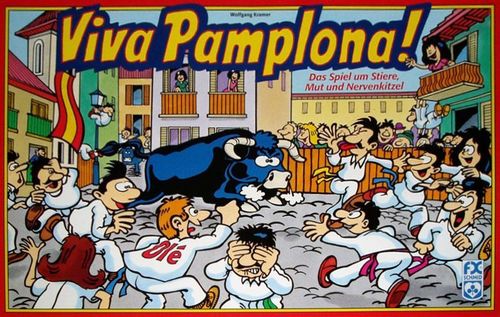
Viva Pamplona!
Viva Pamplona! Rulebook
Table of Contents
Table of Contents
Game Components
- 1 game board
- 6×3 playing pieces (runners)
- 1 bull ("Torro")
- 2 special dice
- 22 Torro cards
- 70 red chips (each worth 1 courage point)
- 30 yellow chips (each worth 10 courage points)
Setup
Each player receives:
-
3 runners
-
30 courage points
-
3 playing pieces (runners) of one color are given to each player and placed on the starting space marked with the arena signpost. Each player also receives 30 courage points as starting capital. It is best to take 10 red chips and 2 yellow chips, which everyone keeps visibly in front of them at all times.
-
The remaining chips are set aside as a supply next to the board, managed by one of the players.
-
Torro, the bull, is placed in the pen behind the starting space.
-
The Torro cards are shuffled well and placed as a face-down deck next to the board.
-
The player who first shouts "Olé!" begins; play then continues clockwise.
Game Flow
The game proceeds in phases. Each phase consists of two parts:
- The Runners' Round forms the first part. Here all players take turns rolling and moving their runners accordingly. Once every player has had one turn, follows
- the Bull Action: it is triggered by revealing a Torro card.
After each Runners' Round, a Bull Action follows. Then another Runners' Round follows, then another Bull Action, and so on, until Torro reaches the arena and the game ends.
The Runners' Round
- The players roll in turn with both dice and move two of their own runners, exclusively forward.
- The number on a die counts in full for one runner. Per pip, he must move forward one space. Splitting or forfeiting the pips rolled is not allowed. Any number of runners may stand on one space.
- The arrows on the dice let a player either leave a runner in place or move it forward 1 to 6 spaces, as he wishes. Staying in place counts as a move in this case too! A good instinct for using the arrows well is decisive for the runners' success.
- The Runners' Round ends once every player has had a turn. Now Torro takes action.
The Bull Action
- The last player now turns over the top Torro card and lays it face up next to the deck.
- A "Torro kommt..." (Torro is coming...) card causes Torro to move forward toward the arena by the number shown on the card. The starting space counts along with it. Nothing else happens yet, and the next Runners' Round begins.
- A "Torro greift an!" (Torro charges!) card triggers a scoring of courage points. Torro does not move in this case. Now what matters is standing as close beside or right in front of Torro as possible. Should such a card be drawn as the very first card of the game, it is shuffled back into the deck and a new card is revealed.
Distributing Courage Points
The courage points are now distributed from the supply, or returned to the supply, as follows:
- Runners on the same space as Torro: +3 courage points each.
- One space in front of Torro: +2 courage points each.
- Two spaces in front of Torro: +1 courage point each. For three or more spaces in front of Torro, there are no more courage points.
- Behind Torro: -1 courage point per space, paid into the supply.
Example: a player who has one runner three spaces behind Torro and another runner six spaces behind Torro must pay a total of 9 courage points.
Worked example: three runners stand at, respectively, 2 spaces behind Torro, at Torro's own space, and 1 space in front of Torro, and so on along a row scored as -2, -1, +3, +2, +1, +0:
- A: 3 + 2 - 2 = 3 → Player A receives 3 courage points.
- B: 2 - 1 - 1 = 0 → Player B gets nothing.
- C: 1 + 0 - 2 = -1 → Player C must give up 1 courage point.
After the courage points are settled, the game continues with the next Runners' Round.
If a player loses all his courage points before the game ends, he may take out a loan of 10 courage points from the supply. This loan will be deducted from the final score.
Special Spaces on the Board
- The orange fear spaces show situations where runners bring themselves to safety in front of the bull. If a player's runner lands on such a space — voluntarily or involuntarily — he must pay one courage point into the supply for it. Staying there afterward costs no further courage points.
- The two pink tomato spaces mark a spot that is hard to get past. Runners and the bull slip on the tomatoes when they land on either of these two spaces, and must immediately be moved back to the space just before the tomato spaces. They then need at least 3 movement points to get past them.
The Scuffle
If runners of different colors are standing on the same space, a scuffle may break out over the best spots.
Two conditions a player must meet in order to start a scuffle with his runners:
- He must be the active player and have just finished his turn with both dice.
- He needs a majority of his own runners over another player's on that space. This majority can be 2:1, 3:1, or 3:2.
He then receives from the losing player as many courage points as the difference between his own and the opposing runners amounts to.
In addition, he may displace the losing runners forward, by one or two spaces respectively, according to the courage points collected from that opponent. The fear and tomato spaces still apply even when runners are moved there by a scuffle.
Example: Player A has just finished his turn and collects 1 courage point from B and 2 courage points from C. A may then move each of B's runners forward by 1 space, and each of C's runners forward by 2 spaces. Since one of C's runners thereby lands on a fear space, C must also pay another 1 courage point into the supply, this time to the bank. D cannot scuffle, since it is not currently his turn. If E moves a runner forward onto the space where A and D are, nothing happens, since A and D cannot start a scuffle when it is not their turn.
Within the arena (light brown spaces), no scuffles take place.
Entering the Arena
"As late as possible, but still ahead of the bull" is the motto here. Placement of runners on the numbered ranks awards a corresponding number of courage points. Whoever is left behind at the end loses courage points.
- The light brown spaces of the arena behind the red finish line count as normal movement spaces. A runner's move onto them is carried out in full.
- Runners who have reached spaces in the arena remain standing there for the time being. At the end of the Runners' Round, they are then placed onto the numbered ranks.
- Placement onto the ranks corresponds to position on the arena spaces. The runner who is furthest ahead takes the first free rank, starting with rank 1; the second runner takes the next one, and so on. If several runners are on the same arena space, they are placed on the same rank.
Example: A is placed on rank 1, B on rank 2, C and D on rank 3, and E on rank 4.
Now Torro is moved. If he does not reach the arena, the next runners that reach the arena are placed correspondingly on the following ranks (from rank 5 onward), and so on.
- Now Torro takes action! If he does not reach the arena in doing so, the action is carried out as usual, and the next Runners' Round begins.
- Further runners reaching the arena are then, after the Runners' Round concludes, placed on the next free ranks, and so on. Once all 12 ranks are occupied, all runners arriving later are also placed on rank 12.
- Runners on ranks may no longer be moved and also no longer receive courage points when Torro charges.
- If a player has only one runner left in play, he may move it using whichever of the two dice results he chooses. Once he has placed all three runners on the ranks, he waits, tense, for the end of the game and the final scoring.
Game End
- If Torro reaches the arena, he ends the game immediately. His move into the arena is also carried out in full.
- If all runners are placed on ranks before Torro reaches the arena, the game likewise ends.
Now it will be shown which group of runners had the most courage. To do this, each player adds up the following results:
- The courage points in his possession.
- The rank points, corresponding to the ranks his runners are standing on. Each runner counts individually, even if several are standing on the same rank.
- The minus points for all the spaces that his runners are, respectively, standing behind the bull. This can get costly!
- Any loans are also deducted.
The player with the most courage points wins.
Congratulations! But should you ever really come to Pamplona, we recommend enjoying the real bull run only as a spectator.