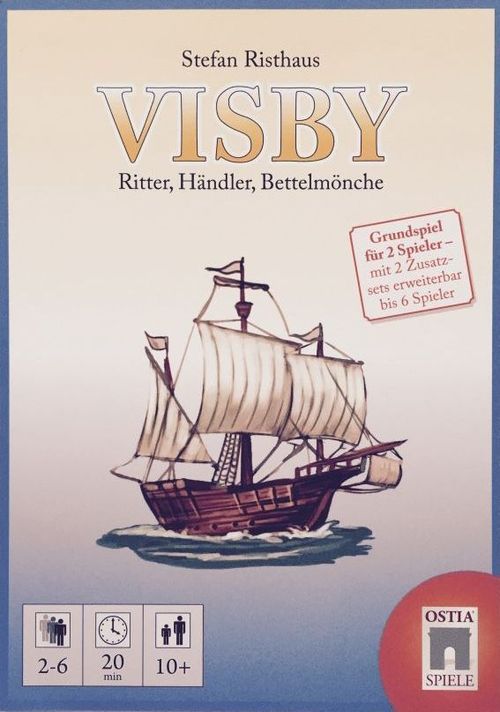
Visby
Visby Rulebook
Table of Contents
Table of Contents
Game Components
- 2-part board with tracks for Battle (Feldzug=red); Merchant Journey (Handelsfahrt=blue) and Market (Markt=yellow)
- 3 Markers for the board's tracks (red knight, blue ship, yellow bag)
- Per player: 8 action cards, 1 seal card, 1 ware card
- 2 display card Markers (red seal, blue bag)
- 1 "short rules" (German only)
Note: The game consists of a Base Game for two players (comes with the general material, cards and pieces for two players) and up to two Expansion Sets (each comes with cards and pieces for two additional players).
Game Preparation
Lay out the board in the middle of the table and place the marker with the matching color on space "1" of each track: red knight on Battle, blue ship on Merchant Journey and yellow bag on Market.
Take a set of 8 action cards to your hand and place one blue display card (the "ware card") and one red display card (the "seal card" with the 1-15 side facing up) in front of you. Place the red seal beside the seal card and the blue bag on the space corresponding to the number of players. Your opponents do the same.
When earning seals during the game, move your red marker forward on your seal card, and turn the card when you exceed 15 seals. When you receive wares, move your blue marker forward on your ware card and when paying wares move it backwards.
Notes:
- Turn the seal card to side showing 16 - 30 when you exceed 15 seals.
- Note that there is no backside on your ware card. You are limited to 15 wares.
- Seals and wares that are neither indicated on the board nor on the players ware card or seal card, are called the "common supply".
Course of Play
The game is played in rounds. The game ends if at least one player has 30 seals or more.
Each round has three phases: I. Supply II. Playing and revealing cards III. Evaluating the cards
I. Supply
Move forward the markers on the board of all three tracks, depending on the number of players taking part:
| Players | 2 | 3 | 4 | 5 | 6 |
|---|---|---|---|---|---|
| Spaces | 3 | 5 | 3 | 4 | 5 |
In case that a marker reaches space 15, any remaining steps will be ignored.
II. Playing and Revealing Cards
Choose 1 action card (in case of 4, 5, or 6 players) or 2 action cards (in case of 2 or 3 players) from your hand and place them face down in front of you. After all of you have chosen cards, reveal the cards so that everyone can see all played cards.
III. Evaluating the Cards
Evaluate the effects of all cards played this round in the following order. The effect of identical cards take place simultaneously. The cards remain in your display until the end of the round, when they will be discarded to your discard pile.
Battle
1. Troops ("Truppen")
Each troops card gains exactly 2 seals for the player who has played the card. Move your marker on your seal card forward two spaces and the marker on the board two spaces backwards. You never get more than 2 seals, even if more seals are available. Troops always get their seals before the knights, but only once.
Attention! If the board does not show enough seals to provide all, the general rule for dividing resources applies (see "What if seals or wares do not suffice?").
2. Knight ("Ritter")
All Knights get 1 seal each simultaneously from the board until there are not enough seals left on the board or every Knight gained 5 seals (the limit).
3. Blacksmith ("Schmied")
When playing the Blacksmith you gain wares depending on the number of Troops and Knights played this round by the other players. Take 4 wares for each Troops card and 2 wares for each Knight card. Do not take the wares from the board, but take them from the common supply!
You gain wares regardless of the success of the Knights and/or Troops and any other Blacksmith cards. Every blacksmith gains the depicted wares.
Examples for Battle
- The board shows 9 seals. 2 cards "Knight" and 1 card "Troops" is played. First, the Troops get 2 seals, and 7 remain on the board. The Knights simultaneously take single seals. When they have taken 3 seals each, only 1 seal is left, that cannot be divided. None of the Knights gets the remaining seal, and it is left over on the board.
- There are 6 seals on the board, while only 1 card "Troops" is played, but no Knight. The Troops gain 2 seals, the remaining seals stay on the board.
- With 10 seals on the board, there is only 1 Knight, but no Troops. The Knight gets 5 seals (limit), the others remain on the board.
- Three Troops and one Knight are played with 5 seals on the board. Each Troops card brings 1 seal to his player. The remaining 2 seals are not sufficient to give one to each Troops card owner and remain on the board. At the second stage the Knight takes the 2 seals from the board.
Merchant Journey
4. Fleet ("Flotte")
Each fleet card gains exactly 3 wares for the player who has played the card. Move your marker on your ware card forward three spaces and the marker on the board three spaces backwards. You never get more than 3 wares, even if more wares are available. Fleets always get their wares before the ships, but only once.
Attention! If the board does not show enough wares to provide all, the general rule for dividing resources applies (see "What if seals or wares do not suffice?").
5. Ship ("Schiff")
All Ships get 1 ware each simultaneously from the board until there are not enough wares left on the board for each ship to get one ware. There is no limit for the number of wares to gain per ship.
6. Tollkeeper ("Zöllner")
When playing the Tollkeeper you gain seals depending on the number of Fleets and Ships played this round by the other players. Take 3 seals for each Fleet card and 1 seal for each Ship card. Do not take the seals from the board, but take them from the common supply!
You gain seals regardless of the success of the Ships and/or Fleets and any other Tollkeeper cards. Every tollkeeper gains the depicted seals.
Examples for Merchant Journey
There are 8 wares on the board for each of the following situations:
- 3 Fleet cards, 1 Ship: each of the Fleets gets 2 wares, the remaining 2 wares are taken by the Ship.
- 1 Fleet, 2 Ships: the Fleet gains 3 wares, the Ships take 2 wares each; one ware is left on the board.
- 1 Ship: the single Ship takes all 8 wares.
Market
7. Merchant ("Kaufmann")
If you have played the Merchant card, you may (voluntarily) change as many wares as you want into seals. The exchange rate is indicated on the board on the yellow track.
Exchange rates printed on the yellow Market track (wares : seals), read from the board graphic on the Game Preparation page:
| Market track spaces | Rate (wares : seals) |
|---|---|
| 0-1 | 3:1 |
| 2-4 | 2:1 |
| 5-8 | 3:2 |
| 9-13 | 2:2 |
| 14-15 | 2:3 |
(Note: this table is not printed as text in the rulebook; it was read from the small board illustration. The values are consistent with the manual's examples: space 9 = 2:2, space 7 = 3:2.)
If there is more than one Merchant played this round, move the marker on the yellow track of the board backwards two spaces for every Merchant beyond the first (not below space "0"). If three Merchants were played, you move the marker back 4 spaces. The exchange rate next to the space with the marker is now in effect for all Merchants this round.
Important! You may trade wares for seals at an exchange rate of a lower space (for example 2:1 instead of 3:2). That may be useful if you do not have enough wares to use the actual exchange rate for all of your wares.
If there is at least one Merchant, the yellow marker moves back to space "0", regardless of the number of wares traded (even when no wares have been traded).
Example: The marker is on space 9 (rate 2:2). Heike and Malte both have played their Merchant and the marker is moved back to space 7. The final exchange rate therefore is 3:2. Heike owns 11 wares and trades 9 of them for 6 seals. Then she trades the remaining 2 wares for 1 additional seal.
8. Mendicant ("Bettelmönch")
When playing the Mendicant you benefit from your opponents' Merchants and the number of cards you have already played. The more cards you have already played, the more wares you gain for the Mendicant. Count all of the cards you have in your discard pile and add the number of cards you have played this round. You gain the following amount of wares from the common supply:
| Cards | 1-2 | 3-4 | 5-6 | 7-8 |
|---|---|---|---|---|
| Wares | 1 | 2 | 3 | 4 |
In addition, the Mendicant gets 2 wares from the common supply for each Merchant your opponents played (not your own) this round.
End of the Round
All players place their played card(s) onto their own face-up discard pile.
If you have played the Mendicant this round, take all of your eight cards back to your hand including the ones from your discard pile and those played this round. All other players are limited to the remaining cards on their hand.
Note: The markers on the board remain where they are. During the supply phase in the round they are moved forward, starting from the spaces where they are now.
What if seals or wares do not suffice?
All identical cards are activated at the same time. In case that seals or wares on the board are not sufficient to provide all required resources to the players, provide only as many resources to each player such as to give each player the same number of resources. Remaining wares or seals will remain on the board.
If you gain wares in excess of 15 wares total on your ware card, you take all wares from the board according to your action card, although the extra ones are lost.
You always get all seals, even beyond 30. Mark the additional seals separately or write them on a piece of paper.
Example: With five wares on the board, Malte and Heike play their Fleet card. Both gain two wares each, and one ware remains on the board. Malte already has 14 wares and can only add one of his wares to his ware card. The other one is lost.
End of Game
The game ends if any player has 30 or more seals. Finish the round to make all played cards activate.
Note: In 2- or 3-player games we recommend, after some games, to play until one of the players has gained 45 seals (finishing the round). Additional seal cards are available for download on www.ostia-spiele.de.
Scoring
All players may now trade their remaining wares for seals at the rate of 3:1.
The player with the most seals wins.
In case of a tie the player with more wares left on the ware card wins, and finally the tied player with the most remaining cards in hand at the end of the game wins.