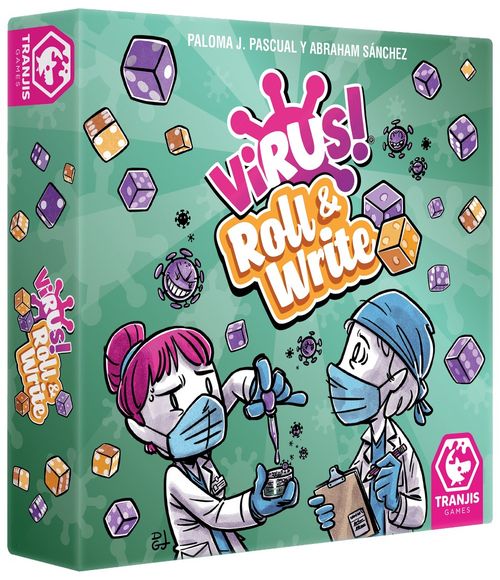
Virus!: Roll & Write
Virus!: Roll & Write Rulebook
Table of Contents
Table of Contents
Components
- 4 clinical trial cards
- 4 laboratory cards
- 1 pad with 50 score sheets
- 1 priority access card
- 1 contaminated samples card
- 12 dice in 4 colors
- 4 pencils
- This rulebook
Objective
The game is won by whoever scores the most points on their final evaluation. You earn points for the number of boxes you've crossed off for each disease, for being the first to complete a disease's grid, and for optimal use of the supplementary resources. You lose points for every study sample you contaminate with virus.
During the game, you'll run clinical trials individually (colored cards) and share laboratory time (research cards) with the rest of the scholarship applicants.
Setup
Place the 4 clinical trial cards, the contaminated samples card, and 2 of the laboratory cards in the center of the table. Return the rest to the box. The laboratory cards are double-sided: one side for games with 2 or 4 players, and the other for when you are 3 players (marked with an icon in the bottom right corner). You can find an explanation of the different laboratory cards further below.
Each player takes the 3 dice of one color. If only 2 of you are playing, each player takes 6 dice from the same color range.
Now, the youngest player takes the priority access card and places it on their side of the table.
Finally, each player takes 1 pencil and 1 score sheet. Everything is ready to start investigating!
First game?
If you are 2 or 4 players, use laboratory cards B2 and C2.
If you are 3 players, use laboratory cards A3 and B3.
Once you know the rules well, you can use the cards in any combination to add more variety and difficulty to your games, always matching them to however many players you are.
The Score Sheet
On your score sheet you will track your progress throughout the game, but before starting, you must fill in a few details:
- Write your name here.
- This tracker shows the rounds you will play, based on the number of players.
- Mark the color of the dice you are using. If two of you are playing, mark both of your dice colors at the top.
The sheet is made up of the following areas:
- A Clinical trials
- B Discovered cures
- C Laboratory row
- D Wildcard tube
- E Virus tube
- F Final evaluation
You can now start the game!
Game Round
The game lasts a fixed number of rounds depending on how many people are playing. You will play 5 rounds if you are 2 players, 7 if you are 3 players, and 8 if you are 4. Cross off the boxes that correspond to more players than you actually have (for example, if you are playing with 2 players, cross off the boxes for 3 and 4 players). In each round, follow these steps:
1. Roll the dice!
Each player rolls all their dice and places them next to their score sheet, so that everyone can see the results the rest have obtained throughout the round.
Dice are only rolled once per round! Results can only be changed by using wildcards (see Wildcards below).
2. Play your turns!
Starting with the player who has the priority access card, alternate turns clockwise, placing 1 single die each time, until everyone has placed all of their dice on the cards. The turn sequence is explained in detail below, under Turn of Play.
3. Contaminated samples!
If you cannot place 1 die from your reserve on any clinical trial or laboratory card, you must place it on the contaminated samples card. Do the same with dice that were left alone in a double laboratory slot (see Laboratory Cards below). Those dice will give you negative points.
Add up the values of all the dice of your color on the contaminated samples card and write the total in the first free box of the virus tube on your score sheet.
4. Retrieve your dice!
Check that you have made all the relevant notations on your sheets, and retrieve your dice.
5. End of the round!
Cross off the matching number on the round tracker before starting the next round.
Only once you have played the last round does the game end, and you proceed to the final evaluation (see End of the Game and Scoring below).
Turn of Play
On each turn you must choose one of your dice to place in a free slot on one of the cards on the table. Under no circumstances can there be more than one die in a slot. There are 2 types of cards where you can place a die: trial cards and laboratory cards.
Priority Access
Each round, the first player to place a die on one of the laboratory cards takes the priority access card. That player will be the one to start the next round.
Clinical Trial Cards
There are 4 trial cards, each associated with one of the 4 diseases in the game: blue, red, green, and yellow. Trial cards always have 2 slots and all work the same way. When you are about to place a die on a trial card:
- If both slots on the card are free, place your die and cross off, in the zone matching the card's color on your sheet, the box that corresponds to the die's value. (Example: you cross off the 1 in your green zone.)
- If the card has one slot occupied by a die (regardless of who placed it), place your die in the other slot and cross off, on your sheet, the box that corresponds to the trial card's color and the value of the sum of both dice — yours and the one that was already there. (Example: you cross off the 4 because the sum of the dice on the card is 4.)
- If the card has both slots occupied, you cannot place your die on it.
In any case, you must be able to cross off the resulting box in order to place the die on the trial card.
If crossing off a number on your score sheet completes a row or column of the grid, you get an extra cross-off. If you complete a row and a column at the same time, you get both bonuses.
Draw a line through all the boxes in the row or column and the icon at its end. Then cross off any box of your choosing in the grid of the color shown by that icon. If crossing off that new box completes a row or column, you get another extra cross-off, and you continue crossing off wherever the icon indicates.
For example: by crossing off the 10 in your green zone you complete a column. You cross off the column and see that the icon's color at the end of the column is red. Immediately, you cross off a number of your choice in your red zone.
Laboratory Cards
Laboratory cards give you access to the benefits of the laboratory row on your sheet. These cards have more complex requirements than trial cards. In games with 2 or 4 players, each laboratory card has 2 slots. In games with 3 players, they only have one slot.
Cards for 2 or 4 players:
- A2 — The value of both dice must be the same.
- B2 — The value of one die must be odd and the other even.
- C2 — The value of the left die must be greater than or equal to the value of the right die.
- D2 — The values of both dice must be different.
Cards for 3 players:
- A3 — The value of the die must be even. Add 1 to that value.
- B3 — The value of the die must be even. Multiply that value by 2.
- C3 — The value of the die must be odd. Add 2 to that value.
- D3 — The value of the die must be odd. Multiply that value by 2.
When you are about to place a die on a laboratory card:
- If the card has no free slots, you cannot place your die.
- If there are still free slots left after placing your die, you do not cross off any box. You must wait until someone completes the card, at which point both that player and you cross off the box that corresponds to the sum of all the dice on the card.
- If the card has only one free slot left (meaning you complete it), cross off the box in the laboratory row that corresponds to the sum of the dice. If 2 players took part, both of you do so. (Example: by placing your die with a value of 2, you cross off the 3 — 2+1 — in your laboratory row. By placing the die showing 5, both players must cross off the box for 11 in their laboratory rows.)
You must be able to cross off the resulting box and meet the condition stated on the card in order to place the die.
If you placed first and, once the card is completed, you cannot cross off the resulting box, you cross off nothing.
Laboratory Row Advantages
- 2 — Extra cross-off: immediately cross off any free box in one of the four diseases. Remember that, by crossing off a box, you can also complete a row or column and earn an extra cross-off. (Example: by crossing off an extra cross-off box, you cross off an empty box of a color of your choice among your clinical trials.)
- 5 — Wildcard: circle an empty box in your wildcard tube. From now on it will be available. You cannot circle a wildcard that is already circled or one you have already used (and crossed off).
You must carry out the laboratory row advantage you have obtained.
Wildcards
On your turn, before placing a die, you may cross off a wildcard you previously circled to change the value of one of your dice before placing it. Remember that you start the game with one wildcard already circled and available. (Example: you cross off a circled box to change your die from a value of 1 to a 5.)
At the end of the game you will earn 3 points for each wildcard you have circled but not crossed off.
Contaminated Samples Card
If you cannot (or do not want to) place a die on a trial or laboratory card, you must place it on the contaminated samples card. At the end of each round, write down in the virus tube the sum of the values of the dice you have placed on this card. You will be penalized for this at the end of the game.
Sometimes it will be impossible to meet the requirements for placing a die on a card, but other times it may be more advantageous to accept the penalty instead of placing them — whether to save wildcards, because the penalty is low, or to force your rivals into spending wildcards or suffering bigger penalties themselves. We've seen it all in the wards of this hospital!
Discovering a Cure
When you cross off every number in a disease's grid, you have discovered a cure!
If no one has claimed it for this color yet, speed bonus! Mark the corresponding box in the discovered cures area of your sheet as shown, and you will earn 5 additional points at the end of the game.
All other players must immediately cross off that same box on their score sheets. They can no longer claim the prize for this color.
If, upon completing a laboratory card, two players discover the same cure at the same time (after making all extra cross-offs), both of them get the speed bonus for that color.
End of the Game and Scoring
At the end of the game, each player counts their points using the final evaluation row at the bottom of their score sheet. Each section scores as follows:
-
Research for each disease: Count the number of boxes crossed off in each clinical trial and check the table below for the points you've earned.
Boxes crossed off Points 0-3 boxes 0 points 4-7 boxes 5 points 8-10 boxes 10 points 11-12 boxes 12 points -
Speed bonus: If you have earned the 5 points for being the first to discover the cure for any of the diseases, add up all of those points and write the total there.
-
Wildcards: If you have circled wildcards, add 3 points for each of them. Crossed-off wildcards score no points.
-
Contaminated samples: Add up the values written in your virus tube and write down the result. Remember that you must subtract this from your score.
Calculate your total, write it in the bottom right box, and compare it with the rest. Whoever has scored the most points has won the game and gets to enjoy the long-awaited scholarship. Congratulations!
In the event of a tie, the player who has crossed off the most boxes in the laboratory row wins. If the tie persists, whoever has the lowest contaminated samples value wins. If there is still a tie, the committee decides to award the scholarship to all tied players, who share the victory.