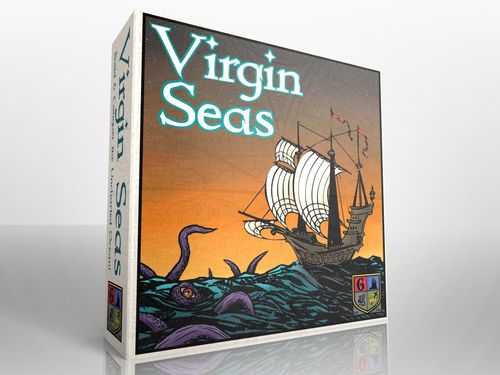
Virgin Seas
Virgin Seas Rulebook
Table of Contents
Table of Contents
Objective
New lands have been discovered in the virgin seas! Take charge of a fleet of sailing vessels as you attempt to secure control of the waters surrounding the newly found islands. The player in control of the most valuable sets of Islands at the end of play wins!
Components
60 fleet cards (15 in each color) 18 event cards 60 Ships (15 in each color)
Setup
-
Separate the fleet decks and ships by color. Each player should choose a matching pair.
-
Each player shall shuffle their own fleet deck and place it face down in front of themselves, to form a draw pile, next to their own stash of ships.
-
Players then draw the top three cards from their draw pile to form their starting hand.
-
Remove the three Kraken cards from the event deck. Shuffle the remaining cards. Draw (5 for two-players, 8 for 3-players, or 11 for 4-players) cards and then shuffle all the Kraken cards back into the deck. Place this deck face down in a place all players can reach. Remove remaining event cards from play.
Card Anatomy
Faction Type: This indicates which faction this card belongs to.
Trump Chart: This chart shows which faction trumps which faction during sea combat.
Combat Icon: This icon tells the player how this ship attacks and in which direction.
Playing the Game
Virgin Seas is played in turns. Each player takes their turn and then play continues clockwise. The last player to have been on a boat goes first.
On the player's turn they will:
-
Play one card, from their hand, face up to the table, with at least one full edge aligning with the edge of another previously played card. Note: The first card played does not follow this rule as there are no other cards to play next to.
-
Players will then place one of their ships onto the card they played, unless they played an island card or a fortress card.
-
Remove any of your opponent's ships from their cards and replace them with one of your own ships, if you have successfully attacked them.
-
Draw back up to three cards.
Combat
Combat in Virgin Seas is both simple and strategic. Only ships can attack other ships and they do so by following two rules.
Trump Order
Virgin Seas uses a rock-paper-scissors mechanic to determine the outcome of battle. Each of the three factions (shield types) can trump one of the other factions and is prone to the third. Red trumps green, green trumps blue, and blue trumps red. If a player places a card, of his own, in a position where it trumps another player's card(s), it will capture that card(s). Note: Only cards with ships on them may be captured.
Attack Type
Each card, that can attack, has a combat icon (bottom right of card) that indicates the direction that card may attack. Each card may only attack in the direction shown, but they may attack multiple ships at once in most cases. Refer to the chart below for more details.
Combat icon key:
-
Four-point compass icon (orthogonal): You may attack card(s) to the left, right, up, or down position of this card. Must be adjacent. Note: In the case of the fortress card, this icon indicates that the fortress protects all of the cards in the left, right, up, or down position from attacks from other players. This applies only to cards that are adjacent to the fortress.
-
Four-point diagonal icon: You may attack card(s) in any of the four diagonal positions from this card. Must be adjacent.
-
Four-point cross (long-range) icon: You may target a SINGLE card, no matter the distance, as long as it is in a direct line with this card. This attack can leap over other ships, but not over islands or fortress cards. This single attack must be launched in a left, right, up, or down direction.
The Fortress Card
Each fleet deck contains one Fortress Card. This card does not attack, but rather protects cards belonging to its own fleet. When placed, the player places a ship of their own color on it. Fortresses, and any card with a matching colored ship adjacent to the fortress, may not be attacked. This protection is applied only to the four cards to the left, right, up, or down position from the fortress. Note: If an opponent has a card w/ship in place prior to the placing of a fortress, it stays in play. However, if that card is captured by the player owning the fortress, that card will be protected.
Placing Islands and the Event Deck
An island card can be placed in any position as long as the edges line up with at least one other card, just like any other card. However, players do not add a token to island cards as they are neutral. No one player controls or owns an island until the game ends and scoring begins.
When a player places an island card to the table, they must draw an event card. Most event cards allow the player to take a unique action, however there are also three Kraken cards in the event deck. When a Kraken card is revealed, it should be placed face up in a place for all players to see. If and when all three Kraken cards are revealed, the game ends immediately! All other event cards may be kept secret and used by the player on their own turn.
Types of Event Cards
Compass: When played the player may move any of their own cards that reside on the outside of the board to another outside position. The card being moved may only connect to two or less cards to considered on the outside of the board. When reconnected to the board, it must connect to one or two cards.
Cyclone: When played the player may swap any two ships in play, except for fortresses.
Mermaid: When played the player may discard any number of their fleet cards in their hand to the bottom of their fleet deck and then redraw back up to three cards.
Poseidon: When played the player may add an additional ship to one of their own cards. This forces opponents to attack a card twice in order to capture it.
Protector: The protector is a reaction card. It is played when another player plays an event card that effects one of the players cards or ships. When played it nullifies the other event card.
Whale: Whales like to eat, so if used, the player may remove any one ship from play except a ship on a fortress card. Yummy humans!
Board Size Restrictions
As players take turns placing cards to the table, one after another, they are slowly building a grid. There is a restriction to the size that the grid may become and its based on the number of players.
The first card played at the beginning of a game has no influence as to where the boundries will be. Players actually decide the boundries when they place a card to the outside of the grid that triggers the maximum length or width allowed.
Example: During a two player game Bob places a card to the edge of the grid, making the grid seven cards wide. No more cards can now be played further in either direction. Players must stay inside this boundary.
Here are the maximum dimensions for grids based on player count:
- 2 player = 7x7
- 3 player = 8x8
- 4 player = 9x9
End Game and Scoring
The game ends immediately, and scoring begins, when one of two conditions are met.
- Three Kraken Cards are revealed from the event deck.
- All players have placed their island cards (each player has 3 in their deck).
There are two ways to score points in Virgin Seas.
- Players score 1 point for each event card they still have at the end of the game. All event cards are discarded after use during play.
The other way to score points is to occupy the waters surrounding the island cards. Determining who controls an island is quite easy. The player with the most cards that share an edge with the island has control. If two or more players have an equal number of cards next to an island, whoever has more cards in the diagonal positions, in regards to the island, gets the tie breaker. If a tie persists, those players each get the victory points.
Example: Both the yellow and blue player have two controlled cards next to the island card in the center. This is a tie. However, since the blue player has another ship in the diagonal position, they break the tie.
Each player adds up their scores. The player with the most points is the winner! If there is a tie, the player with the most ships in play is the winner. Now it is time to set up and pay again!