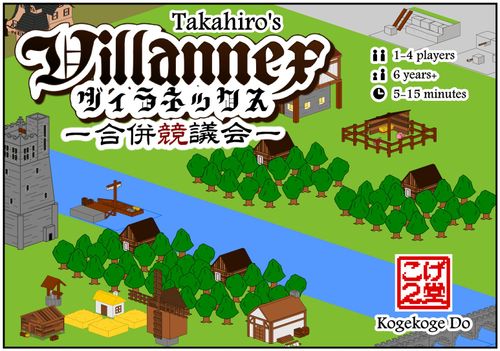
Villannex (2014)
Villannex (2014) Rulebook
Table of Contents
Table of Contents
Contents
32 Village cards:
- 24 building cards
- 8 occupation cards
8 production cards
Village card layout: a resource is connected to the effect; the card has a name, an effect, and resource frames. Building cards are shown as the Building card (Village card), occupation cards as the Occupation card (Village card). Production cards have a pointing arrow at the produced resources.
Overview and goal
- The players are village mayors, trying to prove to the others that their village is the best.
- Each player's village is the 2 cards in front of them.
- Each player's resources are the resource frames (on his village cards) that are "set to produce", i.e. that have a production card underneath it, pointing at the frame.
- The value of a village, is the value of the resources plus the bonus from occupation cards.
- The value of resources and bonuses depend on all cards on the table.
- Building cards changes the value of each resource.
- Occupation cards gives a bonus to all villages that fulfill the requirements.
Example. This village produces one wood, two livestock, and one grain.
- The Charcoal hut causes wood to be worth 2 points each, and stone to be worth -3 points each.
- The Cook's effect gives 5 bonus points for each set of 1 livestock and 1 grain.
- So this village would get 2 points for its wood, and 5 bonus points; a total of 7 points.
How to play the normal game (2-4 players)
Preparations 1: Shuffle all the cards, and deal 6 to each player. These should not be shown to the other players.
Preparations 2: Deal 2 production cards to each player.
This game has no starting player. All players play simultaneously.
Step 1. All players choose 4 cards from their hands and show 1 to the others.
- The rest of the cards aren't used; put them to the side.
Step 2. When all players have seen the others' cards, all players retake their 4 cards to their hand.
- If it takes too much time, you can try set a time limit of 1 or 2 minutes.
Step 3. All players simultaneously choose 2 of their hand cards and put down before them, and chooses which resource frames that will produce. Put a production card underneath each, with the arrow pointing at the frame of your choice.
- The other 2 cards aren't used; put them to the side.
Step 4. Resolve all the resources and the effects of the cards, and calculate score. The village with the most points wins.
Example of a 3 player game
The example shows three villages: your village (the middle column, labelled "You" / あなた in the manual), the Left village and the Right village. The score table has one row per resource, with a column per mayor and a total per row. The table's printed row notes are "No such building, so 0 points", "Stone bridge 4 points, Walls 5 points", "Grain field 4 points", and the Cook occupation bonus row. The manual's printed final totals are:
- You: 27
- Left: 26
- Right: 22
Note: the per-cell figures of this example table are graphic-only in the source PDF and are not reproduced cell by cell here; the printed row notes and final totals are transcribed as shown.
Score calculation
- Write the name of the players (mayors) in the columns.
- Note down how much each village produces of each resource.
- Check all cards in all villages and determine the value for each resource.
- Note down how much points each village gets for their produces resources.
- Check all occupation card effects, and note down the bonus points for villages that meet the requirements.
- Total up the production value and occupation bonus for each village.
If there's text on the village cards, please observe these rules:
- "
were produced" means in ALL villages. In the example, 4 stone were produced. 8 grain were produced (counting the Trading Post effect). - "
that were produced in each village" means in YOUR village. In the example, you produced 1 wood. - "
that were existed" means in ALL villages. In the example, there is 1 Trading Post. - "If
" means it happens if the condition is met. In the example, "If 5 or more Grains were produced" does not happen. "If 3 or less Grains were produced" does not happen. - "For each
" means it happens each time the conditions are met. In the example, "For each 1 Stone that were produced" happens 4 times. "For each set of 1 Livestock and 1 Grain that were produced in each village" happens once in your village, and twice in Right village. - "Each village
" means it happens in the villages that meet the conditions. In the example, a "Villages with 2 or more Grain" would refer to both Left and Right village.
Optional rules
Booster draft
- During preparations step 1, after dealing 6 cards to each player, do a "keep one card, send the rest to the left" 6 times. If you do, you can skip play step 1 and 2, since most can guess what the others have.
2 round game
- After scoring the first round, move all the village cards to a central, common area. These cards are no one's village, and the resource frames are ignored.
- Each player retakes the 4 cards they didn't use, to form a new hand.
- Deal 2 new cards to each player from those that weren't dealt at the start.
- Play another round with these new cards.
- This second round, the effects of of the common area cards are also counted.
- The player with the highest total after these 2 rounds wins.
Revealing one at a time
- Determine start player in any suitable fashion.
- During play step 1, instead of showing 4 at a time, the turn player chooses 1 card to show.
- Turn player then chooses one player who has shown less cards than he, to be the next turn player.
- If all players have shown equal amount of cards, turn player shows another card.
- When all players have shown 4 cards, play resumes as normal.
Solitaire game (for one player)
Preparations 1: Shuffle all cards, and make a deck.
Preparations 2: Draw 6 cards to form your hand, and take 4 production cards.
The solitaire game is 4 rounds long. You win if you manage to complete 4 rounds without failing.
Step 1. [From round 2 and on] Place your village from the previous round (all four cards) in a common area (they're still in play), remove the production cards from them and draw cards from the deck until you have 6 cards in hand. Draw 2 sets of 2 cards from the deck.
Step 2. These are the random villages. Choose one of the random villages to keep, discard the order.
Step 3. Choose 2 cards from your hand and put beside the random village you chose. All these 4 cards count as "your village". Put one production card under each village card, your choice. Calculate score. Villages from previous rounds do not produce, but still work for all other purposes.
Step 4. You clear the round if you manage to reach the designated score for the round. The score goal is for 20 points times the round, i.e. 20 for round 1, 40 points for round 2, 60 points for round 3, and 80 points for round 4. Note that only the score for the current round counts, you do not total your score from previous rounds. You can't continue to the next round unless you complete the current. If you clear round 4, you win. If you clear it with 100 or more points, it's a complete victory.