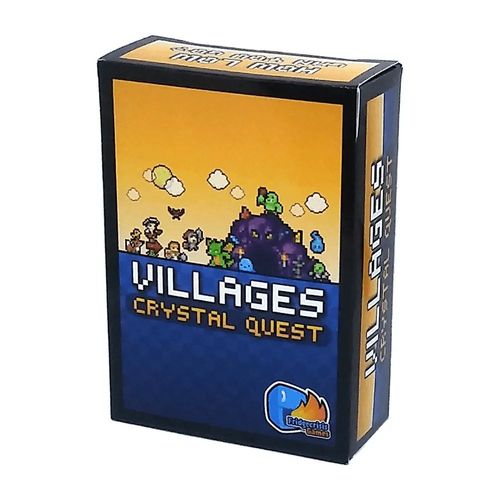
Villages: Crystal Quest
Villages: Crystal Quest Rulebook
Table of Contents
Table of Contents
Contents
- This rulebook
- 22 cards for the main deck, including:
- 19 Units
- 2 Animals
- 1 Building
- 24 treasure cards, including:
- 6 Crystals
- 18 other Treasures
- 24 monster cards
Setup
Add the new units, animals, and buildings to the main deck. You may follow the deckbuilding rules from the base game rulebook and remove some of the base game cards, but you can also just mix them all together for faster setup.
Set aside all 6 Crystal cards into 3 separate piles. Distribute the rest of the treasure cards onto these piles. Shuffle each pile individually, then stack them into one deck. This makes sure the Crystals are evenly distributed throughout the treasure deck. Put this deck in the middle of the table, somewhere near the main deck.
Shuffle the Crystals into 3 treasure piles, then stack them!
Shuffle the Monster cards together to form a Monster deck and put it next to the Treasure deck. Leave space for a Monster discard pile.
And finally, for the first round of the game, give the High Score card to the dungeon, as if they were a player. Set this card near the Monster deck as well.
Crystal Quest
Crystal Quest is a new way to play Villages. It's very similar to the original game, but with the rule adjustments listed below.
Action Phase
As your action phase, you now have the following 3 options:
- Do nothing.
- Attack another player's village.
- Raid the dungeon (see the "Raiding the Dungeon" section on page 8).
Discard Phase
Instead of discarding a card as your action phase, you must discard one (if you have any) at the end of your turn, even if you took an action. This is a new required phase.
Ending the Round
Emptying your hand does not end the round in this game mode, and you won't earn extra gold for doing so. Instead, the final turn of the round begins when a certain number of Crystals have been found in the dungeon. The number required depends on the number of players.
| Players | Crystals |
|---|---|
| 2 | 4 |
| 3 | 5 |
| 4 | 5 |
| 5 | 6 |
For example, if you're playing with 4 players, then as soon as the 5th Crystal is revealed, the final turn begins. The player who found the last Crystal does not get another turn before the round ends.
Scoring
Add the gold value of the treasure in your treasure pile (a new personal pile, similar to your graveyard) to your score at the end of the round.
Raiding the Dungeon
Valuable treasures are hidden deep in the dungeon, guarded by powerful monsters of all kinds. Instead of attacking other villages as your action, you can send your entire village to explore the dungeon together.
Raiding the dungeon follows these steps:
- Decide which village to send.
- Decide how many monsters to fight.
- Draw and reveal monsters.
- Assign units to fight monsters.
- Draw treasures.
- Lose units (if any monsters survived).
1) Decide which village to send
Any of your villages can be sent to the dungeon. Choose your biggest and strongest!
2) Decide how many monsters to fight
You can choose how many monsters you'd like to encounter, up to the number of units in the attacking village. However, you may find that fighting more than 1 or 2 monsters at a time might be dangerous, so choose carefully.
3) Draw and reveal monsters
Draw the chosen number of monsters from the monster deck and flip them over. Some monsters will summon other monsters, and some units have abilities that let you redraw monsters or cancel monster abilities. You can choose the order in which to apply these effects.
4) Assign units to fight monsters
It's time for battle! To defeat a monster, it must be fought by one or more of your units, and each unit can only fight one monster. Divide your forces so that the combined power of your units is equal to or greater than the power of the monsters they are fighting. Any additional power beyond what it needed can not be carried over to other monsters.
When applying ability text, a dungeon raid counts as going to battle. Monsters are a sub-category of units, so dungeon monsters are considered defending units in a defending village, and your units are attacking units in an attacking village.
Most unit abilities only affect themselves, the particular monster they're fighting, and/or the other units fighting the same monster. For example, the Joker's ability applies to the individual battle he's involved in, not to other monsters being fought by his allies.
You may also hire one or more units from your hand during this step. Any hired units will go to your graveyard after battle, as usual, so use them carefully.
For more help with applying abilities, see the "Extra Notes" section on page 15.
5) Draw treasures
For each monster you were able to defeat, you get some treasure. The treasure icons at the bottom of each monster card tell you how many treasures to draw for that monster.
Most of these treasures will go to your treasure pile, a new personal pile you can keep near your graveyard. These treasures will increase your score at the end of the round.
A few of these treasures tell you to attach them to one of the units who raided the dungeon. This effect lasts for as long as that unit is in that village. If the unit is kidnapped, discarded, destroyed, or moves to a player's hand, move the attached treasure to the bottom of the treasure deck.
After drawing treasure cards, move all defeated monsters to the monster discard pile.
6) Lose units
If any monsters survived your attack, they will retaliate and destroy a unit from your village. Shuffle all of the village's units together, including those who may have defeated other monsters, and randomly choose one to send to your graveyard. You only lose one unit, no matter how many monsters survived the battle. Do not draw treasures for the surviving monsters--just move them to the monster discard pile.
Example Dungeon Raid
King Fridge sends a village containing a Joker, Tamer, and Thief to raid the dungeon. He decides to face 3 monsters--a risky move.
These 3 monsters are drawn and revealed to be a Cave Bat, Fell Knight, and Deep Dragon. The Cave Bat's ability allows it to summon yet another monster, but Fridge uses the Tamer's ability, which cancels the Cave Bat's call.
Tamer cancels Cave Bat's ability!
Next, Fridge sends the Joker to fight the Deep Dragon. The Joker's ability allows it to defeat the normally superior Deep Dragon all by himself.
Joker makes the weaker unit win!
Meanwhile, the Tamer and Thief team up to fight the Cave Bat. The Thief's ability does nothing against monsters, since they don't have a hand to steal from.
In a tie, attackers win!
That leaves the Fell Knight as the last surviving monster. Left unopposed, he would kill off a random unit from the village, but King Fridge has a plan. He hires a Priest from his hand.
Fell Knights always lose against Priests!
Victory! Fridge sends the hired Priest to his graveyard and draws his earned Treasures.
Extra Notes
Ability Details: For the sake of applying ability text, the dungeon's hand has 0 cards in it, its graveyard is the monster discard pile, it will not allow other players to defend it, the only reward you can choose for defeating it in battle is drawing treasures, and the dungeon ceases to exist as a player or village as soon as battle is over, other than owning the High Score card in the first round.
Power Dice: When you raid the dungeon, roll one of the dice for yourself and roll the other for the dungeon. Apply the dungeon's die result to the monster with the highest power. If there is a tie, choose one. You can apply your result to any one of your units. Roll another 2 times if applying the result to the Gambler.
Alchemist: Use the monster's treasure icons as their gold value.
Greedy Gold Mine: For Crystal Quest, replace the text with the following: "The player who finds the final Crystal gets 10 bonus gold."
Medusa: The Medusa's ability can be used when she is hired for a dungeon raid to defeat any one monster.
Pirate: The dungeon can't lose gold, but you can still add 2 to your score if the dungeon has the High Score card.
Mummy: Send the Mummy to the monster discard pile after battle.
Vulture: Monsters can't be added to your hand, but you can use the Vulture to take a unit defeated by surviving monsters.
Wolf: Cave Bats and Spiders are animals, as well as monsters. The Wolf gets bonus power when they appear in the dungeon.