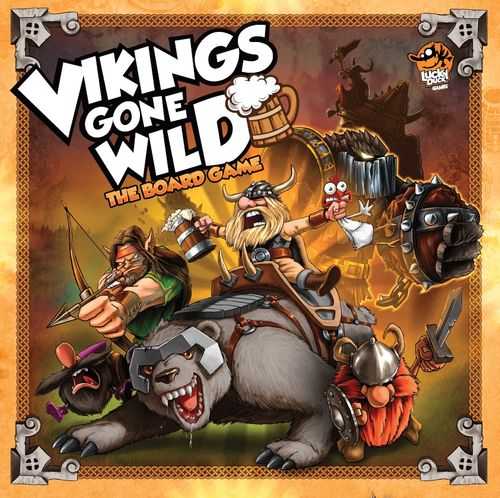
Vikings Gone Wild
Vikings Gone Wild Rulebook
Table of Contents
Table of Contents
- Goal of the Game
- Video Tutorials
- Contents
- Setup
- How to Play
- Game Round
- #1 Production Phase
- #2 Drawing Phase
- #3 Players Phase
- #4 Storage Phase
- #5 Round-ending Phase
- The End of the Game
- The Divine Favor Cards
- Basic Rules
- First Game Setup
- FAQ
- Cards
- Expand Your Game!
Goal of the Game
In Vikings Gone Wild, players take the role of heads of clans fighting against each other to prove to the gods who is the best.
You will gain Victory Points (VP) mainly by attacking other players, defending successfully, upgrading your Town Hall and completing missions. The last turn is reached once any player obtains 40 or 30 Victory Points, depending on the number of players, but the final winner will only be determined once the 24 Bonus points have been attributed.
During each turn, you play the cards in your hand to buy Units or Defenses, construct Buildings and attack the ones of your fellow players. You will have to find the right balance between investing in your economy and growing your army!
Video Tutorials
If you want to learn the game the easy way, visit our website at www.luckyduckgames.com
You will find many video tutorials and other content to learn and master this game. If you have any questions about the game don't hesitate to check out our online FAQ or contact us directly!
Contents
- 1 Game Board
- 16 Player Tokens
- 20 Construction / Damage Tokens
- 25 Gold Bars
- 25 Beer Barrels
- 12 Town Halls Cards
- 4 Starting Decks of 10 cards each
- 14 Defenses Cards
- 18 Units Cards
- 52 Buildings Cards
- 4 Helper Cards
- 40 Odin's Path Cards
- 8 End-Game Bonuses Cards
- 12 Divine Favors Cards
- 20 Missions Cards
- 1 First Player Token
- 4 Player Sheets
Setup
2 to 4 players can play Vikings Gone Wild: The Board Game.
Player Setup
- Each player picks a Player Sheet.
- He then picks 2 matching Player tokens and puts the smaller one on the starting position of the scoring board.
- The larger Player token goes on your Player Sheet's flag.
- Each player receives 3 Town Hall cards (one each of Levels 1, 2 and 3). Place the Level 1 Town Hall card facing up with the Level 2 and Level 3 Town Hall cards under it) on your Village Area.
- Sort all the Mission cards into 2 separate piles, one pile with only the 1 Victory Point Mission cards and one pile with all of the 2 Victory Points and 3 Victory Points Mission cards together. Shuffle both piles separately. Each player randomly picks 2 Missions from the 1 Victory Point pile and puts them face up on their Player Sheet. Then place the combined 2 and 3 Victory Point Mission card pile at the bottom of the 1 Victory Point pile.
- Place the now-combined Mission Deck on the side, so that it is accessible to every player.
- Each player receives a Starting Deck containing 6 Beer cards, 2 Gold cards and 2 Viking Warrior cards; shuffles it; and places it on their Player Sheet.
Board Setup
Put all (8) Units, (9) Defenses and (10) Buildings cards face up on their assigned spots.
- Shuffle all Odin's Path cards and put 5 of them face up in the assigned spot of the Odin's track.
- Place the Odin's Path Deck in its location (top left corner of the board).
- Randomly draw 3 Divine Favor cards per player and return the rest to the box. Shuffle them and put the Deck on its assigned spot. Cards with (3+) sign should be used only in 3 or 4 players games.
- Draw the top 2 cards of the Divine Favor Deck and place them, face up, on the right of the deck.
- Shuffle all End-Game Bonus cards and place the first 4 cards on their assigned spots. Return the rest of the cards to the box.
- Place the Construction/Damage tokens and Beer barrels/Gold bars all around the board so that they are accessible to all players.
How to Play
Game Round
A game round is divided into five phases:
- #1 Production Phase
- #2 Drawing Phase
- #3 Players Phase
- #4 Storage Phase
- #5 Round-end Phase
#1 Production Phase
During this phase, every player will put a Beer barrel on each Brewery and a Gold bar on each Gold Factory which they own. These resources are usable during the round, just like playing a Beer or a Gold card.
NOTE: A Brewery or Gold Factory can never have more than one resource on it!
Example: Vincent has two Gold Factories and one Brewery. Therefore, he produces 2 Gold bars and 1 Beer barrel during his turn.
#2 Drawing Phase
During this phase, every player draws 5 cards. For each Tavern which a player has built, their hand is increased by one extra card.
Example: Vincent has 2 Taverns, therefore, he draws 7 cards (5 + 2 for both Tavern) into his hand during each round's draw phase.
The Drakkar building allows a player to retain a card in hand from the previous round. If the player has kept a card from the previous round thanks to a Drakkar, that card does not count against the hand limit in the draw phase.
Example: Vincent has 2 Taverns and has kept one card from the last round thanks to his Drakkar. At the end of the draw phase, he has 8 cards in his hand (5 + 2 for both Taverns + 1 kept in hand from the previous round thanks to the Drakkar).
#3 Players Phase
During this phase, all players will take their turns clockwise around the table, starting with the first player.
Each player has 6 different types of actions:
- Buy Units, Defenses, or Odin's Path cards
- Buy Buildings
- Upgrade the Town Hall
- Attack
- Complete a Mission
- Exchange Resources
There is no limit or set order to the actions that a player takes in the course of his turn. Each player can build, attack and buy in the order of their choice and at their convenience.
3.1 Buying Units, Defenses, or Odin's Path cards
Each player may purchase Units, Defenses and face-up Odin's Path cards, with the only limit being the number of resources that the player has available for purchases during their turn.
Each card that you can buy has a purchase price in Gold (yellow square), Beer (brown circle), or both.
In the example below, the Pigator costs 4 Beer and 3 Gold.
The players can buy cards by using resource cards from their hand or Beer barrels and Gold bars from their Buildings and Containers. To do so, they must pay the number of resources equal to the purchase price of the card (top right corner of the card).
A card cannot be played during the same turn in which it is purchased. When you buy a card, place it in your Player Area with the other cards played during this turn. They will be discarded when the round finishes. Never place a newly purchased card directly into your hand.
Example: Vincent wants to buy an Elf Archer that costs 3 Beers. He plays 2 Beer cards from his hand and 1 Beer barrel from his brewery. He puts the Beer cards and barrel as well as the Elf Archer card in his Player Area with the other cards he played during this turn.
Note About Resource Icons
A Beer barrel token = 1 Beer, and is storable.
A Gold bar token = 1 Gold, and is storable.
The 1 Beer and 1 Gold icons (printed on cards) are non-storable resources.
Effectively, this means only produced or looted resources are storable.
Note About Odin's Path
If a player buys a card from the Odin's Path river, all the cards remaining in the river which were to the left of the purchased card are moved to the right and then the empty space next to the Odin's Path Deck gets filled up immediately by the top card on the Deck. The current player can still buy a card that has just been revealed if s/he has enough resources.
3.2 Buying Buildings
Unlike any other cards, Buildings are permanent. Therefore, they are not mixed with the player's Deck but stay in front of them, in their Village Area, for the entire game.
Like the other cards to buy, Buildings have a purchase price in Gold and/or Beer (top right corner of the card).
The maximum limit of the Buildings that can be built in Village of the player is determined by the level of the player's Town Hall. The Town Hall is not included in that limit.
When a player wants to buy a Building, they first check their current Town Hall Building limit. If there is room and they have fewer than three of that type of Building, they pay the Building's price and place it in front of them and put a Construction token on it. This results in two things: that Building can neither be used nor attacked during that round. The Building will become active at the end of the round when the Construction token is removed during the Round-End Phase.
A player cannot build the same type of Building more than 3 times per game.
3.3 Upgrading the Town Hall
The Town Hall is the heart of the player's village. Therefore, it defines the maximum size of the Village Area.
With a Level 1 Town Hall, the player's Village Area is limited to a maximum of 3 Buildings (not including the Town Hall).
To upgrade to Level 2, the player will have to spend 3 Gold. After upgrading their Town Hall, the player places the Level 2 Town Hall face up and places a Construction token on it. The Level 2 Town Hall does not become active until the next round, as with any new Building, when the Construction token is removed. However, the other players cannot attack the Town Hall for the remainder of the current round.
With a Level 2 Town Hall, the number of Buildings player can have in their Village Area cannot exceed 6.
With a Level 3 Town Hall, there is no limit to the number of Buildings a player can own. The limit of 3 Buildings of each type still applies. When a Town Hall is upgraded to Level 3, the player is instantly awarded 5 Victory Points.
IMPORTANT: Once a round, at your turn, you may return one of your Buildings back into the supply. However, you are not granted any reimbursement or bonuses by doing so.
3.4 Attacking
During his turn, a player can attack another player's Building(s), an Undead, or Draco.
In order to make a successful attack, the combined strength value of the attacking Units must be equal to or greater than the defense value of their target.
Each Unit can be sent to attack only one single target. The strength value of a Unit cannot be divided to attack two Buildings or two Undead, for example.
Attacking Another Player
You do not attack a player directly but instead attack their Buildings.
YOU CAN ONLY ATTACK ONE PLAYER PER TURN.
YOU CANNOT TARGET PLAYERS WHO HAVE ALREADY BEEN ATTACKED BY OTHER PLAYERS THIS ROUND.
EXCEPTION: A player may be unable to attack either of the other players because they attacked each other. In that case, and that case only, the player is allowed to attack any players' Buildings that have not already been attacked.
Only Units and Heroes can attack Buildings.
Each Building has a defense value. To make a successful attack, the total strength value of the player's attacking Units and Heroes must be equal to or greater than the Building's defense. You can use as many Units and Heroes as you want to attack a single Building, but you cannot divide the strength value of your Units or Heroes against multiple Buildings.
It is recommended that you attack one Building at a time for better clarity and strategy. Nonetheless, you can attack all Buildings simultaneously if you wish.
When an attack is successful, a Damage token is placed on that building. This does two things:
- It allows for the counting of Victory Points and indicates that the Building can no longer be attacked during this round.
- It also indicates that the player has been attacked and can no longer be the target of another player until the next round.
WARNING: A Building with a Damage token is not destroyed. It can still be used by its owner.
Example: Vincent attacks Marta's Gold Factory with his Viking Warrior. The Gold Factory's defense value is 1. The Warrior's strength value is 1. The strength is at least equal to the defense, so the attack is successful. Marta puts a Damage token on her Gold Factory.
The more Buildings a player successfully attacks, the more Victory Points he gets at the end of his turn (see table).
| Successful Attacks | Victory Points |
|---|---|
| 1 | 1 |
| 2 | 3 |
| 3 | 5 |
| 4 | 7 |
| 5 | 9 |
| 6 | 11 |
| 7 | 13 |
Extra Damage Rewards
Some Buildings have one or more symbols below their defense value. These indicate extra damage rewards. Because such Buildings are more resistant to attack, the attacker receives the listed damage reward in addition to any other Victory Points won by having made a successful attack.
If the damage reward is a Victory Point symbol, the victorious attacker receives the indicated number of Victory Points.
If the symbol is a Beer barrel or Gold bar, they loot it from the targeted Container. If it is empty, the attacker wins no resource. Any resource looted this way is stored immediately in the attacker's Container, if possible. If the attacker has no available Container space, the looted Beer or Gold is put on top of the player's Town Hall and will be discarded at the end of the round if not used during that turn.
If the symbol is a Divine Favor, they get to choose one Divine Favor card (see section "The Divine Favor Cards").
How to Defend Yourself Against Another Player
You never defend your Buildings during your turn but during your attacker's turn.
To defend yourself against another player, you must have purchased Defense cards and have them in your hand.
When a player declares an attack on one of your Buildings, you can play one or more Defense cards to increase the defense value of the Building under attack. If the combined defense value of the Building and the played Defense cards is higher than the attack value, the attacker is rebuffed.
WARNING: You cannot increase your attack once a Building has been defended. You have to plan for a possible defense in advance of your attack.
After a Building is successfully defended, the defender immediately wins a number of Victory Points equal to the number of UNIT and HERO cards repulsed.
The Defense cards remain on the defended Building until the end of the round. That Building can be attacked again, but the effect of the Defense cards will remain until the end of the round.
Total Defense
If after the attacker's turn none of the defender's Buildings have been damaged, it is considered a Total Defense. Therefore, the defender earns 1 additional Victory Point and places a Damage token on his Town Hall to signal that he has already been attacked during this round.
Example: Vincent attacks Marta's Level 1 Town Hall with 2 Elf Archers. The Town Hall has a defense value of 4, and the Archers have a strength value of 2 each for a total of 4. But Marta places a Cannon card on her Town Hall which adds +2 to her Building's defense, so the defense value is 6 versus an attack value of 4. Vincent's attack on this Building was defeated. Because Vincent attacked with 2 units, Marta gains 2 Victory Points. Furthermore, because Vincent does not declare any more attacks, Marta get 1 additional Victory Point for completing a Total Defense!
Attacking the Draco or Undead Cards
You can find the Undead cards among the Odin's Path cards and the Draco on the board.
Defeating Undead cards from the Odin's Path rewards you with the resource displayed on the card and 1 Victory Point. Once defeated, the Undead card is put in the Odin's Path Discard Pile. It is possible to attack as many Undead as are available and as your hand allows.
If you defeat the Draco located on the board, you are rewarded with a resource of your choice.
WARNING: Each player can only attack Draco once per round.
3.5 Complete a Mission
During setup, each player received two Mission cards.
Each Mission card has a goal to achieve. If you meet a goal's requirements, you can announce it to the other players and immediately receive the number of Victory Points written on the card. Then you place the accomplished Mission, facedown, on the Mission Successful spot at the bottom right of your Player Sheet.
WARNING: A player can only complete 1 Mission per round!
During the Drawing Phase, if you only have one Mission card face up, draw a new one.
If more players need to draw a Mission card, it always starts with the first player.
NOTE: Once per turn a player can pay 1 Gold to change one of his Mission cards. The discarded Mission is returned to the bottom of the Mission Deck. A player can never have more than 2 Mission cards face up at the same time.
3.6 Exchange Resources
The player may exchange 2 identical resources for one of the other type:
- two Beer can be exchanged for one Gold
- two Gold can be exchanged for one Beer.
This action can be used repeatedly.
Example: Vincent exchanges a Beer card and a Beer barrel for a non-storable Gold resource.
NOTE: The resources gained that way are not storable. Only the resources that have been produced or looted from Draco or the other players can be stored.
#4 Storage Phase
During this phase, and this phase only, players can move their unused produced resources to their Containers. A player can also move already stored resources to another Container for that resource.
If the player does not have a Container for that resource, the resource produced during that round is lost.
NOTE: During that Phase, if a player has 4 identical resources stored in a Container, they earn 1 Victory Point.
#5 Round-ending Phase
During this phase many things will occur:
- All players discard the cards played during this round.
- All players also discard the remaining cards in their hand that they didn't play during this round, except for cards retained due to Drakkar.
- All Construction and Damage tokens are removed.
- The Odin's Path card on the rightmost is discarded face down in its associated Discard Pile. Then, all cards facing up are moved to the right. Finally, a new card is drawn and placed in the empty spot.
- The first player of the ending round gives the first-player token to the player on their left who will become the new first player in the next round.
A new round can now begin.
The End of the Game
The game ends when any player has won a certain number of Victory Points. That number depends on the number of players.
- 40 Victory Points — two players
- 30 Victory Points — three or four players
If a player reaches or exceeds the Victory Point limit at any time during a round, the current round becomes the last one. All players can play and finish their turn normally to try and earn the most Victory Points before the round ends.
EXTENDED PLAY RULE: If your group of three or four players likes longer playing sessions, you can increase the Victory Points game-end condition to 40.
End-of-Game Bonus Points
During the board setup, 4 Bonus cards were drawn.
For each Bonus card Players verify if they meet the condition. If only one player meets the condition of a Bonus card, they earn an extra 6 Victory Points. If more than one player meets the condition of a Bonus card, the 6 points are divided equally (2 players = 3 Victory Points each, 3 players = 2 Victory Points, 4 players = 1 Victory Point).
After the final round and tallying the Bonus points, the player with the most Victory Points wins the game.
In case of a tie between several players:
- Take the remaining Bonus cards which were placed back into the box during setup;
- Shuffle them;
- Pick one randomly;
- The players who are tied check the condition of the selected card; and
- If one player meets the conditions of the selected Bonus card while the other does not, then the player meeting the condition wins. If more than one player or neither of them meet the condition, they are still tied. If they are still tied, repeat this process for the other Bonus cards from the box.
- If there is still a tie after all Bonus cards have been checked, the tied players share the victory.
The Divine Favor Cards
The Divine Favor cards are the most powerful cards in the game.
You cannot buy Divine Favors cards; they are earned.
There are 2 ways to earn a Divine Favor card:
- When a player reaches a certain number of Victory Points (5, 12 and 20 Victory Points) even when this is not that player's turn (for example while defending), or
- By successfully attacking a Level 3 Town Hall.
When a player has to pick a Divine Favor card, s/he flips the card on top of the Divine Favor Deck and chooses one between that one and the 2 face-up Divine Favor cards for a total of three options. The chosen card is put in the Player's Area. If the player picks one of the 2 face-up Divine Favor cards, the now empty Divine Favor spot is immediately filled with the one drawn from the top of the Divine Favor deck so that there are constantly two cards facing up.
If there are no Divine Favor cards left, the players can no longer win any.
Basic Rules
- Any time you have an empty Deck and must draw a card or reveal the top card from your Deck, shuffle your Discard Pile and make a new Deck.
- The cards played during your turn are discarded only after all the players have completed their turns. Therefore, you do not shuffle the cards that have been played during your turn if you have to shuffle your Deck in the middle of your turn.
- The cards you purchase (except Buildings) go with the cards you played in your Player Area.
- You can choose the starting player as the last one who drank a beer or the one with the longest beard.
- When 2 effects are separated by a "+", you can resolve either in any order.
For example, with the "Alviss" card you may draw two cards first and then attack using Alviss and the newly drawn Units.
- Definition of « Draw »: « Draw x card(s). » without any other specifications, always means « Draw x card(s) and keep them your hand ».
First Game Setup
To simplify your first game and gradually introduce rules, we advise that you use the following Bonus cards:
- ACCOMPLISHER
- BUILDER
- KING PIG
- MINER
FAQ
Q: What should I do during the Draw Phase when I have less than 5 cards left in my Deck? A: Take the cards you have left in your Deck, shuffle your Discard Pile and draw more cards for a total of 5 cards in your hand.
Q: Do Defense cards count as Buildings for the Town Hall limitation? A: No. The Town Hall itself is also not included in this limit.
Q: Can I store my unused Beer cards or Gold cards in my Containers? A: No. The only resources you can store are the ones produced by Breweries, Gold Factories, or looted while successfully attacking an opponent's Container.
Q: When I successfully attack a Brewery or a Gold Factory, can I take the resource on it? A: No. Only Beer and Gold containers can be looted.
Q: When I successfully attack an empty Container, can I take a resource from the supply? A: No. You only loot resources from your opponent. If the player doesn't have any resources stored, you have nothing to loot.
Q: Do Undead cards count for the Follower Bonus? A: No. Undead cards are put in the Odin's Path Discard Pile once they have been successfully attacked.
Q: Can I spend what I looted during the same turn? A: Yes.
Q: Can I attack with Mjolnir or Sword without a Unit? A: No. These cards need a Unit to carry them.
Q: Can players look through each other's Discard Piles at any time? A: Yes.
Q: Can you have more than one Hero in an attack? A: Yes.
Q: Can you get the bonus Victory Point for having a full Container, each round, for the same group of 4 resources? A: Yes.
Q: Do Buildings with a Construction token on them count towards the Beer Specialist, Gold Miner or Dvergar cards? A: Yes.
Q: Do you earn the Total Defense bonus when you only get attacked once and successfully defend? A: Yes.
Cards
Town Hall
Card anatomy: Name, Defense Value, Extra Damage Reward, Card Effect, Upgrade Cost.
The Town Hall is the player's headquarters. It limits the number of maximum constructible Buildings.
Players can upgrade their Town Hall in order to increase that limit. At level 3, there is no limit to the total number of Buildings, and the player immediately earns 5 Victory Points for its construction.
Buildings
Card anatomy: Name, Defense Value, Purchase Price, Extra Damage Reward, Card Effect.
Buildings are permanent cards. Once purchased, they immediately sit in the Village Area and will remain there until the end of the game.
You cannot build more Buildings than what your current Town Hall allows.
Each player can build only 3 Buildings of the same kind.
Odin's Path
Card anatomy: Name, Type of Card, Purchase Price, Card Effect, Odin's Path Card symbol.
The Odin's Path cards provide a wide range of resources, Units, Defenses and improvement cards.
Undead
Card anatomy: Name, Zombie Defense Value, Card Effect, Odin's Path Card symbol.
The Undead cards can be attacked during the player's turn. They are found among the Odin's Path.
If a player beats an Undead card, they win the reward and put the card, facing down, in the Odin's Path Discard Pile.
Divine Favors
Card anatomy: Name, Divine Favor Card symbol, Card Effect.
The Divine Favors are the most powerful cards in the game.
You cannot buy them. They are earned through Victory Points (5, 12 and 20 points), but also by attacking the other players' Town Halls of level 3.
Some cards contain the word HERO. They differ from the UNIT by their power.
Units
Card anatomy: Name, Attack Card symbol, Purchase Price, Unit's Strength.
The Unit cards are used to attack other players, Undead cards, or the permanent Draco. Each Unit entitles you to one attack only, but you can combine them in order to increase the total strength value of an attack.
Defense
Card anatomy: Name, Defense Card symbol, Purchase Price, Card Effect.
The Defense cards are used to defend Buildings against other players.
These cards are played once a player has declared an attack on a Building. The defender can then temporally increase the defense value of the Building being attacked and cause the attack to fail.
End-Game Bonuses
Card anatomy: Bonus Name, End-Game Goal, Reward.
Missions
Card anatomy: Mission Name, Mission Goal, Reward.
Expand Your Game!
- Guild Wars Expansion
- It's a Kind of Magic Expansion
- Ragnarok! Expansion (Solo & Co-op Mode)
Check out our website: luckyduckgames.com