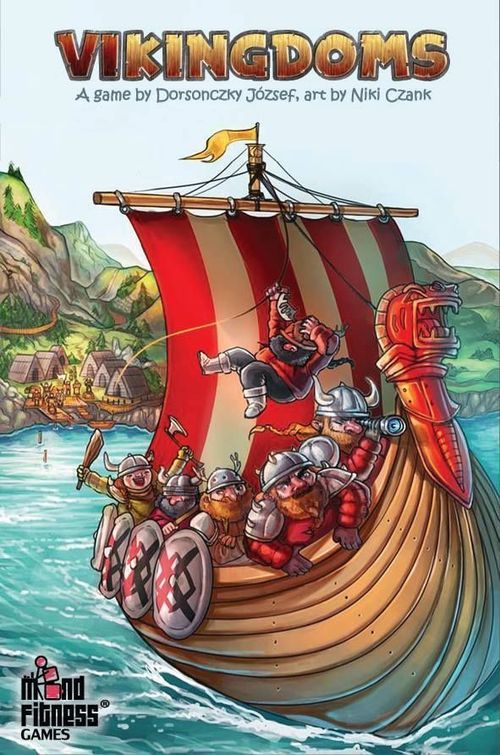
Vikingdoms
Vikingdoms Rulebook
Table of Contents
Table of Contents
Overview, Goal of the Game
The players are Viking seafarers who expand their territories by continuously raiding new lands. They loot coins and build villages, ports, and other settlements. During their raids, they may capture prisoners or even get their hands on allies.
The islands of the five kingdoms – five pairs of territory tiles – lie at the mercy of the raiders and are 'waiting' to be pillaged. Each raid requires a larger troop of six or more Vikings that players recruit together so they can loot together, and the player whose Viking leads the raiding troop chooses the first tile.
The player who builds three villages or three ports or collects 16 coins can build the VI. Kingdom, and wins the game.
Components
- 6 board tiles
- 12-12 Viking pieces
- 12 territory tiles
- 2-2 territory markers
- 1 raid marker
- 4 ally tiles
Set-up
- Place the 6 board tiles edge-to-edge to create the board (see figure).
- Choose a colour and take the 12 Vikings and 2 territory markers.
- Shuffle the 12 territory tiles and both players randomly draw one. Place the remaining tiles in a row next to the board in pairs - these will be the islands you'll be raiding - the five islands. Each island is built from two territory tiles (tile pairs).
- Start building your territory: place the tile you've drawn in front of you, then place one territory marker on the left (the lockup) and one on the right (the camp) side of the tile, and finally place your Vikings in the camp (next to the tile).
- Take as many Vikings from your opponent as shown on your territory tiles and place them in your lockup (prisoners).
- Place the 4 ally tiles on the free side of the board.
- The owner of the less wealthy territory – the one with fewer coins or, in case of a tie, the youngest player – decides from which of the islands the raiding starts, the upper or the lower island – places the raid marker next to that island.
The player who has placed the raid marker starts the game, then they take turns.
Gameplay
The game consists of two distinct phases:
Recruitment –> Raiding –> Recruitment –> Raiding – and so on.
During the recruitment phase, players place Vikings on the board or move the ones that are already there until they build up a raiding troop – a troop (stack) of 6 or more Vikings. In the raiding phase, players take the upcoming territory tiles – each player takes one –, and then they perform the actions on the tiles: take or exchange prisoners, taking an ally, etc. At the end of the phase, they fit the tile into their territory.
Recruitment Phase
In this phase, players recruit a troop of 6 or more Vikings. In the followings, we will call any such unit a raiding troop.
If the player on turn can build up a raiding troop with his own Viking on top, he must do so! This is the golden rule of recruitment and is only applied to your colour! It is not mandatory to build the raiding troop with the opponent's colour!
In his turn, a player chooses one action: PLACING (A) or MOVING (B). Attention, the player cannot choose his action freely if by moving he can build a raider troop with his Viking on top (he must move according to the golden rule).
- A, PLACING: places one of his Vikings on an empty square.
- B, MOVING: moves Vikings from a troop on top of another one.
The player chooses a troop – any colour (from both colours!) – and moves one or more Vikings onto another one, as it is not allowed to move onto empty squares. No matter how many Vikings you want to move from a troop, you always take them from the top.
Important: In Vikingdoms a player who doesn't have any Vikings in his camp and has no possibility to move on the board loses his turn and his opponent is up next.
How to Move the Vikings
The size of the troop – height – determines how the Vikings from that troop can be moved (doesn't matter how many Vikings are moved):
- 1 Viking: a single square in an orthogonal direction.
- 2 Vikings: over any number of free squares in an orthogonal direction.
- 3 Vikings: in an L shape – two squares orthogonally and one square sideways, or one orthogonally and two sideways. The only troop from which Vikings can jump over other troops.
- 4 Vikings: over any number of free squares in a diagonal direction.
- 5 Vikings: over any number of free squares in any direction.
Important: Undoing the opponent's exact last move is not allowed.
Examples:
- a) You can move 1, 2, 3, or 4 Vikings from the troop of 4 onto the white Viking – not anywhere else!
- b) From the troop of 2, you can move 1 or 2 Vikings onto the white Viking.
- c) From the troop of 3, you can move 1, 2, or 3 Vikings onto the white or red Viking.
- d) The Vikings from the first row can be moved onto each other.
End of the Phase
The recruitment phase ends as soon as the first raiding troop is built. Right after that, the Raiding starts.
Raiding Phase
Players raid the territories that are next to the raid marker.
Place the raiding troop on the raid marker, then each player takes one of the two territory tiles. The first to take a tile is the player whose Viking leads the troop – has the Viking on top. His opponent must take the remaining tile.
Territory Tiles
There are twelve territory tiles, from which six types of buildings can be built: village, port, fortress, workshop, farm and marketplace.
Each tile gives additional coins and prisoners, their amount shown on the upper left and right corner.
Two tiles also contain rioters, these can be found on the picture.
Resolving the Taken Tile
Before adding the taken tile to your territory, the effects of the tile must be performed strictly in the following order!
- Prisoners. The player who has more prisoners on his tile takes as many Vikings from his opponent as the difference is between them, and places them in the lockup (example: 4-1=3, takes 3 prisoners). In case of a tie, no prisoners are taken. If the opponent doesn't have enough Vikings in his camp, the prisoners are taken from the raiding troop.
- Riot. When a player collects a second rioter, a riot breaks out, and he loses one of his territory tiles. His opponent takes a territory tile of his choice, and places it in front of himself. He also receives the prisoners that are shown on the tile (example: due to a riot, the player loses a tile and 4 prisoners).
- Ally. When a player collects his second village or port or fortress tile (by raiding or by a riot), he will also take an ally tile. If both players achieve this goal at the same time during a raid, the first player to choose an ally is the player whose Viking is on the top of the raiding troop (example: two ports were collected and an ally tile was taken).
- Prisoner exchange. If a player has two or more prisoners, he can initiate – if he wants to – a prisoner exchange. They exchange the same number of prisoners and place them back into their camp (example: the players exchange 3 prisoners).
Ally Tiles
There are four different ally tiles. Whenever you obtain one, you place it underneath one of your territory tiles.
- FREYA – the lawbreaker: It is no longer mandatory to build the raiding troop with your Viking on top!
- VÖLUND – the wealthy: Gives 3 coins to your territory.
- GUNNAR – the strategist: You may immediately exchange two territory tile pairs between themselves.
- LÖKE – the conqueror: You immediately take two prisoners from your opponent, and put them in your lockup.
End of the Phase
The phase ends by building your territory tiles into your territory, disbanding the raiding troop and thus each player putting his Vikings back in his own camp, and finally, moving the raid marker next to the upcoming island (territory tile).
If no one has reached a victory condition, a new recruitment phase begins.
End of the Game
If at the end of the raiding phase one of the players has 3 identical buildings in his territory – 3 villages or 3 ports – or has 16 coins collected, the game ends immediately and the player wins the game since he has built the VI. Kingdom.
Example: victory with three villages. Example: victory with 16 coins.
If both of them reach a victory condition (3 villages or 3 ports or 16 coins) at the same time, the player with the 3 identical buildings wins.
If both of them have built 3 identical buildings (one of the players 3 villages the other 3 ports), or both collected 16 coins, the winner is the player who had his Viking leading the last raiding troop - who had his Viking on top.
Attention, Riots Can Spoil Your Victory!
Although, after taking the territory tile, a player will have 3 identical buildings or 16 coins, it is possible that his victory might still be spoiled by his opponent. If a riot breaks out due to the taken tile, his opponent may take such a tile from him that at the end of the phase he won't have 3 buildings or 16 coins.
Example: with the port tile, the player has gathered 16 coins, but because he has now collected a second rioter, his opponent can take any of his tiles – worth 1, 2, 3, 5, or even 6 coins; so, at the end of the phase, he won't have 16 coins.