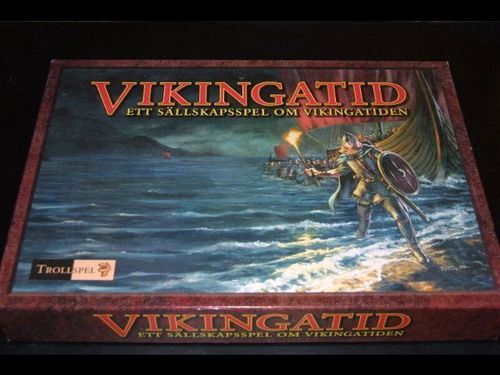
Vikingatid
Vikingatid Rulebook
Table of Contents
Table of Contents
The Game Components
The board
The board consists of three parts:
The known world. This is where the players' fleets usually are. Denmark (Danavalde), Norway (Norge) and Sweden (Svea Rike) are Viking kingdoms. Most journeys start here. Furthermore, the map consists of land and sea areas. Some areas are empires, and others are provinces of these empires, marked in the same colour. There are also areas that belong to no empire at all.
The areas show the following symbols:
| Symbol | Explanation |
|---|---|
| Sea serpents | Give the danger value of a sea area. Each serpent corresponds to 1 danger point. |
| Dragon heads | Give the danger value of a land area. Each head corresponds to one danger point. |
| Coins | Give the trade value of a land area. Each coin corresponds to one danger point. |
| Shields | Give the army strength of a land area. Each shield corresponds to one army. The number corresponds to the strength of the armies. |
| Cities | No influence on the game (is already accounted for in the trade value). |
Unknown land areas (Oupptäckta Landområden). This part of the board looks like the known part of the world. The difference is that ships can only move here if the player has played a discovery card. The players get victory points for discovering previously unknown land areas.
Tables and information. Here are the following tables:
- Spelomgången (turn): Lists the phases of a game turn and their order.
- Spelomgångsvisare/Tidlinje (turn track / time line): Displays the current turn. Each turn corresponds to 25 years. This table also shows the dice roll necessary to be christianised.
- Segerpoäng (Victory points): Here the players mark their victory points with counters.
- Statskassa (Royal Treasury): Here the silver coins are placed for each kingdom.
- Symbolförklaring (Symbol Explanation): Explains the symbols on the map.
- Reaktionstabeller (Reaction tables): There is one table for each empire. They show what happens if Vikings build camps in these empires.
- Gäldtabellen (Money table): Shows how much money the players get for the "Money" (Gäld) result on the reaction table.
Game counters
There are counters for each player, and there are shared counters. Pay attention to the fact that front- and backside of a counter may have different meanings. It is important to place the counters always with the proper side up.
Each player has the following counters (please refer to the pictures in the original rules):
- Trading ships (short hull, plaid sails). The number stands for the amount of ships. There are counters for one, three, five and ten ships. Counters can be exchanged to represent always the right number of ships.
- War ships (long hull, striped sails). The number stands for the amount of ships. There are counters for one, three, five and ten ships. Counters can be exchanged to represent always the right number of ships.
- Trade camps (River banks). Shows how many trade camps the player has. There are counters for one, two, three and four camps. Counters can be exchanged to represent always the right number of camps.
- War camps (River banks). Shows how many war camps the player has. There are counters for one, two, three and four camps. Counters can be exchanged to represent always the right number of camps.
- Victory points ("Segerpoäng"). Is placed on the victory point table to indicate the number of victory points of the player.
- Home country (Hemland). Is used when a player emigrates from his Viking kingdom. This counter marks the new home country.
Counters for the Viking kingdoms:
- King ("Kung"). Shows which player is king of each kingdom.
- War/Peace (Krig). Is used to indicate war in a Viking kingdom. Unfortunately, this counter is not printed correctly. Please write the word "Peace?" on the backside to indicate that the respective kingdom is on its way to peace.
Shared counters:
- Year ("År"). Is placed at the year 800 on the timeline on the board. This counter indicates the current game turn.
- Trade stop. Shows that there is no more trade in a land area.
- Plundered (Plundrat). Shows that a land area was plundered this turn.
- Discovered ("Upptäckt"). Indicates that an unknown land area has now been discovered.
- Conquered ("Erövrat"). Is used to mark conquered land areas.
- Heritage ("Förläning"). Marks an area a player got as heritage.
- Small kingdom ("Smårike"). Marks an area a player got as small kingdom.
- Separatists ("Utbrytare"). Shows Viking counters that separated themselves from the player they belonged to and now are independent.
- Byzantine / Western Caliphate / Eastern Caliphate ("Bysans" / "V. Kalifatet" / "Ö. Kalifatet"). Marks areas that have been conquered by the respective empire.
- Silver (coins of 1, 3, 5 and 10). Is used to show how much silver a player owns. Is also used for the treasuries of the Viking kingdoms and placed in the proper field on the board.
Cards
The game includes 112 cards (and three pages of their translation per player). Unused cards are to be placed in a pile next to the board, face down. Used cards are placed face up in another pile, face up. When there are no more cards to draw, the used cards are shuffled and recycled.
Dice
In the game, there are six ten-sided dice, abbreviated as D10.
Preparations
All players roll their dice. The highest number is the first to choose his home country - Denmark, Norway or Sweden. Then the other players choose, in order of their dice roll, until everybody has a home country. There is no limit how many players can start in the same kingdom. With many players in one land, the king's election and co-operation are important. With few players per kingdom, the opposition between the Viking lands grows. The players may also decide beforehand, which lands are played.
Each player takes a set of counters, three cards and his three pages of card translation.
Basic Rules
Summary of the game turns
Each turn consists of eleven phases (also listed at the end of each player's card translation sheets), played in this order:
- Draw cards. Each player draws one new card. This is valid also in the first turn, so that each player starts effectively with four cards.
- Roll for empire reactions. For each area where players have built camps in an empire, roll on the empire reaction tables.
- Election of kings. The kings of Denmark, Norway and Sweden are elected in this order.
- Distribution of silver. The players get silver from their treasury.
- Buying ships. The players buy trading and war ships and place them on the board.
- Initiative and journeys. Each player rolls his dice. The highest roll gets the initiative and conducts one of his journeys. The players continue to roll for initiative and perform journeys until there are no more ships on the board.
- Taxation. The players share their silver with their treasuries.
- Clear markers and discard. All "plundered" and "trade stop" markers are removed from the board. All "Peace?" counters are removed. Change all "War" markers to "Peace?". Remove ships that cannot be moved (e.g. trading ships that are locked in because of plundering). Players with more than three cards have to discard down to three cards.
- Victory points distribution. Each player gets victory points for conquered areas, discovered lands and being king of his kingdom.
- Christianisation. Starting in the year 900, each player rolls a dice to see if he becomes christianised.
1. Draw cards
Each turn, every player draws a card. At the end of a turn, no player is allowed to have more than three cards. If he draws a fourth card and doesn't play it this turn, he must discard one of his cards (see phase 8). Played or discarded cards are put on a pile, face up. When all cards are used up, the discard pile is shuffled and used again.
Cards can be played throughout the turn, if the card doesn't say otherwise. When a card is played, its instructions are followed. Some cards contradict the rules. "Free trade", for example, enables a player to trade despite a trade stop. Many cards can also be played against other cards, or combined for special effects. If two cards contradict each other, the last played is considered valid. So it is possible to cancel the effect of a "trade stop" card with "free trade".
2. Roll for empire reaction
For each area that contains camps in an empire, roll a dice and compare the result on that empire's reaction table, adding +1 to the roll for each war camp in that area.
| Result | Effect |
|---|---|
| Fred | Peace. Nothing happens. |
| Krig | War. All camps in the area are destroyed. |
| Gäld | Money. The player gets money corresponding to the "Gäld" table on the board (roll a dice). Then he converts all camps into the corresponding type of ship, placing them in the same area (one ship per camp). |
3. King's election
Each turn, there is a king's election in the three Viking kingdoms (Denmark, Norway and Sweden, in this order), if there are any players in the respective country. All players from that kingdom roll a dice. Even a player from another country may participate if he is the current king (can happen through cards). Furthermore, one player rolls a dice for the kingdom itself. If one player rolls at least three points higher than any other player, he is king for the current turn. This is displayed by placing the king ("Kung") counter of that kingdom in front of the player. If no player rolls sufficiently high, or the country rolls highest, no player is king for this turn. This is displayed by placing the king counter in the respective country on the map.
Modifications for each player's dice roll:
- +1 for each three camps the player has on the map, rounded down (not valid if the player is alone in his country).
- +1 if the player is currently on the throne.
- +1 per silver the player paid before the roll.
Before the dice roll, all players may pay silver to influence this roll. Each player may pay up to all of his silver to modify any of the dice rolls (his own, another player's or the country's). Each silver gives plus one on the roll, which thus can exceed ten.
It is allowed to negotiate with other players before the election. Players may give silver or cards to each other, or agree to play in a certain way in the next turn. No agreements are binding.
A player who is king may not emigrate from the country of which he is king. A player who is king of a Viking kingdom gets two victory points that turn, in the victory points phase.
4. Distribution of Silver
In this phase, players get silver as follows:
- Each player belonging to Denmark, Norway or Sweden gets five silver from his home country. This symbolises the country's trading value and does not influence the treasury.
- The king of a country gets half the treasury, rounded down. If there is no king, that silver vanishes instead.
- The rest of the treasury is shared among the players of that kingdom (rounded down), including the king. Any silver that cannot be divided up remains in the treasury until the following turn.
If a Viking kingdom is at war, the players' silver is halved (rounded down) at the end of this phase. This silver is out of the game.
Players with their own home country (i.e. they have emigrated) get no silver from their land, but keep all formerly earned silver, according to the rules for home lands.
5. Buying Ships
Each player buys ships for all of their silver. There are two types of ships: war ships and trading ships. Each ship costs one silver. A player may buy trading and war ships as long as the total number of ships does not exceed his amount of silver. A player may also choose to buy only ships of one type.
The purchased ships are placed on the map. Ships may be placed in the home country or at trading or war camps the player owns. The number of ships to be placed in the home country is not limited. At each camp, two ships of the corresponding type may be placed.
6. Initiative and Journeys
6.1 Initiative
Each player rolls a dice. The rolls determine the order on which the players make their moves. The highest number gets initiative and plays first. If two or more players roll the highest number, they roll again among themselves. The player with the initiative conducts one of his journeys. Instead, he can choose to pass. Then the player with the next highest number gets initiative. If he passes, too, initiative goes on to the next player, and so on. If all players pass, the initiative phase is over and no more fleets can be used this turn. All unused ships are removed from the board.
When the player with initiative has done his journey, a new initiative roll is made, and the game continues with the next journey. This is continued until all journeys are over.
The player with initiative activates one of his fleets. A fleet consists of ships of the same type (war ships or trading ships) that start in the same area. A player may divide his ships into any number of fleets. A fleet consists of at least one and no more than ten ships. If a player has more than ten ships of one type in his home country, he must divide them up into several fleets.
6.2 Moving fleets
A fleet moves one area at a time, across the sea or along rivers. They are allowed to change river if there is more than one river in the same land area. When a fleet enters a land area from one sea area, it also has to leave the land by the same sea area.
The fleet moves until it reaches a camp of its type (war camps for war fleets, trading camps for trading fleets), or when it reaches its destination. A destination is a land area where the player intends to trade, plunder or build camps. A fleet may pass sea and land areas on the way to its destination.
Danger value. On the way to this destination, the player adds all danger values of passed areas together. A sea area's danger value is given by the number of sea serpents shown on the map. A land area's danger value is represented by dragon heads.
If a fleet enters a land area with appropriate ("war" or "trading") camps of the same home country, that area's danger value is reduced by one per camp. An area's danger value can never be less than zero.
When the fleet reaches its camp or destination, the player rolls a dice. If he rolls higher than the total of danger points accumulated during the journey, the fleet suffers no losses. If he rolls lower or equal, he loses as many ships as the number he rolled. If he rolls ten, the fleet suffers no loss at all.
A destination, or a camp of the same type as the fleet, works as a break in the danger scale. The accumulated danger points are reset to zero, and the fleet can continue to a new destination. Thus, only danger points accumulated after leaving the destination/camp are counted for the next dice roll.
A player also needs to roll a dice if his fleet accumulates ten danger points. When he enters an area that raises the danger points to ten or more, he rolls a dice and loses ships as above. Then, the fleet's danger points are reset to zero, and it can continue its journey.
Plundered areas. A trading fleet cannot enter a plundered land area. If a trading fleet begins in a camp, and another player's war fleet plunders the area, the trading fleet remains, but has to leave the area as soon as possible - it can neither trade nor build trading camps in the area. If all adjacent areas are also plundered, the trading fleet cannot move, but is removed from the game in the cleanup phase (phase eight).
6.3 Trading Fleets
After having rolled for losses, the trading fleet can do two things:
- Trade
- Establish trading camps
It is allowed to conduct trade and establish trading camps in the same area, if the fleet contains enough ships.
Trading. The player removes one ship from the fleet. He gets silver equal to the area's trade value. A trading stop occurs in the area, shown by placing a trade stop marker on the map. At the end of turn, the trade stop marker is removed (phase eight). In areas with trading stop, no trading is allowed, but trading fleets may still move through or establish trading camps there.
Establish trading camps. The player chooses how many trading camps he wants to build in the area. He removes two ships per camp and substitutes them with a "trading camp" counter. All players together may not have more trading camps in an area than the area's trading value.
After trading and/or building trading camps, the fleet continues its journey to new destinations. A trading journey is finished when all ships of the fleet are used up.
6.4 War fleets
After rolling for losses due to danger points, the fleet must fight against the area's armies. This is valid even if the area is already plundered - even if it is the same fleet that has plundered the area earlier.
Combat. The Viking player rolls one dice per war ship. For each roll of five or less, the land area loses one army.
At the same time, another player rolls one dice per army (shields) in the area. For each war camp in the area, the number of armies is reduced by one. A land area without armies cannot be fought. For each roll equal or below the armies' strength (the number in the shields), the war fleet loses one ship. If any of the armies' dice shows a one (1), the armies roll ALL their dice again and add up the number of losses inflicted. This continues until no army dice shows a one (1) result, symbolising that the defenders were prepared for the attack and ambush the Vikings. Remember that no Viking dice may be rolled again after a rolled one!
If all of the area's armies are destroyed, the war fleet has won. If all Viking ships are destroyed, the journey is over. If nothing of this happens, the Viking player can choose either to continue the fight or move on to another area. If he continues the fight, it is done like before, with the difference that each side rolls as many dice as they have ships/armies in the area NOW.
If a card says that an empire or an area fights, it works the same way, except that no side rolls again after a natural 1.
Plundering. A fleet that defeats all armies in an area can plunder it. If the army strength was five, the Viking player gets as many silver as the number of armies he defeated. If the strength was three, he receives one silver. If the army strength was two, he does not get anything. This symbolises how civilised an area is and thus how much there is to plunder. Plundering happens after combat and cannot be done if all ships were destroyed.
When an area has been plundered, put a "plundered" (plundrat) marker in the area. A plundered area cannot be plundered again in the same turn. No trading ships can enter a plundered area. The marker is removed at the end of turn. There is automatically a trading stop in all plundered areas. Therefore, it is not necessary to put a trade stop and a plundered marker in the area.
Establish war camps. A war fleet that defeats all armies in an area can establish war camps there. The player chooses how many camps he wants to build. He removes two ships per camp and substitutes these accordingly. All players together cannot have more war camps per area than the number of shields printed on the map. Only players from the same kingdom can have war camps in the same area.
After plundering or establishing war camps, the fleet moves on to its next destination. A journey is over when all ships in the fleet are used up.
When attacked, a war camp counts as two war ships with strength five.
7. Taxation
At the end of each turn, all players distribute their money after the following system:
- A player from a Viking kingdom pays half his silver (rounded down) into the treasury.
- The treasury of a Viking kingdom also gets one silver per trading camp which this kingdom has established on the map. Trading camps which have a trade stop or were plundered do not contribute to this.
- A player who emigrated from his home country keeps all his silver. He also gets as much silver as he has trading camps on the map, except for trading camps which have a trade stop or were plundered.
8. Remove markers and discard
All trade stop and plundered markers are removed from the map. Remove all Peace? markers. Turn all War markers onto their "Peace?" side (remember the misprint). Remove ships that could not move (like trading ships locked in an area due to plundering). Players with more than three cards must discard their hand down to three cards per player.
9. Victory points
Victory points are marked with the victory points ("Segerpoäng") counter on the board. Each turn, players get victory points for their conquered areas corresponding to the areas' trade value. Players also get two points per turn and kingdom for being king of a Viking kingdom. Furthermore, players get five victory points for discovering a hitherto unknown land area.
10. Christianisation
Each turn, starting in the year 900, every player rolls a dice to see if he becomes christianised. The chances for this are given on the turn track. When all players have become christianised, the game ends after this turn. Players can also become christianised by cards.
Christian players get a +2 bonus on reaction rolls of Britain and the German-Roman Empire and when defending against attackers from these empires. Each turn, a dice is rolled for each area in Britain or the German-Roman Empire that contains Christian camps. At a roll of one, these camps go up in the regional population and are removed from the board.
11. Next turn
If all players are christianised, the game is over. Otherwise, the turn marker is moved one step further, and a new turn begins.
Index
Conquests
An area is conquered if it contains one trading camp per trading value AND one war camp per shield symbol. This is marked by placing a conquered ("Erövrat") counter in the area. For each conquered area, the player gets victory points equal to the area's trade value each time victory points are given. Thus, a conquered area gives victory points for each turn it remains conquered.
If an area contains camps of another player (only possible for the same Viking kingdom), the player cannot conquer the area, except by using the cards Heritage ("Förläning") or Small Kingdom ("Smårike").
If a camp in a conquered area is lost, the area is not conquered any more. To re-conquer it, the player must rebuild any lost camps.
Pulling down camps
Each camp can be pulled down. The player removes them and places ONE ship of the appropriate type in the area. This is done in phase 5, when new ships are placed on the map.
Passing war camps of other kingdoms
A player with war camps in an area can stop another player's fleet from entering that area. He can charge any amount of silver as duty or completely forbid the other player to enter the area. Any duty has to be paid immediately by the player who wants to enter. If he does not, he cannot enter the area without combat.
If a player's war fleet is prohibited to enter an area, he still can do so. He then has to fight against war camps and any war ships in the area, following the rules for war between Viking kingdoms. Of course, this is also the case if he prefers fighting to paying duty...
A player's fleet can always pass through an area with war camps from the same Viking kingdom, independent of which player owns them.
War between Viking kingdoms
Players from the same country may not fight each other.
Other players' trading camps can be destroyed by moving a war fleet there, if the other player has neither war ships nor war camps in the area. This is done by the usual combat rules. Each war camp corresponds to two ships, both must be destroyed to destroy the war camp. Their strength is five. Remember that Vikings never roll again after a natural 1.
For each land area where camps or ships are destroyed, there is a risk of war between the participating Viking kingdoms. Each participating player rolls a dice. If anyone's result is lower or equal to the number of ships he lost, plus two per camp, then war breaks out between his and opponent's kingdom. Any player involved in the combat can furthermore declare war voluntarily after the fight.
Combat between home countries and Viking kingdoms always results in war for the kingdom, since home countries can never be at war.
Peace occurs at the end of the next turn, when the "Peace?" marker is removed, if none of the countries at war have fought each other any more. If there is any combat between the two kingdoms, the "Peace?" marker is immediately turned back to its War side. This causes the kingdoms to refrain from fighting each other for a full turn before they can go back to peace.
If two Viking kings agree, they can announce a King's Peace at the end of the Election phase. Then, no players from their kingdoms may fight each other.
Players of kingdoms at war get only half as much silver in the silver distribution phase (phase 4). A King's Peace makes them get their normal rate of silver, even if there was war between the kingdoms one turn before.
Empires
Land areas with fully drawn borders are own kingdoms. No camps may be built there. No war fleets may enter a kingdom. Trade works as usual.
Most kingdoms have provinces. These are adjacent areas on the map in the same colour. In provinces, the normal rules for areas apply, with the addition that the kingdom tries to drive away any camps built in the provinces. In the Empire Reaction phase (phase 2) and whenever a player builds a camp in a province, he must roll on the Empire Reaction table.
Denmark, Norway and Sweden
These areas function as kingdoms. No other players may enter these areas (except for Denmark's sea area, see below). The areas are home countries for the players who belong to the respective kingdom. There is no limit on the number of ships a player may set up in his home country.
Denmark
Denmark contains both land and sea in the same area. The whole area is counted as one area, and there is no danger value for its sea part.
If players from other kingdoms want to pass through Denmark's sea area, they can be stopped by Denmark's players. If any of Denmark's players requests so, the other player's fleet may not enter Denmark. This may lead to war between Denmark and the other kingdom. Roll a dice. If the result is lower or equal to the number of ships stopped, war breaks out. Put a War marker into Denmark and the other kingdom.
Undiscovered land areas
The land area of Iceland and further west are undiscovered at the beginning of the game. Fleets can move there only if a player plays a discoverer's card which allows this. The player who discovers a land area first gets five victory points.
The turn after a player has discovered a land area, all players may move their fleets into this area as usual.
Emigration
A player can leave his original kingdom by saying that he emigrates. This is done at the beginning of the Taxation phase (phase 7), before the player pays his taxes.
When emigrating, a player chooses one of his conquered countries as new home country. A home country marker is placed in the area. In the silver distribution phase (phase 4), the player gets no more silver from his old country. Instead he keeps all silver he earns. The same player can emigrate several times. He only needs a conquered territory that he can choose as new home country.
A player who emigrates has no more access to his old Viking kingdom. He may not place any new ships in that kingdom. He cannot become king of it, either, except by use of cards, which is also the only way for the player to return to his old Viking kingdom. He is not involved in any wars his home country is participating in.
An emigrated player has no more connection to his old kingdom and cannot go back there (except by some cards). The old fellow countrymen become enemies, like the other Vikings, but they can agree to help each other voluntarily, for example by agreeing to keep trading camps in shared areas or by letting each other pass through areas with war camps.
A player may build as many ships as he likes in his new home country, as long as he can pay one silver per ship, as usual.
A player who loses his home country becomes homeless. This is the case even if he loses only one camp in his home country, which thus is no longer conquered. He must then get by with the silver he gets by trade and plundering. If he conquers another area, he may declare it as home country. He gets silver for trading camps as usual, but loses the possibility to place an unlimited number of ships in his home country.
Winning the game
When the game ends, each player gets one victory point for each of his camps. The player with the most victory points at the end of the game wins.
Explanation of cards
Heritage and Small Kingdom
Heritages and small kingdoms are received by cards. When a heritage or a small kingdom is created, a corresponding marker is placed in the area, which no longer needs to roll on the Empire Reaction table. The player does not need to defeat any more armies to build war camps there. The area counts as conquered, and the player gets victory points for it every turn.
Friendly town
"Uncivilised" areas means areas with an army strength of two. Civilised areas have army strength three or five (empires).
Free passage
Players may build trading camps in a plundered area with this card.
Appendix
A short history of Vikings
The Viking era lasted from the end of the 8th until the middle of the 11th century. There are no exact years, since it was a matter of a pattern of trade and contacts, changing form and intensity over a long period and culminating in the great plundering and conquering raids in the latter part of the Viking era.
There were many reasons for the Vikings' trading and plundering raids. Due to the fall of the Roman Empire and the migrations of the 6th and 7th century, many of the old trade routes broke. Jews (in the Mediterranean and Orient) and Frisians (in Europe) took over the trade. They now got competition by the Vikings and their widespread trade network.
Other reasons for Viking raids were overpopulation, general fighting mood, striving for fame and looking for adventure. Dissatisfaction with the politics at home also contributed. The origin of royal authority drove the freedom-loving warriors into emigration.
By the Vikings controlling the Russian trade routes (Dnjepr to Byzantine, Volga to the Arab world), the Nordic countries became more important in world trade, as link between east and west. The Vikings' trading goods were furs, slaves (from Baltic, Finnish and Slavic areas) and jewellery.
The Danish Vikings dominated primarily the European Atlantic coast and the English east coast. The Normans went further west, towards northern Scotland and the north and west of Great Britain. The Swedish controlled Hedeby for a long time, but travelled also further south on the Russian rivers. There they settled, around Novgorod and Kiev, among others.
The Scandinavians were, little by little, absorbed by the European culture, and assimilated in the areas where they settled.
The Viking kingdoms were united little by little and christianised around the year 1000. The silver mines in the Caliphate went dry and just after that, Viking trade ceased.
Viking Era - The Game
Viking Era is hopefully an entertaining game - that means that history was not taken literally throughout. The German-Roman Empire (also Frankish Empire) was not a political unit over the whole time represented by the game. Its borders varied in a way impossible to simulate in a game. The Scandinavian "Viking kingdoms" had no kings around 800, as they can in the game, they only came later.
We are well aware of these and other compromises. We have intentionally neglected some of the historical correctness, if it was not possible to include it in a smooth fashion. Viking Era is a game - not a history lesson of college level.
Inside these limitations, we have tried to get in as many historical occurrences as possible, and hopefully, Viking Era may nevertheless give a clear image of what the time of the Vikings implies.
The cards
BESKYDD - Protection. The fleet gets -2 on its value. Counts for one dice roll. (Play at any time.)
BRA HANDEL - Good trade. Doubles the trade value of any one area. Counts for one single trade. (Play during a trade journey.)
BRETLÄNDSK ATTACK - British attack. Everybody who has camps in any provinces of Britain is attacked by as many armies (strength 5) as rolled on the table below (roll separately for each area; if the whole empire is conquered, this card has no effect). (Play at any time.)
BYSANTISK EXPANSION - Byzantine expansion. Four Byzantine armies (strength 5) invade one of the areas below. If they defeat any Vikings there and also that area's armies, the area becomes part of the Byzantine Empire. (Play at any time.)
BÄRSÄRK - Berserk. Wins automatically the fight in one area. If two berserk cards are played in one fight, they cancel each other, and the fight is conducted as usual. (Play immediately before a fight.)
EXIL - Exile. The player who is king may send one of his followers into exile. That player gets ten war ships free and must leave his homeland this turn. (Play immediately after Distribution phase.)
FRED - Peace. Play on any Viking kingdom currently at war. Remove the war marker. (Play at any time.)
FRI HANDEL - Free trade. Trading ships may conduct trade despite trading stop. Counts for one time. This card can also be played to cancel the effect of a trading stop card. (Play at any time.)
FRI LEJD - Free passage. Trading ships may pass a plundered area. Counts for one time. The ships may not trade in that area (unless after playing a free trade card). (Play at any time.)
FÖRLÄNING - Heritage. Play on one area in German-Roman Empire or Britain where the player has at least one war camp. If the player is Christian, the area counts automatically as conquered ("FÖRLÄNING"). Otherwise, the player must roll 1-5 to be successful. (Play at any time.)
GRUVORNA SINAR - Mines go dry. The mines in the East go dry. The trade value of the province Khorasan is reduced to two. Counts for the rest of the game. (Play at any time.)
GUDARNA INGRIPER - Divine intervention. The player may re-roll his dice for one action. This may be used e.g. to change one initiative roll or one fight. Counts for all dice the player needs to roll for that action. (Play after a dice roll.)
HANDELSSTOPP - Trade stop. Closes one area for trade for the rest of this game turn. (Play at any time.)
HAVSMONSTER - Sea monsters. Hitherto unknown sea monsters attack the fleet! The sea area's danger value increases by five for this journey. (Play on a fleet at sea.)
INBÖRDESKRIG - Civil war. Play on a Viking kingdom currently not at war. That country immediately goes to war. Follow the normal rules for war. (Play at any time.)
INFLYTANDE VID KUNGAVAL - Influencing King's Election. This card gives the player +2 on any one dice roll at the election. (Play during Election phase.)
INITIATIV - Initiative. The player wins automatically the initiative for one Viking journey. If two or more players play this card at the same turn, they roll the dice to see who wins. (Play immediately after initiative roll.)
KHAZARER - Kazakstanians. Everybody who has camps in any provinces of Kazakstan is attacked by as many armies (strength 5) as rolled on the table below (if all of Kazakstan is conquered, this card has no effect). (Play at any time.)
KRISTNAD - Christianisation. Play on any player. If D10 is more than the number of turns started, this card has no effect. Otherwise, that player is Christianised. (Play at any time.)
KUNG - King. The player who plays this card can try to become king of another Viking kingdom than his own. The player and the current king (or the kingdom, if there is no king) each roll a dice. If the player rolls higher, he becomes king. Anyone can bet money like in a normal election. Money that was bet before is not counted again. (Play immediately after Election.)
MAGYARHORDER - Magyar hordes. Everyone with camps in Magyarlandet and/or any adjacent areas is attacked by as many armies (strength 5) as rolled on the table below (roll separately for each area). (Play at any time.)
OGILTIGT KUNGAVAL - Invalid election. The just held election is not valid. A new election is to be held. All players may bet new money. Former bets are lost. (Play immediately after Election.)
PEST! - Plague! In the following areas, each player loses one war and one trade camp per area (3 different cards!):
- Kazakstan and all adjacent areas which are not part of the empire
- Byzantine, Western and Eastern Caliphate and all adjacent areas
- Britain, Ireland, German-Roman Empire and all adjacent areas
(Play at any time.)
PETJENEGHORDER - Petjeneg hordes. Ten armies (strength 5) move the following way: Kalmykien, Georgien, Beresan, Moldavien, Bolgaraland. As long as there is at least one of them, they attack all Vikings and armies they encounter. (Play at any time.)
RIKSENANDE - Unifier of the Kingdom. When this card is played, no more players are allowed to emigrate or be sent into exile by the king. This is valid for the rest of the game. Only takes effect if D10 is less or equal to the number of turns already begun. (Play at any time by the king.)
RÖVARBAND - Robber gang. Robbers in the area. The land area's danger value increases by two for this journey. (Play on a fleet in a land area.)
SJÖOVÄDER - Sea storm. It is storming in the area. The sea area's danger value is increased by two for this journey. (Play on a fleet in a sea area.)
SMÅRIKE - Small kingdom. Play on an area where the player has at least one war camp. This area counts as conquered and gets a marker "SMÅRIKE". (Play at any time.)
SÄRKABÄRSÄRKAR I VÄSTRA KALIFATET - Berserks in the Western Caliphate. Everybody with camps in any provinces of the Western Caliphate is attacked by as many armies (strength 5) as rolled on the table below. (Play at any time.)
SÄRKABÄRSÄRKAR I ÖSTRA KALIFATET - Berserks in the Eastern Caliphate. Everybody with camps in any provinces of the Eastern Caliphate is attacked by as many armies (strength 5) as rolled on the table below. (Play at any time.)
TORS HAMMARE - Thor's Hammer. The player gets -2 on his dice rolls for any one fight. Counts for the whole fight. (Play at any time.)
TROSTVIST - Religious quarrel. All followers must immediately take on the same religion as the king (Christian or not Christian), or a civil war breaks out. This has the same effect as war between Viking kingdoms, but only one kingdom is affected. (Play at any time on one king.)
TYSK-ROMERSK ATTACK - German-Roman attack. Everybody with camps in any provinces of the German-Roman Empire is attacked by as many armies (strength 5) as rolled on the table below. (Play at any time.)
UPPROR! - Rebellion. Rebellion in one area of choice.
- War camps in that area need to fight against the area's full army value.
- Trade camps without army camps in the area are destroyed.
(Play at any time.)
UPPTÄCKTSRESANDE - Discoverers. Allows discovery of an undiscovered land area. (Play at start of journey, i.e. when leaving the last discovered land area.)
UTBRYTARE - Separatists. One area which includes a war camp becomes independent, i.e. all camps remain there, but are not under control of any player. If D10 is higher than twice the number of war camps in the area, the card has no effect. (Play at any time.)
VÄNLIGT SINNAD BY - Friendly town. One trade camp may be placed for free in one area which is passed through this turn. This is not valid in civilised areas. (Play during a trade journey.)
VÄRINGAGARDE - Viking troops. Up to four war ships may be sold as mercenaries in Miklagård (Byzantine). Sold ships are removed. Price as indicated for the dice rolls (silver per ship). This card is an exception to the rule that war ships may not move into a kingdom. (Play before the journey.)
VÄSTKALIFATISK EXPANSION - Western Caliphate expansion. Four Western Caliphate armies (strength 5) invade one of the areas below. If they defeat any Vikings there and also that area's armies, the area becomes part of the Western Caliphate. (Play at any time.)
ÖSTKALIFATISK EXPANSION - Eastern Caliphate expansion. Four Eastern Caliphate armies (strength 5) invade one of the areas below. If they defeat any Vikings there and also that area's armies, the area becomes part of the Eastern Caliphate. (Play at any time.)
The game phases
- Draw cards
- Reactions of the empires
- Election of the kings
- Distribution of silver
- Buying ships
- Initiative and Journeys
- Taxation
- Clear markers from board
- Receive victory points
- Christianisation
- Next turn