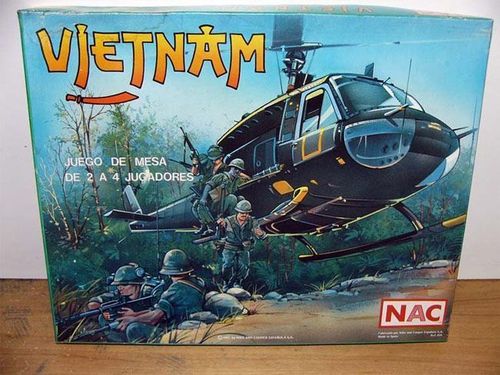
Vietnam
Vietnam Rulebook
Table of Contents
Table of Contents
- 1. Game Components
- 2. Explanation of the Components
- 3. Number of Players
- 4. Duration of the Game
- 5. How to Win the Game
- 6. Initial Placement and Reinforcements
- 7. Movement of the Counters
- 8. Combat and Bombardment
- 9. Use of Grouping Counters
- 10. Garrisons
- 11. Atmospheric Factor
- 12. Game Levels
- 13. Sequence of Turns
1. Game Components
- A board, 64 x 80 cm, representing an imaginary sector of South Vietnam.
- Nine die-cut counter sheets, representing the combat units, together with various auxiliary counters.
- A plastic tray for storing the counters.
- Two auxiliary sheets, for keeping track of the garrisons (guarniciones) and groupings (agrupaciones).
- A special wargame die.
- These instructions.
2. Explanation of the Components
2.1. The Board
The board is a map of an imaginary sector of South Vietnam.
- It has two clearly differentiated zones: the main board, which occupies almost all of the board, and the enlargement zone of a B.A.F. (Base de Apoyo al Fuego, Fire Support Base), which represents, at a smaller scale, each of the B.A.F. on the main board.
- On the main board the following elements have an effect on play:
- Fire Support Bases (B.A.F.): hexagons with a circle and a black dot inside.
- Hills: hexagons with a black dot inside.
- Villages: hexagons with the drawing of a population.
- Roads: thick light brown lines.
- Trails: thin light brown lines.
- Helicopter base: hexagon with two black rectangles inside.
- Rice paddies: hexagons with thin parallel lines of blue or green; located around AN-KHA, THUM-VUC and PHIN-BIN-DO.
- Cong River: light blue line that crosses the board from one edge to the other.
- Streams: thin light blue lines.
- Swamp zone: grey hexagons.
- Dense jungle: dark green hexagons.
- Jungle: lighter green hexagons.
2.2. The Counters
General classification:
- American Army: black letters and numbers with a garnet silhouette on a blue background.
- A.R.V.N. (Army of the Republic of Vietnam): black letters and numbers, with a blue silhouette on a garnet background.
- North Vietnamese Army and Vietcong: red silhouettes, letters and numbers on a yellow background.
- American affected infantry: letters, silhouettes and numbers in black on a blue background.
- South Vietnamese affected infantry: silhouettes and numbers in black on a garnet background (no names).
- North Vietnamese affected infantry: silhouettes and numbers in black on a yellow background (with names for the Vietcong regulars; without a name, North Vietnamese infantry).
In addition to these counters, which represent the contending armies, there are other counters with an auxiliary mission:
- 20 counters (ten for each side) to represent possession of certain points on the board (B.A.F., hills and villages). The North Vietnamese have green letters on a yellow background, and the Americans black letters on a blue background.
- 30 counters with an arrow drawn inside, to mark open routes in attacks on B.A.F.
- One NAC counter for marking turns.
- One counter for marking the "atmospheric factor".
2.3. The Typical Counter
The counters of the two opponents have different characteristics, depending on the type of counter, which make them different from one another. These characteristics are:
- Unit type: infantry, artillery, etc.
- Combat factor (factor de combate): the operational capacity of the counter, that is, the possibility of fighting that it is able to concentrate in one combat. It serves to engage combat between the different counters.
- Movement factor (factor de movimiento): the number of hexagons each counter can move at most in order to engage in combat each turn, although it may make a smaller move or not move at all.
The explanatory diagram shows a sample counter labelled "4-2/502", with the arrows marked UNIT, UNIT TYPE, MOVEMENT FACTOR and COMBAT FACTOR. On the sample counter the movement factor is the number at the lower right and the combat factor is the number at the lower left.
2.4. Counter Types
- Infantry.
- Affected infantry.
- Vietcong guerrillas.
- Elite infantry.
- Affected elite infantry.
- Helicopter-borne infantry.
- Affected helicopter-borne infantry.
- Guns (cañones).
- Mortars.
- Anti-aircraft artillery.
- Rocket launchers.
- "Huey" helicopters.
- "Cobra" helicopters.
- "Cayuse" helicopters.
- "Chinook" helicopters.
- Troop groupings (agrupaciones de tropas).
- Garrisons (guarniciones).
- Road (vía).
In addition to these counters there are two NAC counters: one to mark the game turns, and another to mark the atmospheric factor.
2.5. The Die
The die is used for resolving combats and represents the "luck factor". So that it is not unbalanced, it is a special die that does not carry a "one" or a "six". It has two "twos", two "threes", two "fours" and a "five", so that the chance of any given result is more even.
2.6. Auxiliary Sheets
Two auxiliary sheets, one for each side, are used to control the units that go into each grouping (agrupación) or make up a garrison (guarnición). Both concepts are explained later.
3. Number of Players
The game admits from two to four players, always in two sides. The possibilities are:
- Two players: one with the American and South Vietnamese troops, and the other with the North Vietnamese and Vietcong.
- Three players: two with the North Vietnamese forces, one of them with the regular North Vietnamese army and the other with the Vietcong forces; and one with the American and South Vietnamese forces.
- Four players: two on each side. The North Vietnamese side is divided equally, as indicated for three players. On the American side, one player has the normal infantry troops, guns and mortars, and the other has the rest of the forces.
Counter Legend
The printed legend numbers the counter illustrations 1 to 17 and names them as follows:
- North Vietnamese infantry.
- Vietcong guerrillas, Vietcong infantry.
- American elite infantry.
- American and South Vietnamese infantry; helicopter-borne infantry.
- American guns.
- North Vietnamese guns.
- North Vietnamese anti-aircraft artillery.
- Mortars (both sides).
- Rocket launchers.
- "Cobra" helicopter.
- "Chinook" helicopter.
- "Cayuse" helicopter.
- "Huey" helicopter.
- Grouping (agrupación).
- Road (vía).
- Garrison (guarnición).
- Atmospheric factor (factor atmosférico).
4. Duration of the Game
The game is played in turns. Each turn is the complete movement and resolution of the combats planned by each player, once for each side.
The game always begins with the player who acts as the "North Vietnamese". The order of turns is therefore always: first, the movement and resolution of the combats planned by the player who acts as the "North Vietnamese"; then, within the same turn, the movement and resolution of the combats planned by the player who acts as the "American". Once both are complete, one turn is finished.
The game lasts 14, 12 or 10 turns, depending on the game level chosen, as indicated later. Once a turn is completed, the NAC turn-control counter is advanced one box on the turn marker template.
The real-time duration of the game depends on the reflexes and speed of movement of the players, and on the game level chosen. Completing a game normally takes between two and six hours.
5. How to Win the Game
Victory in this game can be obtained in the following ways:
- By achieving the surrender of the opponent.
- By eliminating all of the enemy counters.
- By having, at the end of any turn, three times as many counters as the opponent.
If, at the end of the last turn of the game (turn 14, 12 or 10, depending on the game level chosen), neither contender has achieved victory by the procedures above, the points obtained from possession of certain places on the board are counted. These are the helicopter base, the B.A.F., the hills and the villages.
The points for possession vary depending on which side holds the place.
For the American player the values are:
- AN-KHA: 10 points.
- Each B.A.F.: 4 points.
- Each village (aldea): 5 points.
- Each hill (colina): 3 points.
- Helicopter base: 3 points.
For the North Vietnamese player the values are:
- AN-KHA: 10 points.
- Each B.A.F.: 8 points.
- Each village (aldea): 5 points.
- Each hill (colina): 3 points.
- Helicopter base: 3 points.
The winner is the player who, after the count, has the higher score, provided the lead is greater than five points over the opponent.
Otherwise the game may be considered a draw, or may be continued until one of the contenders wins. The choice between these options must be agreed by both players before the game begins.
For one of the places mentioned in this section to count as controlled by a player, at least one of that player's land counters must be present on it.
6. Initial Placement and Reinforcements
Before the game begins, both players place on the board the counters that enter play on the first turn. The setup below is for a 20-turn game.
(Note: the printed text states "20 turns" here, but section 4 gives 14, 12 or 10 turns as the game lengths. Both are reproduced as printed.)
North Vietnamese Player
- In Thum-Vuc: 1 Vietcong infantry counter (3-7).
- In any hex within a maximum distance of six hexes of Thum-Vuc:
- 1 cannon counter (2-4).
- 2 mortar counters (1-5).
- In any hex within a maximum distance of ten hexes of Thum-Vuc:
- 6 North Vietnamese infantry counters (4-7).
- 2 Vietcong infantry counters (3-7).
- Guerrilla counters may be placed in any location on the board. At least five of them must enter on the first turn, although all may enter.
American Player
-
In DUKE:
- 3 American infantry counters (5-5).
- 1 artillery counter (2-2).
- 1 mortar counter (1-3).
These counters must be placed on the auxiliary sheet in the section corresponding to DUKE.
The infantry counters may be distributed among the boxes marked Z.D.1, Z.D.2 and Z.D.3, with a maximum of two cannon and mortar counters, each in its own box. The counters are placed in STONE and BOSTON in the same way.
-
In STONE:
- 3 American infantry counters (5-5).
- 1 cannon counter (2-2).
- 1 mortar counter (1-3).
-
In BOSTON:
- 3 American infantry counters (5-5).
- 1 cannon counter (2-2).
- 1 mortar counter (1-3).
-
In AN-KHA: 2 A.R.V.N. infantry counters (3-7).
-
In PHIN-BINH-DO: 1 A.R.V.N. infantry counter (3-7).
-
In the helicopter base: 1 A.R.V.N. infantry counter (3-7).
-
In any hex not within a radius of ten hexes of Thum-Vuc:
- 3 American infantry counters (5-5).
- 6 A.R.V.N. infantry counters (3-7).
Reinforcements
Reinforcements may enter from any hex marked with a six-pointed star bordered by a black line for the North Vietnamese player, and from any hex marked with a black six-pointed star for the American player.
Both players may hold back part or all of the reinforcements they could receive in a turn, to receive them on later turns. The exception is the units that enter on the first turn.
Each player receives reinforcements before his own movement, as indicated in the sequence of play.
Reinforcements cannot be received in a marked entry hex if enemy counters are in that hex. They can be received if enemy counters are in adjacent hexes, or if the player has counters adjacent to the counter or to the enemy counters located in that hex.
Reinforcement Schedule
North Vietnamese player: from the second turn onward, the North Vietnamese player may receive a maximum of 12 counters per turn (not counting grouping counters), and no more than six false groupings (groupings that carry no counter) may enter in one turn.
The North Vietnamese player chooses these 12 counters. If he does not wish to bring in all 12 in a given turn, he may bring in fewer, bearing in mind that this does not change the maximum of 12 reinforcement counters per turn.
American player:
- Second turn: 3 American infantry (5-5); 1 "Cobra" helicopter (0-40); 1 "Huey" helicopter (0-36); 1 "Cayuse" helicopter (0-36).
- Third turn: 3 American infantry (5-5); 1 mortar (1-3); 1 "Cobra" helicopter (0-40); 1 "Chinook" helicopter (0-40).
- Fifth turn: 3 helicopter-borne infantry (6-5); 1 cannon (2-2); 3 "Huey" helicopters (0-36); 1 "Cobra" helicopter (0-40); 1 "Chinook" helicopter (0-40); 1 "Cayuse" helicopter (0-36).
- Sixth turn: 6 helicopter-borne infantry (6-5); 6 "Huey" helicopters (0-36); 1 "Cobra" helicopter (0-40); 1 "Chinook" helicopter (0-40); 1 "Cayuse" helicopter (0-36).
(The printed schedule has no entry for the fourth turn.)
7. Movement of the Counters
In each turn each counter may move only once across the board, except for the exceptions explained later.
A counter's movement is given by its movement factor (factor de movimiento): the number of hexes it can move at most, in any direction, each turn. It may make a smaller move or simply not move.
Split movement (movimiento fraccionado) means moving part of the movement factor, attacking an enemy counter, and then moving the rest of the movement factor. Split movement is prohibited, except for helicopter counters and for counters in the enlargement zone, as explained later.
Except for these exceptions, all movements of a player's own counters must be made, and only then are the combats that have been engaged resolved. Once this is done, and still within the same turn, play passes to the opposing side. When the movements and combats of both sides are complete, the turn is finished and the next turn begins.
Land counters may pass over other own land counters. This also applies to helicopter counters passing over one another.
The control zone of a counter is the six hexes that surround the hex in which the counter is located.
Stacking of a player's own counters is allowed (placing several counters, one on top of another, in the same hex), as explained below. A hex may never contain counters of both sides, except helicopter counters, which may be placed on top of enemy land counters.
Once a counter has moved, it is immobilised until the next turn (except in the case of combat in the enlargement zone).
Movement terrain effects:
- All land counters that move through rice paddies (arrozal) increase their movement factor by one hex.
- All land counters that move along a road (ruta) double their movement factor.
- All land counters that move along a trail (sendero) increase their movement factor by two hexes.
To benefit from these advantages, the movement must be carried out entirely over these hexes. That is, in a given turn a counter that is already on a hex of one of these types makes its whole move for that turn over such hexes, and at the end of it is also on a hex of the same type.
Cannon, anti-aircraft, mortar and rocket launcher counters cannot pass over river or stream hexes, except by bridge or ford.
Other counters may pass through river hexes, subtracting four points from their movement factor for each river hex traversed, and one point for each stream hex. A bridge or ford does not subtract points from the movement factor.
In this game counters may be placed and move on the board in three different ways:
-
Individual counters. One counter per hex. In this case the counter may move as many hexes as its movement factor.
The control zone of a counter is the six hexes that surround the hex in which the counter is located. A counter may not pass through the control zone of another enemy counter. If it does so, it is obliged to stop in the first hex of the control zone it passes through, and engage combat with that counter.
When a counter enters the control zone of two or more enemy counters, it chooses which of them to attack, and may, if it wishes, attack several of them at the same time.
The control zone of land counters does not affect the movement of helicopter counters. Helicopters are affected only by anti-aircraft fire.
-
Stacking. In hill, base or village hexes counters cannot be stacked. In the other types of hex, only two counters may be stacked. In this case all stacked counters move at the movement factor of the lowest of them.
The control zone of a stack is the six hexes that surround the hex in which the stack is located. Any enemy counter, stack or grouping that passes through its control zone must engage the stack. If it enters the control zone of two or more enemy stacks, it chooses which of them to attack, and may, if it wishes, attack several of them at the same time.
-
Troop groupings (agrupaciones de tropas). Only the North Vietnamese player has troop groupings. Their movement mechanism and control zone are the same as explained for stacking. Everything relating to groupings is explained in their own section.
The movement of counters in the enlargement zone is explained later.
8. Combat and Bombardment
8.1. General Rules for Land Counters
Land counters may fight against other land counters using their combat factor. One or several of a player's own counters, stacks or groupings may engage in combat with one or several enemy counters, stacks or groupings, provided they are in adjacent hexes. Before the combats are resolved it must always be stated which counters, stacks or groupings attack which.
Combats are resolved using the two combat resolution tables (A and B). One or the other is used depending on the number of combat factors taking part in that combat.
If the sum of the combat factors of the attacking counters is greater than 20 and the sum for the attacked counters is greater than 12, table B is used. Otherwise, that is, if either sum is not greater than these values, table A is used.
(Transcriber's note: the printed text reads "a 12" for the attacked-side threshold; it is read here as "greater than 12", parallel to the attacker's "greater than 20".)
The steps of combat resolution are:
- Add the combat factors of the different attacking counters, and then the combat factors of the attacked counters.
- Calculate the difference in combat factors between the attackers and the attacked. The difference may be equal, superior or inferior for the attacker. Locate the attacking player's difference of combat factors on the horizontal line of the resolution table.
- Roll the die, first the attacker and then the attacked, performing the same operation to obtain the difference between the two scores, which may be equal, superior or inferior for the attacker. Locate this difference in the vertical column (difference between die rolls).
- The intersection in the table of the box for the difference in combat factors (horizontal) with the box for the difference between die rolls (vertical) gives the result of the combat. The result may be:
- A.A. — attacker affected.
- D.A. — defender affected.
Both results are always followed by a figure, which indicates the number of affectations each side must make as a result of the combat. The concept of "affected unit" is explained below.
Land counters double their combat factor (only when defending) when they fight in a hill or a village.
8.1.1. Affected Unit
A unit is said to be affected when, as a consequence of a combat and by applying the combat resolution table, an affected-defender or affected-attacker result is obtained. A unit may also be affected by helicopter attacks. An affectation means a reduction in the counter's potential.
Each player may distribute as he wishes the number of affectations he obtains as the result of a combat.
All American infantry, elite infantry, helicopter-borne infantry, North Vietnamese infantry and Vietcong infantry counters have two levels of affectation. The rest of the counters have only one level; when these are affected they are eliminated and removed from the game.
Example: If in an attack the attacking side has two American infantry (5-5) and one cannon (2-2), the defending side has four North Vietnamese infantry (4-7), and the result of the combat is A.A.3, the American player may choose between:
- Eliminating one infantry counter (two affectations) and the cannon counter (one affectation).
- Affecting both infantry counters (two affectations) and eliminating the cannon counter (one affectation).
- Eliminating one infantry counter (two affectations) and affecting the other (one affectation).
Counters with two levels of affectation, when affected, must be exchanged for the affected counter of the same type. American infantry, elite infantry, helicopter-borne infantry and Vietcong regular counters have affected counters bearing the same numbering, so the counter must be replaced by the affected counter with the same number. In the case of North Vietnamese infantry and South Vietnamese (A.R.V.N.) infantry, the counter is replaced by the counter of the same type that the player wishes, since these counters carry no numbering.
If an affected unit is affected again it is eliminated and removed from the game.
The correspondences are:
| Type | Normal | Affected |
|---|---|---|
| American infantry | 5-5 | 3-5 |
| A.R.V.N. infantry | 3-7 | 2-7 |
| Elite infantry | 6-7 | 4-7 |
| Helicopter-borne infantry | 6-5 | 4-5 |
| North Vietnamese infantry | 4-7 | 2-7 |
| Vietcong infantry | 3-7 | 2-7 |
Diagram caption (movement): "The light counters move. Counter A heads toward the dark counter D, and counter C toward E."
8.2. Artillery
The counters that can make artillery fire are of three types: guns (cañones), mortars and rocket launchers. They may perform two different functions:
a) Support (apoyo)
- Cannon, mortar and rocket launcher counters may support the attack or the defence of one or several of their own counters involved in a combat.
- Each counter that gives support adds four combat factors to the total combat factors of the counters involved in the combat, provided they are within a radius of 18 hexes.
- Each counter may support only one combat, but several counters may support the same combat.
b) Bombardment (bombardeo)
A cannon, rocket or mortar counter may bombard an enemy counter, provided it is within its range. If several enemy counters are within range, the player indicates which of them is attacked, rolls the die, and applies the artillery fire table, depending on the result for the distance fired at and the type of hex on which the bombarded counter stands.
To resolve bombardments, the artillery fire table is used. First find the type of counter firing (the distance at which it fires changes with the counter type), then match the corresponding vertical column of the table, which lists the different hex types on which bombardment may be carried out. The intersection gives the number that must be obtained with the die to hit the attacked counter. If it hits, the counter takes one affectation.
The numbers in parentheses indicate that to fire at jungle or dense jungle hexes, one of three conditions must be met:
- a) A friendly counter is on some hill no more than twelve hexes from the bombarded hex.
- b) The unit to be bombarded has been located by a helicopter counter, provided this was done in that same turn.
- c) The fire is delivered from a strongpoint (B.A.F., helicopter base, hill or village) at hexes from which the bombarding counters are firing at that position. In this case the shots must be made in the opposing side's movement turn, after it has made its own bombardments, and the counters doing so may not fire again in their own movement.
A single artillery, mortar or rocket counter may bombard or support only once per turn, and can never perform both actions in the same turn.
Combat Table A. Printed heading: "Tabla de combate de apilamientos -A-" (Stacking combat table, A).
Columns are the difference in combat factors, from left to right: -5 or less; -3 to -4; -1 to -2; 0; +1 to +2; +3 to +4; +5 to +6; +7 to +8; +9 to +10; +11 or more.
Rows are the difference in die rolls, from top to bottom: +3, +2, +1, 0, -1, -2, -3.
| Die diff. \ Factor diff. | -5 or less | -3 to -4 | -1 to -2 | 0 | +1 to +2 | +3 to +4 | +5 to +6 | +7 to +8 | +9 to +10 | +11 or more |
|---|---|---|---|---|---|---|---|---|---|---|
| +3 | A.A.1 D.A.1 | D.A.1 | D.A.2 | D.A.2 | D.A.3 | D.A.3 | D.A.4 | D.A.4 | D.A.4 | D.A.4 |
| +2 | A.A.1 | A.A.1 D.A.1 | D.A.1 | D.A.1 | D.A.2 | D.A.2 | D.A.3 | D.A.3 |
Artillery Fire Table (Tabla de disparos artilleros). Columns: weapon type; distance in hexes; terrain type (road/ford, rice paddy, strongpoint, jungle). A figure gives the value entered in the resolution. Figures in parentheses apply to jungle hexes and are explained under Bombardment above. The asterisk (*) is printed as in the original; its meaning is not stated in the pages read for this transcription.
| Weapon | Distance (hexes) | Road / ford | Rice paddy | Strongpoint | Jungle |
|---|---|---|---|---|---|
| Guns (cañones) | 2-6 | 3 | 3 | 3 | (3) |
| Guns | 7-12 | 3 | 2 | 2 | (2) |
| Guns | 13-24 | 2 | * | * | * |
| Rockets (cohetes) | 3-6 | 3 | 2 | 3 | (2) |
(The header of the strongpoint column in the printed table is "P. FUERTE".)
Combat Table B. Printed heading: "Tabla de combates de apilamientos -B-" (Stacking combat table, B). Used by the same procedure as Table A, when the thresholds in 8.1 are exceeded.
Columns are the difference in combat factors: -5 to -8; -3 to -4; -1 to -2; 0; +1 to +2; +3 to +4; +5 to +6; +7 to +8; +8 to +10 (as printed; the column is read as +9 to +10 by parallel with Table A); +11 or more.
Rows are the difference in die rolls: +3, +2, +1, 0, -1, -2, -3.
| Die diff. \ Factor diff. | -5 to -8 | -3 to -4 | -1 to -2 | 0 | +1 to +2 | +3 to +4 | +5 to +6 | +7 to +8 | +8 to +10 | +11 or more |
|---|---|---|---|---|---|---|---|---|---|---|
| +3 | A.A.2 D.A.2 | D.A.2 | D.A.2 | D.A.4 A.A.1 | D.A.4 A.A.1 | D.A.6 A.A.2 | D.A.6 A.A.1 | D.A.8 A.A.3 | D.A.8 A.A.3 | D.A.8 A.A.3 |
| +2 | A.A.2 | A.A.2 D.A.2 | D.A.2 | D.A.2 | D.A.4 A.A.1 | D.A.4 A.A.1 | D.A.6 A.A.2 |
8.3. Helicopters
Only the North American player has helicopter counters. There are four types: Cobra (0-40), Chinook (0-40), Huey (0-36) and Cayuse (0-36).
Their movement is determined by their movement factor.
Helicopters may operate only from a base that has room for them, that is, a base whose entry on the auxiliary sheet has free helicopter spaces. When they enter play they start their movement from any reinforcement entry hex, but must determine their movement from an own base.
If for any reason a helicopter counter cannot reach a base, or the base is at the limit of its helicopter capacity, it may be placed on a hex adjacent to a base, on the board. It must then use its next movement turn to go to a free base, if one exists. If its movement ends on a hex that is not rice paddy, the counter is eliminated and removed from the game.
Helicopter counters are the only counters that may perform "split movement".
A helicopter counter must leave a base and end its movement at another base (the same one or a different one). Between the two it may perform a single action (transport or attack). For this it may use all of its movement or part of it, with the only rule being that it operates (lands and takes off) from its bases.
Depending on type, helicopter counters may perform three different actions:
A) Transport
- Only the "Huey" and "Chinook" types may transport. A "Huey" may carry only one infantry counter, while a "Chinook" may carry either two infantry counters or one artillery counter (mortars count as infantry counters in this case).
- They may carry units from the base they take off from, or land at, or pick up or drop units on any hex of the board except dense jungle. If they do not drop or pick up units en route, they may perform any other action.
B) Attack
- All models except the "Chinook" may perform this action.
- They may attack any type of land unit, using for this the helicopter fire table (tabla de disparos desde helicóptero), printed in section 8.5.2. To use it, first consult the vertical column, which lists the helicopter types. Then locate the distance to the target in the top horizontal row. If firing at a helicopter base, hill or village, always consult the last box of the row. The intersection of the two gives the box showing the value to be obtained with the die, to give one affectation level to the counter or grouping attacked.
- Figures with a "+" in front indicate a double die roll: the two values are added, and the sum must match the figure for the shot to hit.
- If the attacked player has several counters in the grouping attacked, and the shot hits, the attacked player chooses which counter takes the affectation.
C) Localisation
- All helicopter types may perform this action except the "Chinook". Helicopters may locate all groupings that are in their control zone or under them. The localisation mechanism is explained in the section on groupings (agrupaciones).
8.3.1. Anti-aircraft Fire against Helicopters
Anti-aircraft fire may be made by any type of counter, but each type of counter fires separately. Fire is made only against helicopter counters that have attacked, or have left or picked up land units, provided they are within range.
To resolve it, the table of anti-aircraft fire against helicopters is used.
- In the first column are the types of counter. Artillery counters comprise guns, mortars and rocket launchers. Fire by counters located in the enlargement zone is made when the helicopters are in the enlargement zone and performing some action, as explained in the section on the enlargement zone. If the helicopter is not in the enlargement zone, fire is resolved according to the counter type.
- The second column gives the distances at which each counter type may fire.
- The third column gives the number of counters that fire. Anti-aircraft artillery always fires one shot per counter.
The intersection of these details with the helicopter type fired at, on the horizontal line, gives the die values that make the shot hit. Figures with a "+" in front indicate a double die roll: the two values are added, and the sum must match the figure for the shot to hit.
When the shot hits, the helicopter counter is eliminated and removed from the game.
If the helicopter counter was carrying land units when it is hit, a new die roll must be made:
- 2-3: the counter or counters carried are eliminated.
- 4-5: the counter or counters carried each take one affectation level.
Table of Anti-aircraft Fire against Helicopters (Tabla de disparos antiaéreos contra helicópteros)
| Counter type | Distance (hexes) | Number of counters | Cobra | Chinook | Huey | Cayuse |
|---|---|---|---|---|---|---|
| Infantry | Stacked | 3 or more | +4 | * | +5 | +5 |
| Infantry | Stacked | fewer than 3 | * | * | +4 | +4 |
| Infantry | 1 | 3 or more | * | * | +4 | +4 |
| Infantry | 1 | fewer than 3 |
(In the printed table the "Stacked" and "1" rows are headed by the distance column, and the "Number of counters" column reads "3 or more / fewer than 3" for infantry and artillery, "Stacked / 1 / 2" for anti-aircraft artillery and "20 or more / fewer than 20" for counters in the enlargement zone. The asterisk () is printed as in the original.)*
8.4. Aviation
As may be observed in the counter sheets of this game, the air units (except the American helicopters) of both contenders have been eliminated. Although this implies some departure from reality, it means greater simplicity and efficiency of play, since the functions of aviation appear in the game through a series of rules.
The functions that aviation can perform are grouped under what is called "air support" (apoyo aéreo). To use it, a die roll must be made before the American movement. Air support is denied if a two is obtained; it may be used if any other value is obtained with the die.
Each "air support" may be used to perform two of these functions per turn, but never the same function twice in the same turn.
a) Bombardment. To use this function, the player must say which grouping or position is being bombarded. A die roll is made; on a three, three affectation levels are given to the counters bombarded, which the attacked player distributes as he wishes.
No bombardment may be made on counters located at a distance of less than five hexes from an own counter.
b) Ground support. Consists of adding four combat factors to the sum of the combat factors of own counters involved in a given combat, both in attack and in defence, but only once per turn.
c) Support for a helicopter-borne landing. Allows a helicopter counter to pick up or leave land units in jungle hexes. Several helicopter counters may do so, provided they are in adjacent hexes.
d) Localisation of groupings. Allows the American player to locate three enemy groupings, chosen freely, by the method explained in section 9.
8.5. Combat in the Enlargement Zone
This type of combat is carried out only when one of the two sides attacks a B.A.F. dominated by the opposing player, after the other combats on the board have been resolved.
The counters making the attack must arrive, by means of their movement factor, at a hex adjacent to the one in which the attacked B.A.F. is located.
If the defender of the B.A.F. is the American player, he must place the counters defending the base according to the arrangement they have on his auxiliary sheet.
If the defender of the B.A.F. is the North Vietnamese player, he places the defenders of the B.A.F. where he wishes, bearing in mind that he may place only two counters in each defensive zone, and one counter in each bunker, artillery and mortar hex.
The attacking player must place at least one counter in each of the defensive zones, on any of the hexes in them marked with a triangle ("cover points"). There are three such hexes in each defensive zone. These counters must remain in that position until the combat in the enlargement zone ends.
The attacking player then places, on the hexes marked with a black asterisk, the counters that are going to make the attack, with a maximum of one counter per hex.
The attacking player begins to move. To reach the hexes where the defenders are, three phases are necessary:
a) Wire (alambradas). Before the attack begins, the wire may have been bombarded, opening routes through it. The players must keep a record of the defensive zones in which routes have been opened in the wire. When the attack begins, counters are placed on the wire hexes where the attacking player wishes, in routes, but always in the defensive zone marked for it. Once the attack has started, routes may also be opened by advancing an attacking counter and placing it on a wire hex. The defending player rolls the die: on a "2" or a "3" the counter is eliminated (not affected) and does not open the route; on a 4 or a 5 it opens the route. For each route opened in the wire, up to four attacking counters may pass.
b) Mines (minas). As with the wire, mines may be cleared by bombardment, the route counter being placed on the hit hex. Routes may also be opened in the mines by "suicide" units, that is, counters which, when they pass over these hexes, make them explode, eliminating the counter but opening the route. For each route opened in the mines, up to four attacking counters may pass.
c) Machine-gun fire (ametrallamiento). Once routes have been opened in the wire and the mines, the attacking counters in each defensive zone receive fire from the defending counters, as follows. The attacking counters pass through the open routes in the wire and the mines, stopping on the mine hex, where they receive the machine-gun fire of the defenders. If they are not eliminated, they continue their movement in that same turn, until they stop on one of the hexes of that defensive zone marked with a five-pointed black star ("hand-to-hand combat hexes").
Defending counters carry out two types of fire. Counters in the defensive zone being attacked fire with FUEGO I (Fire I). Counters that are not in that defensive zone fire with FUEGO II, provided the defensive zone where they are located is not also being attacked.
The resolution of this fire uses the B.A.F. machine-gun table. In the first column the type of infantry making the fire is consulted (normal or affected, regardless of number). On the horizontal line the type of fire is consulted. The die is then rolled, and the value obtained is looked up on the top horizontal line of the table. The intersection of this value with the type of infantry and the type of fire gives the number of affectations the attacker suffers. Counters located in bunkers cannot fire, and neither can counters that are not infantry.
Machine-gun table in B.A.F. (Tabla de ametrallamiento en B.A.F.). Column headings are the die roll: 2, 3, 4, 5.
| Type of counter | Type of fire | 2 | 3 | 4 | 5 |
|---|---|---|---|---|---|
| Infantry | Fire I | 2 | 3 | 4 | 6 |
| Infantry | Fire II | 0 | 1 | 2 | 3 |
| Reduced infantry (infantería reducida) | Fire I | 1 | 2 | 2 | 3 |
| Reduced infantry | Fire II | 0 | 1 | 2 | 2 |
The attacker removes the counters that are eliminated.
The defending player then decides whether to receive the attackers in the defensive zone or to retire into the bunkers. He may also send more forces from other defensive zones (if these are not being attacked) to the attacked one, always keeping the maximum of two counters per defensive zone.
If he chooses the first option, the attacker must attack all the counters that are in the defensive zone. These combats are resolved with the die. The attacking player rolls the die, multiplying the score obtained by the combat factors of the attacking counters, thus obtaining a value. The attacked player does the same, obtaining a second value for his counter. The higher of the two values wins the combat: the counter or counters that obtained it survive, and the others are eliminated (not affected) and leave the game.
The counters of the defensive zone then attack the attackers, combats being resolved in this way until there are no counters left in the defensive zone. The defending player may bring counters from other defensive zones into the attacked one whenever he wishes, provided that defensive zone has not already been captured. If this happens, the attacking counters are placed in the occupied defensive zone, and combat continues in the bunkers and on the other hexes of the B.A.F.
The attack is ended only when the attacking player so wishes, or when the B.A.F. has been conquered.
Counters located in a bunker add two points (only when defending) to the unit's normal combat factor.
Each attacking counter must engage the nearest defending counter, respecting the control zones of enemy counters. Once the attacking player's combats are resolved, the defender moves, and this mechanism continues alternately until the B.A.F. is conquered or the attack is repulsed.
If several attacks against several B.A.F. are made in the same turn by the same player, they are resolved one after another until all are resolved.
While the resolution of an attack on a B.A.F. is in progress, counters that do not take part in it make no movement at all, except helicopter counters and the counters they carry, as explained below.
Therefore the North Vietnamese player may not add counters to those already in the enlargement zone, whether attacking or defending it.
In close-quarters combat and in combat in the bunkers, the movements and the resolution of the combats alternate between the two players.
Helicopter counters must perform their actions before the movement of the player's own counters.
8.5.1. Artillery Fire against the B.A.F.
Fire by cannon, mortars and rocket launchers against a B.A.F. is resolved, unlike fire against other targets, by means of the artillery fire table against the B.A.F. (Tabla de disparos artilleros contra B.A.F.).
Counters of this type may not be introduced into the enlargement zone among the attacking counters, though they may be among the defending counters. Artillery counters located within the B.A.F. may not fire at attacking counters within the enlargement zone, but may fire at those within their range from the position of the B.A.F. on the main board.
In the artillery fire table against a B.A.F., that is, fire made from outside the B.A.F. against it, the first column lists the types of counter that may bombard a B.A.F., and the second column the distance in hexes, on the main board, from which they fire. The horizontal line gives the different zones of the B.A.F. The player must indicate which particular target is fired at each time (for example defensive zone one, or the central bunker, or the wire of defensive zone three).
The intersection of these values gives the result to be obtained by adding the scores of a double die roll for the shot to count as a hit.
When firing at a bunker or a defensive zone, each hit means one affectation for the counters found there. When a shot hits the wire or the mines, the attacked player marks the defensive zones in which routes have been opened.
Artillery fire table against B.A.F.
| Type | Distance (hexes) | Defensive zone (Z.D.) | Bunker | Wire / mines |
|---|---|---|---|---|
| Guns (cañones) | 1-7 | +5 | +5 | +6 |
| Rockets (cohetes) | 1-4 | +5 | +5 | +5 |
| Mortars (morteros) | 1-2 | +4 | +4 | +5 |
8.5.2. Helicopters in the Enlargement Zone
Helicopter counters may not move within the enlargement zone, but they may perform actions that affect combat in the enlargement zone.
a) Fire from helicopters. These shots are resolved using the last column of results of the helicopter fire table (tabla de disparos desde helicóptero), the "(0-1) P.F." column. The helicopter must be placed on or adjacent to the main-board hex where the attacked B.A.F. is located, and the player must decide against which particular counter it fires. The shot is then resolved in the same way as for other targets.
Helicopter fire table (Tabla de disparos desde helicóptero)
| Type | Distance 0 | Distance 1 | Distance 2 | (0-1) P.F. |
|---|---|---|---|---|
| Cobra | 3-4 | 2-3 | 3 | 3 |
| Huey | 2-3 | 3 | 2 | 2 |
| Cayuse | 3 | 2 | * | * |
(The asterisk is printed as in the original. "P.F." is posición fuerte, strongpoint, that is, a B.A.F., helicopter base, hill or village.)
b) Transport of counters. Helicopter counters may pick up or leave land counters in the enlargement zone, provided there are no enemy counters in the central bunker. If the helicopter ends its movement in the B.A.F. and the central bunker is then conquered, the counter is eliminated and removed from the game. Counters that a helicopter leaves in the enlargement zone begin to move from the hexes of the central bunker.
Helicopter counters that perform actions within an attack on a B.A.F. may not move in the American player's next movement turn.
c) Anti-aircraft fire in the B.A.F. This is carried out after the helicopters have performed some action in the B.A.F. It is resolved with the anti-aircraft fire against helicopters table, using the last group among the counter types (the vertical column "counters in the enlargement zone"), regardless of whether the helicopter is on or adjacent to the B.A.F. hex, and the table is used in the same way as explained in section 8.3.1.
8.5.3. Sequence of Play in the Enlargement Zone
When an attack on an enlargement zone takes place, the sequence is:
- Placement of the defending counters.
- Placement of the attacking counters.
- Opening of routes in the wire.
- Fire against the wire.
- Opening of routes in the mines.
- Movement of the attacking forces.
- Machine-gun fire.
- Hand-to-hand combat.
- Reception of reinforcements by helicopter.
- Helicopter attack.
- Anti-aircraft defence.
- Combat in the bunkers.
9. Use of Grouping Counters
Grouping counters (fichas de agrupaciones) are used only by the North Vietnamese player. They represent a set of counters, to facilitate and conceal the movement of those counters on the board.
The North Vietnamese player has 30 groupings.
The maximum number of counters that may go into one grouping is six. There is no minimum number needed to form a grouping, because grouping counters that carry no counter (a false grouping) may be used.
The North Vietnamese player may introduce only six false groupings per turn.
Grouping counters are never lost, since they are symbols that summarise, and are not combat units.
Because the grouping counter has a summary function, the North Vietnamese player's auxiliary sheet has 30 sections. In each section, the counters that make up a grouping are placed each turn.
Each grouping is represented in the game by two counters. One is placed in the box to the left of the grouping, indicating the number of that grouping. The other is placed on the board, and marks the position of that grouping.
A grouping moves at most the movement factor of the slowest counter in it.
To make it difficult for the opponents to know the number, location and composition of enemy combat groups, the grouping counters are used as follows. Each grouping has two counters with the same number, one for the board and one for the auxiliary sheet. When one of these groupings is formed, the board counter is placed face up, while the one from the auxiliary sheet is placed face down, together with the counters that make it up. In this way the American player knows that his opponent has a certain combat group, but does not know its composition or its location. Only on entering its "control zone" is its exact composition known.
In addition, the North Vietnamese player may use his grouping counters to mislead the enemy by forming false groupings (agrupaciones falsas), not made up of any unit but behaving as real groupings, moving at most the movement factor of the fastest units the North Vietnamese side has. The American player must therefore enter their control zone, or use the localisation systems (air support or helicopters), to discover whether a grouping is false.
The North Vietnamese player, at the phase marked in the sequence of play, may form or break up groupings, putting into or taking out of a grouping as many counters as he wishes. To enter a grouping, counters must be placed on the hex where it is located. When they leave a grouping, they begin their movement from the hex where the grouping is.
To form a grouping with counters already on the board, those counters must be placed on the hex where the grouping is to be formed. Afterwards, once the grouping is formed, they are removed from the board and placed in the section of the auxiliary sheet for that grouping. On the board hex where it was formed, a grouping marker is placed face up; the other grouping counter is placed face down in the box to the left of each section, where the counters that make up the grouping have been placed. In this way the counters on the board are identified. For all effects, the counters on the sheet are considered to be on the board, but summarised by the grouping counter.
One or several counters may leave a grouping and join the board, thereafter moving independently of the grouping in any direction. Groupings may be formed or broken up in each turn, completely or partially, in the phase of the game marked in the sequence of play.
Localisation, as explained earlier, may be carried out in the following ways:
- By use of air support.
- By means of helicopter counters.
When localisation is carried out by one of these two means, the North Vietnamese player must declare:
- Whether the grouping is genuine.
- Whether it carries more or fewer than two counters (if it carries two, he may declare either of the two things).
- Whether it carries artillery counters.
Groupings must be fully revealed when they enter the control zone of American or South Vietnamese units, and when they move across rice-paddy hexes.
In that case, he places two counters on the hex where the grouping was, and the other counters (if there are any) on any hex of its control zone.
When a grouping is going to be attacked by American ground units, the grouping must be broken up before the attacking counter or counters make their movement.
North Vietnamese and Vietcong counters form a single side, so their groupings may be made up indistinctly of North Vietnamese units, Vietcong units, or both.
False groupings do not create a true control zone. Once located, enemy units may continue moving until they complete their movement. In this case one might speak of "split movement", but without combat, since the localised grouping is false. The sequence for the player who is moving is:
- Movement.
- Encounter with the false grouping.
- Completion of the movement still to be made.
If a counter enters the control zone of two or more North Vietnamese groupings, it must decide which of them to attack.
10. Garrisons
Both auxiliary sheets have sections for placing the different land garrisons of each position. The counters that make up a garrison must be placed in the relevant section.
On the American player's auxiliary sheet, in each B.A.F. the three defensive zones are marked. In these zones only infantry counters may be placed. The artillery zone takes cannon counters only, the mortar zone takes mortar counters only, and the bunker takes any counter. This is the only zone of a B.A.F. where helicopter counters may be placed.
In the other sections, both cannon and mortar counters may be placed in the artillery boxes.
Each division of a section is marked with a name indicating the type of counter that may be placed in it.
The North Vietnamese player's auxiliary sheet has no sections for B.A.F.s. Therefore, when a B.A.F. is conquered by this player, he must leave on the B.A.F. hex the grouping counter with the counters that cease to be garrison. In the sections for "Base de helicópteros", "X-Ray", "Columbus" and "Eagle", any type of counter may be placed. In the rest of the sections, infantry and artillery counters (cannon, mortars and rocket launchers) must be placed.
In no case may more counters be placed as garrison than the template admits, nor more than one counter per box.
On the main board the garrison marker must be placed, provided there are troops at that point, according to nationality.
Counters that are in garrison must be placed face up on the auxiliary sheet.
11. Atmospheric Factor
Before beginning each turn, either player rolls the die to decide the weather for that turn.
According to the score obtained, the weather marker is placed on the template on the board, which indicates the existing modifications, as follows:
- Die roll of 2: bad weather. Air support is not used. Helicopters carry out transport missions only, and only "Cobra" helicopter counters may carry out attacks.
- Die roll of 3, 4 or 5: good weather. Does not affect any counter.
12. Game Levels
The game admits three levels:
a) A 14-turn game, using all the rules detailed in these instructions.
b) A 12-turn game, with the following modifications to the general rules:
- Air support is eliminated.
- The American player may pick up and drop troops in the jungle without the need for air support.
- The B.A.F. "Stone" is considered eliminated from the board and is, for all effects, a jungle hex with no incidence in the game, nor in the victory points.
- The American player receives in the fourth turn the reinforcements that he receives in the fifth turn at level a), and those of the sixth in the fifth.
c) A 10-turn game, played with the modifications of level b), with the following added:
- All counters (except helicopters) increase their movement factor by two points.
- Counters are eliminated directly; that is, all counters have only one level of affectation.
- The atmospheric factor is not used.
- The North Vietnamese player does not use grouping counters, and must move all his counters face up on the board.
- Combat in the enlargement zone is eliminated. Garrison counters in the B.A.F. double their combat factor, and combats are resolved using the combat tables, one or the other depending on the number of factors taking part.
13. Sequence of Turns
Before the game begins, each player places the counters with which he starts to play: first the North Vietnamese player and then the American player, as explained above. The game is always started by the North Vietnamese player, who attacks first.
The sequence of play in each turn is:
- Die roll to determine the atmospheric factor.
- Entry of North Vietnamese reinforcements.
- Formation and/or readjustment of groupings.
- North Vietnamese artillery fire.
- Movement of the North Vietnamese counters.
- Resolution of combats on the board.
- Resolution of attacks on B.A.F.s.
- Entry of American player reinforcements.
- Movement of helicopter counters.
- Resolution of helicopter actions.
- Anti-aircraft fire.
- Movement of the American player's counters.
- Resolution of combats engaged by the American player.
Once all these sequences have been carried out, a turn is finished, and the NAC counter is advanced one box on the turn marker.
(Omitted from the transcription: the publisher's contact note for questions about the instructions, and the copyright line of the printed booklet, which are not rules.)