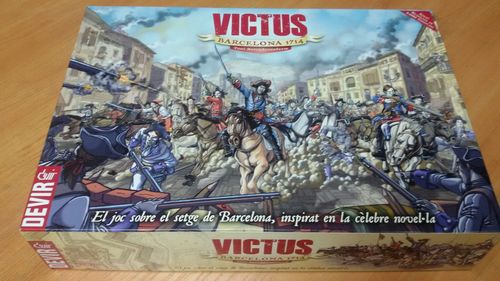
Victus: Barcelona 1714
Victus: Barcelona 1714 Rulebook
Table of Contents
Table of Contents
- Components
- Before the First Game
- Component Descriptions
- Board
- Event Cards
- Chance Cards
- Bourbon Action Dice
- 5 Pins for the Markers and 5 Axles
- Trench/Camp Tiles
- Mine Disc
- Reinforcements Disc
- Batteries Disc
- Cannon Pieces
- Infantry Pieces
- Coronela Pieces
- Starting Player Tile (Flag of Saint Eulalia)
- Rubble/Ruined Tiles
- Bastion Defense Tiles
- Barricade Tiles
- Bourbon Troop Tiles (with values 1, 2, 3, 4, 5, 6, 8, 9, 10 and 12)
- Bourbon Battery Tiles
- Razed Bourbon Camp Tiles
- Villarroel Resignation Tiles
- Victory Point Tiles
- Board Description
- Event/Leader Card Anatomy
- First Game Rules
- Combat
- End of the Game
- Full Game Rules
- Combat
- End of the Game
- Competitive Game Rules
- End of the Game
- Adjusting the Difficulty
- Solo Game: Villarroel and Casanova
- End of the Game
- Glossary of Key Terms
Components
- 1 board
- 150 event cards
- 14 chance cards
- 6 Bourbon action dice
- 5 pins for the markers
- 5 metal axles
- 6 trench/camp tiles
- 1 mine disc
- 1 reinforcements disc
- 1 batteries disc
- 12 cannon pieces
- 13 infantry pieces
- 32 Coronela pieces
- 1 starting player tile (Flag of Saint Eulalia)
- 28 rubble/ruined tiles
- 10 bastion defense tiles
- 10 barricade tiles
- 5 organ-gun tiles
- 160 Bourbon troop tiles (with values 1, 2, 3, 4, 5, 6, 8, 9, 10 and 12)
- 10 Bourbon battery tiles
- 6 razed Bourbon camp tiles
- 3 Villarroel resignation tiles
- 48 victory point tiles (with values 1, 3, 5 and 10)
- Collector's certificate/"In Memoriam"
- Rules summary
- Rulebook
Before the First Game
The game contains a large number of cardboard tiles. Punch them out carefully, making sure they don't break, and store each type separately so they are easier to find when setting up a game.
Take the five pins for the markers and the corresponding metal axles and assemble them, as shown in the picture, onto the markers on the board.
Unwrap the cards and sort them into four piles according to the picture on their backs.
Component Descriptions
Board
The board represents a large part of the layout of Barcelona in the years 1713 and 1714, with the city of Barcelona and its surroundings as far as the Bourbon camp positions. All of this terrain is divided into spaces inside and outside Barcelona, with one special space, Military Deputy's Expedition, which is considered a space outside Barcelona.
There are also the Wounded and Reserve boxes and the Captured zone (which have specific uses during games), as well as some markers and reference tables. Almost all spaces inside Barcelona are numbered (except Montjuïc, Port, Beach and Saint Eulalia Redoubt), while some of the spaces outside have a name or identifying code.
Event Cards
The event cards have three different backs, each corresponding to a different stage of the game: Stage I – Pópoli, Stage II – Berwick and Stage III – Assaults.
The event cards represent the most important situations that occurred during the siege of Barcelona and that are narrated in the novel Victus.
Players will have some of these cards in hand and will have to play one each round, often reluctantly, since most of them bring no good news for the people of Barcelona.
Chance Cards
These cards are used to resolve the game's two main sources of randomness: determining the movement of the Bourbon troop tiles, and which spaces of Barcelona are bombarded by the Bourbon batteries.
Discarded chance cards are placed face up next to the pile. Whenever the pile runs out, the discarded cards are taken, shuffled, and a new chance card pile is formed.
Bourbon Action Dice
The faces of these dice indicate one of four possible Bourbon actions and the intensity with which it will be carried out. Each die is a different color.
5 Pins for the Markers and 5 Axles
These pins are mounted on the board, using the metal axles; each one on one of the five markers shown in the drawing of the Neuf-Brisach fortress.
Trench/Camp Tiles
These tiles are used to mark the construction of the Bourbon attack trench. Each tile represents one of the six sections of the trench and is associated with a camp on the board. While a section of the trench has not yet begun to be built, the corresponding tile remains in the camp space on the siege line, showing its camp face; when construction of that trench section begins, the tile is placed in the corresponding trench position, showing its trench face.
When a text refers to a trench tile, it means the tile is on the board showing its trench face (in one of the trench positions on the board, i.e. the 1st, 2nd or 3rd); conversely, if it refers to a camp tile, it means the tile is on the board in its 0 position, showing its camp face. If it refers to a trench/camp tile, then the visible face does not matter.
Mine Disc
This disc is placed on the Bourbon marker (at the start of the game on space 0) and shows the progress of the mine that the Bourbons are trying to dig underground to weaken the city's defenses.
When the mine explodes, it affects as many spaces of Barcelona as the number of the space the mine disc is on.
Reinforcements Disc
This disc is placed on the Bourbon marker (at the start of the game on space 0) and indicates the quantity of Bourbon troops ready to enter combat at each of the Bourbon camp spaces. When the reinforcements disc moves along the Bourbon marker and ends its movement on a space with symbols (batteries, healing, mine or advance), it activates those effects.
Batteries Disc
This disc is placed on the Bourbon marker (at the start of the game on space 1, which is its minimum value, since during the game it can never drop to 0) and indicates the bombardment capacity of the Bourbon batteries against Barcelona. Thus, when a bombardment against Barcelona must be resolved, the value of the space the batteries disc is on indicates how many spaces of Barcelona receive bombardment hits.
Cannon Pieces
These pieces represent part of the artillery that Barcelona has for its defense. Cannons are not troops. Cannons can fire even if there is no Barcelonan troop in the same space. They have no combat value, so if Bourbon troop tiles enter a space with cannons and no Barcelonan troops present (or, as the result of a combat, only Bourbon troops and Barcelonan cannons remain in a space), the cannons are eliminated immediately and the Bourbon troops continue their movement if they had not yet finished it.
Infantry Pieces
These are the professional troops that defend Barcelona. Their combat value is 3, which often allows them to face combat situations against Bourbon troops of value 1 or 2 without being eliminated.
Coronela Pieces
These are Barcelona's troops formed by members of the guilds. Their combat value is 1. If Barcelona runs out of a minimum number of Coronela pieces (the professionals needed to keep the city running), the city surrenders to the Bourbon siege.
Starting Player Tile (Flag of Saint Eulalia)
Each round, the player holding the Flag of Saint Eulalia is the first to take their turn, and the turn order continues with the player to their left. In addition, during their turn, the starting player gets a +1 to the value given by the Gunpowder Store marker.
Rubble/Ruined Tiles
These tiles are used to mark the destruction that Bourbon bombardments cause to Barcelona's urban fabric (buildings, streets, squares, etc.). A tile placed in a space of Barcelona, showing its ruined face, allows Bourbon troops to advance more quickly through the interior of the city.
A space with a rubble/ruined tile has no effect on the movement of Barcelonan troops or on markers (if it is one of the spaces associated with a marker).
If Barcelona accumulates too many rubble/ruined tiles, the city's government may announce surrender.
As with trench/camp tiles, if the text of an event card refers to a rubble tile, it means the tile is on the board showing that face; if it refers to a ruined tile, it means the tile is on the board showing that face. When it refers to a rubble/ruined tile, the visible face does not matter.
Bastion Defense Tiles
These tiles are placed in bastion spaces. Each bastion can have at most one bastion defense tile.
The tile has two faces: "+1" and "+2". When a defense is added to a bastion, it must show its "+1" face; if another one needs to be added later, it is flipped so it shows its "+2" face.
Bastion defenses can be reduced or eliminated by bombardment or Bourbon mine hits, but not during combats in the bastion where they are present.
Barricade Tiles
These tiles are very similar to bastion defenses. Unlike those, they only have a "+1" value, but they can be placed in any space of Barcelona and there is no limit to how many can be in one space.
As above, barricades can be eliminated by bombardment or Bourbon mine hits, but not during combats in the spaces where they are present.
Bourbon Troop Tiles (with values 1, 2, 3, 4, 5, 6, 8, 9, 10 and 12)
Each Bourbon troop has a value of 1. The values on the Bourbon troop tiles are used to summarize the quantity of Bourbon troops present in the same space.
Whenever two or more Bourbon troop tiles are combined, they may be replaced by one or more tiles that add up to the value of the combined tiles. Likewise, if a Bourbon troop tile takes a number of casualties lower than its value, it may be replaced by one or more tiles that add up to the resulting value.
Bourbon troop tiles have two different faces (on one they are "firing" and, on the other, "loading"); on the board, before advancing them, all Bourbon troop tiles must show the same face. As they advance across the board, they are flipped so players always know at a glance which tiles have already moved and which have not.
Bourbon Battery Tiles
These tiles mark the board spaces where there are special Bourbon battery emplacements. Battery tiles can be eliminated if Barcelonan troops win a combat at those emplacements.
Razed Bourbon Camp Tiles
If Barcelonan troops enter a Bourbon camp and win the combat, the players must place a razed Bourbon camp tile. If during that same turn the Bourbons must advance, no Bourbon troop tile will come out of razed camps.
Villarroel Resignation Tiles
These tiles are used for the solo version of Victus. If they think it best, the Villarroel player may use one of these tiles to cancel the effect of the card played by the Casanova player.
Victory Point Tiles
When playing a competitive game, players use these tiles to accumulate victory points (VP). At any time, a player may exchange a group of VP tiles they have earned for a single tile that adds up to their value. Players keep their earned VP tiles face down, so other players cannot see their value.
Board Description
The board includes the following elements:
- Markers (Generalitat, Port, Gunpowder Store, Saint Cross/Saint Mary of the Sea, Sense/Fury)
- Bourbon marker
- Camps
- Barcelonan Action Table
- Captured zone
- Bourbon Advance Arrows
- Reserve box
- Wounded box
- Game Sequence reference
- Barcelonan Special Sight Icons
- Bourbon Action Table for the dice
- Rambla
- City Wall
- Bastions
- Military Deputy's Expedition
Event/Leader Card Anatomy
Event card fields:
- Flavor text — A fragment of the novel Victus appears here, which inspires the effects the card causes. This text has no effect on the course of the game.
- Event/leader effect — On event cards, the text describes a series of actions that players must resolve when they play the card during their turn. The text on leader cards (the text states whether it is a Barcelonan or Bourbon leader, and their illustration appears) describes actions that remain in effect while that leader stays active.
- Marker adjustment — Different markers appear here along with the value by which their pin must be moved. Positive values move the pin clockwise; negative values move it counter-clockwise.
- Priority Barcelonan actions — In the full game rules, this section of the Twenty-Fourth War Council indicates which Barcelonan actions are considered priorities during the turn in which the card is played.
- Sense/Fury points — In the competitive game rules, the Sense or Fury points the card carries appear here.
- Card number — There are 150 event cards, each numbered. Cards 1 to 50 belong to Stage I; 51 to 100 to Stage II; and 101 to 150 to Stage III.
- Leader image — Leader cards include an image of the novel character they represent. All leader cards corresponding to the same character share the same image.
Chance card fields:
- Bourbon troop advance — These boxes show how the Bourbon troop tiles must be moved on the board when it is their turn to advance.
- Spaces affected by battery bombardment: Stage I, II or III — Depending on the stage being played, players consult the corresponding line to know which spaces of Barcelona are the target of the Bourbon bombardment.
- Card number — There are 14 chance cards, each numbered.
Whenever the text of a card contradicts a rule, what the card states must be applied.
First Game Rules
We recommend that the first time you play Victus, you do so following the first-game rules. These rules are designed so new players can quickly learn the basic mechanics of a game of Victus without needing to read the whole rulebook at once. Once you have played a first game following these rules (or if you are experienced enough with board games, or reckless enough, to tackle the full rules the first time), you can keep reading the rulebook to discover what a complete game of Victus is like and take on this game's challenge in full.
Setup
- Place the board in the center of the table. The board is made up of two parts: unfold them properly and place them so they connect along their shared edge, as shown in the picture.
- Prepare the markers. Place the pins on the Generalitat, Port, Gunpowder Store, and Saint Cross/Saint Mary of the Sea markers so they point to the space with the highest value. The Sense/Fury marker is only used with the competitive game rules.
- Place the cannons. Put one cannon in each bastion space and two in Reserve.
- Place the infantry. Put one infantry piece in each bastion space and three in Reserve.
- Place the Coronela. Put one Coronela piece in each Barcelona space that is not a bastion, and five in Reserve.
- Place the trench tiles. Put the six camp tiles, one on each of spaces A0, B0, C0, D0, E0 and F0.
- Place the Bourbon discs. Put the reinforcements disc on space 0 of the Bourbon marker and the batteries disc on space 1 of the same marker.
- Leave the dice next to the board.
- Stack the rubble/ruined tiles. Take the rubble/ruined tiles and set them next to the board; this is the rubble/ruined tile pile.
- Stack the razed Bourbon camp tiles. Take the razed Bourbon camp tiles and set them next to the board; this is the razed Bourbon camp tile pile.
- Stack the bastion defenses. Take the ten bastion defense tiles and set them next to the board; this is the bastion defense tile pile.
- Sort the Bourbon troops. Place all the tiles next to the board and sort them into piles by their number; make another pile with the Bourbon battery tiles.
- Place the chance card pile. Take the chance cards, shuffle them, and leave the deck face down next to the board.
- Choose the starting player. The player who has spent the least time in Barcelona is the starting player (if you can't agree, decide at random). This player takes the starting player tile (Flag of Saint Eulalia) and places it on the table in front of them.
- Prepare the event card piles. Take the event/leader cards and split them into three piles by their back. From each pile, find the cards that have a • in the Stage area (bottom left). Shuffle these cards and place them next to the board, forming three separate piles. Return the rest of the cards without a • to the box.
- Leave the rest of the components in the box. To follow these first-game rules, you do not need the rest of the components.
Game Sequence
A game of Victus consists of four stages, symbolized with Roman numerals: I, II, III and IV. Except for Stage IV, which is special, each of the first three stages is made up of a series of rounds; each round, every player takes their turn.
Start of Stage I / II / III
- Start of round
- Each player's turn
- Start of turn
- Resolve the card effect
- Adjust markers
- Bourbon actions
- Barcelonan actions
- End of turn
- Each player's turn
- End of round
End of Stage I / II / III
Stage IV
Historically, the first stage corresponds to the initial events of the siege of Barcelona (starting July 25, 1713), with the Bourbon troops under the orders of the Duke of Pópoli. The second stage begins with the arrival of Marshal Berwick, who took charge of the siege of Barcelona and began construction of the attack trench. The third stage represents the first assaults by Bourbon troops against the walls of Barcelona and the fighting by the defenders. Finally, the fourth stage places us in the fierce clashes of September 11, 1714, at the walls and in the streets of the city.
Start of Stage I / II / III
At the start of each of the first three stages, a player takes the event cards corresponding to that stage (I for the first, II for the second and III for the third), shuffles them, and deals the number corresponding to each player according to the number of players (see table).
Players add the cards they receive to any left over from previous stages still in their hand.
Then a number of rounds are played depending on the number of players in the game (see table).
| Players | Cards | Rounds |
|---|---|---|
| 2 | 5 | 4 |
| 3 | 4 | 3 |
| 4 | 3 | 2 |
Start of Round
- Some cards played on previous turns refer to actions that must be done at the start of the round. These actions are done now; if more than one must be resolved, the players decide the order in which to resolve them.
- Each player looks at the cards in their hand, chooses one, and places it on the table in front of them, face down. Once all players have placed their card on the table, the player holding the starting player tile takes their turn. Once they have finished, the next player, clockwise, also takes their turn, and so on.
Each Player's Turn
- Start of turn
- Resolve the card effect
- Adjust markers
- Bourbon actions
- Barcelonan actions
- End of turn
1. Start of Turn
The effects of some cards occur at the start of a player's turn; these effects are resolved now. If a player must resolve more than one effect at the start of their turn, they decide the order in which to resolve them.
2. Resolve the Card Effect
The player reveals the event card they played and resolves its effect (in a first game there are no leader cards). The effect must be resolved in the same order in which it is written; that is, every action must be resolved before starting the next one (each action has a • at the start), except in cases where instructions are given on how to specially resolve some actions that occur later during the turn.
- The text may indicate that different actions must be done depending on certain conditions. In these cases, players must check which of the situations is occurring in the game at that moment and apply the action indicated by the card.
- The text may indicate different actions and let the players decide which one they want to do.
- Sometimes the text indicates that an effect should be applied a certain number of times, or that it should act on a certain number of game elements. If it is not possible to do so in full, players must apply the effect as many times as possible, or act on the maximum possible number of board elements.
Example 1: Víctor has played a card that has him take five Barcelonan troops that are on wall spaces, and place each one in one of the five Barcelona spaces indicated: 12, 21, 25, 26 and 35. But if there are not five Barcelonan troops among all the wall spaces of Barcelona, then the action to take is to set the Port and Saint Cross/Saint Mary of the Sea markers to their minimum value.
Example 2: Victòria has played a card that says: "Take 10 Barcelonan troops from Barcelona spaces (that are neither Montjuïc nor Beach) and place 5 on Montjuïc and 5 on Beach." At that moment there are only eight Barcelonan troops that meet these conditions, so she takes the eight Barcelonan troops (the maximum number that meet the conditions) and distributes them between Beach and Montjuïc, but without placing more than five on either space. After this, the card's effect indicates Batteries +1, and so the batteries disc advances one space on the Bourbon marker.
3. Adjust Markers
The player checks the markers section of the card and modifies the board markers according to the values shown there:
- Positive: move the marker's pin as many spaces as the card indicates, clockwise.
- Negative: move the marker's pin as many spaces as the card indicates, counter-clockwise.
4. Bourbon Actions
The player rolls the Bourbon action dice corresponding to the stage being played:
- Stage I – Pópoli
- Stage II – Berwick
- Stage III – Assaults
- Stage IV – September 11
The result of each die is an action the Bourbons must carry out. The dice are resolved in the same order in which they appear on the table (for example, in Stage II, first the blue die's action is resolved, then the yellow die's, and finally the red die's). Each die (Bourbon action) must be fully resolved before resolving the next one.
The possible Bourbon actions are:
Reinforcements — Depending on the number of flags shown by the die result, the reinforcements disc must be moved one, two or three spaces to the right on the Bourbon marker. If after moving the disc it ends on a space with a symbol, the corresponding action must be resolved (the mine symbol that explodes has no effect in the First Game rules — treat it as if it weren't there):
- Healing: check the values currently shown by the Port marker, then by the Saint Cross/Saint Mary of the Sea marker.
- Bombardment: the Bourbon batteries fire on the city of Barcelona. The number of hits shown on the die indicates how many casualties are inflicted in each space of Barcelona targeted by this bombardment.
Example 3: During Stage I, Victòria has rolled the Bourbon action dice. The reinforcements disc is on space 1. First the white die is resolved, which has rolled Reinforcements 1: the reinforcements disc advances one space to the right to the first space 2, which has a Batteries icon, so the batteries disc also moves one space to the right. Next the gray die is resolved, which also has a result of Reinforcements 1. The reinforcements disc again advances one space to the right and now lands on a space with a Healing icon.
First the Port marker is checked, which is at +1; so Victòria takes one Barcelonan troop from Reserve and places it in the Port space. Next she checks the Saint Cross/Saint Mary of the Sea marker, which shows a 2: 2 infantry pieces and 2 Coronela pieces may be taken from Wounded and placed in the Saint Cross-14 and Saint Mary of the Sea-34 spaces, respectively. At that moment, the Wounded box has six Coronela pieces but no infantry. So only two Coronela pieces are healed, and they are placed in the Saint Mary of the Sea-34 space.
- Port: +1: take one Barcelonan troop from Reserve and place it in the Port space. −1/−2: take one or two Barcelonan troops that are in Barcelona spaces and place them in Reserve.
- Saint Cross / Saint Mary of the Sea: 3/2/1/0: take that many infantry and Coronela pieces (or as many as possible) from Wounded and place them in the corresponding hospital space: infantry at Saint Cross-14 and Coronela at Saint Mary of the Sea-34.
Advance: the Bourbon troop tiles advance as many spaces as the number of advance symbols shown on the space (see "Advance," below).
Reinforcements +X/−X: these notations appear on some event cards. When they are positive values, it means the reinforcements disc must be moved X spaces to the right on the Bourbon marker; when negative, it means the reinforcements disc must be moved X spaces to the left on the Bourbon marker. After moving the reinforcements disc due to one of these notations (whether positive or negative), the symbol on the space where the reinforcements disc lands must be resolved, if applicable, as explained above.
Bombardment
Depending on the stage being played, players consult the corresponding line to know which spaces of Barcelona are targeted by the bombardment.
To resolve the bombardment, a player reveals the top card of the chance deck and looks, in the part corresponding to the stage being played, at as many spaces (left to right) as the value shown by the batteries disc on the Bourbon marker. Each of the affected spaces (those indicated on the boxes considered on the card) must take as many casualties as the number of hits shown on the die.
Each casualty can be:
- 1 Barcelonan troop, or
- 1 point of bastion defense, or
- 1 cannon.
If the space has none of these possible casualties available and more casualties must still be applied, for each one:
- if the space has no rubble/ruined tile, place a rubble tile there (from the rubble/ruined tile pile);
- if the space already has a rubble tile, flip it so its ruined face is showing;
- if the space already has a ruined tile, ignore the hit.
If a rubble/ruined tile must be added to the board and the rubble/ruined tile supply is exhausted, use any other tile or object you have available (e.g. buttons or coins) to temporarily mark the corresponding spaces.
After resolving the bombardment action, the chance card used is discarded face up next to the chance card pile. If a chance card must be drawn to resolve a bombardment and the pile is exhausted, shuffle all previously discarded chance cards and form a new chance card pile, face down, next to the board.
Example 4: During Stage I, Victòria has rolled the Bourbon action dice. First the white die is resolved, showing a Bombardment 2 result, which means each bombarded space will take two hits. Players check the batteries disc and confirm it is on a space with value 3; so three spaces will receive the bombardment.
A player reveals the top card of the chance card pile and checks the first three spaces in the Stage I section: 11, 45 and 46. Each of these board spaces receives two hits. Space 11 has nothing, so the first hit requires placing a rubble tile there, and the second requires flipping that tile so its ruined face is showing. Space 45 has an infantry piece. Players have no choice but to apply one of the hits to eliminate the infantry; the second hit requires placing a rubble tile. Space 46 has a Coronela piece, an infantry piece, a cannon, and a bastion defense of value 2. Players decide to apply one of the hits to the bastion defense (flipping the tile so its value-1 face is showing) and the other to eliminate the Coronela piece.
Next they resolve the gray die, showing a Bombardment 1 result. As before, the bombardment affects three spaces, but this time each only takes one hit. A player reveals the next card from the chance pile, and the Stage I section shows 21, 48 and 25. Space 21 has only a rubble tile, so the hit forces it to be flipped to its ruined side. Space 48 has a cannon, a Coronela piece, and a bastion defense of value 1; players decide to eliminate the bastion defense tile. Finally, space 25 only has a ruined tile, so the hit has no effect.
Advance
To resolve an advance result, follow this sequence:
-
Place at each camp as many Bourbon troops as the reinforcements disc indicates on the Bourbon marker. If there are already Bourbon troop tiles on the board, these new Bourbon troop tiles must be placed showing the same face ("firing" or "loading"). Then place the reinforcements disc on space 0 of the Bourbon marker.
Warning: if a camp has a razed Bourbon camp tile, no Bourbon troop tile should be placed at that camp.
-
A player reveals the top card of the chance deck and looks, in the "Bourbon Troop Advance" section, at as many spaces (left to right) as the number of advance symbols shown on the die (or on the Bourbon marker space, if the advance occurred because the reinforcements disc landed on a space with the advance symbol).
-
All Bourbon troop tiles on the board advance as many spaces as the number of advance symbols shown, following the arrows on the board spaces in the same color order indicated by the chance card drawn. Once a tile's movement is finished, it is flipped, so that if it was showing its "firing" face, it now shows its "loading" face. In this way, all Bourbon troop tiles, before advancing, must show the same face on the board, making it easy to tell, while advancing, which tiles have not yet moved (especially if more than one player is moving them at the same time).
Warning: Bourbon troop tiles in the 0 position of a trench/camp tile are automatically taken from there and placed on the space where the trench tile is (if it is not in position 0), and begin their advance from there.
-
Once all Bourbon troop tiles on the board have been moved, a combat takes place in every space where there are both Bourbon troop tiles and Barcelonan troops (see "Combat").
Special cases:
- When, while advancing a Bourbon troop tile, it enters a space with one or more Barcelonan troops, the Bourbon troop tile ends its advance there; any remaining spaces it still had left to advance are ignored, and it is flipped.
- If a Bourbon troop tile enters (or remains on the board after a combat) a space with one or more cannons and no Barcelonan troops present, the cannons are eliminated and the Bourbon troop tile may continue its advance if it still had spaces left to advance.
- If a Bourbon troop tile enters a space with no Barcelonan troops and a ruined tile, the Bourbon troop tile ignores that space as one of the advances it had to make and continues following the arrow of the same color with which it entered that space.
Example 5: An Advance 3 must be resolved. Players have revealed the top card of the chance pile and checked the first three spaces of the movement: YELLOW, RED and RED. With this result, the Bourbon troop tile of value 8 makes the following movement.
YELLOW: a yellow arrow leaves its space, so the tile advances to Bastion of Sant Pere-52. Since this space has no Barcelonan troops and has a ruined tile, the Bourbon tile does not end its YELLOW movement there, but instead follows the yellow arrow leaving this space and reaches space 24. This space also has no troops, but it has a rubble tile that has no effect on the advance, so it ends its YELLOW movement in this space.
RED: from space 24, the Bourbon troop tile follows the red arrow and advances to space 33; it finds only a ruined tile there, so its movement does not stop and it follows the next red arrow, which takes it to space 26, from where it advances again, because there is also a ruined tile, to space 34, where it stops.
RED: the Bourbon troop tile does not make the final movement, because the second red move already took it to space 34, where it encountered Barcelonan troops (4 Coronela). Since this triggers a combat, the Bourbon troop tile ignores the rest of the advances it still had to make.
Example 6: Players must resolve an Advance 1 following red arrows. Víctor and Victòria simultaneously begin advancing the Bourbon troop tiles on the board, each starting from one end, to speed up the game: they take Bourbon troop tiles from the board showing their "firing" face, advance them one space following the red arrow, and flip them so their "loading" face is showing.
They finish advancing them, but notice there are still two tiles on the board with their "firing" face up. They had overlooked them! They advance the Bourbon troop tile of value 6 "firing" following the red arrow, and it lands on a space where there is already another Bourbon troop tile of value 6. Players decide to remove both from the board and replace them with a Bourbon troop tile of value 12, showing its "loading" face.
The Bourbon troop tile of value 4 advances following the red arrow to the empty space, and they flip it so it shows its "loading" face.
Example 7: An Advance 2 must be resolved. Players reveal the top card of the chance pile and check the first two spaces in the Bourbon Advance section: YELLOW and YELLOW comes up.
With the first YELLOW advance, the Bourbon troop tiles of value 3 and 4 in the same space advance to Bastion of Jonqueres-51, and from there, the second YELLOW advance takes them to Hort d'en Favà-22 space, where they are left flipped showing their "firing" face.
As for the Bourbon troop tile of value 8, players advance it following the yellow arrow to Bastion of Sant Pere-52, corresponding to the first YELLOW advance. The second advance is not made, since in this space it has encountered two Barcelonan troops, which it will have to fight. Players leave the tile at Bastion of Sant Pere-52 and flip it so it shows its "firing" face. The combat must be resolved after all Bourbon troop tiles on the board have advanced.
Example 8: Players must resolve an Advance 3: they draw the top card of the chance pile and get YELLOW, RED and YELLOW.
With the first YELLOW, the Bourbon tile of value 3 advances to Bastion of Sant Antoni-44, where it finds two cannons and a bastion defense of value 2. None of these are Barcelonan troops, so they don't stop it; it can keep advancing, and it also immediately eliminates the two cannons.
With the RED advance it advances to space 11, and with the final YELLOW advance, to space 13. Here it stops, and players flip it, leaving its "firing" face showing.
Trench
Trench/camp tiles have four positions on the board (0, 1, 2 and 3), corresponding to Camp, 1st Parallel, 2nd Parallel and 3rd Parallel, respectively. When a trench/camp tile is in position 0 it must show its camp face. For the remaining positions, flip the tile so it shows its trench face.
For each trench symbol in the die result, players take, from the rearmost position (0 is the rearmost and 3 the most advanced) with trench/camp tiles, the one earliest in alphabetical order and place it in the next position (0 → 1 → 2 → 3). If there are Barcelonan troops in the same space as a trench/camp tile, it cannot be taken to resolve the Bourbon die's trench action; at the end of the action, the combat in that space must be resolved (see "Combat").
Trench symbols in the result that cannot be applied (because all trench tiles are already in the 3rd Parallel position, or because the trench tiles not in the 3rd Parallel position cannot be taken since there are Barcelonan troops in the same space) have no effect.
Special cases:
- Trench +X: this notation appears on some event cards. It must be resolved like the result of one of the Bourbon action dice. So, for example, if a card shows Trench +6, it means the trench tiles must be moved as if it were a Bourbon die result of 6 symbols.
- Trench −X: as above, this notation means a trench action of X symbols must be resolved, but in this case the indicated value X must be applied in the opposite direction, following these criteria: as many times as this value indicates, players take, from the most advanced position with trench tiles, the last one in alphabetical order and place it in its previous position (3 → 2 → 1 → 0). If a trench tile is in the same space as Barcelonan troops, it cannot be taken to resolve this trench action; at the end of the action, the combat in that space must be resolved (see "Combat").
Example 9: Players have gotten a Trench 3 result on the Bourbon action die; so they must resolve the three symbols following the trench result criteria:
1st: the rearmost position with trench/camp tiles is 0, where tile D is (showing its camp face). Since it is the only tile in position 0, it is chosen to advance one position to space D1. Here it is flipped and now shows its trench face.
2nd: players look again for the rearmost position with tiles, and now it is 1 (1st Parallel), where tile D is. Since it is also the only tile in this position, it is again chosen to advance one position, to space D2.
3rd: now the rearmost position with trench/camp tiles is 2 (2nd Parallel), where tiles B, D, E and F are. In this case, the tile that must advance is B, the first in alphabetical order; so players advance trench tile B to position B3.
But if, in this same situation, an event card with the notation Trench -4 had been played, players would have had to resolve this trench value of -4 as follows:
1st: trench tile C would be taken from the 3rd Parallel C3 and placed at the 2nd Parallel C2.
2nd: trench tile A would be taken from the 3rd Parallel A3 and placed at the 2nd Parallel A2 (the first two trench tiles chosen would have been C and A, because they are the ones in the most advanced positions).
3rd: now the most advanced position with trench tiles would be the 2nd Parallel. The last tile in alphabetical order with a trench tile would be F, so they would take it and place it at its 1st Parallel position F1.
4th: finally, they would take trench tile E and place it at its 1st Parallel position E1.
5. Barcelonan Actions
To carry out Barcelonan actions, the player has as many action points (AP) as the current value of the Generalitat marker. They may combine any actions they want, in any order, and as many times as they want, always limited by the AP available. There are four types of actions: movement, markers, artillery and defense. The possible actions of each type are:
| Type | Action | AP |
|---|---|---|
| Movement | Move 1 or more Barcelonan troops | 1 |
| Markers | Healing | 3 |
| Markers | Improve 1 marker with no troop present | 2 |
| Markers | Improve 1 marker with troop present | 1 |
| Markers | Move 1 cannon | 1 |
| Artillery | Fire 1 cannon | 1 |
| Artillery | Repair 1 cannon | 3 |
| Defense | Remove 1 rubble/ruined tile | 1 |
| Defense | Add 1 bastion defense | 1 |
Note: the costs of the Barcelonan actions in this table match the "Priority Cost" column of the table printed on the board.
Movement Actions
Move 1 or more Barcelonan troops. You can move:
- a single Barcelonan troop from one Barcelona space to another adjacent Barcelona space, up to two consecutive times, or
- one or more Barcelonan troops from one space to another adjacent space.
Two spaces are adjacent if they share a side; spaces that only touch at a corner are not adjacent.
This action does not require moving all the Barcelonan troops in a space; you can move all of them, some of them, or only one, but all that do move go to the same space.
Special movements:
- The Rambla: for movement purposes, the strip of the Rambla makes all spaces that touch it adjacent to each other. So, for example, a Barcelonan troop at space 15 can move, with 1 AP, to the Bastion of the Àngel-48 space.
- Camps: Barcelonan troops can enter and leave a camp from either of the two spaces that one of the camp's two arrows points to. But camps are not adjacent to each other, so a Barcelonan troop CANNOT move directly from one camp to another.
Example 10: It's Victòria's turn and she must carry out Barcelonan actions. She checks the Generalitat marker and sees she has 4 AP available. She decides to use them to move the Barcelonan troops at space 12 and reorganize the defenders on that stretch of wall.
1st AP: moves two infantry and two Coronela pieces from space 12 to 45, where there is already one infantry piece.
2nd AP: of the Barcelonan troops at space 45 (three infantry and two Coronela), she moves one infantry and two Coronela to the Bastion of Sant Antoni-44 space, joining the two cannons and the value-2 bastion defense already there, while two infantry remain at space 45.
3rd AP: moves one of the Coronela pieces from space 12 to Bastion of Tallers-46.
4th AP: moves one of the two remaining Coronela pieces at space 12 to wall space 47.
Finally, one Coronela piece remains at space 12.
Example 11: There is one Coronela piece and one infantry piece at space 15. With 1 AP, they can be moved together to any of the spaces adjacent to it: 14, 13, 42, 41, 31 and 25; but, in addition, using the Rambla's special movement, they can be moved to 58, 12, 47, 48 and 21.
The player, however, only wants to move one of them, and uses 1 AP to move the infantry piece two consecutive times: from 15 to 21 using the Rambla's special movement, which makes these two spaces count as adjacent, and then from 21 to 22.
Example 12: It's Víctor's turn and he wants to attack the Bourbon camps. He has an infantry piece in front of camps C and D. To attack both, he would first have to move the infantry to one of the two camps, then move it back to the space it's currently in, and then move it to the other camp, since it cannot move directly from one camp to another. This would cost him 3 AP.
He also has a second infantry piece in front of trench tiles A and B, which are in position 1 (1st Parallel) because construction of the trench has already begun. In this case, Víctor could move the infantry to one of the two spaces and then move it back to the other; this would cost him 2 AP.
Marker Actions
Improve 1 marker with no troop present. Each marker (GENERALITAT, PORT, GUNPOWDER STORE, SAINT CROSS / SAINT MARY OF THE SEA) is associated with a Barcelona space of the same name, except for the hospitals (SAINT CROSS and SAINT MARY OF THE SEA), which are two separate spaces. Moving a marker's pin one space clockwise costs 2 AP if there is no Barcelonan troop in the associated Barcelona space (for hospitals, if there is no Barcelonan troop in either of the two spaces).
Improve 1 marker with troop present. Same as above, but if there is a Barcelonan troop present in the associated Barcelona space, moving the marker's pin one space clockwise costs 1 AP (for hospitals, it is enough for there to be a Barcelonan troop in one of the two spaces).
Example 13: At this point in the game, players have no Barcelonan troops at either the Port space or the Gunpowder Store-36 space. So, if they want to improve those markers, it costs them 2 AP per space of the marker.
However, at the Generalitat-32 space there is a Barcelonan troop; so improving the Generalitat marker by one space only costs them 1 AP.
Likewise, improving the Saint Cross / Saint Mary of the Sea marker by one space also costs them 1 AP, because even though there are no Barcelonan troops at the Saint Cross-14 space, there are Barcelonan troops at the Saint Mary of the Sea-34 space.
Healing. Resolved the same way as when healing is triggered as an effect of the reinforcements disc moving on the Bourbon marker.
Artillery Actions
Move 1 cannon. Moving a cannon tile from its current space to an adjacent space costs 1 AP.
Special movement:
- The Rambla: you can move cannons between spaces adjacent to the Rambla just as with the action of moving Barcelonan troops.
Fire 1 cannon. Each cannon piece can only fire once per turn. When a cannon fires on a space, it eliminates a quantity of Bourbon troops equal to the value of the GUNPOWDER STORE marker at that moment. The target space must be:
- any adjacent space, or
- if the cannon is in a bastion, it can be a space outside Barcelona that meets both of the following conditions:
- it is located at most four spaces away, and
- from that space there is a combination of Bourbon movement (following the arrows of the spaces) that leads to the bastion where the cannon is, without passing through any Barcelona space beforehand.
Players reduce the combat value of the Bourbon troops in the space they fired at by as many points as the value of the GUNPOWDER STORE marker at that moment.
Exceptions:
- Cannons firing from the Montjuïc bastion reach six spaces away instead of four.
- For Bourbon troop tiles hit by cannon fire from Montjuïc or Bastion of Santa Madrona-41, the blue cannon icons may be used to find a combination of Bourbon movement to the bastion they were fired from.
- Holding the Flag of Saint Eulalia increases the value given by the GUNPOWDER STORE marker by 1; during their turn, the starting player has this higher GUNPOWDER STORE value when firing cannons.
- Firing on a camp space has no effect.
Example 14: Víctor has 6 AP (the Generalitat marker is at 6) to resolve Barcelonan actions and has the Gunpowder Store marker at value 3.
1st AP: since there is a Coronela piece at the Gunpowder Store-36 space, he uses the point to move the Gunpowder Store marker's pin one space clockwise, so it becomes value 4.
2nd AP: he wants to fire with the cannon he has at space 21. Since it is not in a bastion space, it can only fire at adjacent spaces. He fires at the Bourbon troop tile in the adjacent space. Since the Gunpowder Store marker's value is 4, it eliminates the Bourbon tile.
3rd AP: moves the cannon from the Saint Cross-24 space to the Bastion of the Àngel-48 space, using the Rambla's movement.
4th AP: now the cannon is in a bastion, and besides firing at adjacent spaces, it can also fire up to 4 spaces away outside Barcelona. He fires at the Bourbon troop tile of value 6, which is four spaces away and has a combination of Bourbon movement connecting it directly to the bastion with the cannon (YELLOW-RED-RED-YELLOW). Since the Gunpowder Store marker's value is 4, he swaps the Bourbon troop tile of value 6 for one of value 2.
5th AP: he wants to fire again with the second cannon at the Bastion of the Àngel-18. He cannot fire at the Bourbon troop tile of value 3 on the left because, even though it is three spaces away and there is a combination of Bourbon movement leading to the bastion (YELLOW-YELLOW-YELLOW), that path passes through a Barcelona space, 47. In this case, he fires at the Bourbon troop tile of value 4, which is eliminated.
6th AP: moves the Coronela piece from the Hort d'en Favà-22 space to the Bastion of Jonqueres-51.
Example 15: The cannon located at Bastion of Santa Madrona-41 can fire at all the spaces with Bourbon troop tiles of value 3, but at none of the Bourbon troop tiles of value 6.
The most distant Bourbon troop tile of value 3 is four spaces away and a movement can be traced leading to the bastion (RED-YELLOW-YELLOW-BLUE CANNON, or also RED-BLUE CANNON-YELLOW-BLUE CANNON).
Defense Actions
Remove 1 rubble/ruined tile. Removes a rubble/ruined tile (regardless of which face it shows) that is in a Barcelona space with a Barcelonan troop, or adjacent to a space with a Barcelonan troop. The rubble/ruined tile is returned to the rubble/ruined tile pile.
Add 1 bastion defense. You can add a bastion defense tile to a bastion, showing its "+1" face, or flip a "+1" bastion defense tile already in a bastion space so its "+2" side is showing. A bastion can only have one bastion defense tile.
Example 16: During her turn, Victòria has 5 AP.
1st AP: removes the ruined tile from space 45, because there is a Barcelonan troop in the same space.
2nd AP: removes the tile from space 12, because it is adjacent to a space with a Barcelonan troop (in this case, adjacent to more than one space with a Barcelonan troop: 45, 46 and 47).
3rd AP: adds a bastion defense to space 44: flips the tile so it shows the "+2" face.
4th AP: adds a bastion defense to space 46: places a bastion defense tile there showing its "+1" face.
5th AP: adds a bastion defense to space 46 again: flips the tile so it shows "+2".
6. End of Turn
- The effects of some cards occur at the end of a player's turn. If a player must resolve more than one effect at the end of their turn, they decide the order in which to resolve them.
- Check that none of the situations that trigger the end of the game through the players' defeat is occurring.
- Eliminate any Bourbon troop tile, Barcelonan troop, or razed Bourbon camp tile that is in a camp space or has a camp tile (see "Combats in Camps").
Example 17: During the RESOLVE THE CARD EFFECT step of the current turn, Víctor has attacked three Bourbon camps. In all three cases he won the combat, so he has placed a razed Bourbon camp tile at each. Since he only had 5 AP, the Coronela piece that attacked the Mas Guinardó camp could not leave it and stayed there. At the end of the turn, Víctor checks that none of the situations that could end the game are occurring: they are not. He then eliminates the three razed Bourbon camp tiles and the Coronela piece at the Mas Guinardó camp.
End of Round
- Some cards trigger effects that must be resolved at the end of the round. If more than one effect must be resolved at the end of the round, players choose the order in which they are resolved.
- No effect (this end-of-round step is reserved for the competitive game rules).
- The starting player gives the Flag of Saint Eulalia to the player on their left, who will be the starting player for the next round.
- All players discard the cards they played during the round and return them to the box.
End of Stage I / II / III
If the stage just played was I or II, a new stage begins following the scheme above. If the stage just played was III, the game continues with the special Stage IV sequence.
Stage IV: September 11, 1714
- The starting player collects the three cards remaining in each player's hand. They shuffle them and randomly choose one.
- Stage IV consists of only one round with a single turn, which is resolved following the normal turn steps, but using this last card.
Combat
If, after resolving a Bourbon advance action, a Barcelonan action, or a card text action, there are both Barcelonan and Bourbon troops in the same space, the combat there must be resolved. To do so, follow these steps:
- Calculate the total combat value of each side:
- BOURBONS = sum of the value of the Bourbon troop tiles present.
- BARCELONANS = sum of the combat value of the Barcelonan troops + value of the GUNPOWDER STORE marker (only if the combat is in a Barcelona space) + bastion defense value (only if the combat is in a bastion space containing a bastion defense tile).
Note: holding the Flag of Saint Eulalia (the starting player tile) increases the value given by the GUNPOWDER STORE marker by 1: during their turn, the starting player has this higher value during combats.
-
The side with the higher combat value wins the combat and inflicts casualties:
- If the winners are the BOURBONS: reduce the combat value of the Barcelonan troops by as many points as the combat value the Bourbons had.
- If the winners are the BARCELONANS: from the combat value the Bourbons had, subtract the value of the GUNPOWDER STORE marker and that of the bastion defenses (if any). If after this a positive value remains, that is the number of casualties the Bourbon troops must take.
-
The side with the lower combat value (or both sides, if tied) loses the combat:
- If the losers are the BOURBONS: eliminate all Bourbon troop tiles in the space.
- If the losers are the BARCELONANS: eliminate all Barcelonan troops in the space.
Warning: if a Barcelonan troop is to take a number of casualties lower than its combat value, the Barcelonan troop is not eliminated; a Barcelonan troop is only eliminated if it takes a number of casualties equal to its combat value.
| Barcelonan Troop | Combat Value |
|---|---|
| Coronela | 1 |
| Infantry | 3 |
Barcelonan Troops Eliminated
Depending on where the Barcelonan troop was (infantry or Coronela) when it is eliminated, it is placed in different locations:
- Barcelona space: the eliminated Barcelonan troop goes to WOUNDED.
- Space outside Barcelona: the eliminated Barcelonan troop goes to RESERVE.
Special Combats
Combats in Camps
If one or more Barcelonan troops enter a camp space that is not razed:
- If there is a Bourbon troop tile in the camp as the result of a previous combat in that camp, leave that tile there. Otherwise, place a Bourbon troop tile in the camp space with the same value shown by the reinforcements disc on the Bourbon marker.
- Resolve the combat normally, but with the following changes:
- If the Bourbons won: leave the resulting Bourbon troop tile from the combat in this space. If an advance occurs later this turn, do not add a Bourbon troop tile to this camp and instead advance this resulting Bourbon troop tile.
- If the Barcelonans won: place a razed Bourbon camp tile at the camp and move the batteries disc back one space on the Bourbon marker.
- If it was a tie: place a razed Bourbon camp tile at the camp.
If Barcelonan troops move into a Bourbon camp space that already has a razed Bourbon camp tile, no combat occurs (since no Bourbon troops remain there) and the batteries disc does not move back on the Bourbon marker.
Combats in Spaces with a Trench Tile
The six trench tiles are an extension of the six camps from which the attack trench is formed. So, combats in spaces containing a trench tile are resolved as if they occurred at their camp in position 0. When resolving a combat in a space with a trench tile:
- If there is no Bourbon troop tile at the corresponding camp (position 0) as a result of a previous combat, place a Bourbon troop tile at the combat space with the same value shown by the reinforcements disc on the Bourbon marker. Otherwise, place the Bourbon troop tile that is at the corresponding camp at the combat space.
- Resolve the combat normally between the Barcelonan troops at the space with the trench tile and the Bourbon troops, but with the following changes:
- If the Bourbons won: leave the resulting Bourbon troop tile from the combat at the camp space (position 0) corresponding to that portion of the trench. If an advance occurs later this turn, do not add a Bourbon troop tile to this camp (position 0), and instead advance this resulting Bourbon troop tile (see "Advance").
- If the Barcelonans won: place a razed Bourbon camp tile at the corresponding camp (space 0), move the batteries disc back one space on the Bourbon marker, and move the trench tile that was present at the space where the combat took place back one position.
- If it was a tie: place a razed Bourbon camp tile at the corresponding camp (space 0).
If Barcelonan troops move into a space with a trench tile whose corresponding camp (position 0) has a razed Bourbon camp tile, no combat occurs (since no Bourbon troops remain there), and the batteries disc does not move back on the Bourbon marker, but the trench tile corresponding to that camp does automatically move back one position.
Example 19: During Barcelonan actions, Victòria has moved an infantry piece to the 2nd Parallel position of camp A's trench. There is no Bourbon troop tile at camp A as a result of previous combats this turn, so the reinforcements disc value is checked. At this moment, the reinforcements disc is on a value-2 space, so a Bourbon troop tile of value 2 is placed in the space where the combat is. The combat between the infantry piece and the value-2 Bourbon tile is resolved; the Bourbon tile is eliminated and the infantry stays unharmed because it has combat value 3.
Then, since this is a Barcelonan victory in a space with a trench tile:
- a razed Bourbon camp tile is placed at position 0 of camp A;
- the batteries disc moves back one space on the Bourbon marker;
- at that moment, camp A has a Bourbon battery tile, which is also eliminated and, as a result, the batteries disc moves back another space on the Bourbon marker; and
- camp A's trench tile moves back one position, from A2 (where the combat took place) to A1.
Victòria has 1 AP left to use. If she moved the infantry to position A1 again there would be no combat, because the camp has been razed and no Bourbons remain there; nor would it move the batteries disc back, because she already destroyed them in the previous combat, but it would move the trench tile back again, which would end up at camp A's position 0.
Instead, she decides to use her remaining AP to move the infantry to the space with trench tile B. There she resolves a combat like the previous case, against a value-2 Bourbon troop tile; she wins the combat and it has the same effects as the trench A combat, except that, in this case, camp B (position 0) has no Bourbon battery tile.
Bourbon Battery Tiles
Some cards require placing Bourbon battery tiles in certain spaces outside Barcelona. If one or more Barcelonan troops win a combat in a space with Bourbon battery tiles (or there was no combat but Barcelonan troops are present in the same space as Bourbon battery tiles with no Bourbon troops defending them), or in a space with a trench tile whose corresponding camp (position 0) has one or more Bourbon battery tiles, the Bourbon battery tiles are removed from the board and the batteries disc moves back as many spaces on the Bourbon marker as the number of Bourbon battery tiles removed.
Combats in Hospitals
It can happen that, because Barcelonan troops appear in a hospital space (as a result of healing), a combat occurs. As soon as the corresponding Barcelonan troops have been added to the hospital based on the SAINT CROSS / SAINT MARY OF THE SEA marker, players must resolve the combat.
Example 18: The Gunpowder Store marker's value is 4, and, after making all the advances of the Bourbon tiles, the following three combats have occurred:
Combat 1: in a space outside Barcelona, 1 infantry piece faces 4 Bourbon troops.
Calculate the combat value of each side:
- Bourbon combat value = 4
- Barcelonan combat value = 3 (the Gunpowder Store marker's value cannot be added because the combat is outside Barcelona)
Losing side — Barcelonans: the Barcelonan troops are eliminated (the infantry piece goes to RESERVE because the combat was outside Barcelona).
Winning side — Bourbons: the Bourbon troop tile's value (4) is reduced by as many points as the Barcelonans' combat value (3). We swap the value-4 Bourbon troop tile for a value-1 one.
Combat 2: at Bastion of Sant Pere-52, 9 Bourbons face 1 infantry piece and 1 Coronela piece.
Calculate the combat value of each side:
- Bourbon combat value = 9
- Barcelonan combat value = 8 (3 infantry + 1 Coronela + 4 Gunpowder Store)
Losing side — Barcelonans: the Barcelonan troops are eliminated (both pieces go to WOUNDED because the combat was in a Barcelona space).
Winning side — Bourbons: the Bourbon tiles' value (9) is reduced by as many points as the Barcelonans' combat value (8). We swap the value-9 Bourbon tile for a value-1 one.
Combat 3: at space 53, 8 Bourbons face 1 infantry piece and 2 Coronela pieces backed by a value-2 bastion defense.
Calculate the combat value of each side:
- Bourbon combat value = 8
- Barcelonan combat value = 11 (3 infantry + 1 Coronela + 1 Coronela + 4 Gunpowder Store + 2 bastion defense)
Losing side — Bourbons: all Bourbon tiles are eliminated.
Winning side — Barcelonans: from the Bourbons' combat value (8) we subtract the value of the Gunpowder Store marker and the bastion defense: 8 − 4 − 2 = 2. This is the number of casualties that must be applied to the Barcelonan troops. The player could decide to apply the first point to one Coronela and the second point to the other Coronela, in which case both Coronela pieces would go to the WOUNDED box and the infantry would remain in the space with the bastion defense tile. But instead, the players decide that the infantry takes both casualty points. Since the infantry piece's combat value is 3, the 2 points are not enough to eliminate it and it stays in the space, so at the end of the combat the infantry and the two Coronela pieces remain in the space along with the value-2 bastion defense tile.
End of the Game
The game can end in two ways:
Players' Defeat
If, at the end of a player's turn, any of the following situations occurs, the game ends and the players have lost:
- fewer than three Coronela pieces remain in Barcelona spaces,
- there is a Bourbon troop tile in the BEACH space, or
- there are fifteen or more rubble/ruined tiles on the board (most will be in Barcelona spaces, but some cards require players to place rubble/ruined tiles on the markers).
Tip: when forming the rubble/ruined tile pile, separate them into two groups, one made up of fifteen tiles, so you have a clear reference for how many rubble/ruined tiles are on the board at any given time.
Players' Victory
If the players resolve Stage IV and none of the defeat conditions has occurred by the end of the round, it means they have achieved the historic feat of holding out until September 11, 1714. Congratulations, you have won the game!
Full Game Rules
If you have already played Victus with the first-game rules, you can now keep reading to master the full rulebook. With the full game rules you will get a complete view of the historical events narrated in the novel, and you will discover all the challenges the game can offer. That said, you will also find that the game's difficulty increases; if you want to adjust that difficulty, at the end of the rulebook, in the "Adjusting the Difficulty" section, you will find guidance on the parameters you can vary to make the game easier or harder.
Below are the rules that must be added or modified relative to the first-game rules you already know, in order to play a full game of Victus. All rules not specifically mentioned in this section remain exactly the same as in the first-game rules.
Historical note: the Military Deputy's Expedition was a failure; in Victus – Barcelona 1714 the players have a chance to achieve a better outcome. Although no members of the Coronela actually took part, the presence of these pieces in the Military Deputy's Expedition space represents the hundreds of non-professional volunteers who joined it hoping to help liberate Barcelona.
Modifications to the First-Game Setup
- Prepare the markers. Place the pins of the four markers (GENERALITAT, PORT, GUNPOWDER STORE and SAINT CROSS / SAINT MARY) so they point to the space with the red-colored value.
- Place the cannons. Put one cannon in each bastion space, except BASTION OF SANTA MADRONA-41 and BASTION OF LLEVANT-56; two in RESERVE and two in WOUNDED.
- Place the infantry. Put one infantry piece in each bastion space, two in RESERVE and one in the MILITARY DEPUTY'S EXPEDITION space.
- Place the Coronela. Put one Coronela piece in each Barcelona space that is not a bastion, three in RESERVE and two in the MILITARY DEPUTY'S EXPEDITION space.
- Place the Bourbon discs. Put the reinforcements disc and the mine disc on space 0 of the Bourbon marker, and the batteries disc on space 1 of the same marker.
- Stack the bastion defenses, barricades and organ-guns. Take the ten bastion defense tiles, the ten barricade tiles and the five organ-gun tiles, and set them next to the board, in three clearly separated piles.
- Prepare the event card piles. Take the event/leader cards and split them into three piles by their back. Shuffle each pile and leave them, face down, next to the board.
Start of Stage I / II / III
The number of cards dealt to each player at the start of the stage, and the number of rounds played during each stage, is as follows:
| Players | Cards | Rounds |
|---|---|---|
| 2 | 7 | 6 |
| 3 | 5 | 4 |
| 4 | 4 | 3 |
Each Player's Turn
2. Resolve the Card Effect
In a full game, players can play event cards or leader cards. The effects of an event card are resolved as explained in the first-game rules. The effects of a leader card last beyond the turn of the player who plays it. Leader cards have the following characteristics:
- Each leader card refers to a character from the novel Victus: in the card's effect section, the indication that it is a leader card appears first, with the text "Barcelonan Leader" or "Bourbon Leader"; then the name of the novel character the card refers to appears. For example: "Barcelonan Leader. Antoni de Villarroel."
- Leader cards show an image of a character from the novel Victus, next to the effect section.
- When a player reveals the card chosen for the round and it is a leader, that leader is considered active from that moment on. If the player already had another leader active in front of them, on the table, they must deactivate it immediately and return it to the box.
- Leader cards remain on the table once the round is over. This way, their effects stay active beyond the turn in which the card was played. The other sections of a leader card (marker adjustment, priority Barcelonan actions) played on previous turns and already on the table in front of the player have no effect.
- A leader stays active until it is deactivated, either during the same turn it was played or during a later turn.
- A player can only have one leader active at a time.
- When an active leader is deactivated, the player discards it and returns it to the box. From that point on, the effect of the leader is cancelled.
- Some characters have more than one leader card. During a game, several leader cards for the same character can be active at once. Each leader card represents different facets of a character; so the most important characters in the novel have different abilities expressed across more than one leader card.
Example 20: Víctor has had a Barcelonan leader active (a card for the character Martí Zuviría) for a few rounds, and now plays another Barcelonan leader card (for the character Rafael Casanova). As soon as he shows the card he has played (activating it), he returns the Martí Zuviría leader card to the box (deactivating it). Later, Victòria plays a card that says a Barcelonan leader must be deactivated. Victòria also has a Barcelonan leader active (for the character Antoni de Villarroel). Since the card does not specify that it must be a leader belonging to the player who played the card, she decides to deactivate Víctor's leader (Rafael Casanova), because she considers it more valuable to keep her own leader (Antoni de Villarroel) active.
4. Bourbon Actions
During a full game, after rolling the Bourbon action dice, the player decides in which order to resolve them (they are not obligated to resolve them in the order shown on the corresponding table). Even so, the action for each die must be fully resolved before resolving the next die.
Reinforcements
- Healing.
- Port: +1: take a Barcelonan troop from RESERVE and place it in the special MILITARY DEPUTY'S EXPEDITION space.
Example 21: During Stage I, Víctor rolls the Bourbon action dice and gets Reinforcements +2 on the white die and Bombardment 1 on the gray die. The Reinforcements disc is on space 0 and the Batteries disc is on the last space of value 2. Víctor decides to resolve the gray die first and then the white die, because this way he first carries out the bombardment on two Barcelona spaces, inflicting one hit on each, and then advances the reinforcements disc two spaces to the right, where there is a batteries icon, which in turn advances the batteries disc one space, to a value of 3. If he had resolved the dice in the reverse order, first moving the reinforcements disc would have taken the batteries disc to the value-3 space, and then, when resolving the bombardment, it would have affected three Barcelona spaces instead of two.
Mine explodes: the Bourbons detonate the mine they have built beneath the walls of Barcelona. To resolve the mine explosion, the player reveals a chance card and looks, in the section corresponding to the stage being played, at as many spaces (left to right) as the value shown by the mine disc at that moment. Each of the affected spaces (those indicated on the boxes considered on the card) must take as many hits as the value shown by the reinforcements disc at that moment.
The hits resulting from the mine explosion cause the same casualty and rubble/ruined-tile effects as bombardments.
Once the casualties have been applied to the Barcelona spaces, the mine disc is taken and placed on space 0 of the Bourbon marker.
If the mine disc is at 0 when it explodes, the explosion affects no Barcelona spaces.
Bombardment
When applying the casualties caused by bombardment hits in Barcelona spaces, each casualty can be:
- 1 Barcelonan troop,
- 1 point of bastion defense,
- 1 cannon,
- 1 barricade, or
- 1 organ-gun.
Trench
Each trench-result symbol that cannot be applied (because all trench tiles are already in their 3rd Parallel position, or because the trench tiles not in their 3rd Parallel position cannot be taken since there are Barcelonan troops in the same space) advances the mine disc one space on the Bourbon marker.
Special cases:
- Trench −X: this notation does not affect the mine disc. Even though the mine disc may not be on space 0 of the Bourbon marker, this notation always affects the trench tiles.
Example 22: Victòria rolls the Bourbon action dice and gets Bombardment 2 on the yellow die, Trench +1 on the blue die, and Trench +3 on the red die. She first resolves the blue die: she takes trench tile E from its 1st Parallel position and places it in the 2nd Parallel, where it coincides with an infantry piece; so she must resolve the combat. Since the reinforcements disc shows value 2, the Barcelonan troop wins the combat, causing the batteries disc to move back one space and the trench tile to return to its position 1. Then she places a razed Bourbon camp tile at the E0 camp space.
Next she resolves the red die, Trench +3: she takes trench tile E again and places it in its position 2, where it again meets the infantry. She still has two trench points left to resolve, but she cannot take any other trench tile, since trench E is in combat because its space has an infantry piece and the rest of the trench tiles are already in their 3rd Parallel position. So she advances the mine disc, which is on space 0 of the Bourbon marker, two spaces. Then she resolves the combat again. In this case, the infantry does not fight any Bourbon troops, because camp E has a razed camp tile, and the batteries disc does not move back again either. However, she does take the trench tile again and places it at position E1. Then she resolves the Bombardment 2 of the yellow die.
Example 23: The card Victòria played during her turn indicates artillery in the Twenty-Fourth War Council section. So the AP cost of the actions Victòria wants to take during her turn will be the cost shown in the GENERAL COST column, except for artillery actions (move a cannon, fire a cannon or repair a cannon), which will cost her 1 AP, 1 AP and 3 AP respectively, as shown in the PRIORITY COST column (instead of the 2 AP, 2 AP and 4 AP shown in the GENERAL COST column for these same actions).
5. Barcelonan Actions
As in the first-game rules, the player receives as many action points (AP) as the current value of the Generalitat marker. But in a full game, actions cost more AP than in the first-game case: each action costs the AP shown in the "General Cost" column of the action table on the board. However, each turn, one of the action groups (movement, markers, artillery or defense) can receive a bonus and have a reduced cost (see the "Priority Cost" column of the same table). The action group that can be done at reduced cost appears in the "Twenty-Fourth War Council" section of the card the player played on their turn. If this section shows "All," it means all Barcelonan actions are bonused during that turn.
| Type | Action | General Cost | Priority Cost |
|---|---|---|---|
| Movement | Move 1 or more Barcelonan troops | 2 | 1 |
| Movement | Healing | 4 | 3 |
| Movement | Send 1 "worm" to counter-mine * | 2 | 1 |
| Markers | Improve 1 marker with no troop present | 3 | 2 |
| Markers | Improve 1 marker with troop present | 2 | 1 |
| Markers | Change 1 card * | 3 | 2 |
| Artillery | Move 1 cannon | 2 | 1 |
| Artillery | Fire 1 cannon | 2 | 1 |
| Artillery | Repair 1 cannon | 4 | 3 |
| Defense | Remove 1 rubble/ruined tile | 2 | 1 |
| Defense | Add 1 bastion defense | 2 | 1 |
| Defense | Add 1 barricade * | 2 | 1 |
* Not available for First Game.
Movement Actions
Send 1 "worm" to counter-mine. The player eliminates a Barcelonan troop that is in Barcelona and takes the mine disc and places it on space 0 of the Bourbon marker.
Marker Actions
Change 1 card. All players discard one of the cards currently in their hand, draw a new one from the pile corresponding to the stage being played, and add it to their hand.
This action cannot be done during Stage IV.
Example 24: It's Víctor's turn. The Generalitat marker is at 6, so he has 6 AP. The card he played this turn indicates that defense actions have a reduced cost.
First he uses 2 AP to send a "worm" to counter-mine (if the card played had indicated Movement in the Twenty-Fourth War Council section, it would only have cost him 1 AP): he sends a Coronela piece to WOUNDED and takes the mine disc and places it on space 0 of the Bourbon marker. Then he uses 3 AP to change a card. Víctor is the round's starting player, so the other players have a card on the table, face down, which is the one they chose to play this round. All players discard one of the cards in their hand (not the one on the table) and draw a new one.
Finally, since he has 1 AP left and has a reduced cost for defense actions, he uses it to place a barricade tile at Bastion of Tallers-46, anticipating the possible attack of the value-9 Bourbon troop tile in front of it.
Defense Actions
Add a barricade. The player takes a barricade tile from the barricade tile reserve and places it in a Barcelona space. Barricade tiles have the same effect as bastion defenses: +1 to the value given by the GUNPOWDER STORE marker during combats in their space.
There is no limit to the number of barricades that can be placed in the same space.
A barricade can be eliminated as a casualty when resolving a bombardment result on the space it is in.
Barricades eliminated from the board return to their barricade tile reserve.
End of Round
- All players discard the cards they played during the round and return them to the box, except for leader cards, which are not discarded and remain on the table in front of each player.
Combat
- Total the combat value of each side:
- BARCELONANS = sum of the combat value of the Barcelonan troops + value of the GUNPOWDER STORE marker (only if the combat is in a Barcelona space) + bastion defense value (only if the combat is in a bastion space with a bastion defense tile) + number of barricades present in the space.
Special Combats
Combats at the Military Deputy's Expedition
The MILITARY DEPUTY'S EXPEDITION space is considered a space outside Barcelona and is special regarding combat. Even if there are Bourbon tiles and Barcelonan troops at the MILITARY DEPUTY'S EXPEDITION, the combat is not resolved; it is only resolved when the effect of an event or leader card states "Combat at the Military Deputy's Expedition." In that case, resolve the combat that may exist in the expedition space.
Combats in Camps
In addition to combats in camps, after resolving the combats:
- If the Barcelonans won: place a razed Bourbon camp tile in the space; move the batteries disc back one space on the Bourbon marker and add a Barcelonan troop from CAPTURED to the Barcelonan troops that won the combat.
Combats in Spaces with a Trench Tile
In addition to combats in spaces with a trench tile, after resolving the combats:
- If the Barcelonans won: place a razed Bourbon camp tile at the corresponding camp (space 0); move the batteries disc back one space on the Bourbon marker; add a Barcelonan troop from CAPTURED to the Barcelonan troops that won the combat, and move the trench tile present at the space where the combat took place back one position.
The Organ-Guns
Organ-gun tiles are only added to the board through the text of some event cards. They have the following characteristics:
- they are not troops;
- when present in a space, they stop the advance of Bourbon troop tiles and trigger a combat there (even if there are no Barcelonan troops);
- each organ-gun in a space adds 5 to the value given by the GUNPOWDER STORE marker in the combat in that space, and
- after resolving a combat in a space with organ-guns, all organ-gun tiles are eliminated from the space.
End of the Game
The following change applies to the number of Coronela pieces in Barcelona. The rest of the victory and defeat conditions are the same:
- fewer than five Coronela pieces remain in Barcelona spaces.
Example 25: Victòria has 6 AP for Barcelonan actions, and the card she played indicates that Movement actions have priority cost. The reinforcements disc shows value 1, and there are six captured Barcelonan troops (one infantry and five Coronela). She decides to spend all 6 AP moving the infantry that is outside Barcelona, so as to push the Bourbon trench back as far as possible and free captured Barcelonan troops.
1st AP: moves the infantry from space e3 to d2, where trench tile D is. She wins the combat against the Bourbon and so places a razed Bourbon camp tile at camp D0; moves the batteries disc back one space; frees a captive (takes the captured infantry and places it at space d2) and moves trench tile D back to position D1.
2nd AP: moves the two infantry from space d2 to C2, where trench tile C is, triggering another combat with a Barcelonan victory: places a razed Bourbon camp tile at C0; moves the batteries disc back one space; frees a captive (a Coronela piece) and takes trench tile C and places it at C1.
3rd AP: moves the two infantry and the Coronela from space C2 to C1. Another combat occurs, but since there is a razed Bourbon camp tile at camp C0, it is won automatically, but it does not move the batteries disc back nor free any captive; it does, however, move trench tile C back to C0, where it is flipped to show its camp face.
4th AP: moves the two infantry and the Coronela from space C1 to D1. Another combat like the previous one must be resolved, because camp D also has a razed Bourbon camp tile; so she takes trench tile D and places it at D0, and it must be flipped to show its camp face.
5th AP: moves the two infantry and the Coronela from space D1 to E1, where there is a trench tile. This time she resolves the combat against a value-1 Bourbon troop tile and wins: places a razed Bourbon camp tile at E0, -1 to the batteries disc, frees a Coronela piece (which she places at this space) and takes trench tile E and places it at E0, showing its camp face.
6th AP: moves the two infantry and the two Coronela pieces from space E1 to F1, with the same result: razed Bourbon camp F, -1 to the batteries disc, frees a Coronela piece, and takes trench tile F and places it at F0, showing its camp face.
By the end of the 6 AP, Victòria has managed to get trench tiles B through F to their camp position (trench A stays at position A1) and has freed one infantry piece and three Coronela pieces (two are still captured).
Example 26: Victòria must resolve an Advance 3. On the previous turn, a group of 12 Bourbons entered Barcelona through a wall space that had no defending Barcelonan troops. The first Bourbon advance follows yellow arrows. The 12 Bourbons advance and enter a space with no Barcelonan troops that has a ruined tile, which would let them continue this first advance following the yellow arrow. But the space has an organ-gun tile that stops the Bourbon troops' movement, and they do not complete the advance. Once all Bourbon troop tiles on the board have finished advancing, Victòria resolves the combats. At the space with the 12 Bourbons, the combat values are calculated: the Bourbons' is 12, while the Barcelonans' is 10 (4 from the Gunpowder Store marker + 5 from the organ-gun + 1 from a barricade in the space). The Barcelonans lose the combat, so all Barcelonan troops must be eliminated (but in this case there are none), and finally the organ-gun tile is eliminated. The Bourbon tiles' value is reduced by 10 points. So, at the end of the combat, the space is left with a value-2 Bourbon troop tile, a ruined tile, and a barricade.
Competitive Game Rules
The first-game and full-game rules have let you play Victus in a fully cooperative way, where all players win the game together, or all lose against the game. But Victus allows for one more degree of depth: the competitive mode. In this mode, players still face the game together, but now a scoring system is established that lets you determine, if the players win at the end of the game, which of them will take the fame of that victory and the glory of having been the city's best military commander. Historically, many officers defended Barcelona, but one, Antonio de Villarroel, stands out and has left his name most firmly in the history books. This is the circumstance that the competitive mode simulates.
If you decide to take on a competitive game of Victus, it is important to approach it with the premise, shared by all players, that the goal is still to win the game. In competitive mode, players need to be well aware that true defeat is being beaten by the game, not another player scoring more points. If that is not the case for you — if you think it is preferable to lose rather than let another player score more points — the competitive mode probably isn't for you, and we recommend you enjoy Victus in its full-game mode instead.
In the competitive game you will discover a new challenge: you will have to fight your own greed to score points at the cost of Barcelona's safety; you will have to find out how far you are willing to stretch the rope to score points without it leading to the city's early surrender.
Note: when playing a competitive game, players have one more restriction on the communication possibilities explained in the "What is a cooperative game?" section at the start of the rulebook: no information at all (neither exact nor approximate) may be given about the Sense or Fury values of the cards (whether cards played that turn or cards still in hand) or about the VP earned.
Below are the rules that must be added or modified relative to the first-game and full-game rules you already know, in order to play a competitive game of Victus. All rules not specifically mentioned in this section remain exactly the same as in the first-game and full-game cases.
Modifications to the First-Game and Full-Game Rules
Setup
- Prepare the markers. Place the SENSE / FURY marker's pin on the central space, marked with the letter R.
End of Round
-
Starting with this round's starting player, each player scores their event/leader card played this round:
2.1. The player moves the SENSE / FURY marker's pin as many spaces as the Sense or Fury points shown on their card (to the left, if the card's points are Sense; or to the right, if they are Fury). If the pin would have to move more spaces than remain in one direction, the pin's movement ends at the last space on that side.
2.2. The SENSE / FURY marker has nine spaces, divided into three groups of three: the central group is red, and the two side groups are ochre. If the pin ends the movement caused by the card in a different group than the one it started in, the player scores the card. Otherwise (the starting space and the ending space are in the same group), the player does not score the card.
Scored card: the player takes as many victory point (VP) tiles as the number of Sense or Fury points their scored card had, and stores these tiles on the table, face down. Players cannot check other players' VP tiles, but they can check their own.
Unscored card: no effect.
-
The player with the lowest Sense/Fury value on the event/leader card they played this round receives the starting player tile (Flag of Saint Eulalia). In case of a tie between two or more players, the starting player tile goes to the player seated closest (counter-clockwise) to whoever was the starting player this round.
Note: if a leader is deactivated during the same round in which it was played, players must set it temporarily aside on the table to resolve this end-of-round step. Once that leader has been scored (or not), the card is returned to the box.
Example 27: At the end of the round, players check the Sense and Fury values of their cards. Starting with the starting player, they apply their Sense and Fury values to the SENSE / FURY marker. Víctor has 2 Fury: he moves the pin two spaces to the right (toward the Fury icon). The pin has moved from a red space to an ochre space, so Víctor scores his card; he takes two victory points. Then, Victòria has 4 Sense: she moves the pin four spaces to the left (toward the Sense icon). The pin has moved from an ochre space to another ochre space, so she scores her card and takes four victory points.
Finally, Eulàlia has 5 Sense: she moves the pin two spaces to the left (it should move five, but only two remain on the marker, so when it reaches the last space, the pin stops moving) (3). Since the pin moved from an ochre space to another ochre space, Eulàlia does not score the card and takes no victory point tile. Next, to find out who will be the starting player next round: the player with the lowest value is Víctor, with 2 Fury; he was the starting player this round, so Víctor keeps the starting player tile and will again be first to take a turn next round.
The card that Víctor and Eulàlia played this turn was a leader, so they do not discard it and keep it in front of them. Victòria does discard hers and returns it to the box.
Stage IV: September 11, 1714
- The Stage IV card is not scored at the end of the round. It is set aside, available to be checked during the end of the game.
End of the Game
There is a new defeat condition for the players:
Players' Defeat
If the players resolve Stage IV and the sum of all players' VP is less than 50.
Players' Victory
If the players resolve Stage IV and none of the defeat conditions has occurred by the end of the round, it means they have achieved the historic feat of holding out until September 11, 1714. Congratulations, you have won the game!
Once it has been determined that the players have won the game, you must find out which of them takes the fame of the game and will be most remembered in the history books:
- Each player counts the VP they earned during the game.
- The player with the most points takes the fame of this game. In case of a tie, the tied players share the fame of the game.
- The fame earned in the game is:
-
- the VP of all players
-
- the value of the Stage IV card, if it was Sense
-
- double the VP of the Stage IV card, if it was Fury
-
- the minimum number of Coronela pieces that must be in Barcelona to avoid defeat (5 in a standard competitive game)
-
- 1 point for each Coronela piece in Barcelona
- − 1 point for each rubble/ruined tile on the board
- +/− X points equal to the difficulty-adjustment bonuses/penalties (if applicable)
-
Warning: note that VP only serve to determine the winner. The fame earned by that winner is determined by the sum above. Don't confuse the two.
Example 28: Víctor, Victòria and Eulàlia have resolved the Stage IV card and win the game. Each takes their VP tiles and counts the total value. Víctor has 13 points; Victòria, 17; and Eulàlia, 25. Eulàlia has the most points and so takes the fame of the game, which is calculated as follows:
- +55 points (the sum of all three players' VP: 13+17+25)
- +6 points (the card played during Stage IV was Fury with 3 VP, so it counts double)
- +5 points (defeat would have occurred if fewer than 5 Coronela pieces remained in Barcelona)
- +6 points (at the end of the game, 6 Coronela pieces remain in Barcelona)
- −13 points (at the end of the game there are 13 rubble/ruined tiles on the board)
- TOTAL: 59 fame points
Example 29: Víctor and Victòria start a Competitive Game. They have done the setup and Víctor has received the Flag of Saint Eulalia tile.
They begin Stage I. Each receives 7 cards from the Pópoli pile, of which they will play 6, the number of rounds in each stage of a 2-player game.
They start the round. Each chooses one of their 7 cards and places it on the table face down.
Víctor takes his turn. He flips the card: it's a Bourbon leader, the Duke of Pópoli, with the following effect:
- Whenever there is a Bombardment: +1 to Batteries (max. 5).
- During Stages I and II: −1 to Advance and Trench on the Bourbon action dice.
He will have to keep these effects in mind for the rest of the game.
The card has no Almanac section, so he does not modify any marker.
He takes the white and gray dice and rolls them. He gets Reinforcements +3 with the white die and Reinforcements +1 with the gray die.
Víctor decides to resolve the white die first: he advances the reinforcements disc 3 spaces and sees that the final space has a Healing icon. He first checks the Port marker's value: 0; so nothing happens. Then he checks the Saint Cross/Saint Mary of the Sea value: 2. At that moment there is no troop in WOUNDED, so this also has no effect.
Then he resolves the gray die: he advances the reinforcements disc 1 space and sees that the final space has a mine-explodes icon. At this moment the mine disc is on space 0, so it has no effect.
Finally, he carries out the Barcelonan actions. He checks the Generalitat value: 5. He has 5 AP for actions, and the card he played indicates that Defense actions have priority.
- 2 AP to move the Coronela from space 58 to 47, using the Rambla.
- 2 AP to advance the Generalitat marker's pin 1 position (Victòria reminds him that the card she played will reduce this).
- 1 AP to place a bastion defense at Bastion of Sta. Clara-55.
This ends his turn and it's Victòria's turn.
Victòria flips her card; it's an event with the following effect: Next round, all players will choose their card at random. Add as many Bourbon troops to the Military Deputy's Expedition as the Reinforcements value.
The first effect applies to the start of next round, so they will have to keep it in mind then. She resolves the second effect now. The reinforcements disc has a value of 2; she takes 1 Bourbon troop tile of value 2 and places it at the Military Deputy's Expedition space. Victòria checks the card's Almanac and moves the Generalitat marker's pin one space counter-clockwise and the Saint Cross/Saint Mary of the Sea pin two spaces counter-clockwise.
She rolls the two dice and gets Bombardment 2 on the white die and Advance 1 on the gray die. She notices it doesn't matter which order she resolves them in: the gray die has no effect, because the Duke of Pópoli card that Víctor has active says that advance results on the Bourbon action dice are reduced by 1. So it becomes an Advance 0, which has no effect.
The white die causes a Bombardment of 2 hits on as many spaces as the batteries disc indicates, which is now on a value-1 space, but the Duke of Pópoli's text says to add 1 to the batteries value; so it counts as a value of 2: it will affect two spaces. Victòria takes the top chance card, flips it, and checks the first two values in the section for Stage I: 51 and 22.
At the Bastion of Jonqueres-51 space there is a cannon and an infantry piece, so both pieces are eliminated and placed in WOUNDED. At the Hort d'en Favà-22 space there is a Coronela piece, which is eliminated, placed in WOUNDED, and a rubble tile is placed at the space.
Finally, she carries out the Barcelonan actions. She checks the Generalitat value: 5. She has 5 AP for the Barcelonan actions.
- 2 AP to place a bastion defense at the Bastion of Tallers-46 space.
- 3 AP to change a card. Both players each choose one of their six hand cards, discard it, and draw another from the Stage I pile.
Victòria's turn ends, and they resolve the end of the round. Víctor played a Fury-3 card; he moves the Sense/Fury marker's pin three positions to the right. The pin has moved from the central red zone to the ochre zone on the right. Víctor receives 3 VP. Victòria's card was Fury-5; she moves the pin 5 spaces to the right, to the final space. She receives no VP because the pin did not change zones.
Víctor keeps the Flag of Saint Eulalia. Victòria discards the card she played this turn, but Víctor does not discard his because it was a leader.
Adjusting the Difficulty
Victus's rules allow for modifications so players can adapt the difficulty to their preferences. Below are some parameters you can change to vary the difficulty of games. We also present two game modes as examples of a much easier or much harder game. When starting the game, players must agree on the modifications they will introduce.
The Coronela Pieces
In the standard full-game and competitive-game rules, players lose the game if, at the end of a player's turn, there are fewer than five Coronela pieces in Barcelona. Before starting the game, players may agree to change this number:
- More Coronela pieces increases the game's difficulty.
- Fewer Coronela pieces decreases the game's difficulty. The minimum possible value is 1, meaning the game is lost if no Coronela pieces remain in Barcelona.
Keep in mind that if playing a competitive game, changing the number of Coronela pieces means changing the value added at the end of the game in the fame calculation, in case of a players' victory.
The Rubble/Ruined Tiles
As above, players can modify the quantity of rubble/ruined tiles that must be on Barcelona at the end of a player's turn for them to be defeated. In the standard rules this quantity is set at 15, but players can decide to change it:
- More rubble/ruined tiles reduces the game's difficulty. The maximum value is 33, which is the number of Barcelona spaces that can be targeted by bombardments.
- Fewer rubble/ruined tiles increases the game's difficulty.
Keep in mind that if playing a competitive game, changing the number of rubble/ruined tiles implies a bonus or penalty that must be factored into the final fame calculation:
- Bonus or penalty = 15 − (number of rubble/ruined tiles)
Given Half a Bomb
The quantity of bombs the Bourbon troops dropped on the population of Barcelona was so high that it reached an average of one bomb for every two people. To simulate this degree of the population's desperation, players can add the following rule to their games.
When a space takes one or more hits from a bombardment or mine explosion, and it already has a ruined tile and there is no other piece or tile that could take ANY of the corresponding hits (fully or partially), players must move a marker's pin one space counter-clockwise. (Warning: only one space, NOT one space per hit that failed to cause a casualty!)
If playing a competitive game, adding this variant implies a bonus in the final fame calculation:
- Bonus = +8 points
The Bourbon Action Dice
Players can decide, when starting the game, to fully or partially remove their ability to choose the order in which the Bourbon action dice are resolved:
- Fully: throughout the game, players resolve the Bourbon action dice in the same order in which they appear on the board's table or in the rules (as explained in the first-game rules).
- Partially: at the start of the stage, before dealing the cards or choosing the card (during Stage IV), players can decide whether, during that stage, they want to choose the order in which the Bourbon action dice are resolved or not.
If playing a competitive game, adding this variant implies a bonus or penalty in the final fame calculation, depending on whether the full or partial option was chosen:
- Full: bonus = +15 points
- Partial: bonus or penalty according to the following table:
| Stage | Choosing the order | Not choosing the order |
|---|---|---|
| I | −1 | +1 |
| II | −2 | +2 |
| III | −3 | +3 |
| IV | −4 | +4 |
Always Priority Cost
To considerably reduce a game's difficulty, players can decide to ignore the general-cost and priority-cost rule for Barcelonan actions and only use the priority cost, as happens in the first-game rules. In this case, players must ignore the "Twenty-Fourth War Council" section of the cards.
Note: if you use this option, the leader text on card 39 ("We were all sick of it, all but one man") has no effect if activated.
If playing a competitive game, adding this variant implies a penalty in the final fame calculation:
- Penalty = −15 points
Moderating Sense and Fury
In a competitive game, you can modify the rule that determines whether a card is scored or not, as follows:
- If the pin ends the movement caused by the card in a differently colored group than the one it started in, the player scores the card. Otherwise (the starting space and the ending space are the same color), the player does not score the card. This means that if a card moves the SENSE / FURY marker's pin directly from one of the three ochre Fury spaces to one of the three ochre Sense spaces (and vice versa), the card does not score.
Adding this variant to a competitive game implies a bonus in the final fame calculation:
- Bonus = +10 points
Victory Level
In a competitive game, players can choose the total quantity of VP needed together at the end of the game to avoid defeat.
- Bonus/Penalty = +1/−1 for every 3 VP more or fewer (respectively) needed to avoid defeat.
Below are two game modes that incorporate different options for adjusting the game's difficulty.
Mode 1: "We'll Leave Your Body More Full of Holes Than a Cream Strainer"
This is the lightest mode the game can take. You can use it if you want to take on a game without too many demands.
- Follow the full-game rules.
- Coronela pieces: you will be defeated if fewer than one Coronela piece remains in Barcelona (that is, if none remain).
- Rubble/ruined: you will be defeated if there are 18 rubble tiles on the board.
- "Always priority cost" option.
Mode 2: "The Terror of Louis XIV's Enemies"
This is the wildest mode the game can take. Coming out victorious should be more than enough reason for your feat to be remembered even 300 years from now.
- Follow the competitive-game rules.
- Coronela pieces: you will be defeated if fewer than 10 Coronela pieces remain in Barcelona.
- Rubble/ruined: you will be defeated if there are 10 rubble tiles on the board.
- Apply the "Given Half a Bomb" option.
- Fully apply the option of playing the Bourbon action dice sequentially.
- Victory level: 80 VP among all players.
Solo Game: Villarroel and Casanova
Victus – Barcelona 1714 also allows for solo play. If you want to face Victus's challenges alone, you must follow the same criteria as when playing a 2-player game, but in this case you will be one real player and one fictional player. In a solo game, you play as Antonio de Villarroel and the fictional player plays as Rafael Casanova.
You will need to apply the changes described below relative to the full-game and competitive-game rules.
Setup
-
Stack the bastion defenses, the barricades, the organ-guns, and Villarroel's resignation tiles. Take the ten bastion defense tiles, the ten barricade tiles, the five organ-gun tiles and the three Villarroel resignation tiles and set them next to the board, in four clearly separated piles. These are the reserves for these tiles.
-
Choose the starting player. The game's first starting player is always Casanova. Choose a part of the table to place the fictional player's material and leave the starting player tile there.
Start of Stage I / II / III
The same number of cards is dealt and the same number of rounds is played as in a 2-player game. The cards dealt to Casanova are placed in a pile, face down, in the part of the table set aside for Casanova: this will be his pile of cards to play. In Stages II and III, the cards Casanova receives are added to any left in his pile of cards to play and shuffled to form a new pile.
| Players | Cards | Rounds |
|---|---|---|
| Villarroel and Casanova | 7 | 6 |
Villarroel receives a Villarroel resignation tile, which he can leave on the table in front of him.
Example 30: Víctor is playing solo (as Villarroel). He starts Stage II and takes seven cards for himself, which he adds to his hand as usual; but he also takes seven more cards to place on Casanova's side. There is one card left unplayed from Stage I, so he takes that card, shuffles it with the seven he just dealt for Stage II, and forms a pile with the eight cards, face down, on Casanova's side. Then he takes a Villarroel resignation tile, which he leaves on the table in front of him, along with the one he received at the start of Stage I and had not used.
Start of Round
- Neither player (neither Casanova nor Villarroel) chooses the round's card beforehand and leaves it on the table as usual. The player with the starting player tile takes their turn first.
Each Player's Turn
When it is Casanova's turn:
Villarroel takes the top card from Casanova's pile of cards to play and plays it. Once he has seen the card that must be played during Casanova's turn, Villarroel can decide to spend one of his Villarroel resignation tiles to ignore the card that has come up; in this case, Villarroel leaves this card next to Casanova's pile of cards to play (face up), places the used Villarroel resignation tile on top of the card, and then takes another card from Casanova's pile of cards to play, to play it that turn.
Exception: a Villarroel resignation tile cannot be used on the card Casanova plays if some effect has stated that the player must choose the round's card at random.
Note: Villarroel receives a Villarroel resignation tile at the start of each round, a tile that lets him avoid playing one of Casanova's cards. If a Villarroel resignation tile is not used during a stage, it remains available to Villarroel in the next stage, and is added to the one he receives at the start of the new stage. This mechanic emulates the strategy of players during a normal game, in which the most harmful cards are kept in hand, unplayed. Villarroel can cancel more than one card consecutively.
A space must also be reserved on Casanova's side to place any leaders that get activated and the victory point tiles that are earned.
During Casanova's turn, it is Villarroel who makes any necessary decisions (interpreting the event card's text, using AP, etc.). Villarroel must treat Casanova the same as he would treat another player (Casanova can have an active leader on his side, score cards, etc.).
Each time Casanova receives new cards (at the start of the round, from the change-a-card action, etc.), they are shuffled with the ones already in his pile of cards to play, and a new pile is formed, face down.
When it is Villarroel's turn:
Villarroel chooses, at the start of his turn, the card he wants to play, not at the start of the round as usual. This way, the real player always chooses the card with full knowledge of the board's situation.
Example 31: Stage III has been reached and Villarroel has not used any of the three Villarroel resignation tiles he has received at the start of each stage. At a certain point, he decides that the card he has drawn from Casanova's pile of cards to play is harmful, so he decides to use one of the resignation tiles: he leaves Casanova's card face up next to his pile of cards to play, places the resignation tile on top of it, and takes another card from Casanova's pile of cards to play. The new card doesn't sit well with him either, so he spends another Villarroel resignation tile, discards this second card, and takes another from Casanova's pile of cards to play. Now he does decide to play this third card; so he resolves Casanova's turn with that card, and he still has one Villarroel resignation tile left to use later.
End of Round
- The player with the starting player tile passes it to the other player, who will be the starting player next round. All players discard the cards they played during the round and return them to the box.
Stage IV: September 11, 1714
The starting player for Stage IV is always Villarroel. He collects the cards remaining in Casanova's pile of cards to play, the cards he may have cancelled during the game with his resignation tiles, which have been set aside next to Casanova's pile of cards to play, and joins them with the three he has left in hand. He shuffles them and randomly chooses one.
End of the Game
Players' Victory
If Villarroel resolves Stage IV and none of the defeat conditions has occurred by the end of the round, it means he has achieved the historic feat of holding out until September 11, 1714. Congratulations, you have won the game!
Once it has been determined that the game has been won, you must find out which of the players (Villarroel or Casanova) takes the fame of the game and will be most remembered in the history books.
Glossary of Key Terms
This section briefly defines the most important terms in the game that appear most frequently in the rules, the board and the cards.
Active / activate: a leader is active, or gets activated, from the moment a player places a leader card face up in front of them, and remains so while it stays on the table in front of the player who played it. Each player can only have one active leader.
Adjacent: two spaces on the board are adjacent if they share a boundary line. Two spaces that touch only at a corner are not adjacent. An exception is spaces that touch the Rambla strip: they are all adjacent to each other, but only for the purpose of Barcelonan troop movement.
Draw a chance card: some event cards require drawing a chance card to determine the outcome of an event. As is done in cases where the advance of Bourbon troop tiles or the target spaces of Bourbon bombardments must be determined, players take the top card of the chance card pile, check its text according to the criteria indicated by the event card, and, after applying the result, discard the chance card face up next to the chance card pile. If a chance card must be drawn and the pile has run out, players take the discarded cards, shuffle them, and form a new pile, face down.
Free: captured Barcelonan troops in the CAPTURED zone can be freed if one or more Barcelonan troops attack a camp or a space with a trench tile that does not have a razed Bourbon camp tile, and win the combat; this allows a player to take any Barcelonan troop from the CAPTURED box and place it in the combat space.
Artillery (X AP): text on some event/leader cards that tells the player they have X AP to use on the Barcelonan actions described in the "Artillery" section (Move a cannon / Fire a cannon / Repair a cannon).
Advance X: when this text appears on an event card, it must be resolved as if it were an Advance result on a Bourbon action die, where X is the number of spaces the Bourbon troops will advance.
Bastion: pentagonal fortifications inserted between two stretches of wall. On the board they are shown as wall spaces, with their name highlighted in red.
Barricade: see barricade tiles in the "Component Descriptions" section.
Battery: Bourbon artillery capacity. In the game it is represented abstractly by the batteries disc, and also by the Bourbon battery tiles and the battery icons on the camps. When the expression "Batteries +/−X" appears on a card it means the batteries disc must be advanced or moved back, respectively, X spaces on the Bourbon marker.
Batteries +/− X: text on some cards, where X is a number. +X means the batteries disc must be moved X spaces to the right on the Bourbon marker. −X means the batteries disc must be moved X spaces to the left on the Bourbon marker.
Bombardment: an attack by the Bourbon batteries against the city of Barcelona. A bombardment affects as many Barcelona spaces as the value of the space on the Bourbon marker where the batteries disc currently is.
Bombardment X: when this text appears on an event card, it must be resolved as if it were a bombardment result on a Bourbon action die, where X is the number of bombardment hits.
Camp: a space located on the outermost part of the map, representing the area around Barcelona. There are fifteen, and they are not considered adjacent to each other. All have a Bourbon battery icon, since if they are attacked and razed, a battery is destroyed. There are six special camps, located furthest to the right (north and northeast) of Barcelona, in front of where the trench will be built; a camp tile is placed at each of them during game setup.
Cannon: see cannon pieces in the "Component Descriptions" section.
Capture: some event/leader cards cause Barcelonan troops to be captured. When a Barcelonan troop is captured, the piece is taken and placed in the CAPTURED zone next to the Mas Guinardó camp.
Space (box): each of the subdivisions of the Bourbon marker and of the different markers.
Coronela: see Coronela pieces in the "Component Descriptions" section.
Bastion defense: see bastion defense tiles in the "Component Descriptions" section.
Deactivate: to remove a leader from in front of the player and return it to the box. If, at the moment a leader is activated, the player already has one active from previous turns, the previous one is automatically deactivated.
Eliminate: to remove a tile (Bourbon troop, barricade, bastion defense, rubble/ruined, etc.) and return it to its pile, located next to the board. An eliminated Barcelonan troop or cannon, depending on the space it was in when eliminated, is placed in:
- the WOUNDED box (if it was in a Barcelona space), or
- the RESERVE box (if it was in a space outside Barcelona).
Space: each of the polygonal zones the game board is divided into, representing the city of Barcelona (Barcelona spaces) and its surroundings up to the siege line (Bourbon spaces outside Barcelona). The MILITARY DEPUTY'S EXPEDITION space is considered a space outside Barcelona and is governed by special rules.
Barcelona space: a space located inside the walls of the city of Barcelona. All Barcelona spaces are numbered, except MONTJUÏC, PORT, BEACH and SAINT EULALIA REDOUBT. When a card refers to pieces or tiles that are in Barcelona, it refers to pieces or tiles located in a Barcelona space.
Space outside Barcelona: a space located outside the walls of the city of Barcelona. The MILITARY DEPUTY'S EXPEDITION space is also a space outside Barcelona. When a card refers to pieces or tiles that are outside Barcelona, it refers to pieces or tiles located in a space outside Barcelona.
Spaces 1X / 2X / 3X / 4X / 5X: some event cards refer to this type of space; these are the Barcelona spaces whose first digit matches what the card indicates. For example, if a card affects spaces 4X, it means it affects spaces 41, 42, 43, 44, 45, 46, 47 and 48.
Hospital: there are two hospitals in Barcelona, SAINT CROSS (14) and SAINT MARY OF THE SEA (34). THE HOSPITAL OF SAINT CROSS is the city's infantry hospital, and SAINT MARY OF THE SEA is the Coronela's. When there is a Healing, infantry pieces that are healed are placed at the SAINT CROSS hospital and Coronela pieces at SAINT MARY OF THE SEA.
Marker +/– X: text on some cards, where X is a number and "marker" is the specific name of one of the four markers (GENERALITAT, GUNPOWDER STORE, PORT or SAINT CROSS / SAINT MARY OF THE SEA). The text means the marker's pin must be moved X spaces clockwise, for positive values, or counter-clockwise, for negative values.
Infantry: see infantry pieces in the "Component Descriptions" section.
Mine +/− X: text on some cards, where X is a number. +X means the mine disc must be moved X spaces to the right on the Bourbon marker. −X means the mine disc must be moved X spaces to the left on the Bourbon marker.
Movement (X AP): text on some event/leader cards that tells the player they have X AP to use on the Barcelonan actions (Move one or more troops / Healing / Send a "worm" to counter-mine) described in the "Movement" section.
Wall: a Barcelona space through which the city wall runs, on the exterior of Barcelona. On the board they can be identified because their name and number are highlighted in red (bastions) or blue.
Parallel: there are three parallels on the board. Each parallel is made up of six spaces: the 1st Parallel is made up of spaces A1–F1; the 2nd Parallel, of spaces A2–F2; and the 3rd Parallel, of spaces A3–F3.
Completed parallel: a parallel (1st, 2nd or 3rd) is considered completed if the six trench tiles are in spaces of the corresponding parallel or in spaces of parallels closer to Barcelona. For example, the 2nd Parallel will be completed if the six trench tiles are in 2nd- or 3rd-Parallel spaces; if any of the six tiles is in a 1st-Parallel space or in the camp position, the 2nd Parallel is not considered complete.
Reinforcements +/− X: text on some cards, where X is a number. +X means the reinforcements disc must be moved X spaces to the right on the Bourbon marker. −X means the reinforcements disc must be moved X spaces to the left on the Bourbon marker.
Box: special zones of the board that can hold pieces or tiles like the rest of the board's spaces. Boxes are not adjacent to any space or box, and so movement to and from a box is governed by special rules. There are three boxes on the board: RESERVE, WOUNDED and CAPTURED.
Barcelonan troops: troops that defend the city of Barcelona and, at times, are sent to or recruited for the Military Deputy's Expedition. There are two types of Barcelonan troops: infantry and Coronela. When Bourbon troop tiles enter a space with Barcelonan troops, they stop their movement in that space, and a combat must subsequently be resolved there.
Value: when a card refers to the value of a marker or a disc on the Bourbon marker, it refers to the value of the space that the marker's pin, or the space where the disc is, currently indicates.
↑ / ↓ to marker / disc: text on some cards (for example: ↑ to Reinforcements, ↓ to GUNPOWDER STORE), indicating that, when using that marker or disc, its current value must be modified as indicated, without moving either the marker's pin or the disc on the Bourbon marker. For example, suppose the GUNPOWDER STORE marker's pin is at value 2 and a card has been played that says ↑ to GUNPOWDER STORE; players do not move the GUNPOWDER STORE pin, but to resolve that card's action, the gunpowder store takes a value of 3.