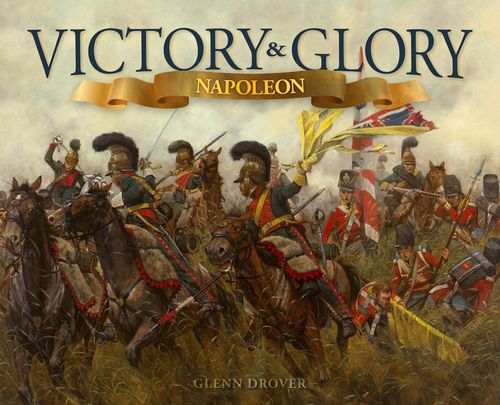
Victory & Glory: Napoleon
Victory & Glory: Napoleon Rulebook
Table of Contents
Table of Contents
- I. Introduction
- II. The Board (Nations and Regions)
- III. The Pieces
- IV. The Cards
- V. Setup
- VI. Nations
- VII. The Game & Rounds
- VIII. The Cards
- IX. British Allies
- X. French Allies
- XI. Military Units Location
- XII. Resolving a Campaign
- XIII. Scoring
- XIV. Winning
- XV. Solo Play
- XVI. Tabletop Miniatures Battles (Optional)
- Appendix A: Units in the Game
I. Introduction
Both players will have to make difficult decisions on what to focus on:
- Economy: the engine that supports their military and keeps their people happy.
- Military: the military force on land and sea that can defeat the enemy and allow their nation to dominate Europe.
- Political Influence: the diplomatic use of power and money to build a network of friends and allies.
- Leadership & Tactics: military innovations and individual generalship that influence the outcomes of battles.
These decisions are made simply by selecting which cards are played from the player's hand, and which end up being discarded. This simple mechanic allows the players to easily create a coherent strategy within the context of the actual events of the era depicted on the cards. In the early years, the French will seem to run rampant, but eventually the tide will turn against them and they will find themselves in a vicious fight to maintain the empire that they have built.
II. The Board (Nations and Regions)
The board is divided into the two Player Nations (France and Great Britain), the Major Nations (Spain, Austria, Prussia, and Russia), and the Minor Nations (Scandinavia, Germany, Italy, Poland, and Egypt).
Historical Note: The Minor Nations of Scandinavia, Germany, and Italy were really a collection of small states rather than unified nations. The growth of Nationalist feeling in these areas, especially in Germany, was sparked by the influence of French nationalism and overbearing French interference, and ended up costing Napoleon the support of his allies.
During the game, the players will vie for control of these areas by placing Influence Markers (cubes in their player color) and launching military campaigns in them. Victory Points will be scored at the end of each era (every three rounds) by the player with the most influence (only) in each nation. The victory points awarded for each era is shown in each nation.
The Victory & Glory Track is used to track each player's Economy, Leadership & Tactics Rating, and their Victory Points.
The board also contains Holding Areas for the four Major Nations' active military units, which are placed there when they are not currently allied to Britain.
III. The Pieces
There are four types of Military Units: Infantry, Cavalry, Artillery, and Navies. Based on preference, the players may choose to either use tiles (each showing the nation's label and color, the unit type, and the value) or Meeples (Cavalry, Infantry, Artillery, Navy).
When using Meeples, the players face the side with the numeric value toward them so that their opponent cannot see it.
There are two types of Influence Markers: British and French.
IV. The Cards
There are two types of cards: Event & Alliance cards, and Campaign cards.
Event & Alliance card parts: Card Name, Body Text, Bottom Text. Example cards: "Spain Restores Louisiana to France" (Body: French Player Gains +1 Economy AND +1 Influence in Spain; Bottom: +1 Influence); "Napoleon Takes Command in Italy" (Body: French Player Gains +3 Leadership; Bottom: +1 Leadership); "Godoy Becomes A French Puppet" (Body: Gain Spain as an Ally (Either France or Britain) AND Gain 2 Influence in Spain, Must have Majority Influence in Spain; Bottom: +2 Influence).
Campaign card parts: Card Name, Outcome Benefits, Hand Card to Opponent Symbol. Example: "Battle of Trafalgar - Naval Campaign: Win = +2 Economy; Lose = -1 Economy".
V. Setup
The board is set up as follows. Place the appropriate markers for each of the three tracked categories for each player.
- Victory Points: France = 0; Great Britain = 0
- Leadership & Tactics Rating: France = 3; Great Britain = 0
- Economic Rating: France = 8; Britain = 6
Influence Markers
Place influence markers as follows:
- France: 2 French Influence
- Great Britain: 2 British Influence
- Italy: 1 British Influence (represents Austrian influence)
- Germany: 2 British Influence (represents British influence in Hanover, Prussian influence in Saxony and northern German states, and Austrian influence in southern Germany)
- Poland: 1 British Influence (represents Russian, Prussian, and Austrian influence)
Cards
Deal each player 10 cards from the blue "1796 - 1801" deck. Place the remaining unused blue cards aside to be used as a Draw Deck.
Starting the Game
The British Player plays first, however, after the first round, the player with the most Victory Points will play first. In the event of a tie, the British Player plays first.
Military Units
Place the starting military units for Britain and Britain's Ally (Austria) in front of the British Player, and the starting military units for France in front of the French Player. The numeric value on each military unit is the combat power for that unit.
British Allies at the start of the game: Austria.
Starting Military Units. Nations that are at war (France, Great Britain, and Austria), have their starting military units placed in front of the owning player.
| FRENCH | BRITAIN | AUSTRIA (British Ally) |
|---|---|---|
| Infantry 1, 2, 3 | Infantry 2 | Infantry 1, 2, 3 |
| Cavalry 2 | Navy 1, 2, 3 | Cavalry 2 |
| Artillery 2 | Artillery 2 | |
| Navy 1, 2 |
Neutral nation's starting military units are placed on the board, in that nation's holding area. All remaining military units are placed near the game board to be used as a pool for recruiting.
| RUSSIA (Neutral) | PRUSSIA (Neutral) | SPAIN (Neutral) |
|---|---|---|
| Infantry 1, 2 | Infantry 2 | Infantry 2 |
| Cavalry 1, 2 | Cavalry 2 | Cavalry 2 |
| Artillery 2 | Artillery 2 | Artillery 2 |
| Naval 1, 2 |
Historical Note: Germany, Italy, and Poland do not have standing armies for game purposes. However their units may be recruited by playing certain cards.
VI. Nations
There are three types of Nations in Victory & Glory: Napoleon.
- Player Nations: France and Britain - These are the two main protagonists in the Napoleonic Wars, and are controlled by the players throughout the entire game.
- Major Nations: Spain, Austria, Prussia, and Russia - These four nations may either be neutral or allied to one of two major nations. If they are neutral, their active army is placed in their 'holding area'. If they are allied (at war), their military units are placed in front of their allied player and are available for use in Campaigns.
- Minor Nations: Germany, Italy, Poland, Scandinavia, and Egypt. The first three nations listed have military units that can be recruited depending on the card, if that player also has a majority of Influence there.
VII. The Game & Rounds
The game consists of 9 rounds that are divided into three eras:
- Defending the Revolution (1796 - 1801) 3 Rounds
- Creating the Empire (1802 - 1807) 3 Rounds
- Defending the Empire (1808 - 1815) 3 Rounds
At the beginning of each round, both players will be dealt 10 cards from the draw deck to form their Hand. The players will take turns playing one card from their hand and performing either the action in the Body Text of the card, or the action in the Bottom Text of the card. After the action is performed, the card is removed from play and will not be available again (Note: this is different from being placed in the discard pile).
Campaign cards are unique in that after one is played, it is handed to the other player who places it in front of them and can subsequently play it. They are only removed from play once the campaign is resolved or at the end of the era.
As stated above, the player with the most Victory Points plays their card first. In the case of a tie, the British Player plays first.
The round ends when each player has played six (6) cards. This includes campaign cards which might not be in the player's hand. When the round ends, any remaining cards in a player's hand are placed in the discard pile. If the draw deck runs out of cards, shuffle the cards in the discard pile to make a new draw deck.
At the beginning of each era, the next deck of cards is brought into the game, and the cards from the previous era are removed from play.
After 9 rounds (all three eras), the game ends.
End Of The Era
After all three rounds of an era have been completed, several things occur:
- All Campaigns are resolved.
- Change the status of allies that lost a campaign in their homeland.
- All Regions are scored.
- Each Player subtracts the total number of their military units (The British Player only counts British Units and the French Player only counts French Units) from their current Economic Rating, and gains or loses the resulting number of Victory Points.
VIII. The Cards
Each era has a deck of cards associated with it (as noted on the backs), and that is used during that era (those three rounds). At the beginning of each round, each player draws 10 cards from the current era draw deck to form their hand. Playing a card results in one or more actions based on the theme of the card. These include an Alliance with one of the four Major Nations (Spain, Austria, Prussia, and Russia), a military Campaign that will end with a battle, the increase or decrease in a player's Economy, increasing or decreasing Influence in one of the Nations of Europe, adding new Military Units to the army of one of the Nations, and the increase or decrease in a player's Leadership & Tactics rating.
Event Cards
Event cards may have one or more type of event that takes effect when these cards are played: Economic, Influence, Military Units, Leadership & Tactics, and Alliance.
Which player is affected by the event depends on what part of the card is selected by the player. If the BODY TEXT of the card is selected, then it affects the player(s) that are named. If the BOTTOM TEXT of the card is selected, then it affects the player that played the card. The effects are mostly positive, but sometimes negative.
Economic
Each player's Economic Rating measures that nation's overall economic power, and their ability to support their war effort.
- Body: The card increases or decreases the named player's economic rating.
- Bottom: The card increases or decreases the economic rating of the player that played the card.
Influence
The Influence points (represented by cubes in the player's color) show how much prestige, diplomatic sway, political power, and military intimidation that each of the two major protagonists had in each Nation.
- Body: Follow the directions on the card by adding or removing Influence as directed.
- Bottom: If the number is a positive number, then the player playing the card may add influence points in a Nation or Nations of their choice. The influence points may be split between multiple Nations. If the number is negative, then the player that loses influence chooses which influence cube(s) to remove.
Recruiting Military Units
Military units represent the armies and navies that engaged in the struggle for control of Europe during the Napoleonic era (1796 - 1815).
Body: Allows the named player to add military units to any Nation's army. This is done by selecting a Nation, placing all of that Nation's unused military units (those that are off-board) face down, and drawing the number of units on the card, and returning the unselected units to the stack of unused units.
In the case of cards that allow the player to recruit military units from one of the Minor Nations with troops (Germany, Italy, and Poland), the player may only do so if they currently have a majority of Influence in that Nation. These cards are the ONLY time that the players can recruit from a Minor Nation. When playing cards that do not specify a Nation, the French player MUST recruit French military units, but the British player may recruit either British military units or military units belonging to any Major Nation (Spain, Prussia, Russia, or Austria).
If the Nation selected is not currently allied (at war), then the new units are placed with the rest of that Nation's military units (their army) in the correct Holding Area. If the Nation selected is currently allied to one of the players, then the new units are placed in front of the player.
In the case of a negative number (losing military units), the player selects from the units in front of them or those already deployed to a campaign. The owning player chooses from where the units will be removed from play, and then selects randomly from his or her units in that group (either in front of them or in a region if on campaign).
Bottom: Same as 'Body' above.
Leadership & Tactics
This rating represents the benefit of great generals, national command structures, training, and tactical doctrine. It is added to the total Combat Ratings and Combined Arms Bonus to get the final Battle Strength for one side in a campaign.
It is also used to determine which player decides the order that campaigns are resolved at the end of an era.
- Body: The card increases or decreases the named player's leadership & tactics rating.
- Bottom: The card increases or decreases the leadership & tactics rating of the player that played the card.
Alliance Cards
Certain cards allow the named player to gain a Major Nation (Spain, Austria, Prussia, and Russia) as an 'ally'. In order to be played, the player must have a majority of Influence in that Major Nation. When played, that Nation's military units are moved from the Holding Area to in front of the allied player, and are now available to that player to be used in Campaigns.
Allied military units may be sent on campaign like the player's national units.
Example: The British player plays a campaign card for Italy. She sends 4 British military units and 3 Austrian military units to Italy to fight in the campaign.
If a player loses a campaign in an allied Major Nation, that Major Nation is defeated, and is no longer allied. Any active military units on the board or in front of the allied player are immediately placed in the 'Holding Area'.
Example: The British player loses a campaign in Austria. Austria is no longer allied to Britain, and therefore all Austrian military units in front of the British player and those on campaign in Germany are immediately placed in the Austrian holding area.
Allied military units do not count when comparing military units to a player's economy at the end of an era.
Campaign Cards
Campaign cards operate differently from other cards.
- When played by either player, both players may place military units in the region where the campaign takes place. They select from the active military units (those in front of them), and place them face down in the region. They may select any of their military units from in front of them (except naval units may only be selected for campaigns in Italy, Spain, France, Great Britain, Scandinavia, and naval campaigns).
- Both players MUST commit at least one military unit to a campaign unless they do not have any valid units available (in front of them).
- The player that did NOT play the campaign card selects and places their military units first, followed by the player who played the campaign card.
- Once placed, military units cannot be removed from the campaign until after the campaign is resolved.
- Once both players have finished selecting and placing their military units face down, the units are turned up to reveal the potential outcome. (The battle is not resolved yet, however.)
- The campaign card is then given to the player who did NOT play the card. They place the card in front of them, and may play the card as if it were one of the cards in their hand. This card remains in front of them until the end of the era when the next deck comes into play (Note: This allows that player to reinforce that campaign throughout the course of the era if they choose to do so).
- If a player decides to play a campaign card that has already been played that era (in effect reinforcing an ongoing campaign), the usual procedure is followed (as above). Any new units sent to the nation where the campaign is taking place are joined to those already there. (In other words: They do not create a second, separate battle).
- Campaign cards are only discarded once the campaign is resolved. However, at the end of the era, all campaign cards from the completed era are removed from play along with the rest of the cards from that era.
Limitations on Which Military Units May Be Used in Which Campaigns
- NAVAL UNITS: Naval units may be selected only if the campaign takes place in Italy, Spain, Egypt, Scandinavia, or at sea (naval campaign).
- SPAIN: Only British, Spanish, French, and French Ally units may be selected for campaigns in Spain. Furthermore, Spanish military units may only be used in campaigns in Spain and France. (Note: In essence, France acts as a block to any British allied units trying to move across her.)
IX. British Allies
The four Major Nations are Spain, Prussia, Austria, and Russia. These four nations may either be allied to Britain or not. Austria starts the game allied to Britain, but may be defeated if Britain loses a campaign in Austria.
Major Nations may join the British alliance if the British player plays an Alliance card. When that occurs, the British player gains the use of that nation's military units from their Holding Area. The British player takes them out of the holding area and places them in front of him or her with the rest of their military.
If Britain loses a campaign in an allied Major Nation, then that nation is defeated and all of their active military units are placed back in their holding area.
X. French Allies
France may gain allied Military Units from Germany, Italy, and Poland as a result of certain Event Cards. However, they may only recruit military units from Nations where they have a majority Influence.
Spain
France may gain Spain as an ally as a result of playing the 'Godoy Becomes a French Puppet' card. The rules for Major Nation allies apply ('British Allies' above). However, if the British player later plays a 'British Diplomacy' card and selects Spain as their ally, Spain switches sides, and all Spanish military units on campaign or in front of the French player immediately become controlled by the British player.
XI. Military Units Location
Military units may be in one of several locations:
- In the unused stack off-board: These are the units that have not yet been recruited or have been eliminated as the result of a campaign.
- In front of a player: These are the units that are in that player's army, including allied units.
- In a major nation's holding area: These are the units of a nation that is not currently allied to Britain. When Britain loses a campaign in a Major Nation that was allied, that nation is no longer allied, and any surviving military units belonging to that Major Nation are placed in that nation's holding area.
XII. Resolving a Campaign
At the end of each era, all campaigns are resolved to determine the winner and the loser. Campaigns may be resolved before the end of an era if an 'En Avant' card is played. If there is more than one campaign that needs to be resolved at the end of an era, the player with the highest Leadership rating decides in which order they are resolved. In the case of a tie, the French player decides.
When resolving a campaign, each player adds together three factors to get their total Battle Strength for that campaign:
- The total value of all of their military units in that region (add together all of the numeric ratings [combat power] on all of the military units on one side).
- Their Leadership & Tactics Rating.
- Their Combined Arms Bonus (+1 for each unique type of unit in the campaign: Infantry, Cavalry, Artillery, and Naval; the highest possible Bonus is therefore '4'.)
The player with the highest Battle Strength for that campaign, wins. There are unique benefits for the winner on each campaign card, as well as benefits or penalties for the loser. In the case of a tie, neither player is the winner, and neither gains the benefit or incurs the penalty.
In addition, the winner loses their lowest value Military Unit in that region, and the loser loses their highest value Military Unit in that region. If there is more than one unit of the same value, then the owning player may select which unit is lost.
In the event of a tie, both players lose their lowest value unit. (Note: If one side has no units in a campaign, then there are no losses taken.)
Naval Campaigns
One campaign card per era is a naval campaign. These are slightly different from land campaigns in the following ways:
- Only naval units may be used in naval campaigns, so when resolving a naval campaign, there is no Combined Arms Bonus.
- The Naval Military Units are placed in the sea instead of a region (they may be placed in any sea area, but placing them where the historical battle takes place is more fun).
- When resolving a naval campaign, Britain gains +3 to their Leadership & Tactics Rating.
XIII. Scoring
There are several ways to score victory points:
- WINNING A CAMPAIGN: Victory Points are often awarded to the winner of a Campaign.
- ECONOMY: At the end of each era, each player subtracts the total number of Player Nation (British or French) military units that they have from their Economic Rating. If the total is positive, then those points are added to that player's Victory Point Total. If the total is negative, then those points are subtracted from that player's Victory Point total. Only French military units for the French Player and only British military units for the British player are counted for this purpose. Allied military units do not need upkeep.
- INFLUENCE: At the end of each era, each player scores Victory Points for each Nation where they have a majority of Influence cubes. The points awarded vary for each nation and in each era. The victory points awarded for each nation in each of the three eras (1st / 2nd / 3rd) is as follows (and also appears on the map):
| Nation | 1st / 2nd / 3rd |
|---|---|
| France | 0 / 0 / 10 |
| Britain | 0 / 0 / 8 |
| Germany | 4 / 5 / 5 |
| Italy | 3 / 4 / 4 |
| Poland | 2 / 4 / 3 |
| Scandinavia | 0 / 1 / 2 |
| Egypt | 2 / 1 / 0 |
| Spain | 2 / 2 / 5 |
| Austria | 3 / 4 / 3 |
| Prussia | 2 / 4 / 4 |
| Russia | 2 / 3 / 4 |
In the case of a tie, no points are awarded to either player.
Scoring Example: At the end of the second era, the French player wins two campaigns, one in Poland (Battle of Friedland) for 2 VP, and one in Germany (Battle of Ulm) for 2 VP.
She has 11 French Military Units and 3 German Military Units. Her economy is currently at 10, so she loses 1 VP (11 - 10 = -1).
She has the most influence in France (0 VP), Poland (4 VP), Germany (5 VP), and Italy (4 VP) for a total of 13 VP for her Influence at the end of the second era.
She adds 16 VP to her total on the Victory & Glory Track.
XIV. Winning
The game ends after all nine rounds are complete and all scoring is complete. The player with the highest victory point total is the winner.
XV. Solo Play
Many gamers do not have ready access to opponents for strategy games, therefore the option to play solo is most welcome. Victory & Glory: Napoleon lends itself to solo play with only a few special rules:
One side is selected by the player to be theirs, and the other is the AI (artificial intelligence). The player will play their side normally according to all of the rules. The AI side will operate as follows:
a) CARD PLAY - The AI side will play 7 cards instead of 6, and will therefore play the first card and the last card every round. The cards are selected blindly for the AI by the player. If a Campaign card is drawn that will obviously disadvantage the AI player (due to the AI player having no military units to send, or their available military units are outnumbered by 2 - 1 by the player's available military units), then that card is placed in front of the player and a new card is drawn and played. If, due to this rule, the AI player runs out of cards in their hand before playing 7 cards, then they draw an extra card from the draw deck until they have played 7 cards that round.
When deciding which action to choose on a given card (body or bottom), the decision should be obvious most of the time. The player is obligated to select the option that is better for the AI player. If there is no clearly superior option, then the choice is made randomly by coin toss.
b) PLACING INFLUENCE - When determining where to place Influence on the map, the hierarchy for regions is as follows:
- Has no influence markers in it.
- Has influence markers, but both sides have the same amount (a tie).
- Has influence markers, but the AI player has one or two influence cubes fewer than the player (close).
- The Nation that has the highest combined VP value for all remaining rounds.
When deciding between more than one Nation in the same category (example: There are two that have no influence in them), then the one with the higher VP value for the current round is selected. If it is still a tie, select the one that has the highest combined VP value for all remaining rounds.
EXAMPLE: It is the fourth round of the game (the first round in the second era). The AI will be placing 1 influence cube. Scandinavia and Egypt have no influence markers in them. Both will be worth 1 VP at the end of the second era, however, Scandinavia will be worth 3 VP total for the second and third eras combined, while Egypt will be worth only 1 VP. The cube is placed in Scandinavia. (Note: If there had been two influence cubes to be placed, the first would have been placed in Scandinavia and the second in Egypt.)
EXAMPLE: It is the 7th round of the game (the first round of the third era). The AI will be placing 2 influence cubes. All Nations have at least one influence cube. There are no Nations where both players have the same number of influence cubes. There are three Nations where the AI player has one or two fewer influence than the player: Germany (1 fewer), France (1 fewer), and Russia (2 fewer). The first influence cube is placed in France (because the total VP value for France is '10'). The second influence cube is also placed in France, (because the players have the same number of influence cubes).
c) ADDING MILITARY UNITS - Whenever a card calls for the British AI player to gain military units, the player will select based on the following hierarchy:
- If the number of active British military units is less than half of the current British Economy Rating, then a British military unit is recruited.
- Major Nation that is allied to Britain in the following order: Russian, Austrian, Prussian, Spanish.
- Major Nation that is not allied to Britain in the following order: Austrian, Russian, Prussian, Spanish.
The French AI player will always recruit French military units unless the card specifically calls for another Nation.
d) SELECTING MILITARY UNITS AND INFLUENCE TO REMOVE - Whenever a card calls for an influence cube or military unit to be removed from the game, the player will always select which one is removed. This selection is done blind in the case of the military units.
XVI. Tabletop Miniatures Battles (Optional)
Players who own Napoleonic miniatures may choose to use this game as a campaign, and to use their miniatures armies to fight the battles on the tabletop. We suggest using Glenn Drover's fast play Miniature Battles: Napoleon Rules. They are fast, furious, and fun, while still feeling very historically accurate to the period.
When doing this, count each military unit committed to a campaign as a 'Corps' on the tabletop as follows:
| Board game | Tabletop |
|---|---|
| Infantry Unit | 3 Infantry Units (6 stands each) + 1 Artillery unit (3 stands) |
| Cavalry Unit | 3 Cavalry Units (6 stands each) + 1 Horse Artillery unit (3 stands) |
| Artillery Unit | 3 Artillery Units (3 stands each) |
| Naval Unit | Does not appear |
The Numeric Rating (combat power) on each military unit in the campaign will dictate what type of unit that it represents on the tabletop:
- Infantry 1: Militia/Landwehr
- Infantry 2 & 3: Regular Troops
- Infantry 4: Guard or Elite Troops
- Cavalry 1: Landwehr or Cossacks
- Cavalry 2: Light Cavalry
- Cavalry 3: Medium Cavalry such as Dragoons
- Cavalry 4: Heavy Cavalry such as Cuirassier or Guard Cavalry
- Artillery 2: Light Artillery or Horse Artillery
- Artillery 3: Foot Artillery
- Artillery 4: Heavy Artillery
The player's Leadership Rating in the Boardgame will affect the player's 'Command Rating' and therefore Command Card hand size in the battle, as well as how many generals (in addition to the commanding general) that they will have in the battle.
| Leadership Rating (Board game) | Command Rating / Generals (Tabletop Battle) |
|---|---|
| 0 - 3 | 4 / 1 |
| 4 - 6 | 5 / 2 |
| 7 - 10 | 6 / 3 |
| 11+ | 7 / 4 |
The battle is won by the player who eliminates 50% of the enemy units on the tabletop (this represents making them combat ineffective, not literally destroying them).
When the battle ends, the winner loses their lowest value unit and the loser loses their highest value unit per the usual rules. Alternatively, if the players agree, they can reflect the real battlefield losses to the board game by converting the losses at the same 'corps' ratio above.
Appendix A: Units in the Game
Each entry lists unit type, value, and how many.
FRANCE (blue): Infantry 1 x3; Navy 1 x2; Infantry 2 x1; Cavalry 2 x1 (Hussar); Artillery 2 x1; Navy 2 x2; Infantry 3 x1; Cavalry 3 x1 (Dragoon); Artillery 3 x1; Navy 3 x2; Infantry 4 x1 (Elite Guard); Cavalry 4 x1 (Cuirassier); Artillery 4 x1 (Guard Artillery).
BRITAIN (red): Navy 1 x2; Infantry 2 x1; Cavalry 2 x1 (Light Cavalry); Artillery 2 x1; Navy 2 x2; Infantry 3 x1; Cavalry 3 x1 (Heavy Cavalry); Navy 3 x2; Infantry 4 x1; Navy 4 x2.
PRUSSIA (purple): Infantry 1 x3 (Landwehr Militia); Cavalry 1 x1 (Landwehr Cavalry); Infantry 2 x1; Cavalry 2 x1 (Hussar Light Cavalry); Artillery 2 x1; Infantry 3 x1.
AUSTRIA (gray): Infantry 1 x2 (Landwehr); Infantry 2 x1; Cavalry 2 x1 (Hussar Light Cavalry); Artillery 2 x1; Infantry 3 x1; Cavalry 3 x1 (Heavy Cavalry); Artillery 3 x1.
RUSSIA (green): Infantry 1 x3 (Militia); Cavalry 1 x3 (Cossack); Infantry 2 x1; Cavalry 2 x1 (Hussar Light Cavalry); Artillery 2 x1 (Horse Artillery); Infantry 3 x1 (Guard Infantry); Cavalry 3 x1 (Heavy Cavalry); Artillery 3 x1.
SPAIN (yellow): Infantry 1 x4 (Guerilla); Infantry 2 x1; Cavalry 2 x1; Artillery 2 x1; Navy 1 x2.
GERMANY (light blue): Infantry 1 x2; Infantry 2 x1; Cavalry 2 x1; Artillery 2 x1 (French Artillery); Infantry 3 x1; Cavalry 3 x1; Artillery 3 x1 (French Artillery).
ITALY (orange): Infantry 1 x2; Infantry 2 x1; Cavalry 2 x1 (French Dragoon Cavalry); Artillery 2 x1 (French Artillery).
POLAND (beige): Infantry 2 x2; Cavalry 2 x2; Cavalry 3 x2.