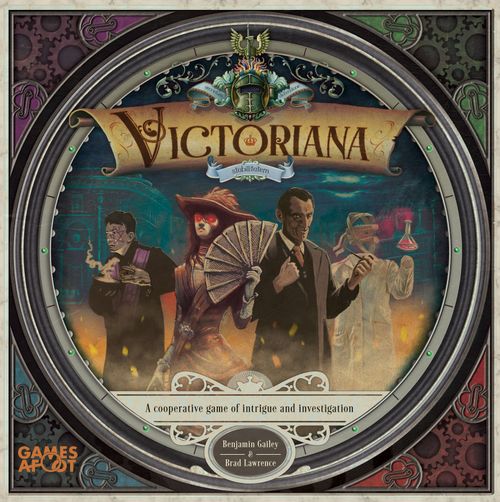
Victoriana
Victoriana Rulebook
Table of Contents
Table of Contents
- Components Breakdown
- Setup
- Sequence of Play
- Player Turns
- Moving about London
- Locales
- Investigating Leads
- Fulfilling an Investigation Option
- Cold Leads
- Specialities
- Evidence and Henchmen
- Generating New Leads
- Uncovering the Conspiracy
- Agents
- Trauma
- Concluding a Round
- Emerging Victorious or Failing to Perform One's Duty
- Victoriana's Golden Rule
- Locale Abilities
- Investigator Abilities FAQ
- The Yard Stands Ready to Assist
Components Breakdown
- London Game Board. Depicts notable landmarks in and around central London. All locales are color coded and marked with icons according to their spheres of influence (Resource Tokens). Some locales have multiple colors/icons to reflect their broader impact on the city and its happenings. Many locales have abilities that can be utilized when an investigator spends time there (see Locales).
- Plot Tracks (4). Plot tracks are advanced as investigators learn more about the conspiracy. The further the tracks advance, the more significantly they benefit investigators.
- Investigators and Standees. Players control investigators. Each has a card denoting the investigator's starting resources and area of speciality, game abilities, and trauma track. A corresponding standee is used to represent that investigator's position in the city of London.
- Agent Cards and Standees (10 cards, 14 standees). Masterminds control capable pawns, called agents. These heinous characters will deploy at various times throughout the game to impede investigators. Similar to investigators, each agent has a card detailing game abilities and a standee to match. They have the same card back as plot cards.
- Conspiracy Cards. There are three decks of conspiracy cards: masterminds (10), plots (24 plot cards), and henchmen (21). Winning the game requires revealing and/or defeating these cards.
- Lead Cards (100). There are four decks of lead cards, each corresponding to a sphere of influence (Occult, Politics, Science, Underworld). Investigators will pursue these cards to uncover aspects of the conspiracy.
- Advantage and Setback Cards. Companions and other tools to aid in your investigations (Advantage, 13), as well as obstacles to impede you (Setback, 12). Advantage and Setback cards have the same cardback as leads; they are shuffled into the lead decks during setup.
- Dice. An 8-sided lead die with faces matching the spheres of influence; a 6-sided clock die with faces corresponding to different clock hand positions; a 10-sided locale die.
Setup
1. Set up board and plot tracks
Unfold the game board and place it within reach of all players. Place the four plot tracks near the board with a tracking token on each starting space. Select 20 plot cards (preferably five of each resource type, shown in the top right corner of the card) and shuffle them together to create the plot deck. Select one plot at random and place it facedown, unseen, near the game board.
2. Choose agents
Randomly and secretly choose the appropriate number of agent cards (2 for 2 players, 3 for 3 & 4 players). Shuffle one unseen into the deck of plot cards and set the other(s) aside facedown. Place the plot deck on top of the previously selected plot card.
3. Prepare conspiracy decks
Shuffle the mastermind cards. Select a mastermind unseen at random and place it facedown. Shuffle the henchmen cards, select three unseen at random, and place them facedown on top of the mastermind card. Return the unused henchmen and mastermind cards to the game box.
4. Arrange lead decks
Randomly and secretly select eight advantage cards and eight setback cards. Shuffle two of each into each of the lead decks and return the rest to the game box. Place each lead deck next to its corresponding area along the edge of the game board.
5. Place tokens
Gather 30 unmarked (without numbers) locale tokens as well as the locale token marked with an "X" and randomize them facedown. Place one token offset near each colored space on the game board, leaving the locale's number(s) visible. Do not place locale tokens on 221b Baker Street, Griffin's Hideout, Speakers' Corner, or Crowley's Sanctum Securum.
Place event and status tokens within reach of all players.
Place the cold lead token on the first space of the cold lead track.
Place the time token on the 12 o'clock position of the clock tower.
Stack the hour tokens in the center of the clock in numerical order, with the 1 token on top.
Take three tokens of each resource type (not including Wild resource tokens) and place them in the grab bag. Shake the bag's contents.
Place the appropriate number of Scotland Yard tokens (four for a two-player game, one for three players, and zero for four players) near the New Scotland Yard locale.
6. Select investigators and starting player
Each player selects an investigator. This can be done randomly or through any means deemed acceptable. Players take their investigator's card and place the matching standee on the Buckingham Palace locale.
Players decide randomly who will act first. The second player to act takes the end-of-round marker. Play proceeds clockwise.
7. Draw starting resources
Players take from stock the resource tokens listed on their investigator cards, one trauma token, and three ability tokens. All other tokens should be set aside within reach of everyone.
8. Place opening leads
Take the top card from each lead deck and shuffle them facedown. Place each one facedown on the side of the gameboard by the clock tower. Make sure the clock hands on the leads' backs are all pointing towards the top of the gameboard.
Roll the lead and locale dice. Find the locale on the game board that matches the type and number rolled. Collect two matching lead tracker tokens and place one on the determined locale and another on one of the four leads. Repeat this process for the remaining three leads.
9. Reveal the first henchman
Turn over the first henchman card and follow its effects (if any).
10. Reveal the first plot
Turn over the top plot card, advance the marker of the corresponding plot track, and discard it. If the top card is an agent, set it aside. It will pursue at the end of the first round.
11. Save the Kingdom!
You have 21 rounds to right what is wrong and preserve the Empire. Play is ready to begin.
Sequence of Play
Play lasts for 21 rounds, with the final round beginning at midnight.
A round always consists of two consecutive player turns.
If the conspiracy has not been thwarted by the end of round 21, the players lose the game.
Player Turns
A player may do the following on their turn in this order:
- Move their investigator
- Perform ONE of the following actions
- Investigate a Lead. If an investigator ends their movement on a locale with a lead token, they may investigate the lead (Investigating Leads).
- Use a Locale Ability. If an investigator ends their movement on a locale with an ability and did not investigate a lead, they may use that locale's ability (Locales).
- Reveal a locale token. If there is a locale token where an investigator ends their turn, they may reveal it.
Investigator Abilities
Each investigator has a number of abilities listed on their investigator card. These represent special talents, advantages or connections that the investigator may use to aid their mission. Investigator abilities come in two varieties, Innate abilities (infinity symbol) and Token abilities (hexagon).
Innate abilities represent innate advantages that require no action to use. They may, however, be limited to specific situations, such as "at the beginning of your turn" or "if you end your turn on an Occult locale." If no timing is specified, the ability may be used at any time.
Token abilities represent unique skills or talents. They also require no action to use, but they DO require the expenditure of one ability token. Some investigators may spend their tokens for one of a variety of effects (e.g. the Invisible Man), while others (Wilhelmina Harker, Captain Nemo) have three unique ability tokens, each of which may be spent once per game.
Example (Wilhelmina Harker's card, shown with Dracula's Resilience: when the clock reaches the quarter-hour symbol, you may heal 1 trauma; Mesmerism: successfully investigate any option on a non-Science lead; Mist Form: use any locale's ability, this does not count as your action; Undead Celerity: your movement is five this turn.)
Example: Aleister Crowley begins his turn in his Sanctum Securus. From there he can travel to one locale: Bedlam Lunatic Asylum. Once there, and with two of his three movements remaining, his options expand. Crowley would like to investigate a lead at the Tower of London, but his remaining two movements will only get him as far as Nikola Tesla's Secret Lab. The lead is about to go cold, so Crowley decides to push his luck. He suffers two trauma, and gains an extra movement for this turn. It's time to see what secrets lurk in the ancient dungeon...
Moving about London
Each investigator is permitted a maximum of three movements per turn. Investigators may move through the city by following the travel paths. Each adjacent locale entered costs one movement.
Investigators may not enter a locale if it does not connect to their current locale by a travel path.
Investigators may suffer two trauma once per turn to gain an extra movement (Trauma).
Locales
Throughout London, certain locations offer investigators assistance during their inquiries. By ending their movement on a locale, an investigator may use that locale's ability once per turn.
A locale's ability cannot be used if an investigator investigated a lead on their current turn.
The symbols displayed on the locales on the game board are for quick reference. Detailed descriptions of locales are in the back of this book and on player aids.
If an investigator ends their turn on a locale with a locale token, they may reveal it. If it is blank, it is discarded. If it is marked with an X, the location of the conspiracy has been discovered! Remove all other locale tokens still on the game board and leave the marked token where it is.
Revealing the conspiracy's locale may cause an agent to pursue investigators (Agents).
Investigating Leads
If an investigator ends their movement on a locale with one or more leads, they may choose to investigate one of them.
The investigator selects the lead card to be investigated and reveals it.
The lead card will contain some, but rarely all, of the following details: title and type; investigation effects; investigation options; other effects (for example, "This Politics card cannot be kept as evidence").
Example card, "Ceremonial Dagger" (Occult evidence lead): When this lead is investigated, draw a resource from the bag. If the resource is Occult, this lead goes cold immediately. Option: CONNECT THE DAGGER TO A PREVIOUS MURDER: Science + Underworld => 1 deduction. Option: REVEAL THE DAGGER'S POWER: 2 Occult + 2 trauma suffered => 3 deductions. Example card, "Secret Meeting with an MP" (Politics): EXCHANGE INFORMATION: 2 Politics + Underworld => 3 deductions; REFUSE NO AS AN ANSWER: 3 Politics + Occult => 5 deductions; This Politics card cannot be kept as evidence.
Title and Type
The name of whatever you are investigating. Its color and icon indicate what type of lead it is.
Investigation Effects
When the lead is initially revealed, follow the instructions written here (if any).
Investigation Options
Most leads will have multiple avenues to represent the different tactics available to investigators.
Each line of symbols represents a possible option for an investigator to choose. The investigator may choose only one investigation option.
The icons to the left of the grey arrows represent the resources an investigator must expend to successfully investigate the lead. The icons to the right of the grey arrows represent deductions and other resources gained. Consult the Icon Legend below and on page 16 for a complete explanation of the game's symbols.
Icon Legend
- Occult (resource) - supernatural, mystical, and magical creatures and phenomena
- Politics (resource) - political institutions and the upper strata of England's castes
- Science (resource) - study and manipulation of the natural world through natural means
- Underworld (resource) - criminal personalities, methods, and networks
- Wild (resource) - may be used in place of any resource
- Player's Choice (resource) - any resource of the player's choice
- Deduction - each one gained eliminates one potential plot card from the plot deck
- Trauma - mental stress, physical harm, or malign influences which may affect an investigator
- Trauma Suffered - causes players to move their trauma marker to the right (negative)
- Trauma Healed - causes players to move their trauma marker to the left (positive)
Example: Sherlock Holmes moves from Somerset House to Cleopatra's Needle. There is a numbered lead token there, so he is able to investigate that lead by revealing the lead card with the corresponding lead token (in this case the lead token number 1). The revealed card is "Impossible Doppelgaenger" (Occult evidence): When this lead is investigated, advance another lead 1/4 hour. Option DISPEL THE ILLUSION: Occult => 1 deduction.
Example: Dion Fortune's prophetic visions have uncovered a Doorway to Another Realm. After placing an event token on her current locale as instructed by the lead, she chooses to enter the doorway and Walk Between Worlds, earning her three deductions. To do so she spends 2 Occult and 1 Science and suffers 1 trauma. (The card: When this lead is investigated, place an event token on your current locale. Until the clock reaches the quarter-hour, this locale is considered to be adjacent to all locales on the board. Options: WARD THE OPENING; WALK BETWEEN WORLDS: 2 Occult + Science + trauma suffered => 3 deductions.)
Fortune reveals the top three cards from the plot deck - Crown Jewels Stolen, Doomsday Device Detonated, and White Fell, the lycanthropic Agent of Evil! Since only one plot track can be increased no matter how many deductions are gained, Fortune now must choose between advancing the science or underworld plot track, as these are the two types shown amongst the cards she revealed (denoted by the icon in the upper right corner of each plot card). She settles on science, moving the marker to its second space and gaining each investigator a Science resource - their understanding of the conspiracy grows! As for White Fell, she is set aside until the end of the round when she will begin her pursuit of the young magician and her compatriots.
Other Effects
Some leads have special conditional effects that occur. Refer to each card for specific instructions.
Advantages and Setbacks
Advantages and setbacks may be encountered instead when investigating a lead. These cards are gained automatically. Unencountered advantages and setbacks are treated as leads when Concluding a Round and may go cold.
Examples: Advantage "Doctor John Watson": Place this card in front of you. Discard this card to heal any investigator 3 trauma. Discard this card for 2 Science. Setback "Bribed Peelers": Place this card in front of you. You may not suffer 2 trauma to increase your movement. You may end your turn at New Scotland Yard and spend 1 Underworld to discard this card.
Fulfilling an Investigation Option
When an investigator chooses an investigation option and expends the required resources, the lead card may be used in one of two ways: Make Deductions or Accumulate Evidence.
Make Deductions
Deductions reveal what nefarious plot the mastermind intends to bring to fruition.
When choosing to Make Deductions, investigators gain the listed benefits (to the right of the arrow) for the chosen option. Every deduction grants the investigator one deduction.
For each deduction earned, the investigator draws a card from the top of the plot deck. Each of the 20 plots has a type (the icon in the upper right) and corresponds to the plot track matching this icon. From the drawn plots, investigators must choose only one and advance the matching plot track by one space. All drawn plots are then discarded.
The lead is then discarded and the investigator generates another lead (Generating New Leads).
Advancing a plot track may result in investigators gaining a benefit. Refer to the plot tracks for more details. There is a limited number of each plot type in the plot deck, so choose wisely.
Be warned: an agent lurks in the plot deck! If it is drawn when investigators are revealing deductions, it enters play at the end of the round (Agents). An agent revealed this way counts as a deduction.
Accumulate Evidence
The lead is placed under the investigator's card with the colored evidence bar showing. It will be used to overcome henchmen (Evidence and Henchmen, below). Investigators do not receive any of the benefits listed to the right of the arrow (deductions, resources, healed trauma, etc.) when accumulating evidence. Satisfying any of the lead's investigation options qualifies it to be kept as evidence. The investigator then generates another lead (Generating New Leads).
(Illustration: Griffin has accumulated two pieces of evidence.)
Cold Leads
If an investigator cannot successfully fulfill an investigation option, or chooses not to do so, the lead goes cold. Discard the lead from play and increase the cold lead track by one. The investigator also suffers one trauma for the failure (Trauma). When a lead goes cold, a new lead is not generated.
Specialities
When an investigator successfully investigates a lead that is the same type as their Speciality (occult, politics, science, underworld), they receive multiple benefits.
- If they choose to make deductions from the lead, one extra deduction is gained.
- If they choose to accumulate evidence from the lead, the evidence is considered wild and can be used to fulfill any required type of evidence.
- When they generate a lead, they generate an additional lead from the same lead pile. (Generating New Leads)
Note that an investigator's speciality may change. This change always affects accumulated evidence. When discarding evidence and removing henchmen from play, only the investigator's current speciality matters (Evidence and Henchmen, below).
Special: William Stead and Miss X's speciality is determined by which character investigates the lead. Evidence should be held separately for each character.
Example: While investigating a lead, Griffin discovers a strange Stinging Mist. With three options to choose from (WADE THROUGH THE MIASMA: 2 trauma suffered => 1 deduction; VENT THE ROOM: Science + Underworld => 1 deduction; COLLECT A SAMPLE AND RUN: Science + Politics + Occult => 2 deductions), Griffin elects to not spend any of his resources, and instead suffers 2 trauma. This would normally allow him to make a single deduction, but since the lead is the same type as Griffin's speciality (Science), he receives an extra deduction. What secrets are contained within the impenetrable murk?
Example: Sherlock Holmes tracks an Escaped Millbank Inmate to Singapore Charlie's notorious opium den. The lead card (Underworld evidence): When investigated, suffer 1 trauma. Option EXTRACT PRISON RUMOURS: 2 Underworld => 1 deduction. When the lead card is revealed, Holmes immediately suffers 1 trauma due to its investigation effect. The convict has some spirit in him! Holmes expends 2 Underworld and the escapee talks. He chooses to accumulate evidence and places the lead under his player card. Since this lead is the same type as Holmes' speciality, when Holmes contributes this evidence to overcome a henchman, it can be used as any of the required evidence types. Because he chose to accumulate evidence, he does not receive any deductions for the deduction icon.
Evidence and Henchmen
Henchmen represent people, creatures, and other obstacles employed by masterminds to impede investigators' progress. Overcoming them is vital to discovering who is at the center of the conspiracy's web.
Each henchman card has an evidence requirement printed along its bottom. To discard a henchman from play, investigators must, as a group, collect evidence that matches those requirements (Accumulate Evidence). When discarding evidence, investigators holding evidence in their speciality may use it as evidence of any type.
Once the required evidence has been collected, investigators may discard it at any time to remove the current henchman from play. Investigators then reveal the next henchman, and follow its reveal effects (if any). If there are no henchmen remaining, reveal the mastermind. This may cause an agent to enter play (Agents).
Evidence should be held in the investigator's card with the colored evidence bar showing (see Accumulate Evidence).
Example: The Scarlet Pimpernel and Richard Burton need to collectively discard evidence (Occult, Occult, Politics) to arrest the Bloodthirsty Cultists that guard the mastermind's identity. Burton currently holds Science and Underworld evidence, and is following up a lead at The X Club. Since Burton's speciality shifts to match his locale's type(s), and since The X Club is both Science and Underworld, both pieces of his evidence can be treated as evidence of any type. The Scarlet Pimpernel's speciality can be either Underworld or Politics, whichever she has the most of. Unfortunately, she has an equal amount of Underworld and Politics, which means she currently has no speciality. The Underworld evidence she possesses can't be used to overcome the cultists. The swashbuckling vigilante has to spring into action before Burton moves! If she can somehow reduce the number of Politics she has (so her switching speciality activates), or if she can acquire Occult or Politics evidence, the two investigators can hand the henchman over to Scotland Yard and unmask who is behind it all!
Generating New Leads
As investigators follow the trail left by the conspiracy, the investigation will branch in various directions. Successfully investigating leads will cause new leads to emerge at various locales.
Whenever an investigator must generate a new lead, follow the steps below:
- Create a lead pile by combining the following:
- One card from the lead deck that matches the type of lead just investigated
- One card from each lead deck matching a type shown at the locale where the lead was just investigated (up to two cards)
- One card from a lead deck of the investigator's choice that matches one of the resources spent to investigate (if no resources were spent, skip this step)
- Shuffle the lead pile (you should have two, three, or four cards), and select one unseen at random.
- Roll the lead, locale, and clock dice.
- The new lead appears at a locale determined by the lead die and the locale die. Find the locale that matches the type and number that were rolled. Place the selected lead card facedown next to any active leads. Rotate the card so it matches the direction shown by the icon on the clock die (the die should be read with the line on the bottom). A lead will enter play with its clock hands pointing towards the top of the game board (12 o'clock), pointing right (3 o'clock), or pointing down (6 o'clock).
- Collect a pair of matching tracking tokens and place the smaller token on the determined locale. Place the larger token on the lead card's back.
- Discard any cards remaining in the lead pile into a single, facedown stack.
Since investigators have some influence over the lead pile's contents, investigators are encouraged to place resource tokens from the stock on the card's back to indicate what type of lead a card is likely to be. Just remember to return the resources to the stock when finished with them.
When specialities require an additional lead to be generated, it is generated from the same lead pile.
Multiple leads may appear on the same locale.
Advantages and setbacks do not generate a new lead after being encountered.
Example: Mrs. Harker's recurring nightmares have driven her to revisit a place from her past: Carfax Abbey. While investigating a lead at the monastery, Wilhelmina rescues a Kidnapped Heiress being held prisoner by a sinister coven. She spends Politics and Science as denoted on the lead card (HELP HER ESCAPE: Politics + Science => 1 deduction). Once she decides whether to use the lead for deductions or evidence, she must immediately generate a new lead.
When generating her new lead, Mina's lead pile consists of: one card from the lead deck that matches the type of lead investigated (Politics); one card from each lead deck matching a type shown at the locale (Occult; up to two cards); and one card from a lead deck of the investigator's choice that matches one of the resources spent to investigate (Politics or Science). The three cards are shuffled and one is selected unseen. Mina rolls the lead, locale, and clock dice. Her results are: Politics on the lead die, 1 on the locale die and the 6 o'clock symbol on the clock die.
The new lead card is placed next to the active leads with its clock hands at the 6 o'clock position. Since the lead has a 2/3 chance of being a politics lead, Mina borrows a Politics resource from the stock and places it on the card's back as a reminder. She chooses a matching pair of tracking tokens and places the larger on the back of the facedown lead card and the smaller on the Politics 1 locale: The Prussian Embassy. What do the Prussians want with the heiress?
Mina's investigator card lists Politics as her speciality, which means she must generate a second lead when following up politics leads. Kidnapped Heiress is, indeed, a politics lead. The second lead must also come from the same lead pile, which now has two cards remaining. Mina rolls the same three dice and repeats the process. Someone - or something - other than the Prussians is involved...
Leads to Begin the Game
Special: The four leads generated during the game set-up are done slightly differently.
Take the top card from each lead deck and shuffle them facedown. Roll the lead and locale dice for all four leads.
All leads generated during set-up enter play with their clock hands pointing towards the top of the game board (12 o'clock).
Uncovering the Conspiracy
As investigators track down leads and assemble clues, the elements that threaten Her Majesty's realm will come into focus.
Accumulating evidence, making deductions, and visiting different locales will enable investigators to eliminate cards from conspiracy decks and reveal locale tokens.
There are three elements to the conspiracy:
- The Mastermind
- The Plot
- The Locale
If at any time all henchmen have been discarded, reveal the mastermind. Follow any effects stated on the mastermind card.
If there is one or fewer cards remaining in the plot deck after applying deductions, reveal the bottom card. That is the conspiracy's plot.
If a locale's token is revealed to be marked with an X, that is the conspiracy's locale.
Example: Miss X tracks and corners an Elusive Foreign Agent, at The Metropolitan Tabernacle. (Lead card options: CONFISCATE THE DIPLOMATIC BAG: Politics => 1 deduction; SPREAD FALSE RUMOURS: 2 Underworld => 1 deduction, and move to the Prussian Embassy; CABLE CONTACTS ON THE CONTINENT: Politics + any resource => 1 deduction, and move to any locale.) She opts to Make Deductions. By expending Politics she gains one deduction and eliminates one card from the plot deck. Since it was the second to last card, Miss X reveals the bottom card of the plot deck: Regicide! She doesn't know who is behind the conspiracy or where they are plotting it, but she knows the Queen is in immediate danger!
Agents
Her Majesty is not the only figure able to summon assistance from among loyal subjects. Masterminds also assemble an array of formidable and capable persons. As the investigators narrow their search and the game reaches its conclusion, agents are deployed to impede their progress. The number of agents the mastermind can draw from is dependent on the number of investigators (2 agents for 2 investigators, 3 for 3 or 4 investigators).
Agents enter play in the following ways:
- One is concealed in the plot deck. When revealed, it is set aside and will harry investigators following the rules for agent pursuit (Pursuit). The revealed agent counts against earned deductions (Make Deductions).
- In a game with two agents, an agent enters play when either the conspiracy's locale or mastermind is uncovered, whichever happens first.
- In a game with three agents, one agent enters play each time the conspiracy's mastermind or locale is uncovered. Select one of the facedown agents at random.
Pursuit
At the end of a round, any agent(s) revealed in the current round or already in play pursue investigators (step 5 of Concluding a Round).
Do the following for each agent in the order they entered play:
- Roll the lead and locale dice. Place the agent's standee at the corresponding locale.
- Follow any instructions listed on the agent's card.
In addition to the effects listed on each agent's card, the following rules are in effect:
- Investigators may never leave or enter a locale occupied by an agent (unless trying to defeat it).
- If an agent is ever placed on the same locale as an investigator, that investigator suffers 2 trauma.
Some agents inflict conditions on investigators. You may become bitten, prey, or even driven insane! When you are instructed to gain a token caused by an agent's pursuit, track the status with a status token.
Example: Success! Griffin and Sherlock Holmes have just uncovered the conspiracy's locale. The unknown mastermind dispatches his remaining agent, the big game hunter Colonel Sebastian Moran, and he joins Caissa in pursuit of the rogue scientist and the consulting detective.
Holmes is interrogating a suspect at Scotland Yard, and Griffin is surveying maps at The Royal Geographical Society. Griffin was the second player to act in the round, so it is time for the agents to give chase. The lead and locale dice are rolled for each agent.
Caissa, already in play, rolls Politics on the lead die and a 2 on the locale die and moves to Somerset House. Holmes is safe for the moment, as New Scotland Yard is three locales away. The Invisible Man is not so lucky. Traced through Griffin's Hideout, the Royal Geographic Society is within two locales of Caissa. Griffin loses a random resource to the Illuminati's machinations. (Card, Caissa, Illuminati Sleeper Agent: After Caissa pursues, if she is within two locales of an investigator, that investigator discards a random resource.)
Sebastian Moran rolls Politics on the lead die and a 5 on the locale die, and enters play at The Carlton Club. The Colonel's sharpshooting abilities, indicated on his agent card, deal 1 trauma to each investigator within two locales. Both Holmes and Griffin suffer 1 trauma from the barrel of the Colonel's air rifle. (Card, Colonel Sebastian Moran: After Moran pursues, if he is within two locales of an investigator, that investigator suffers 1 trauma.) At the end of each subsequent round, unless the agents are defeated, they will pursue the investigators by moving to different locales.
Defeating Agents
Each agent has a combination of resources printed on their card. An investigator may move to a locale with an agent and expend those resources. The agent is then defeated, permanently removed from play. This does not count as the investigator's action.
If an investigator begins their turn on the same locale as an agent they cannot move, but they may attempt to defeat the agent, investigate a lead at that locale, or use that locale's ability.
Trauma
It is likely, however unfortunate, that investigators will meet with resistance during the course of their inquiries. This is represented by trauma.
Trauma can reflect many things: psychological stress, physical harm, a malign influence, etc.
Trauma is tracked along the top of an investigator's card beginning at the white space. When suffering or healing trauma, the number of skulls depicted indicates the number of spaces to be moved along the track. The red or green arrow indicates the direction.
Each investigator can safely suffer five points of trauma. If, at any time, an investigator's trauma marker moves past the rightmost position, that investigator is eliminated from play. The forces of darkness have overwhelmed them.
Unfortunately for the other investigators, the eliminated investigator still factors into round considerations. The clock still advances as if they were in the game.
Many events can be a source of trauma for investigators. Trauma can also be voluntarily suffered for two purposes:
- Suffering two trauma will add one movement to an investigator's maximum movement for the current turn.
- When investigating a lead, an investigator may suffer one trauma to select three random resources from the grab bag. The investigator selects one to keep, and the other two are returned to the bag. An investigator may do this only once per turn and only when investigating leads. Whenever the grab bag is emptied, it should be refilled following the instructions in step 5 of Game Setup.
Example: While pursuing a lead, Sherlock Holmes uncovers a strange arcane symbol: an Inverted Pentagram (RING THE BELL: Occult => 1 deduction; SHUT THE BOOK: 2 Occult => 2 deductions; SNUFF THE CANDLE: 3 Occult => 3 deductions). Occult curiosities not being his area of expertise, Holmes calls in some overdue favors by suffering 1 trauma. He draws three resources from the grab bag, netting Politics, Occult and Underworld. Holmes opts to keep the Occult, placing the other two back into the bag. The Occult will now allow him to satisfy Inverted Pentagram's first option. The trauma suffered brings Holmes to the brink, the shadowy fifth spot on his trauma track. Unless he can get to Bedlam soon, he is certain to be overcome.
Concluding a Round
After two consecutive player turns, the round ends. The end-of-round marker is included to help players track who has taken turns.
When the player holding the marker completes their turn, do the following in order:
- Advance the time token to the next quarter hour space.
- If the time token reaches the 12 o'clock position, reveal the next hour token.
- Rotate all active lead cards so the clock hands on their backs advance a quarter hour.
- If a lead's clock hands return to the 12 o'clock position, it has gone cold. Discard it from play, collect its tracking tokens, and advance the cold lead track by one. Multiple leads may go cold. For each lead going cold, one investigator must suffer one trauma.
- Agents Pursue - Follow the instructions outlined under Pursuit.
- Pass the end-of-round marker, if necessary:
- 2 players: the marker is not passed
- 3 & 4 players: the marker is passed two places to the left
- Play proceeds with the next player's turn.
Example: Wilhelmina Harker and Aleister Crowley have come to the Queen's aid this game, and Aleister Crowley's turn has just ended. Since he was the second consecutive player to act, it also signals the end of the round.
Wilhelmina advances the time token to the next 1/4 hour space. The clock tower now shows the time as 9:45. No need to reveal the next hour token yet.
Three active leads are in play. Lead one is resting at the 12 o'clock position, Lead two at 6 o'clock, and Lead three at 9 o'clock. Each lead card is rotated so the clock hands face the next quarter hour. Lead one now shows as 3 o'clock, Lead two shows as 9 o'clock, and Lead three returns to 12 o'clock.
Lead three has gone cold. The lead card is discarded from play, and the tracking tokens are collected, and the cold lead track is advanced one space. Additionally, one investigator must suffer 1 trauma. Since Wilhelmina's vampiric form will regenerate the trauma on the hour, she agrees to take the burden.
There are no agents on the board - yet - so step five is ignored. There are only two players, so the end-of-round marker remains with Crowley. Wilhelmina prepares to act.
Emerging Victorious or Failing to Perform One's Duty
Victoriana has only one victory condition: halt the conspiracy threatening the British Empire.
Once the conspiracy has been successfully uncovered, investigators have until the clock tower shows 12:15 (the end of round 21) to do the following:
- Assemble at the conspiracy's locale
- Pool their collective resources
- Match the types and amounts of resources corresponding to each element of the conspiracy (the mastermind, the plot, and the locale)
If, at any time in the game, the above condition is met, the mastermind is thwarted and the players win.
The mastermind and plot have unique combinations of resource requirements printed on their cards.
The locale always requires four resources matching its type (or two of each, if it has multiple).
Only investigators present at the conspiracy's locale may contribute their resources.
Investigators face an uphill battle to preserve the Empire. If any of the following conditions are met, the investigators immediately lose:
- The cold lead track reaches eight or higher
- All investigators are traumatized (six or more trauma)
- The end of round 21 is reached (12:15 displayed on the clock tower)
Indeed, answering the Queen's call is not for the faint of heart. History will not record the failure of your efforts, yet the world will suffer its consequences. Godspeed!
Example: In this conspiracy, Userkare (the mastermind) is attempting to awaken the Ancient Ones (the plot) beneath the Houses of Parliament (the locale). The resource icons along the bottom of the mastermind and plot cards total five Occult, three Science, and two Underworld. The Houses of Parliament is a political locale, so its requirement is four Politics. To defeat this conspiracy would require the investigators to assemble at the Houses of Parliament with 5 Occult, 4 Politics, 3 Science and 2 Underworld between them. If they can do this before Big Ben finishes chiming midnight (the 21st round), everyone wins! Anything else, and the world is devoured.
Victoriana's Golden Rule
Masterminds are crafty foes. They have undoubtedly anticipated every eventuality, even ones this rule book does not address.
If there is ever a conflict between cards, a question about the timing of game events, or any other rules dispute, always choose the option that is least advantageous for investigators.
Locale Abilities
221B Baker Street: Gain 2 Underworld.
Bedlam Lunatic Asylum: Heal all trauma from your investigator by resetting your trauma marker to the white space on your player card.
Buck's Row, Whitechapel: Draw and keep three random resources from the bag.
Buckingham Palace: Exchange up to one piece of evidence with another investigator. The exchange does not have to be equal.
Carfax Abbey: Move any one investigator to any locale.
Crowley's Sanctum Securus: Gain 2 Occult.
Crypt of the Knights Templar: Discard 2 Occult to gain 1 deduction.
Freemasons' Hall: Exchange up to two resources with any one other investigator. The exchange does not have to be equal.
Griffin's Hideout: Gain 2 Science.
Isambard Brunel's Workshop: Discard 2 Science to gain 1 deduction.
London University: Generate a Science lead. It enters play at the 12 o'clock position.
Millbank Prison: Discard 2 Underworld to gain 1 deduction.
New Scotland Yard: If any Scotland Yard tokens remain, gain two resources of your choice then draw and keep two random resources from the bag. You may only choose Wild if your investigator begins the game with Wild. Discard a Scotland Yard token from this locale.
Singapore Charlie's: Generate an Underworld lead. It enters play at the 12 o'clock position.
Somerset House: Discard 2 Politics to gain 1 deduction.
Speakers' Corner: Gain 2 Politics.
The British Museum: Exchange any number of Science and/or Occult for a matching number of Science and/or Occult.
The Houses of Parliament: Generate a Politics lead. It enters play at the 12 o'clock position.
The Old Bailey: Exchange any number of Underworld and/or Politics for a matching number of Underworld and/or Politics.
The Time Traveler's Hermitage: Rotate all leads in play two quarter turns anticlockwise.
The Tower of London: Generate an Occult lead. It enters play at the 12 o'clock position.
Underground Fighting Pit: Suffer 2 trauma to gain 3 resources of your choice (Player's Choice). You may not choose Wild.
Investigator Abilities FAQ
Wilhelmina Harker
- Mesmerism: When generating a new lead after using this ability, do not add a lead card to the pile for resources spent (as Wilhelmina did not spend any).
- Mist Form: Wilhelmina does not have to occupy the locale to use its ability, and she may still use her action for the turn to use an additional locale ability.
Griffin - The Invisible Man
- A Living Ghost: Griffin must choose which of his three ability options he is activating when spending a token. He may spend the token retroactively (for example, to avoid the placement of a status by an agent). He must possess the evidence he wishes to use as another type.
Sherlock Holmes
- Newspaper Archives: Revealing a lead in this fashion does not cause its abilities to activate; those are not activated until the lead is investigated. Similarly, revealing an advantage or setback does not cause Holmes to gain that card.
Aleister Crowley
- Dark Pacts: Crowley may use this ability as many times per turn as desired. Crowley may even eliminate himself from the game through the use of this ability.
Ada Lovelace and Charles Babbage
- Spirit Programming: Roll the lead and locale dice to determine placement of the Wild resource.
- The Analytical Engine: If the lead goes cold, the resources are discarded. The Brain may only be on one lead at a time.
Dion Fortune
- Visions of Atlantis: The card chosen for play must come from the lead card pile.
The Scarlet Pimpernel
- Duelist Extraordinaire and Friends in High and Low Places: The immunity from agents and henchmen refers to any effect that may target investigators or cause them trauma. It does not make them immune to such effects as Rasputin's plot deck ability.
- Speciality: If she has neither type of resource or an equal amount of both resources, then the Pimpernel has no speciality.
Dr. Jekyll and Mr. Hyde
- Speciality: Dr. Jekyll has a Science, Mr. Hyde has an Underworld speciality.
- The Evil Mr. Hyde: While Mr. Hyde is in play, agents do not pursue as normal once removed from the board.
Sir Richard Burton
- Speciality: Burton's speciality is entirely determined by his locale. If the locale has two types, Burton has two specialities; if it has no type, Burton has none.
- Knight for a New Century: The three elements of the conspiracy are: the locale, the plot, and the mastermind. These extra turns do not cause leads or rounds to advance; they have no effect on gameplay other than to allow Burton to move and take an action up to three extra times a game.
- To Mecca: Once the conspiracy's locale is revealed, all unrevealed locale tokens are removed from the game save the unspent tokens Burton has revealed and collected.
The Time Traveller
- Forewarned is Forearmed: The Time Traveller may not select Wild resources as part of this ability.
William Stead and Miss X
- Speciality: William Stead has a Politics speciality, Miss X has an Occult speciality. Evidence they collect must be separated by the character who collects it (see bottom left of player card).
- Borderland Investigators: Even though only one character may act each turn, movement may be split between both.
- Telepathic Link: Even though both characters may act and reveal locale tokens this turn, movement must still be split between both.
The Yard Stands Ready to Assist
Have a question? Need some advice? Interested in game variants, expansions, or printable miniatures for your investigators? Visit www.victorianathegame.com for all of the above and more!