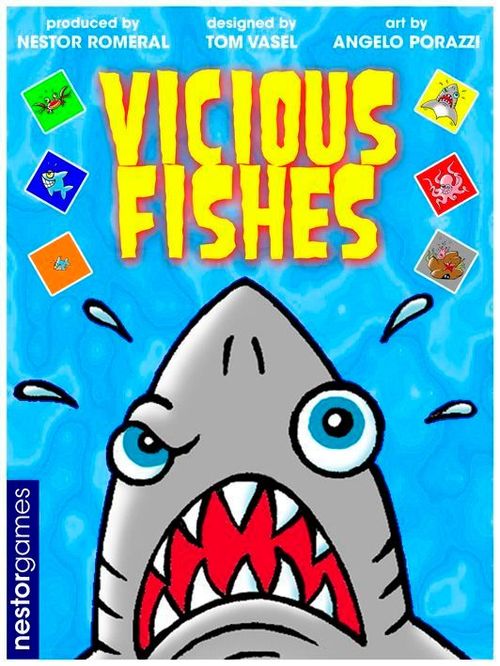
Vicious Fishes
Vicious Fishes Rulebook
Table of Contents
Table of Contents
Material
Vicious Fishes includes:
- A Vicious Fishes board (2 pads), showing an 8x8 grid and a scoring track.
- 54 fish tiles in 6 factions (10 fish each). Note: Shark, crab, and octopus tiles are considered "fish" for game purposes.
- 6 multi-colored fish tiles (2 colors each).
- 4 "rock" tiles.
- 20 mission tiles (showing 3 colored squares).
- 6 sea star scoring pieces (one of each color).
- Around 30 black (fish bone) counters.
- 2 carrying cases.
- 6 unassembled tile racks.
Setup
Each player takes a tile rack and assembles it.
Place the board in the middle of the table, representing the pond over which the fish are fighting. The players should collectively choose where the four rock tokens are placed on the board. No tiles may be placed on the rock tokens, and all four sides of the rock act as a side of the board. If players cannot decide where to put the tiles, place them in the center four squares of the board.
The 60 fish tokens (nine each of red, blue, green, yellow, white and black; and six dual-colored) are shuffled and placed face down next to the board. Each player draws six tokens secretly, and places them in the tile rack so that only that player can see them.
The mission tiles are shuffled and placed face down. Each player then draws one mission tile secretly. The rest of the mission tiles are discarded without being revealed.
The fish bone counters are placed near the board so that all players can access them.
Place the six sea stars scoring tiles next to the scoring track. They are considered to be on the "0" space.
The player who has most recently eaten seafood is the starting player, with play proceeding clockwise around the table.
Game Play
A player's turn consists of the following:
- Place a fish tile on any empty square on the board.
- Resolve attacks (if any).
- Score survivors (if any).
- Draw a new fish tile from the pile (if possible).
- Pass the turn to the next player.
1. Placing a fish tile
- Fish can be placed on any empty square – facing in the direction of your choice.
- Most fish have a mouth that shows the direction of attack. A fish can attack ONLY in this direction.
[Diagram labels: color aid, front of the fish, attack value.]
- An octopus attacks all eight surrounding tiles.
- Crabs attack in two different directions.
2. Resolving attacks
As soon as a fish tile is placed, immediately resolve its attacks. The player who placed the tile determines the order of the attacks. Once any attacks made by the fish just laid have been resolved, then any attacks made by fish already in the pond on the new fish will be resolved.
- Each tile that the placed fish can attack (1, 2 or 8) is checked in an order chosen by the player who laid the tile. If the attack value of the fish being attacked is less than the total attack value of all the live fish attacking it, then the fish being attacked is eaten. If the values are equal, nothing happens.
- For example: If a blue fish with an attack value of 6 attacks a red fish with an attack value of 3, the red fish is eaten. If a red fish with an attack value of 2 attacks a green fish with an attack value of 4 (that is already being attacked by a blue crab with an attack value of 3), then the total attack value against the green fish is 5, causing the green fish to be eaten. If a blue fish with an attack value of 2 attacks a red fish with an attack value of 4 that has no other fish attacking it, then nothing happens.
- Remember: A fish already on the board will only attack back if its mouth or claw is facing in the direction of the fish tile just placed. (The octopus will always be able to attack back.)
[Example: the red fish is placed and the green fish dies.]
- When a fish is eaten, place a black fish bone counter on it. Move the sea star scoring token of the same color as the last fish to attack it one space forward on the scoring track. If the eaten fish is a shark, then move the sea star forward one extra space. These dead fish with the black counter cannot attack, be attacked, or contribute to an attack for the remainder of the game.
3. Scoring Survivors
Some fish may survive the fierce battles. For every fish adjacent (either orthogonally or diagonally) to the tile just placed that is now totally surrounded (eight tiles) by other fish, the edge of the board, and/or rocks and is still alive move the corresponding sea star one space forward on the scoring track. The fish that is being placed should also check to see if this applies.
This is a reward for that fish who is a true survivor! If the surviving fish has an attack value of "1", move the corresponding sea star one extra space forward on the scoring track.
When scoring survivors, resolve the tile above and to the right of the fish just laid, and continue until all adjacent fish have been checked. This is simply to aid in keeping track of the fish.
Remember: Whenever a fish is placed on the board, both it and all live fish adjacent to it should be checked for attacks/surviving.
Other notes regarding placement
The active player always decides the color of a dual-colored fish for scoring purposes. The color chosen may be changed each time that fish is involved in scoring. For example, if Bob places a blue/yellow fish attacking a green fish and eating that fish – he can declare the attacking fish blue. That scores one point for blue. Later on, Joe can play a tile that effectively makes the fish safe. He can declare that it is yellow, scoring one point for yellow.
A fish may be placed so that it attacks no one (or is an ineffective attacker), but is killed instantly, when attacked back by fish already on the board. This is a legal and often effective strategic move.
Game End
The game ends when the last tile has been placed and all fish have been scored. Each player now reveals their mission tile and finds the two schools they were supporting (their two highest scoring colors) and the school they dislike (their lowest scoring color).
Players add together the score of the two colors they were supporting and subtract points from their total equal to the score of the fish faction that they dislike.
The player with the most victory points is the winner. Ties are won by the player whose disliked faction has the lowest score. Further ties are broken by turn order, with the player who went first winning ties, etc.