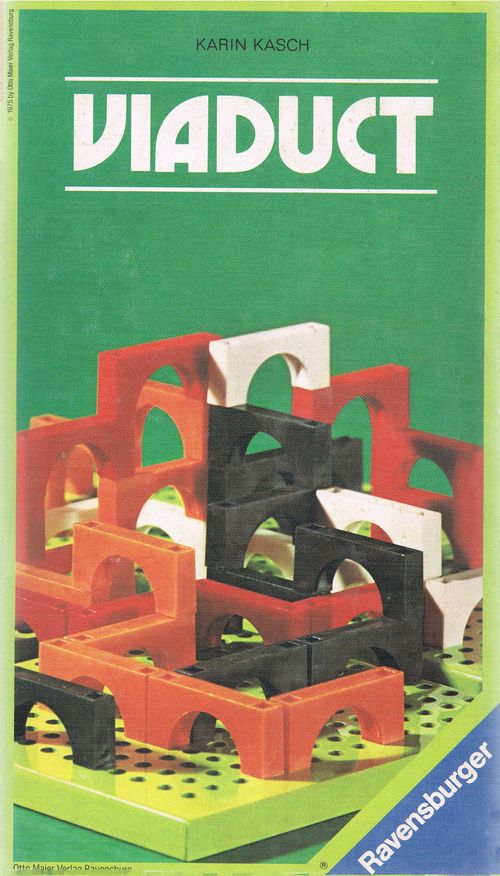
Viaduct
Viaduct Rulebook
Table of Contents
Table of Contents
Game Contents
- 1 game board
- 20 bridge pieces ("Stecksteine") in each of 4 colours
- 1 die
Game Idea
The game board has 8 target platforms marked with the letters A to D. Matching platforms carry the same letter and lie diagonally opposite each other. Each player tries to build a continuous viaduct from their bridge pieces between their own target platforms (A to A, B to B, and so on). A gap must be crossed, so the players' structures inevitably cross one another.
This gives two goals that must be reassessed again and again: a player will try to get over obstacles and make a connection with as few detours as possible. At the same time, players try to put obstacles in the way of their opponents, if necessary with "wild" bridges that do not advance their own construction. Opposing bridges may be built over and under to reach one's own target, and one may also build one's own bridges on top of them. The first player to build a continuous viaduct wins the game.
Game for 3 to 4 Players
Preparation
Each player receives as their supply 20 bridges in a colour of their choice. The players agree which target platforms each of them is to connect. They also decide who rolls first.
Course of Play
The players roll the die in turn and carry out the moves that the roll allows. The faces of the die offer the following moves:
- One pip: The player may place one bridge of their own colour, or remove one and return it to their own supply.
- Two pips (diagonal): The player may place two bridges of their own colour, or remove two and return them to their own supply.
- Symbol (the pictogram on the die face; the scan does not name it): The player may not place a bridge of their own colour. Instead they may (but need not) remove any one bridge of another colour and return it to the player it belongs to. If this symbol appears on the very first roll of the game, the die is rolled again.
The choice between placing and removing is compulsory. For example, with a roll of two pips a player may not place one bridge and remove another. A player may only remove bridges that do not yet carry any other bridge, i.e. no further bridges have been inserted into them.
If a player has used up their supply without reaching their goal, then on their next roll they must remove some of their own bridges and try again to reach the goal.
Where Bridges May Be Placed
The six holes of a target platform, and the space directly vertically above them, are reserved for the corresponding player. No opposing bridge may stand or project there. Apart from this, a player may place their bridges at any place on the board. Every bridge must naturally rest on something; a bridge may not hang freely in the air.
Joining Bridges
To form a continuous viaduct, the individual bridges belonging to it must touch one another in a precisely defined way. The rear flap of the folded rules sheet shows two diagrams illustrating which contacts make a valid connection and which do not.
- Valid connections (Diagram 1): the bridges must touch in the area of their bridge pillars, either side by side, face to face, or one on top of the other in a plug connection.
- Invalid connections (Diagram 2): contacts at a corner, or contacts not in the area of the bridge pillars, do not count as a connection.
End of the Game
The game ends when a player has completed a continuous viaduct between their target platforms. A target platform counts as reached when at least one of the player's own bridges has a peg inserted into one of the six holes of that platform.
Strategy Notes
At first, the rolls will mostly be used to place bridges. In the course of the game it usually becomes clear that some bridges are badly placed and that the course of the viaduct should be rebuilt. One then removes the useless bridges.
Each player decides their own strategy. They may occupy their target platforms first and build outward from there, or begin elsewhere, for example in the middle of the board. The target platforms offer many possible connections, but opponents can seal them off with their own pieces. It is therefore wise to lead at least one bridge out of one's target platform early. This doubles the connection possibilities, and a blockade becomes very difficult for the opponents.
When it can be seen that an opponent is about to build a blockade, one should immediately place one of one's own bridges in that blockade. This almost always allows the original obstacle to be built into one's own route.
Game for 2 Players
This game can be played with the die, or as a purely strategic game without the die. In both cases the players must not only connect their target areas, but also make detours or branches that are determined by the opponent.
With the Die
The two players choose their target areas and their colours, for example 20 orange and 20 black bridges each. One player then also receives two white bridges and the other two red bridges. Before the actual start of the game, the players place these two additional bridges in turn at any places on the board, except on the target platforms. The players must include the two bridges set by the opponent in their own construction. They belong to the player's own colour, but during the whole game they may not be removed or moved.
After these first two bridges have been placed, play follows the rules for the 3 to 4 player game. The four target platforms that are not in use may also be built upon.
Without the Die
As in the two-player game with the die, each player first places two additional bridges, which must be included in their own construction. In addition, each player gives the opponent 5 bridges of their own colour to hold in custody, so that each player keeps only 15 bridges as their supply.
The players place or remove one of their own bridges in turn. A player may place two bridges at once only 5 times during the game, and each time must request one of the bridges held in custody by the opponent in order to do so. Otherwise, the same rules for placing apply as in the 3 to 4 player game.