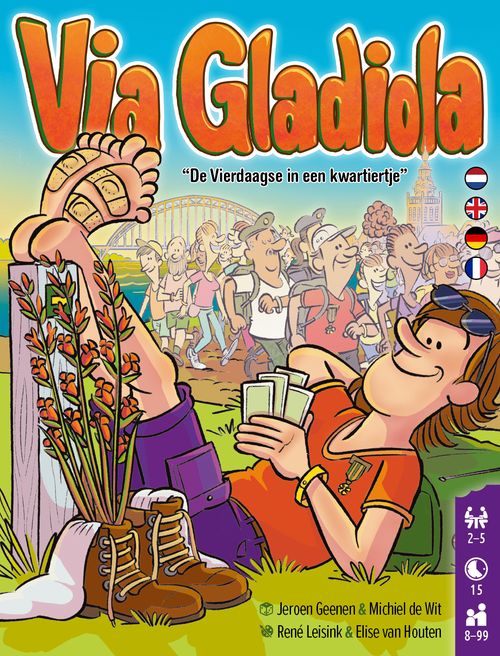
Via Gladiola
Via Gladiola Rulebook
Table of Contents
Table of Contents
Preparation
- Place the START card (0 km) marked Day 1 in the centre of the table to start the walk pile.
- Set aside the other 3 START cards (0 km).
- Shuffle the 49 Distance cards (values 1–49 km), the 6 FINISH cards (value 50 km), and the 8 Gladiola cards together.
- Deal 8 cards to each player. Keep these secret!
- Place the remaining cards face down as a draw pile.
Playing the Game
The game is played in 4 rounds (Day 1 to 4). The player who most recently went for a walk starts. Players take turns clockwise. On your turn, choose one of these actions: Walk, Rest, or Play a Gladiola.
Walk
Play 1 card from your hand. It must be of higher value than the top card of the walk pile and cannot be a Gladiola. Place it face up on top of the walk pile.
The more you push yourself (the bigger the difference), the more cards you have to draw. Moving too far is not allowed. The table below shows the ranges:
| Difference | Result | Effect |
|---|---|---|
| Up to +5 (thumbs-up icon) | Safe pace | Draw no card |
| +6 to +10 (single-card icon) | Pushed too far | Draw 1 card |
| +11 to +15 (double-card icon) | Overexerted | Draw 2 cards |
| +16 or more (red X icon) | Too far | Not allowed |
If you play a FINISH card (50 km), the day ends immediately. We'll explain what happens later.
Rest
Draw 1 card from the draw pile. Sometimes resting is better than pushing yourself too far.
Play a Gladiola
Play 1 Gladiola card from your hand (only during Day 4). Place it beside the walk pile. Gladiolas do not affect the walk pile. Playing a Gladiola is a good way to skip your turn without drawing a card.
You may only play Gladiola cards during Day 4, the final day of the game.
Empty Draw Pile
If the draw pile runs out, take all cards from the oldest completed day (starting with Day 1), except the START card (0 km). Shuffle these cards to form a new draw pile. If the draw pile runs out again later, repeat this with the next oldest day (Day 2, then Day 3).
Card Layout
Each card shows you the following information:
- Value (0–50 km).
- Blisters (bandage icon, 0–5) which count as penalty points toward your final score. Less is better!
- Pace indicator shows how far you can advance from that card and how many cards you may need to draw from the draw pile.
Example: the top card of the walk pile is 21.
- If you play 22–26, you draw nothing (thumbs-up icon).
- If you play 27–31, you draw 1 card (single-card icon).
- If you play 32–36, you draw 2 cards (double-card icon).
- You cannot play a 37 or higher (red X icon).
Finish Card
When you play a FINISH card (50 km), the current day ends immediately. Set the walk pile aside. Take the START card for the next day and place it in the centre of the table to begin a new walk pile.
End of the Game and Scoring
When Day 4 ends, it is time for final scoring:
- Each player adds up the number of blisters on the cards remaining in their hand.
- The player with the fewest blisters wins.
- If tied, the tied player with fewer cards wins.
- If still tied, the tied players share the victory.
Tip: Play multiple games and keep a running total of blisters. The lowest total wins.
Variant
To add a bit of strategy, you can play with this rule: the game ends immediately when a player plays their last card. Score the game as usual.