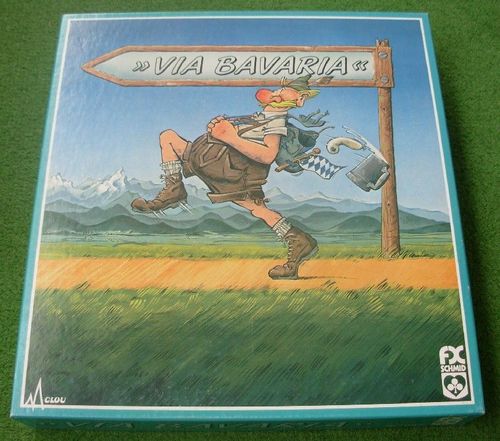
Via Bavaria
Via Bavaria Rulebook
Table of Contents
Table of Contents
Contents
- 1 game board
- 6 pawns, each with Ferdl's portrait
- 6 pre-runner markers (Vorlaufsteine), small, one per player colour
- 64 picture cards
- 10 counter cards (Kontrakarten)
- 6 grab cards (Grapschkarten)
- 8 jokers
- 2 notepads (Spielblöcke) for recording completed tasks
Goal
The game board shows pictures of 10 tasks, all along the VIA BAVARIA. Each player tries to complete these 10 tasks first.
A task is completed by collecting picture cards that match a combination of picture symbols, as shown under the illustrations of the individual task fields (Aufgabenfelder).
Setup
The 88 playing cards (picture cards, counter cards, grab cards and jokers) are shuffled thoroughly, and each player is dealt 8 cards. The remaining cards are placed face down on the space in the middle of the game board. This is the draw pile (Mittelstapel).
Each player receives a large pawn with Ferdl's portrait and places it on the start field. The small pre-runner markers are set aside off the board for now. Each player takes a sheet from the notepad and a pencil ready; completed tasks are marked on it later.
Turn Order
The youngest player at the table begins, and play then proceeds clockwise. On their turn, a player may either exchange cards or, if possible, complete a task.
Picture Cards
The picture cards show a beer tankard (Maßkrug), a white sausage (Weißwurst), a mountain boot, or a flag, the Bavarian one of course, with white and blue diamonds. But beware: not every white sausage is the same. The picture cards also differ in the shape of the frame in the upper-left corner: diamond, circle, square, and triangle.
Joker Cards
Every picture card can be replaced by a joker card.
Exchanging Cards
To get cards for a combination into your hand, you may exchange cards on your turn. You place 1, 2, 3 or 4 of your cards face up beside the draw pile and replenish them with the same number of new cards from the draw pile. When the cards in the middle of the game board have run out, the open discard pile (Ablagestapel) is shuffled and placed face down in the middle.
The Task Fields
To complete a task, a player collects cards so that the picture cards match one of the combinations shown on the task fields. Each combination contains four symbols, some separated from one another by lines. These lines determine the frames of the required picture cards. Of the collected cards, 4 must always match the depicted symbols and the required frames of the task field.
Example: The task field's requirement is shown as four adjacent frames. The matching picture cards may be:
- 4 cards with 4 different frames;
- 4 cards with 2 pairs of identical frames;
- 4 cards that all have the same frame.
The example task in the rulebook illustration requires 4 different pictures with 4 different frames.
Completing a Task
Laying down cards: If you can complete a task, i.e. the required combination and your collected cards match, show these 4 cards to your fellow players and lay them face up beside the draw pile. Show the cards, of course, not the players.
Moving your pawn: Then move your pawn from its current position onto this task field. If you pass over pawns of fellow players, you may annoy them with pre-runner markers (see below).
Replenishing your hand: Then replenish your hand from the draw pile back up to 8 cards, and mark the completed field on your notepad with a cross.
Each player tries to complete each task once. There is no fixed order for the tasks. A player decides, based on the cards in their hand, which task they want to complete, i.e. which field they collect for (exception: pre-runner markers).
Pre-runner Markers (Vorlaufsteine)
The movements of the pawns on the game board give rise to the function of the small pre-runner markers.
Situation: You can complete a task and move your pawn onto that field. In doing so you pass over another player's pawn. If you wish, you can now annoy them. Take the pre-runner marker in the colour of the passed player and place it on a task field that player has not yet completed. The pawn follows the pre-runner marker. That task field, and no other, must be the next one the passed player tackles. When they have managed it (their pawn and their pre-runner marker now stand on the same field), they remove their pre-runner marker from the game. Then they may choose their next field freely again. If you pass over several pawns, you may do the same with all of the passed players.
If the pawn of a player is passed over whose pre-runner marker is already placed, hands off! That pre-runner marker may not be moved. Any number of pawns and pre-runner markers may stand on one task field.
Note: The VIA BAVARIA is not a circle! There is no connection between the Yodeler and the Beer-tent Brawl, so no pawn can be moved between them. Your path therefore leads back again.
Counter Cards (Kontrakarten)
Each task field on the game board has a matching counter card. On these cards Ferdl is sad: everything that succeeds for him on the game board goes wrong here.
Situation: Your pawn is passed over. This can have consequences (pre-runner markers), unless you hold the counter card for the field the other player wants to move to. Show it to them, place it on the discard pile, and immediately take a new card from the draw pile. The countered player has had bad luck:
- They must move their pawn back to the field from which their move started.
- They may not place pre-runner markers.
- There is no cross for completing the task.
- They must lay down all of their cards.
Only in the next and the round after next do they draw four new cards each from the draw pile. In the third round after the counter they play fully again. Apart from playing grab cards, no other actions are possible for them during this time.
If the pre-runner marker of a countered player has already been placed, it remains on the board.
Grab Cards (Grapschkarten)
The greedy hand. You may play grab cards whenever you like, whether or not it is your turn. Choose a fellow player, show them the grab card, and take one card from their hand. The grab card is then discarded. If a player has only six cards left in hand, you may take no further cards from them. The grab card also may not be played against players who are just laying down four cards to complete a task.
If you have only 6 cards in hand, there is no need to panic. After completing a task, you always replenish back up to 8 cards.
Tips for Play
- A player threatens to win the game. This player is not you. Find allies. With the help of grab cards, the number of cards held by the runaway leader can be reduced. Agreements are permitted at any time.
- Place the runaway leader's pre-runner marker so that you can counter him: you hold a matching counter card, but your pawn stands so that the runaway leader will not pass over you. Another player stands more favourably and holds a grab card. Even if you end up with one card fewer afterwards, ask them to take a card from you, and tell them which one (the counter card, of course!).
- Place other players' pre-runner markers so that the others do not have to pass over you, unless you hold the matching counter card.
- Be cautious and want to play it safe: collect for a field whose counter card you hold yourself.
All 10 Tasks Completed
Congratulations! You have won the game, even if Ferdl might have done it a little better.