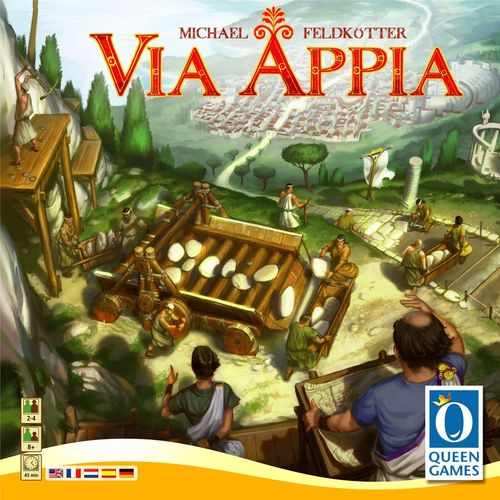
Via Appia
Via Appia Rulebook
Table of Contents
Table of Contents
Game Components
Shared Game Components
- 1 Game board
- 46 Tiles for construction of the Via Appia — 9 large, 13 mid-sized, and 24 small
- 41 Bonus tokens — 11 gray, 13 brown, and 17 beige
- 9 Victory point tokens — 3x 6, 3, and 1 points
- 9 City markers
- 30 Sesterces
- 1 Quarry & assembly instruction
- 1 Pusher for pushing stones into the quarry
- 64 Stones, made from wood, to be pushed into the quarry — 8 large, 22 mid-sized, and 34 small
- 16 Income cards
- 4 Tokens push +1
- 1 Start player token
- 1 Rules booklet
Individual Components for the Players
- 4 Transport carts
- 4 Player pieces
- 4 Scoring markers
- 4 Markers 50+
- 4 Screens
Set-up
Place the game board in the center of the playing area.
-
Sort the components: Place the bonus tokens for each road segment (A, B, and C) on that segment's corresponding space. Stack the victory point tokens on their designated spaces next to the cities in the order 6-3-1 (from top to bottom). Exception: In a two-player game, use only the 6 and 1. Place the stones and tiles in their respective storage spaces on the game board. Keep the push +1 tokens, city markers, 50+ markers, and sesterces in easy reach of all players next to the game board.
-
Mix the income cards: Place 7 income cards face up next to the game board and place the remaining cards next to them as a face-down draw pile.
-
Load the quarry: Slide the quarry into the slots of the game board. Load 4 large, 8 mid-sized, and 12 small stones into the quarry, arranging them randomly, thus assuring a different set-up for each game. Keep the pusher ready to use next to the game board.
-
Distribute game components: Randomly determine a starting player and give him the start player token. Then, each player takes:
- 1 Player piece in a color of his choice, placing it at Rome;
- 1 Screen of his chosen player color, setting it up in front of him;
- 1 Scoring marker of his color, placing it on space 1 of the scoring track;
- 1 Transport cart, keeping it next to his screen.
Additionally, give:
- The starting player: 2 small (gray) stones and 1 sesterce
- The 2nd player: 2 small (gray) stones and 2 sesterces
- The 3rd player: 1 small (gray) and 1 mid-sized (white) stone and 2 sesterces
Sequence of Play
Players take their turns in clockwise direction. During his turn, the active player performs one of the following actions: Income, Quarry, Road construction, or Travel.
Income
The player chooses one of the face-up income cards and receives either the number of sesterces (from the general supply) or stones (from the stones storage) as shown. He keeps the sesterces behind his screen and the stones in front of it. Then, he flips the income card face down.
When only 3 or fewer cards remain, the player receives both sesterces and stones. In addition, the player who takes the final card receives a "push +1" token, provided he doesn't already have one.
Note: This means that each player may not own more than one "push +1" token at any time.
After the last card has been flipped, draw 7 new cards from the pile and reveal them next to the game board. Then, shuffle the face-down cards and all income cards in the pile to form a new draw pile. If a player is entitled to receive a stone that is no longer available in the storage, all players must return half the amount (rounded down) of their stones of this size to the storage. Then the player receives his stone(s).
Quarry
The player may push up to 2 of his stones into the quarry, one after the other. The player places the first stone behind the quarry, as shown in the example, and subsequently pushes it into the quarry, using the pusher. He may use the pusher at any angle he wants, but no part of the pusher may cross the line between the two bars. The second stone, if any, is pushed into the quarry the same way.
Note: Place the stone you want to push into the quarry behind the dotted red line. When pushing, no part of the pusher may cross this line.
The player exchanges each stone that drops off the quarry on the other side for a tile of the same size or smaller, taken from the tiles storage, or he may sell it immediately for one sesterce. Return the stones to the stones storage after they have been exchanged or sold.
The player must load any tiles he has received onto his cart, matching the cart's appropriate spaces exactly.
Note: This space of the cart can contain either one large tile or one mid-sized and one small tile. You cannot load two small tiles here! Of course you may also load a single mid-sized or small tile here.
If the player pushed 2 stones into the quarry, but no stones fell off, he still receives one small tile or one sesterce. If the player owns a "push +1" token, he may use it now and push a third stone into the quarry.
Road construction
The player adds 1 or 2 tiles to the Via Appia, minding the following rules:
- A player may do construction work in each road segment adjacent to a city that he has visited at some point during the game.
- Players may place tiles only on spaces that are connected to another tile by a line or to a city located behind it.
- During his turn, a player may build a second tile only in the same road segment in which he built the first tile, and only if all previous road segments have been completed. Thus, a player can't place two tiles on segment B unless segment A is complete.
Example: A player who has travelled to Tarracina may do construction work both in segment A and in segment B of the Via Appia.
Example: Tiles can be placed on spaces marked with a connecting line, and not on spaces without one.
The active player receives a bonus token of that road segment for each tile he added to that segment, in addition to the victory points shown below:
- Large tile — 5 victory points
- Mid-sized tile — 3 victory points
- Small tile — 1 victory point
The active player records his victory points on the scoring track immediately. When building 2 tiles, the player receives a bonus payment of 1 sesterce.
Note: If a player has gained more than 50 victory points, he places his 50+ marker in front of him.
Travel
The player moves his player piece 1, 2, or 3 tiles forward. This costs him 1, 3, or 6 sesterces.
The player piece may move only on or over spaces covered with a tile. Furthermore, the piece may only move along connecting lines between the tiles.
Note: You may never enter a space not covered by a tile!
Only 1 player piece may occupy a small or mid-sized tile, whereas 2 player pieces may occupy a large tile simultaneously.
Example: Moving along the red arrows is not allowed because there are no connecting lines; furthermore, there is no tile on the space under the left arrow. Moving along the green arrows is legal.
A player can move no further than the next city, where he must stop and receive the city's topmost remaining victory point token. Additionally, he must place a city marker on the city marker space. (The last player to reach this city skips this action.)
Each city marker on a city's corresponding marker space reduces the travel costs for all players on that road segment who have not yet reached that city. Each city marker reduces the travel costs by one sesterce.
Example: There is one city marker in Benvenutum. Thus, moving 1 tile forward is free for players in segment B, moving 2 tiles forward costs them 2 sesterces, and moving forward 3 tiles costs 5 sesterces. This marker does not affect segment A.
Note: City markers only reduce travel costs; players never earn sesterces from traveling on a road.
End of the Game and Final Scoring
The game ends at the end of the game round during which:
- either a player claimed a victory point token in Brundisium
- or the construction of the Via Appia is completed.
In both cases the full game round is played, ensuring that all players have had the same number of turns.
The player owning the most sesterces gains 2 victory points; in case of a tie for the most sesterces, all tied players receive 2 victory points. Finally, the players count their bonus tokens from the different road segments in order to determine who has built the most tiles in each segment:
- The player who has built the most tiles in a segment gains 8 victory points.
- The player who has built the second-most tiles in a segment gains 4 victory points.
In case of a tie for the most tiles, the tied players share the victory points for the first and second position. In case of a tie for the second position, the tied players share the 4 points, rounded down.
The player with the most victory points is the winner of the game; in case of a tie for the most victory points the tied players share the victory.