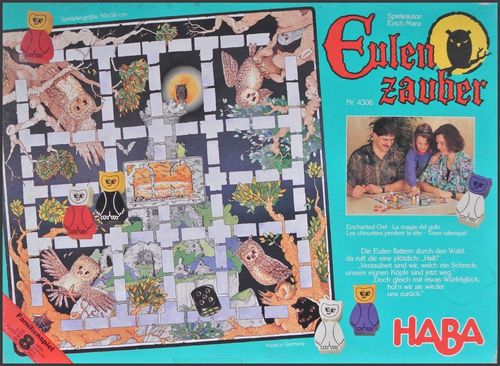
Verzauberte Eulen
Verzauberte Eulen Rulebook
Table of Contents
Table of Contents
Components
- 1 game board (50 × 50 cm)
- 3 wooden dice
- 17 two-part wooden owls (a body and a head, each separately)
Object of the Game
An evil magician has bewitched all the owls and put differently coloured heads on them. With four bodies of one colour and heads of different colours, the players set out on the path into the forest. There they try to put the correct heads back on their own owls. A complete owl is then brought to safety in the centre of the board, in the old ruin. The player who succeeds first wins.
Setup
Lay out the board and place the dice so that they are reachable by the youngest player. Each player chooses a colour and receives the four body parts of that colour. These are then fitted with heads of other colours as follows:
- 2 players: the four heads of the opposing colour.
- 3 players: two heads each of the two opposing colours.
- 4 players: one head each of three different opposing colours (three different colours in total) and one head of the player's own colour.
Each player chooses a corner from which to start. The black owl is placed in the centre of the board.
Turn Sequence
The youngest player begins and rolls all three dice at once.
Each die is used to move one owl according to the rule for its symbol:
- Head die ("Kopf-Würfel", shown with the symbol 5): a playing piece whose head is in the player's own colour must be moved.
- Body die ("Körper-Würfel", shown with the symbol 2): a playing piece whose body is in the player's own colour must be moved.
- Eye die (black, "Augenwürfel (schwarz)"): a playing piece whose head or lower part is black must be moved. This move must always be carried out last.
Movement
- On the board, the owls must be moved in one direction along the paths by the rolled number of spaces.
- If two playing pieces end up on the same space with the exact dice number, their heads must be swapped. Of course, pieces may be jumped over, but in that case the heads are not swapped.
- No more than two owls may stand on the same space.
- A black owl (whether complete, or only its head or body) blocks the path and may not be jumped over. Any piece may, however, move onto the same space with the exact dice number, and then the heads are swapped. Pieces that already stood on a space onto which a black owl moves may continue moving.
- Owls, whether coloured or black, may move freely in any direction, except into the centre space and into the starting spaces.
- Coloured owls may enter the centre space only if they are of a single colour and reach it with the exact dice number.
End of the Game
The player who first brings three owls of their own colour into the centre space, and whose remaining parts stand on the board without any black part, wins the game.
Variant for Two Advanced Players
Set up the game as for four players. However, each player now receives two sets of four body parts of the same colour. The player who first brings five owls into the centre space consisting only of their own colour, and whose remaining parts stand on the board without any black part, wins the game.