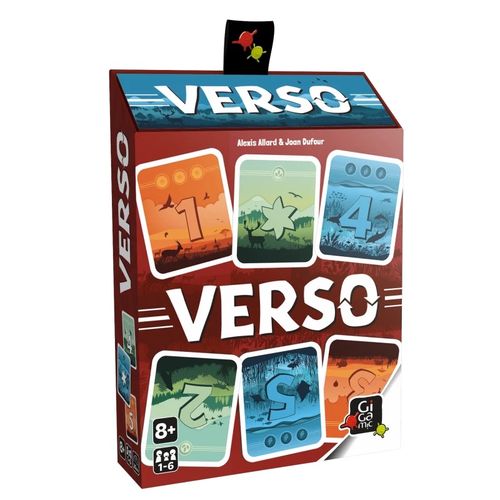
Verso
Verso Rulebook
Table of Contents
Table of Contents
Contents
90 cards:
- Blue cards (sea)
- Green cards (land)
- Orange cards (sky)
60 victory point tokens
Goal of the Game
Create sequences and squares with your cards to gain the most victory points.
Card Anatomy
Each card has 2 faces.
Each face has:
- A color: Blue, green or orange;
- A value: 1-6 (or a joker);
- A number of victory points: 1 or 3 points.
Card Characteristics
The 2 faces of a card are always different:
- The reverse of a blue card will always be either green or orange.
- If one side of a card shows 1 victory point, its reverse will always show 3 victory points.
- The values on either side of a card will always be numerically adjacent (i.e. +1 or -1).
Example: A card with a 3 will have either 2 or 4 on the other side. Note that cards with a 6 will have a 5 or 1 on the reverse.
Jokers are an exception and could have any number on the reverse. They always score 1 victory point.
Example: An orange card worth 1 point, showing the number 5 on its front, has a blue card worth 3 points, showing the number 6, on its reverse.
Setup
- Use 15 cards per player. For 6 players, use all the cards. Shuffle the cards and form a deck in the center of the table, allowing space for a discard pile. Return any remaining cards to the box.
- Place the victory point tokens in the center of the table.
- The player who last went on a journey plays first.
How to Play
Take turns clockwise. On your turn, choose ONE of these two actions: DRAW A CARD or BANK A SEQUENCE.
Draw a Card
Take the top card of the deck. You can either:
- Keep the faceup side, without looking at the reverse side; or
- Flip the card and keep the flipped side. You cannot change your mind after seeing the reverse.
Then add the card to your card layout in front of you.
Placement rules: All your cards must remain visible. Arrange your cards in horizontal lines by color (land, sea and sky), creating sequences of cards in numerical order from smallest to largest, going from left to right.
Your layout is not set in stone: You can rearrange your cards at any point.
Important! You can never have 2 cards of the same color and number face up at the same time, nor have 2 jokers of the same color. If this happens, discard the last card you drew. You cannot swap it for a different card.
Example: Gail takes the Orange 5 worth only 1 victory point from the deck. She decides to keep it instead of flipping it, because there is a risk she would get a Blue 6 or Green 6, which she already has. She places the Orange 5 into her card layout, to start a sequence of orange cards.
Bank a Sequence
A sequence is a line of between 2 and 6 consecutively numbered cards in the same color. The joker takes a number of your choice (between 1 and 6).
To bank one of your sequences, follow these 4 steps:
- Announce the color of the sequence that you wish to bank.
- Your 2 immediate neighbors must immediately flip their highest value card in that color, if they have one. Note: They flip a joker only if it is their only card in that color. If the card they flipped then has the same color and number as another card in their playing area, they must discard the card they flipped.
- Immediately take the same value of victory tokens as victory points at the top of the cards in that sequence.
- Regardless of how many cards are in your sequence, discard only the 2 highest numbered cards in that sequence.
Example: Ben is banking a sequence of 3 blue cards: 3 - Joker - 5. He gains 5 victory points and discards the joker (which represents a 4) and the 5. His two immediate neighbors must flip their highest blue card.
Peter, Ben's neighbor, has a Blue 1 and a joker. He must flip the 1. The 1 becomes a Green 6, so he must discard it because he already has a Green 6.
Square of Cards
At any point in the game, if you have at least 3 cards in each color (blue, green and orange) in your playing area, you immediately gain 7 victory points for forming a square. You do not need to discard any cards and do not cause your opponents to flip any cards.
Squares of cards can be formed by drawing cards or when you reorder a flipped card after an opponent banks one of their sequences.
Before you can form a new square and gain another 7 victory points, you must undo your square, and then reform it.
Example 1: Helen draws a Green 5 and adds it to her playing area. This gives her a square of 9 cards, so she scores 7 victory points.
Note: You can bank a square even if you have more than 9 cards (see Sofia's playing area in the next example).
Example 2: John banks a sequence of green cards (the 2 and 3). He discards the 2 and 3 and scores 4 victory points. This means Sofia and Helen, his neighbors, must flip their highest numbered green card. Sofia flips her Green 6, which becomes an Orange 1. This gives her a third orange card, which she places down where it can complete a square. She immediately gains 7 victory points.
Game End
The game ends when you draw the final card in the deck.
Each player can then bank one final sequence of cards, but this time your neighbors do not flip any cards.
Count up your final number of victory points.
The winner is the player with the most victory points. If there is a tie, the tied players share the victory.
Solo Mode
Goal of the Game
In solo mode, the goal is to score the highest number of points possible. See if you can beat the designers' scores!
Setup
Form a deck of 35 cards.
How to Play
Each turn, you must choose either to draw a card OR bank a sequence.
Following your turn, you simulate an opponent taking their turn by flipping the top card of the deck to reveal its reverse side.
- If one of the faces on your opponent's card is a joker: Nothing happens.
- If the number on the reverse side of your opponent's card is higher than the number on the side initially visible: Flip your highest numbered card in the same color as the reverse side.
Finally, discard your opponent's card and play your next turn.
Game End
As soon as the deck runs out, the game ends immediately. You may bank one final sequence of cards.
Count your victory points for your final score.
| Score | Result |
|---|---|
| 60+ points | What an incredible performance! All hail the Deck Legend! |
| 55-59 points | You're definitely a pro! |
| 50-54 points | You're a model player. Respect! |
| 45-49 points | What talent! |
| 40-44 points | Great stuff! |
| 35-39 points | Good job! You've hit the average Verso score. |
The Ultimate Challenge
The designers of VERSO scored 64 points! Can you beat them at their own game? May the best player win!