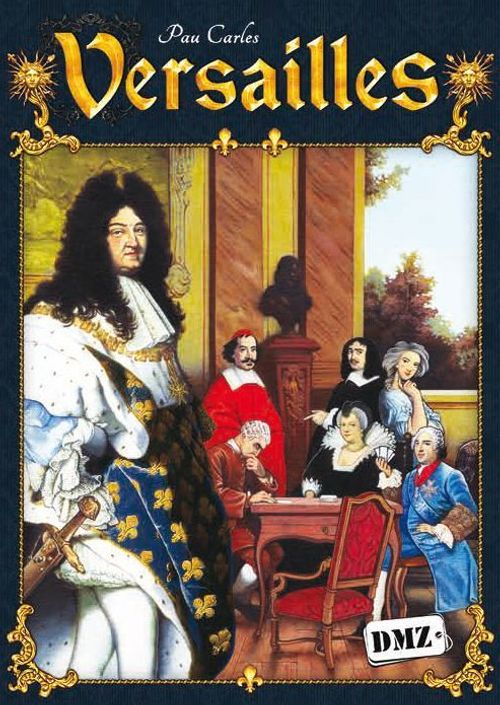
Versailles (2015)
Versailles (2015) Rulebook
Table of Contents
Table of Contents
Game Components
Versailles contains:
- 35 character cards, 5 copies of each of the 7 characters. These cards have silver backs.
- A deck of 96 cards, containing 12 copies of each of the 7 characters plus 12 action cards. These cards have golden backs and a number (ranging from 1 to 6) on a lacre sigil. This number is the card's value, and will be important during the course of the game.
- 34 influence markers.
- 6 Chamberlain's Favor markers.
- 4 Player's Aids.
Preparation
- Sort the character cards and give a copy of each to every player. Put another set of the 7 characters in the center of the table, face up. Those copies will be used to keep track of the influence every character has, while the cards given to the players will serve to keep track of the control every player has on each character.
- Shuffle the deck and give 4 cards, face down, to each player. This will be their initial hand.
- After inspecting their hands, each player should choose two character cards to put face down in front of him. Once every player have made their pick, turn the cards face up and put a card from the deck under every character, face down. Player can always inspect which cards are under every one of their characters, but should not show it to the others.
- Finally, randomly determine an initial player.
Goal of the game
The goal of the game is to earn as much influence as possible. During the course of the game, characters will gain influence. At the end of the game, whoever manages to control a character will take the influence this character gained. Players compete not only to win the control of as many characters as they can, but also to make the characters they favor gain as much influence as possible. At the end, the player how gets more influence will be the winner.
Playing the game
Versailles is played in turns. Starting with the initial player and going clockwise, every player completes his turn before the next player. In his turn, a player must go through every phase, in this order:
Influence Phase
During this phase, choose one character to influence. You do so by choosing a card from your hand and putting it under the chosen character, face down. You can put the card under a character you already have on the table, with cards already under him, or choose a new one by retrieving its card from your pile of character cards and putting it face up beside the others.
Example: Player A already has two cards under the King. In the influence phase, he can opt to put a third card under the King, or choose another character from his character pile to receive its first card.
Put the cards in a way everybody can easily count how many you have under every character. There's no limit to the number of cards you may have under a character, but you can only influence once every turn.
Action Phase
You must play an action, which may be either activating a character or playing an action card.
If you want to activate a character, you just have to play this character's card from your hand and be one of the players with more cards under this character. It's OK if other players has the same number as you, as long as no other has more.
When you activate a character, just follow the instructions written on the Player's Aid for that character.
It's possible that some actions tells you to discard another card from your hand for it's value number. Make sure you have a card in hand with the necessary value, otherwise the action will fail. Remember: the value of a card is the number on the lacre sigil.
If the action succeeds, this character will probably earn an influence marker, as instructed on the Player's Aid. Put this marker on the character's copy in the center of the table, not in the player's copy.
Example: Player A has enough cards under the King to activate it, so he plays a King's card from his hand to do so. He chooses the Duchess and puts an influence marker on the Duchess card in the center of the table. Because the Duchess has now more markers, the King also gains one.
Example: Player A wants to activate the King, but cannot because player B has more cards under the character than him. Instead, player A activates the Duchess. He chooses player B's King and discards a card. Because the card's value (2) is less than the number of cards under the character (3), the action is successful and player B has to randomly discard one of those three cards. Now both players have the same number of cards under the King and, if nothing changes, player A will be able to activate the King next turn.
During the game, influence belongs to the characters and never to the players!
You can also play an action card instead of activating a character. If you do, just follow the instructions on the card. If the card allows you to activate a character, you must choose one you may legally activate.
It is possible that you are unable to play because all cards in your hand are characters you cannot activate. In that case, show your hand, choose one of the characters you are showing and put the first card of the deck under this character. Then, discard your hand.
Draw Phase
Draw cards from the deck until you have four cards in hand again. If any other player also has less than four cards, he also replenishes his hand now.
If anytime the deck runs out of cards, just shuffle the discard pile to prepare a new deck to draw from.
End of the game and victory
If anytime there are two characters with 5 or more influence tokens, the game ends. Discard all player's hands and all Chamberlain favor markers.
For every character, follow these steps:
- Each player shows all the cards he has under this character and counts how many match with the character (kings under the King, spymasters under the Spymaster, and so on). The player or players with more cards under the character, regardless of if they match or not, adds one to the number of matches.
- The player with the greatest number of matches gets the influence tokens this character had. If two or more players tie in matches, all of them get as many influence tokens as this character had.
Repeat this procedure for all seven characters until all the influence tokens have been distributed between the players.
The player, or players, who get most tokens is the winner.
Example: Players A, B and C clash for the control of the King. A and C have more cards under, so both get an extra match. Player A has a total of three matches (two kings plus the extra), player B has two (two kings) and player C also two (one king plus the extra). Player A is the one with most, so he gets the four influence markers on the King.
The Characters
The character's special action is written on the player's aid, but here is a more comprehensive explanation.
The King
Put an influence marker on a character of your choice. If this character has now more influence markers than the King, put also a marker on the King.
The King allows you to put influence markers on other characters without having to activate them and also is the only one who can put two influence markers in just one action, so is the fastest character in the game.
You should remember to put the influence marker on the other character before checking if you have to put it on the King or not. This way, if you choose a character with at least the same number of markers than the King, he will always get a marker!
The Queen
Choose a character and discard a card. If the card's value is greater than the total of cards any player has under this character, put the card on your hand under this character and an influence marker on the Queen.
To successfully activate the Queen is like getting a second influence phase. Because controlling the most characters is the best way to win the game, the Queen's ability is a powerful one.
For the Queen to succeed in her action you must discard a card with greater value than the number of cards any player has under the chosen character. So, if you choose the Cardinal because you only have one card under him and other player has three, the discarded card's value should be 4 or more, because otherwise it will not be greater than the number of cards your opponent has and the action will fail. If you happen to be the player with most cards under the chosen character, you have to outbid yourself! You should keep in mind that the card you are going to put under the character is the one left on your hand, so it may be a good strategy to make them match.
The Cardinal
Choose a character and discard a card. If the card's value is lower than the number of influence markers on this character, move one of those markers to the Cardinal.
To control the Cardinal is to be able to reduce the amount of influence a chosen character has, because that's the way the Cardinal gains his influence markers. It's difficult to activate him at the beginning of the game, because there aren't many influence tokens yet, but by the end of the game, the Cardinal's ability may prove very useful!
The Seneschal
Choose a character and show the first 8 cards from the deck. If any of those cards match the name you choose, add one of those to your hand and an influence marker on the Seneschal. Discard the other cards.
The Seneschal may be very useful to get the cards you need. If there are less than 8 cards left in the deck when you activate the Seneschal ability, remember to shuffle the discard pile and add it under the deck. Also, if you show more than one copy of the chosen character, you can pick anyone of them, but only one.
The Duchess
Choose a player and a character. Discard a card: if the card's value is lower than the number of cards this player has under this character, randomly discard one of those cards and put an influence marker on the Duchess.
The Duchess allows you to discard cards from under the opponent's characters, which give you a huge advantage in the fight for the control of a character. This ability may be even used to secure control of the Duchess!!!
The Spymaster
Discard a card to look at all the cards another player has under a character. If the card's value is greater than the number of cards inspected, put an influence marker on the Spymaster.
To know how many cards really match under every character is a very useful tool to decide which strategy is best, so the Spymaster's ability can come in handy. Also, because you can always choose which character of which player do you want to inspect, you can always make the Spymaster's action successful. This makes him one of the easiest character to gain influence with.
The Chamberlain
Choose up to two characters without a favor marker and put one on them. When a character with a favor marker activates, move any influence marker this character earns during this action to the Chamberlain (if any). Discard the favor marker at the end of the action.
The Chamberlain is the only character that cannot gain influence by himself, but has to wait for other to gain it for him. When you activate the Chamberlain's ability, choose two, one or zero characters that don't already have a favor marker (doesn't matter how many influence markers they have) and put one on each. You can't choose the Chamberlain.
When a character with a favor marker activates, if this character wins any influence marker during this action, put it on the Chamberlain instead. At the end of this action the favor marker is discarded, regardless of if the Chamberlain has won an influence marker or not.
Remember the Chamberlain can only steal influence markers gained on activation, not by other means like an action card or be targeted by the King's ability. In those cases, the favor token isn't removed either.