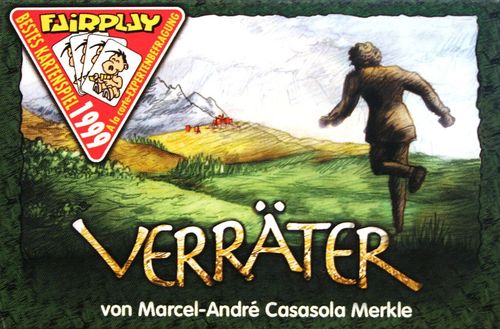
Verräter
Verräter Rulebook
Table of Contents
Table of Contents
- Contents
- Preparation
- Meaning of the Cards and Setup
- Course of Play (Reference Card 5)
- Phase 1: Determine the Conflict Location
- Phase 2: Choose Actions
- Phase 3: Play Supply Cards
- Phase 4: Reveal Action Cards
- Phase 5: Resolve the Landscape and Determine the Victorious House (Points in the Rectangle)
- Phase 6: Distribute Victory Points (Points in the Circle)
- Phase 7: Carry Out the Builder Action
- Phase 8: Carry Out the Strategist Action
- Phase 9: Discard Supply Cards
- Phase 10: Draw Supply Cards
- Phase 11: Return Action Cards to the Middle of the Circle
- Phase 12: Pass On the Start Player Card
- Phase 13: End of the Round
- End of the Game
- Final Scoring and Determining the Winner
Contents
Verräter, by Marcel-André Casasola Merkle. A card game for 3–4 players, ages 12 and up. Playing time: 45–60 minutes.
Selected for the "Spiel des Jahres" 1999 recommended list, and awarded the à la carte Card Game Prize for Best Card Game 1999.
- 4 Allegiance cards (1 each in 4 colors)
- 1 Start Player card
- 12 Landscape cards (2 each of City, Village, Forest, River, Meadow, and Wasteland)
- 12 Estate/Trading-Post cards (3 each in 4 colors)
- Supply cards (in the values: five 2s, five 3s, five 4s, five 5s, two 6s, one 8)
- 1 Strategy card
- 1 Conflict card
- Action cards (Traitor, Diplomat +2, Diplomat +5, Builder, Strategist, Farmer)
- Reference cards
- This rulebook
Attention: More information and game aids for Verräter can be found at: www.casasola.de/verraeter
Note: Verräter is, like its sister game Meuterei (Mutiny), a demanding card game that resembles a board game. The reference cards and a detailed rulebook will help you find your way into the game.
Preparation
Have paper and a pen ready. Keep the reference cards close at hand while you read the rules.
Note: Reference card 1 is included twice in the game.
To make your start into the game as easy as possible, this rulebook is split into two parts: on the left-hand pages you will find the rules of the game — running alongside them, on the right-hand pages, is an introductory game. Play it through with the components to get a vivid impression of how the game unfolds and of its most important mechanisms.
Throughout this rulebook, passages set in italics reproduce that right-hand introductory example (a game with four people, in the colors Brown, Blue, Green, and Yellow), printed alongside the corresponding rule.
Meaning of the Cards and Setup
- Sort the playing cards.
Together, the players sort the cards and build the playing field according to Reference card 1.
Allegiance Cards
Allegiance cards show a player's color and which noble house he currently belongs to.
- Each player chooses one card.
Each player places an Allegiance card in front of himself. The players sit around the table in the following order: Brown, Blue, Green, and Yellow.
Start Player Card
- One player is chosen at random. He places the Start Player card face up in front of himself.
- He turns his Allegiance card so that it shows the Eagle side. The Allegiance card of the following player must show the Rose, that of the next player the Eagle again, and so on.
Brown is chosen by lot as the start player and places the Start Player card in front of himself. Brown turns his Allegiance card so that it shows the Eagle, Blue turns his to the Rose side, Green turns his to the Eagle side again, and Yellow to the Rose side.
Landscape Cards (Reference Card 2) Form the Playing Field
The cards show the conflict points of a landscape and the scoring table with the victory points.
The front and back of each card stand for the noble houses of the Eagle and the Rose, respectively.
- First separate the landscape cards into two groups, making sure each landscape type is represented once in each group.
- Turn the cards of one group to the Eagle side, and those of the other group to the Rose side.
- Shuffle both groups together, so that the cards are mixed, and lay them out in a circle in the middle of the table (Reference card 1).
The players lay out the landscape cards clockwise in a circle (Reference card 1): the twelve cards are arranged around the circle as City, Village, River, Meadow, Wasteland, Forest, City, Village, River, Meadow, Wasteland, and Forest, each showing either its Eagle or Rose side as determined by the shuffle. In this example, the circle ends up with the Rose City, the Eagle Wasteland, the Eagle Wasteland, the Rose River, the Rose Forest, the Eagle Village, the Eagle Weide (Meadow), the Rose Ödnis (Wasteland), the Eagle Wald (Forest), the Rose Dorf (Village), the Eagle Fluss (River), and the Rose Stadt (City).
Estate/Trading-Post Cards
Estate cards determine how many Supply cards you may draw at the end of a round; Trading-Post cards bring extra victory points at the end of the game.
- Each player takes the 3 cards of his color.
- Beginning with the start player, each player places one of his cards, Estate side up, under any landscape of his choice.
- Estates only produce Supply cards when the allegiance of the player and of the landscape match.
Important: Only one card may ever lie under a landscape at a time!
Each player places two of his color's Estate/Trading-Post cards from his stock under his Allegiance card. The third card, each player slides, Estate side up, under a landscape of his choice: Brown chooses the Eagle City, Blue the Eagle River, Green the Eagle Village, and Yellow the Rose Village.
Supply Cards
Supply cards are important in conflicts, for scoring landscapes.
- Shuffle the cards. At the start, each player receives 3 Supply cards into his hand.
Each player draws 3 Supply cards with the following values: Brown: 2, 4, 6 Green: 2, 3, 5 Blue: 3, 4, 8 Yellow: 3, 4, 5
- Then place the remaining Supply cards within easy reach as a draw pile.
Strategy Card and Conflict Card
The Strategy card shows which player may choose the landscapes involved in the conflict.
The Conflict card marks the two landscapes involved.
- The player to the left of the start player begins the game as the first Strategist, and places both cards in front of himself.
Blue receives the Strategy card and places it in front of himself.
Action Cards
Action cards show which role a player takes on during a round. Each role brings different advantages with it (Reference card 4):
- Traitor: He switches allegiance during the conflict and brings 1 extra victory point.
- Diplomat +2: He brings 2 extra conflict points and 1 extra Supply card.
- Diplomat +5: He brings 5 extra conflict points.
- Builder: He allows the building of an Estate or Trading Post.
- Strategist: He brings possession of the Strategy card, and with it the choice of the next conflict location; he also brings 2 extra Supply cards.
- Farmer: He brings exactly 3 Supply cards.
Place the cards face down in the middle of the circle.
The players place the Action cards in the middle of the playing field.
Course of Play (Reference Card 5)
The game consists of 8 rounds (with 4 players) or 9 rounds (with 3 players) and is divided into several phases. The heart of the game is the conflict. Players who share an allegiance try, together, to outbid the players of the opposing allegiance in conflict points.
The side that achieves the higher total of the landscape's conflict points, the Supply cards played, and the associated Diplomats is victorious.
The game begins:
Phase 1: Determine the Conflict Location
- The player holding the Strategy card determines the conflict location.
- To do so, he places the Conflict card over the boundary between two neighboring landscapes of different allegiance (i.e., one of the two landscapes shows the Eagle, the other the Rose) (Reference card 3).
Blue (the holder of the Strategy card) places the Conflict card over the boundary between the Eagle River and the Rose City (Reference card 3). Will the noble house with the Eagle on its coat of arms take the City, or will the House of the Rose conquer the River? Accordingly, Brown and Green try to defend the River, while Blue and Yellow want to fend off the assault on the City.
Phase 2: Choose Actions
- Beginning with the start player, he takes all 6 Action cards, mixes them...
- ...and places the top card face down back in the middle of the circle. This card cannot be used as an action this round.
- From the remaining cards, he chooses one and places it face down next to his Allegiance card.
- He then passes the remaining cards on to the player to his left.
- This player likewise chooses a card for himself and passes the rest on, and so on.
- Finally, the last player chooses one of the remaining cards for himself...
- ...and places the last remaining Action card(s) face down again in the middle of the landscape circle.
Note: So that you can later work out which cards the other players may have chosen, you can use Reference card 4 to help during your first games.
Brown mixes the 6 Action cards face down and places one back in the middle of the circle unseen. In our example, this is the Diplomat +2. Without letting the other players see, Brown picks the Builder from the remaining cards and places it face down next to his Allegiance card. He then passes the remaining cards to Blue. Blue chooses the Traitor. Green takes the Strategist. Yellow chooses Diplomat +5. The Farmer goes face down back into the middle of the playing field.
Phase 3: Play Supply Cards
- Beginning with the start player, each player in turn, clockwise, now places 0–5 Supply cards face up in front of himself. With the conflict points on these cards, he supports his noble house.
Brown bets everything on one card and plays all three of his Supply cards (2, 4, and 6). Blue plays his 4 in front of himself. Green passes and plays nothing. Yellow, finally, plays his 3.
Phase 4: Reveal Action Cards
- All players reveal their Action card.
- The player holding the Traitor card immediately (already in this round) belongs to his new allegiance. Only when he later chooses the Traitor once again does he return to his old allegiance.
Special case: If all players begin the round with the same allegiance, the Diplomat +5 also switches his allegiance in this phase.
All players reveal their Action card. Blue (who played the Traitor, i.e., he defects to the opposing allegiance) immediately turns his Allegiance card to the Eagle side. He has thus switched fronts, and in this very conflict joins Brown and Green in defending the Eagle River.
Phase 5: Resolve the Landscape and Determine the Victorious House (Points in the Rectangle)
- First, it is determined which noble house (Rose or Eagle) has won the conflict.
- The base value is formed by the conflict points of the landscape card (the number in the rectangle).
- Added to this are the conflict points on the played Supply cards that, after Phase 4, share that same allegiance.
- If players have chosen the Diplomat +2 or +5 cards, these values are also added to the points of the respective noble house.
- The noble house with the highest overall total from the landscape's conflict points, the Supply cards, and the Diplomats wins the conflict.
Special case: In the event of a tie between the noble houses, there is no winner. Neither landscape cards nor victory points are awarded for the conflict. Only the Strategist and the Traitor collect the points due for choosing their role (2 victory points and 1 point, respectively).
Now the victorious noble house is determined. For this, all conflict points on each side are added up: The River contributes 5 points as its base value; added to this are the Supply cards played by Brown (12), Blue (4), and Green (0). Together that is 21 conflict points. The base value of the City is 15; added to this are Yellow's 3 points. Together that is 18 points. Since Yellow chose the Diplomat +5, however, he may add another 5 points. The Rose side can thus claim 23 points for itself. Final score: Eagle: 21 Rose: 23 The House of the Rose wins the conflict.
Phase 6: Distribute Victory Points (Points in the Circle)
- Every player whose Allegiance card shows the successful noble house receives victory points, as noted in the scoring table on the conquered landscape card of the defeated house.
- The Roman numeral corresponds to the number of players belonging to the victorious house.
- The number below it shows the points each of these players receives (Reference card 5).
- The Traitor additionally receives 1 point.
- The Strategist additionally receives 2 points.
- The points are recorded immediately.
- The landscape card of the defeated house is turned over and from now on belongs to the victorious noble house.
Yellow now receives victory points for this success (Reference card 3): he looks up the scoring table of the defeated landscape — in this case, the River. Since he is the only one who played for his allegiance, he receives 5 victory points. Had the opposing side been successful in the conflict instead, the City's table would have credited each of the three players 4 victory points. Blue receives 1 victory point for the Traitor card. Green receives 2 victory points for the Strategist. Yellow receives 5 points, ahead of Brown (2), Blue (1), and Green (0). The defeated landscape (the Eagle River) is turned to the Rose side.
Phase 7: Carry Out the Builder Action
- The player holding the Builder card may now bring one of his Estate/Trading-Post cards into play, move it, or turn it over.
- He places his Estate/Trading-Post card, showing whichever side he wishes, half underneath a free landscape card, so that the Estate or Trading Post is clearly visible to everyone (Reference card 5).
- Alternatively, he may also turn over one of his own cards, thereby converting an Estate into a Trading Post, or vice versa.
- It is not permitted to turn cards over while moving them, or to remove cards entirely.
- A player may own at most 2 Trading Posts.
Important: In the final scoring, points are awarded for every Trading Post in play, regardless of the allegiance of the landscape it belongs to.
Brown, who chose the Builder, takes one of his Estate/Trading-Post cards from play and places it, Estate side up, half underneath the Eagle Meadow.
Phase 8: Carry Out the Strategist Action
- The player who chose the Strategist (he has already been credited his 2 victory points) receives the Strategy card and may determine the conflict location for the next round.
- The Strategy card remains in that player's possession until another player chooses the Strategist action card.
- To secure the 2 extra victory points of this role, the player who currently holds the Strategy card may also choose the Strategist as his action card in Phase 2.
Green, who chose the Strategist, receives the Strategy card from Blue and places it in front of himself. In the coming round, he will get to determine between which landscapes the next conflict is fought.
Phase 9: Discard Supply Cards
- All played Supply cards are collected on an open discard pile next to the draw pile.
The players now hand in all the Supply cards they played, and collect them on an open discard pile.
Phase 10: Draw Supply Cards
- Supply cards are drawn from the face-down draw pile. If it is used up, the discard pile is immediately shuffled and put into play as the new draw pile.
Card limit:
- In a round, a player may never draw more than a total of 3 Supply cards, and may never hold more than 5 in hand.
- To stay within the hand limit, a player must sort out excess cards before drawing and/or draw fewer cards.
- The player who chose the Farmer action draws exactly 3 cards first.
- Beginning with the start player, all other players then draw 1 card for each of their Estate cards — but only if the Estate lies under a landscape card that matches the player's current allegiance.
- The player with Diplomat +2 draws 1 additional Supply card (still subject to the overall maximum of 3).
- The Farmer receives no additional cards here.
- Estates that lie under a landscape of the opposing allegiance produce no cards (nor do Trading Posts).
The players now draw Supply cards: Brown (with the Eagle allegiance) may draw 2 cards (he has 2 Estates under Eagle landscapes). Blue may not draw any card (his Estate has the wrong allegiance). Green draws 1 card for his Strategist. Yellow may also draw 1 card. Had Yellow, for example, chosen the Farmer as his action card, he could have drawn 3 cards instead of one.
Phase 11: Return Action Cards to the Middle of the Circle
- All Action cards return to the middle.
The players place the Action cards back in the middle of the playing field.
Phase 12: Pass On the Start Player Card
- The Start Player card is passed to the left-hand neighbor.
- The new start player does not need to be the player who currently holds the Strategy card in front of him.
Brown passes the Start Player card to Blue, and the next round begins.
Phase 13: End of the Round
- The round is complete. The next round begins again with Phase 1.
Brown begins the next round by determining the conflict location. Blue gets to choose an action card first. Will Yellow be able to defend his lead?
Now begin your own first game. If you have questions about points of detail, read the corresponding paragraphs on the left-hand pages.
End of the Game
- After 8 rounds (9 with 3 players), the game ends once the Supply cards have been drawn in Phase 10.
Early End
- If a noble house conquers all 12 landscape cards, the game ends early. The current round is still played out to its conclusion (through Phase 10).
Final Scoring and Determining the Winner
- Extra points for Trading Posts: Every Trading Post lying in the landscape circle brings its owner extra victory points, regardless of the allegiance of the landscape it belongs to. First, all players reduce their hand of cards down to a maximum of 3 cards. A player then receives, per Trading Post, 1 point for each card in hand. Maximum: a player can thus score at most 6 victory points from Trading Posts (2 Trading Posts × 3 hand cards).
- The player with the most victory points has won.
If certain passages of text are still unclear to you, read the examples printed in italics on the right-hand pages of this rulebook.
Still have questions? More information at: www.casasola.de/verraeter
You can also play Verräter online at: www.brettspielwelt.de
© 1998 by Adlung Spiele · 71686 Remseck a. N. Tel.: 07146/44005 · Fax: 07146/44006 www.adlung-spiele.de · [email protected]