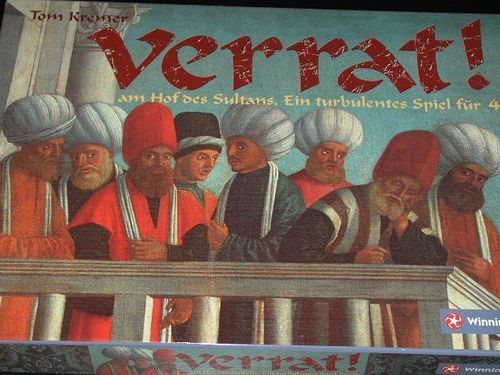
Verrat!
Verrat! Rulebook
Table of Contents
Table of Contents
Game Materials
- 1 Gameboard
- 1 black Sultan
- 12 Viziers (1 fat, 1 small and 1 big vizier in each color)
- 36 Power cards (6 of each type: Horses, Canons, Gold, Troops, Supplies, Ships)
- 6 Pardon cards [in German: Gnade]
- 4 Travel Planners
- 4 Traitor Indicators in the four colors
- 12 Numbered Vote markers [a spare set included]
- 4 Turn Order Overviews
- 1 Sand Timer
The illustration on page 2 of the rulebook names the various spaces on the gameboard. It is not reproduced here.
Beginning in the (empty) lower left corner and going anti-clockwise you will find the following spaces:
- The three small squares on the arrow are the First, Second and Third Dungeon leading to The Island of Banishing (the oval space).
- The seven rectangular spaces are the Cities of Bukhara, Tabriz, Shiraz, Kaffa, Gidda, Uskub and Isfahan.
The central part of the board shows 12 spaces for the Viziers, each with a smaller space for the Vote-marker. The bigger double-ringed space at one end is the Sultan's Throne. Note that the Vizier at the Sultan's right hand also has a double-ringed space showing the importance of this seat.
Preparations
The Sultan is placed on his throne (the big double ringed circle).
The viziers are placed on their 12 spaces in any order (players do not know yet, which color they will be using).
The 12 Vote-markers are mixed backside up and randomly placed on the twelve small spaces close to the Viziers, and then turned over.
The 36 Power cards and 6 Pardon cards are shuffled well. Each player receives 2 cards, which they place openly in front of them. The remaining 34 cards are distributed face down into the 7 cities - 4 cards at Kaffa (vis-a-vis the Sultan) and 5 each in the other cities. The top card in the other cities are always revealed.
Each player receives a Travel Planner. Finally, all Traitor Indicators are mixed together and distributed face down. Players turn them over and finally discover the color of their viziers.
[Translators note: This doesn't quite work in my copy as the colorcoded wheels gives the game away. But this is not a problem as it is still far easier to simply chose a color before the game, place the viziers on random spaces, randomly distribute the small numbers, and then begin the game. None of the viziers are allowed to stay in the court during the first turn anyway... Mik]
Objective
The player who dethrones the Sultan wins the game.
To do this they need at least one of each of the 6 different Power cards (Pardon cards ["Gnade"] are not Power cards). They collects these by sending their viziers into the far-away cities along the borders of the realm. At the same time they must keep enough influence at court in order to ensure they aren't pointed out as a traitor and banished. The two contradictory objectives determine a good part of the game.
The (double-ringed) seat to the right of the Sultan has a significant purpose. This is the one favored by the throne. Whoever collects all 6 Power cards and places a vizier on this space, wins the game.
Turn Sequence
The game is played over several rounds, during which each of the following 7 activities are performed in order. It might be helpfull to keep the Overview cards in front of the players during the first game, as the activities must be performed in the order stated:
- Palace Intrigues
- Planning Travels
- Performing Travels
- Collecting Power cards
- Banish a vizier
- Pardon by the Sultan
- Changing places at the Palace
1. Palace Intrigues
Each player in turn - beginning with the player who controls the vizier with the highest voting rights - explain their plans for the round.
3 topics should be presented:
- Where will the player send their viziers,
- Which vizier should be sent to the dungeons as a traitor (only from players with at least 4 Power cards),
- Whether player would trade Power cards with other players.
Discussion will not take long during the first round, but will soon increase its importance. To begin with, it will always be interesting to find out where the players wants to send their viziers, because a vizier can only collect a Power card from a city in which he is the sole visitor. The decision to banish a traitor and his subsequently disappearence does also have a strong influence on the game play as it will weaken the inflicted player considerably.
Later players will try to gather more information about others and try to intiate trades with or against each other. Thus, conspiracies are quite common.
The flow of this type of phase naturally depends very much on the players and may be freely arranged. But we recommend that you limit the time to a minute per player and another 2 minutes for the discussion. Mostly you will get through the phase without the use of a timer, but during exceptionally talkative debates any player may place the timer on the table, thereby indicating that the time is running out within a minute.
Important: No matter what player has said or promised, they are never obliged to keep their word! This applies to the travels, appointing traitors and all other declarations.
2. Planning Travels
After the debate the players will secretly designate a new space for each of their viziers on the Travel Planner. A vizier may travel from the court to any city, from a city to any other city or from a city back to court. Vizier may not move from one seat in court to another seat within the court. A vizier can also choose to stay in the same place.
The initial letter of the city or the number of the seat indicates where the vizier is moving.
Each player also makes a secret decision on the Traitor Indicator of who they want to send to the dungeon, and then places the wheel backside up on the table.
As already mentioned, a vizier may only be sent to the dungeons if a player to whom he belongs, has at least 4 different Power cards (not counting Pardon cards).
3. Performing Travels
Player reveal their Travel Planners simultaniously by placing them face up on the table. In turn order, beginning with the player who controls the vizier with the highest voting rights, each player moves their viziers to the selected destinations.
A vizier may always move to a city or stay in a city no matter whether other viziers travel to the same city or not. But if a vizier is returning to the court from a city, he may only perform the move if the space is vacant and no other players want to move a vizier to that same space. (If other players Travel Planner indicate that they also want to move to that space, both viziers stay in their current spaces).
4. Collecting Power Cards
When all players have finished moving their viziers, each player in the same turn order may take the cards they are entitled to and place them face up on the table in front of them. Only the players with a vizier who is alone in a city may take the top card from the stack in that city, and then reveal the next card - except in Kaffa. There, player who owns the vizier may, if he is alone, search the stack, choose one card and return the rest face down in the space.
If a vizier is present in seat with the number "1" by the end of this phase, controlling player may demand a Power card from another player, provided that they don't have that type of Power card themself and that the other player has at least two copies.
5. Banish a Vizier
The Sultan is extremely mistrustful, and rightfully so. To be safe he throws a vizier into the dungeons every turn. Only the viziers present at court may vote (with as many votes as their seat number) on which vizier the Sultan should treat as a traitor. If the Traitor Indicators are pointing towards more than one vizier, it is the one who receives the most votes against him, gets sent to the dungeons. In the event of a tie, the vizier with the higher seat number gets thrown to the dungeon.
The unfortunate is thrown into the 1st Dungeon to the left, behind the Sultan. If that dungeon is already occupied, the vizier there is moved to the 2nd Dungeon. If that is also occupied that vizier is moved from the 2nd to the 3rd Dungeon. If there is a vizier in there as well, he must be moved onto the Island of Banishment, and the owning player must play the remainder of the game with only 2 viziers.
6. Pardon by the Sultan
A player with a vizier in the dungeons may ask the Sultan for mercy if they have a Pardon card. Only viziers in the 2nd or 3rd Dungeon may be pardoned. The Pardon card is placed at the bottom of the stack in any city. The vizier is released immediately and given to its player. During the next round vizier may be returned to play (as described in 2. Planning Travels)
Note: Unfortunate viziers who end up on the Island of Banishment cannot be pardoned anymore.
7. Changing Places at the Palace
As the last activity during each round, all viziers present at the court move one space in clockwise direction.
This means that the voting rights and thus the influence of the viziers change every round.
The round is completed and another begins anew with the 1. Palace Intrigues.
End of Game
The game ends instantly, and often unexpectedly, when a player has at least one of each type of Power card, while at the same time having one of their viziers on the double-ringed space to the right of the Sultan.
This player overthrows the Sultan, grasps the power and wins the game.