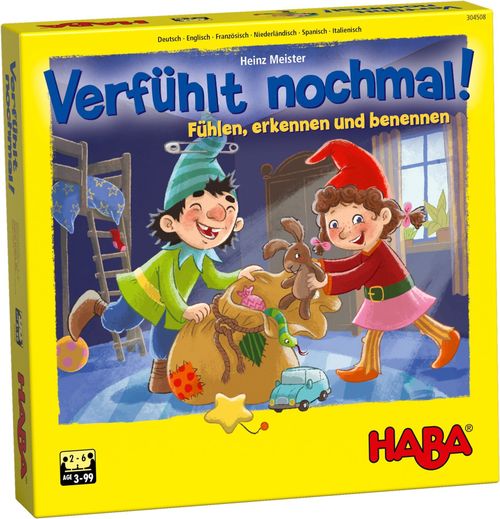
Verfühlt nochmal!
Verfühlt nochmal! Rulebook
Table of Contents
Table of Contents
Aim of the game
Fiddle Faddle! That toy car was there just a moment ago, and now it's disappeared! Then you're told that your room is in a mess and you need to get it tidied up immediately. But maybe it's not your fault and the brazen goblins are to blame? Sometimes, they scurry around the room, hiding your toys in their magic pouches. But when you discover the pouches and feel what is hidden inside, the goblins will be forced to hand it all back again. The aim of the game is to find as many toys as possible.
Before the first round, the players are allowed to familiarize themselves with the wooden figures and matching illustrations.
- The wooden figures can also be placed on the pictures. The outlines match up and can therefore be compared.
- Identifying the shape by touch is not so easy. The children can practice ahead of the game by closing their eyes and feeling the outlines.
- We recommend starting with the less boisterous version of the game (see below).
Game contents
8 magic pouches, 10 wooden figures, 10 cards, 10 blank cards for custom labeling, 1 set of instructions
Game preparations
Select any eight wooden figures and the matching cards. The remaining figures and cards are returned to the box.
Put one wooden figure in each of the eight magic pouches and seal the pouches shut. Now place the pouches on the table and shuffle them around. Make sure that the pouches do not overlap each other.
The cards are shuffled and stacked face down.
How to play
The youngest player starts.
Turn the topmost card over and place it where everyone can see it. Now look at the wooden figure depicted. You will soon be feeling for it!
All join hands, hold them up in the air and say together "Fiddle Faddle!" This signals the start of the game. Let go of each other's hands. Players start to feel the outside of the magic pouches in a race to try to find the correct figure.
A word of caution - it can get quite boisterous, because everyone will be trying to get hold of the most likely looking pouch at the same time!
There are some important goblin laws that must be obeyed during the hunt:
- You are not allowed to open the magic pouches and look inside. As soon as a player picks up a magic pouch, no-one else is allowed to snatch it away.
- Only when the pouch is returned to the middle of the table is another player allowed to reach out for it.
If you think you have identified the missing figure, hold the magic pouch up and call out "Fiddle Faddle!" At this point, all the other players have to stop what they are doing. Open the magic pouch, take out the wooden figure and place it on the card to see if it matches.
Is it the correct one? Good for you! Your reward is to keep the card. Put the wooden figure back in the pouch, place it in the middle of the table and shuffle the pouches all around again. Now turn over the next card. The players all join hands again and call out "Fiddle Faddle!" and the next round begins.
Is it a different wooden figure? Unfortunately, you do not win the card and you are out for the rest of this round. Place the wooden figure back inside of the pouch and place it back to the middle of the table. Rearrange the pouches in such a way that none of the players knows which one you just opened. It's now your responsibility to give the others the start signal. They then continue to search for the missing figure.
If all but one of the players have incorrectly identified the missing figure... the remaining player automatically wins the round and is allowed to take the card even if they didn't find the correct one. Now turn over the next card. Again, everyone joins hands to give the start signal for the new round.
End of game
The game ends as soon as all of the cards in the stack have been taken. The player with the most cards wins.
If the children are still too young to count properly, they can put their cards in a row. The child with the longest row wins. It is also possible for the game to be tied with multiple winners.
Making the game easier or harder
You can make the game easier by...
- playing with a limited selection, say five or six different figures and the corresponding cards in the first rounds.
- by selecting figures with very distinct shapes.
You can make the game harder by...
- telling the players that they are allowed to feel with only one hand. For mixed-age groups, you can also have the rule that the younger children are allowed to use both hands and the older children only one hand.
- replacing a correctly identified figure with one from the box until no more are left. The matching card is then inserted face down into the stack.
Game variant using household items
You can supplement the game with up to ten items found around the home, e.g. a cork, a coin, a pine cone. Draw the outline on the enclosed blank cards, and you're ready to go.
Less boisterous game variant
Here, the children take turns rather than all playing at the same time. The preparations are the same as for the standard game.
How to play
The youngest player starts. The topmost card is turned over. Try to identify the matching wooden figure by sense of touch. You can carry on feeling the pouches until you are ready to choose one. Open the magic pouch and see if it is the correct wooden figure that matches the card.
Did you find the right wooden figure inside? Then you win the card and it is the next player's turn.
Was it a different wooden figure? Then the card is returned to the pile and it is the next player's turn.
End of the game
The game must have enough rounds to ensure that every child has the same number of turns. The player who has the most cards wins the game. It is also possible for the game to be tied with multiple winners.