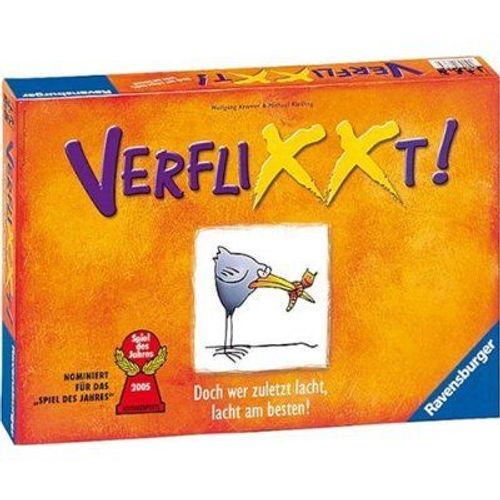
Verflixxt!
Verflixxt! Rulebook
Table of Contents
Table of Contents
Object of the Game
Players use fate and fortune to gather the Plus and Good Luck path tiles while trying to avoid the Minus path tiles. The Good Luck tiles are especially important because they can turn your Minus tiles into Plus tiles. The player with the most points at the end of the game is the winner!
Contents
- 32 Path tiles (8 Plus, 18 Minus, 6 Good Luck)
- 1 Start tile (blue)
- 1 Finish tile (orange)
- 18 pawns (3 each in 6 colors)
- 8 Guards (wooden cylinders)
- 1 die
Set Up
The Start Tile, the Path tiles, and the Finish tile are laid out as shown. The 8 Guards are placed on the Good Luck tiles and on the +8 and +7 Plus tiles.
Each player takes 2 (when playing with 5-6 players) or 3 (when playing with 2-4 players) pawns and places them on the Start tile.
The youngest player is given the die and takes her turn first.
How to Play
On your turn you roll the die and must move either one of your own pawns or one of the Guards. Then you pass the die to the player on your left, who then takes the next turn.
You can always move one of your own pawns. But in order to move a Guard, there must be at least one pawn on the tile with the Guard. This pawn can be yours or can belong to any other player! If one or more Guards are the only pieces on a tile, you are not allowed to move a Guard from that tile.
You must always move the chosen piece forward a number of tiles equal to the die roll, no more and no less. Only if a pawn or Guard is moved to the Finish tile are you allowed to ignore excess movement points (you do not have to move to the Finish by exact count).
Any number of pawns and Guards can be on a single tile.
Taking a Path Tile
If a pawn is alone when it is moved from a tile, the owner must remove that tile from the path and place it face-up on the table in front of him. If any other pawns or Guards were on the tile, the tile remains on the path and cannot be taken.
As a result of taking the tiles, gaps will form in the path. These gaps are ignored and passed over when moving pawns and Guards. Note: If very large gaps are formed, the path can be condensed by moving the path tiles back together.
Example: Red rolls a 5 and moves from the -4 to the Good Luck tile. The -4 is not taken because Blue is there too. Then Blue rolls a 5 and moves to the same Good Luck tile. Blue must take the -4 because his is the only piece there. In another example, Orange rolls a 4. He can move from the -2 to the -7, or from the Start tile to the -5. Instead he moves the Guard from the Good Luck tile where Red & Blue have pawns. No other Guards can be moved at this time because there are no pawns with them.
The Value of the Path Tiles
- Each green Plus tile adds from 1 to 8 positive points to your score.
- Each Good Luck tile converts one red Negative tile to a positive value. You can wait until the end of the game to decide which red tile you want to convert with each Good Luck tile.
- Each unconverted red Negative tile subtracts 1 to 10 points from your score.
If you have more Good Luck tiles than you have red negative tiles, then you can convert all of your red tiles to positive values, but the extra Good Luck tiles are worthless.
The End of the Game
When a player has moved all of his own pawns to the Finish tile, the game is over for him. He cannot roll the die and move Guards.
The game ends when all players have moved all of their pawns to the Finish tile.
Each player then adds up his plus points (green tiles as well as red tiles converted by Good Luck tiles) and then reduces his score by the values of his unconverted red tiles. The player with the most points wins!
Variants
If you've mastered the basic game and need a bigger challenge, here are some variants for you to try. The basic rules remain the same, but are changed slightly as noted below.
Variant 1
The 32 Path tiles can be laid out (between the Start and Finish tiles) in a different order, such as:
- First lay out the -1 to -8, then the +1 to +8, then the Good Luck tiles, and ending with the -1 to -10 tiles. Place the Guards on the Plus (+1 to +8) tiles.
- Place all the Good Luck tiles at the end of the path. Place the Guards on the Plus (+1 to +8) tiles.
- Place all 32 tiles entirely at random. Place the Guards on the Good Luck tiles and the +8 and +7 green tiles.
Variant 2
A player who rolls a "1" has 3 choices: He can move a pawn or eligible Guard forward one tile, backwards one tile, or simply leave it in place.
Variant 3
If all of the pieces have passed a Path tile without it having been removed from play, immediately move it to the end of the path in front of the Finish tile!
Variant 4
The game ends immediately when the first player moves all of his pawns to the Finish tile. Players with pawns that are alone on a Path tile when the game ends must take that tile as part of their score.
Variant 5
The game ends immediately when the next-to-last Pawn has moved to the Finish tile. The owner of the Pawn still remaining on the Path must take, as a penalty, the worst Red negative tile that is free of Guards and his Pawn. This tile cannot be converted with a Good Luck tile!
BSW Variant (Unofficial)
If you play online at BSW, you'll notice that collected tiles are not laid out face-up but instead are kept in a face-down stack.
Translator's Variant (Unofficial)
Keep your collected tiles in a face-up stack as a compromise between the BSW rules and the publisher's rules.