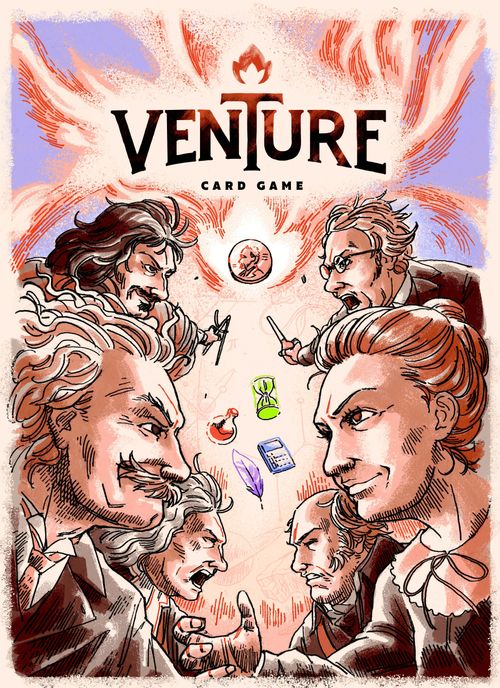
Venture (2019)
Venture (2019) Rulebook
Table of Contents
Table of Contents
Rules
Number of Players and Age Range
The game supports 3 to 6 players, ages 10 and up.
Game Contents
- 1 rules
- 6 roles
- 24 missions
- 24 instruments
- 56 action cards
Game Objective
Each player is a scientist in search of completing their own 4 missions. The first one to do it will win the game, thus winning the Nobel Prize and gaining the respect of their fellow colleagues.
Type of Cards
Role Cards
Each scientific field (printed as "filed") will be represented by 1 role card (the physicist in the example) that includes their own specific talent which makes each role unique. Next to the talent, you will find a symbol, which also represents the role. All talents by each role can be activated, once per turn, by discarding any 1 ACTION card that has the role's specific symbol.
For example, to activate the physicist's talent, the player who plays as the physicist must discard 1 card with the physicist symbol. Each player has to place their role uncovered on the table where it will remain untouched for the rest of the game.
Role symbols (the printed Symbols key pairs an icon with each role name): Mathematician, Chemist, Astronomer, Physicist, Biologist, Geologist.
Instrument Cards
Instruments are what players will be searching for so they can complete missions and win the game. There are 4 different types of instruments: Calculators, Hourglasses, Quills, and Measuring Flasks. Each type of instrument will have its own identifying color to match with the appropriate missions.
Mission Cards
Mission cards provide each player with the objectives they need to complete in order to win the Nobel Prize. The cards are easily identifiable by a frame, whose colors (purple, blue, green or red) match the specific INSTRUMENT the player needs. It is also specified below the card illustration.
During gameplay, players will search for and pair instruments with their missions. More about completing MISSION CARDS will be explained in the The Game: Phase 3.
All mission cards also contain an identifying number at the top right. This is only to identify it for setup purposes. Each card represents a scientific event described by a title at the top and a description at the bottom of the card.
Action Cards
Action cards are what players use during gameplay to advance their own missions and simultaneously sabotage their opponents. These cards are identifiable by a light bulb icon on the top left. The light bulb can be either on or off; its function is only at the Phase 1 of a player's turn:
- if the light bulb is on, the player is forced to suffer the effects of the card;
- if the light bulb is off, the player chooses whether to play it immediately on anyone or put it in their hand to be played later.
At the bottom right of the card illustration, you may find a symbol that corresponds to one of the six roles in the game. These are the cards needed to activate the role's talent.
If an ACTION card doesn't have a symbol in the top-left, it is played immediately. Otherwise, the following two symbols specify when a card may be used:
- LONG-TERM cards: as their name suggests, indicate a card with lasting effects. When active, players place LONG-TERM cards face-up next to their role. When the effects have run their course, they are discarded. Players may be subject to more than one LONG-TERM card at the same time.
- INSTANT cards: can be played at most moments during the game, even out-of-turn. Players discard INSTANT cards are immediately discarded after carrying out their actions, unless they are used to imitate a long-term card; in this case, the card will simulate their behavior and thus, be placed next to the player's role. If multiple INSTANT cards are played one after the other, the most recent action wins over the previous one, effectively overriding the actions of the previous cards.
Like MISSION cards, ACTION cards represent a scientific event, and is described by the title and description.
If an ACTION card is used against a player who is protected by a LONG-TERM card, the card will automatically be discarded with no possibility to reuse it against another player.
Setup
- To start, shuffle all ROLE cards from the deck and deal 1 role to each of the players. Roles will be visible to all players at all times. Remove any extra ROLE cards from the game.
- Prepare the MISSION cards by choosing the following based on the number of players in the game:
| # of Players | Missions in the Game |
|---|---|
| 3 | From #1 to #12 |
| 4 | From #1 to #16 |
| 5 | From #1 to #20 |
| 6 | From #1 to #24 |
- Shuffle the MISSION cards to be used and deal 4 to each player. Place your missions face-up next to your ROLE card. Remove any extra missions from the game.
- Prepare the deck:
- a. insert all the ACTION cards;
- b. place the appropriate number of instruments into the deck using the following table. Example: if there are 3 players, include 4 calculators, 4 hourglasses, 4 quills, and 4 measuring flasks. Remove any extra instruments from the game.
| # of Players | Instruments in the Game |
|---|---|
| 3 | 4 |
| 4 | 5 |
| 5 | 6 |
| 6 | 6 |
- Shuffle the deck and deal 5 cards face down to each player.
- Put the remaining deck face down in the middle of the table.
If at any point during the game the deck has run out of cards, make a new deck by shuffling the discarded pile and repositioning it face down in the middle of the table.
The Game
The game starts with the player who was dealt the mission with the highest number. Example: in a game with 3 players, the first player will be the one who received mission card #12. Play continues clockwise, but this may vary during gameplay.
The game is divided in 4 different phases.
Draw 1 Card from the Deck
Players draw a card face-up. If it is an INSTRUMENT card, the player keeps it. If it's an ACTION card:
- with the light bulb OFF, the player chooses whether to keep it or play it immediately (either on themselves or another player). If the player uses the card during this phase, it will not count as one of the 2 actions allowed in the next phase;
- with the light bulb ON, the card takes effect immediately. A player may protect themselves from negative effects.
Before starting phase 1, discard any inactive LONG-TERM cards you have. The lamp icon is only valid during this phase of the game.
Phase 2: Take Up to 2 Actions
The player chooses to take up to 2 actions. Possible actions are:
- activating the talent on their ROLE card by discarding an ACTION card with the appropriate symbol;
OR
- using an ACTION card on themselves or another player.
Instruments from your hand can only be used in this phase of the game if an action card specifically requires it.
Phase 3: Complete One Mission
The player takes 1 instrument from their hand and places it on top of the mission that requires that instrument. Once done, the mission is considered complete.
This phase is optional. You may only complete 1 mission per turn.
Phase 4: Draw 2 Cards and Discard to Hand Limit
To finish a turn, the player draws 2 cards, face down, from the deck and adds them to their hand. The cards just drawn can only be played in future turns. A player's hand may not exceed 5 cards. If there are more than five in a player's hand at the end of their turn, they must discard down to 5 cards.
End of the Game
The game ends when one player manages to complete all 4 of their missions and becomes the Nobel Prize winner.