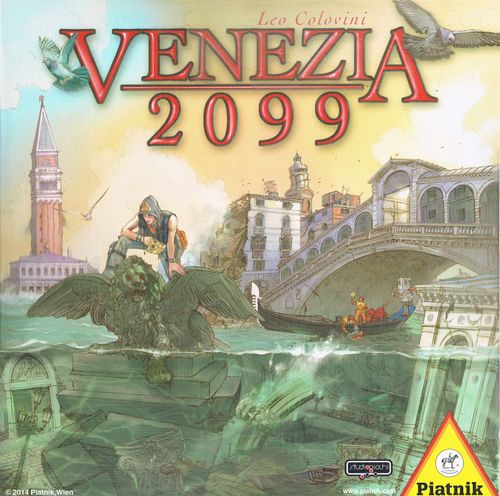
Venezia 2099
Venezia 2099 Rulebook
Table of Contents
Table of Contents
Contents
- 64 large tiles, consisting of:
- 48 city tiles, each representing a district in the city; many will sink during the course of the game. There are 6 coloured sets (black, brown, aquamarine, red, purple and green) and each set contains 7 tiles with the values 2, 3, 4, 5, 6, 7, 8 and x. The reverse side of the tiles show water.
- 16 tiles depicting a floating platform on the front and reverse sides.
- 1 game board consisting of 4 plastic interlocking parts with 64 slots to fit the 64 tiles. Every slot has depressions at the corners to facilitate easy extraction of the tiles.
- 20 playing figures split into 5 sets of 4 pawns in the colours blue, yellow, white, orange and natural.
- 52 playing cards consisting of:
- 42 prophecy cards, split into 6 coloured sets numbered 3, 4, 5, 6, 7, 8 and x. Each card matches one of the large tiles with the exception of the tiles bearing the value 2.
- 10 gondola cards, split into 5 sets of 2 in the colours of the playing figures.
- 60 small square treasure tiles, split into 6 sets of 10 in the 6 colours of the 48 city tiles (i.e. the background of the number in the corner of the tile).
- 60 coins.
A pencil and paper are additionally required for the score.
Game Setup
- Before the first game all cardboard components need to be carefully separated from the punch boards.
- The 4 parts of the game board are pieced together in order to form a grid of 8 x 8 squares.
The following game setup is for 3 to 5 players. The setup for the 2 player version is described at the end of this rule.
-
The 64 large tiles are shuffled and randomly placed in the 64 slots of the game board.
-
The 60 small treasure tiles are sorted according to colour and placed beside the game board.
-
The 42 prophecy cards are shuffled and dealt amongst the players.
- with 3 players everyone receives 12 cards
- with 4 players everyone receives 9 cards
- with 5 players everyone receives 7 cards
Excess cards are placed aside with their faces down. They are not required for the game.
-
Every player gets:
- 2 gondola cards
- 4 playing figures with 3 players or
- 3 playing figures with 4 or 5 players
in their chosen colour.
-
Every player receives 1 coin more than cards received (for example: In the 5 player version everyone receives 7+1=8 coins).
-
The group chooses a player to begin the game.
-
Now all playing figures must be positioned on the game board. Beginning with the first player and continuing clockwise, all players must position their playing figures on the tiles of their choice adhering to the following rules:
- Only one playing figure per tile.
- A player's figures must be positioned on tiles with different values; they can also be placed on the floating platforms.
Game Play
The player who begins completes his first move and play proceeds clockwise.
Moves
A move consists of up to 3 actions which are performed in the following sequence:
- Move a playing figure (voluntary)
- Buy a treasure (voluntary)
- Play a prophecy card (compulsory)
After the move has been completed it is the next player's turn.
1. Move a playing figure (voluntary)
A player may move one of his playing figures by one or more squares in any direction on the game board in adherence with the following rules:
- Only one playing figure may occupy a given square at a time.
- A playing figure may not cross any square that symbolizes water.
- A playing figure may not cross any square that is occupied by another playing figure.
- A playing figure may cross a floating platform.
- A playing figure may occupy a floating platform.
Example: The yellow playing figure on the square with the black value 2 may be moved to any of the squares covered by the yellow arrows.
2. Buy a treasure (voluntary)
The player now has the possibility to buy a treasure that matches the colour of one of the square tiles occupied by one of his playing figures. Careful: it is not allowed to buy a treasure and move a playing figure afterwards. The sequence described above must be respected! The purchase of treasure is completed by placing 1 coin more than coins already on the square. This means if there is no coin on a square, a player pays 1 coin for the treasure. If there is already 1 coin on the square he must pay 2 coins, if there are 3 coins on the square he must pay 4 coins etc.
Note: the colour of the treasure must match the coloured dot on the square tile occupied by the playing figure. Treasure may not be purchased for a swimming platform. After paying the required price a player takes the correct treasure from the stock and places it in front of himself.
Example for above picture: The player with the white playing figures may buy either a purple treasure for 1 coin, a brown treasure for 2 coins or a black treasure for 4 coins.
3. Play a prophecy card (compulsory)
At the end of his turn a player must always play the prophecy card with the lowest value in his possession. X is the highest value after 8 and 2 is the lowest value. If the players has 2 or more cards with the lowest value he gets to choose which one he plays.
Example: The player has 2 cards with the lowest value "3". He can choose which of the 2 cards he plays.
Venice Is Sinking!
If a player has played a prophecy card the square tile with the matching colour and value on the game board must be turned around. This means that this part of Venice has sunk. If there is a playing figure positioned on this square it falls into the water. It must be removed from the game board and is no longer in play. The player who owns the playing figure can react and defend himself by immediately playing a gondola card (see gondola cards). Any coins on the sunken tile are also removed from the game.
Example: Due to the prophecy cards played the square tile marked with the light green coloured value "3" must be turned around. The blue playing figure falls into the water and is put aside if the player affected does not play a gondola card.
Gondola Cards
There are 2 ways a gondola card can be used:
- During your turn it may be used to move your playing figure to any available square even when you cross water.
Example: The player with the blue playing figure plays a gondola card and moves his playing figure to the square tile marked with the aquamarine coloured value "x".
- It can also be used to save your playing figure from falling into the water after a square tile has been sunk. In this case the gondola card must be played immediately, even if it is not the turn of the player concerned. The playing figure can then be moved to any other available square tile that shows a section of the city. If the playing figure is not saved, it is put aside and is no longer in play.
Example: The prophecy card with the brown coloured value "5" is played. The player concerned wishes to save his yellow playing figure and immediately plays a gondola card. He then places his yellow playing figure on the square tile marked with the aquamarine coloured value "x".
Spent gondola cards are placed aside on a separate pile. If a player's last remaining playing figure falls into the water and he does not possess a gondola card in order to save it, he is not allowed to buy any more treasure. He must however continue to play his lowest available prophecy card when it is his turn and his score will be evaluated at the end of the game.
End of the Game and Score Line
The game is over when all prophecy cards have been played. Points (p) are awarded to players as follows:
- Treasure: The value of a treasure tile depends on how many square city tiles in the corresponding colour have survived at the end of the game.
- 1 city tile: 6 P
- 2 city tiles: 3 P
- 3 city tiles: 2 P
- 4+ city tiles: 1 P
- Surviving playing figures: For every playing figure positioned on a square city tile players receive the value of that tile in points. Playing figures that are positioned on floating platforms do not receive any points.
- City tiles with "x": If a playing figure is positioned on a city tile marked with the value "x" the player concerned adds up all surviving city tiles in that colour. This number is multiplied by 2 and added to the player's score.
- Coins: 1 point for every coin in a player's possession.
- Gondola cards: There are no points for any remaining gondola cards.
The player who gathered the most points is the winner. In the event of a tie the player who has more surviving playing figures is the winner.
The printed rulebook closes this section with a pictorial score-line example (per-colour treasure and tile values). The pictorial example is not reproduced in text here; the scoring rules above are transcribed in full.
2 Player Game
The 2 player version game differs only in the game setup:
- The following components are removed from the game:
- All city tiles and prophecy cards marked with values "7" and "8"
- One set of city tiles and 1 set of prophecy cards, of a single matching colour
- 10 swimming platforms.
- The remaining 36 square city tiles are randomly placed on the game board to form a 6 x 6 grid. Empty slots are not part of the game.
- Every player receives: 3 playing figures of a colour, 10 prophecy cards and 11 coins.
All other rules remain unchanged and play proceeds as already described.
Warning! Not suitable for children under 36 months. Contains small parts. Danger of suffocation. Please keep address for further reference.