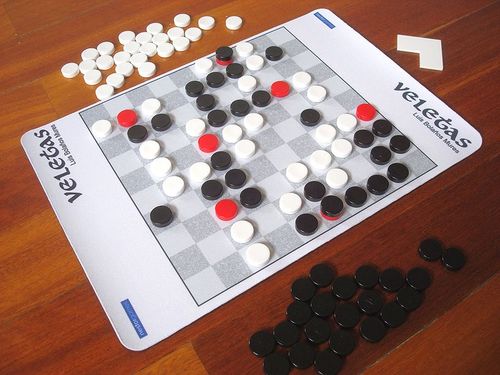
Veletas
Veletas Rulebook
Table of Contents
Table of Contents
Material
- 7 red discs (shooters)
- 50 white discs
- 50 black discs
- Board (10x10)
- Plastic 'L' (corner)
- Carrying case
Definitions
A piece is a shooter (red), a black stone or a white stone.
A group is a set of one or more like-coloured, orthogonally adjacent stones. The size of a group is the number of stones in it. Stones on top of shooters aren't part of any groups.
An immobilized shooter is a shooter that can't make any legal move in the current position.
Play
The board starts out empty. Black starts the game by placing three shooters on empty squares of the board, and then White places the remaining four in the same fashion. In both cases, no shooters can be placed orthogonally or diagonally adjacent to any other. This restriction doesn't apply to the rest of the game.
From then on, the players take turns, starting with Black. On his turn, a player can (but is not obliged to) move a shooter to an empty square in a straight orthogonal or diagonal line, without jumping over any other pieces. Then, the player must place a stone of his colour on an empty square which is on the same straight orthogonal or diagonal line as the destination square of the moved shooter (or any shooter, if none was moved), with no other pieces in between along that line. This is called shooting. Claimed shooters (see below) can't move or shoot.
At this moment, if there are no immobilized shooters on the board, the player's turn ends. If there are any immobilized shooters on the board that haven't been claimed before, each one of them is claimed by the player who owns the biggest group orthogonally adjacent to it. If there is no such group or the biggest such groups of each colour are the same size, the shooter is claimed by the opponent. Claiming a shooter is indicated by placing a stone of the corresponding colour on top of it. Claimed shooters remain unchanged for the rest of the game.
The game ends when a player has claimed the majority of shooters, i.e. at least four of them. That player wins. Draws are not possible.
Smaller Versions
For shorter but still reasonable games, the following variants are suggested (use the plastic corner to reduce the board size accordingly):
- 7x7 board with three shooters. Black places one shooter on his first turn, and White places the other two. Whoever claims two shooters wins.
- 9x9 board with five shooters. Black places two shooters on his first turn, and White places the other three. Whoever claims three shooters wins.
Examples
Example: White moves and shoots a stone. The diagram shows a shooter moving in a curved (orthogonal-then-diagonal) path to a new square, then a straight shot from that square landing a white stone two squares away.
Example: Illegal. Movements and shots from shooters can't jump over other pieces, whether they're white stones, black stones or shooters. The diagram shows a shooter's move blocked by a stone in its path, and a shot blocked by a stone lying between the shooter and the target square.
Example: Black claims the immobilized shooter as he owns the biggest group orthogonally adjacent to it. White's group on the left is irrelevant because it's only diagonally adjacent to the shooter.
Example: White has ended her turn immobilizing the shooter. The sizes of the biggest black and white groups orthogonally adjacent to the immobilized shooter are tied, so the shooter is claimed by the opponent (Black in this case).